Question
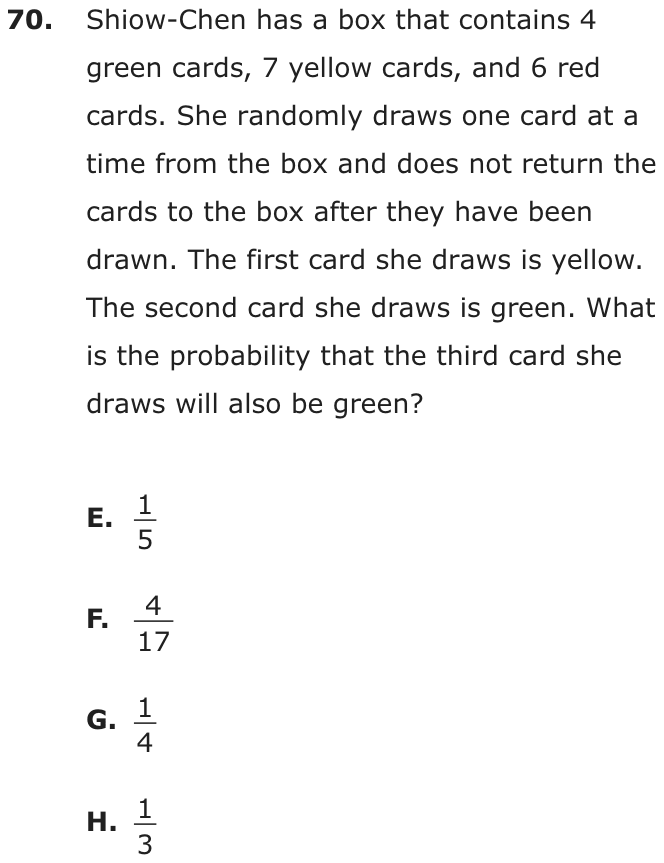
Shiow-Chen has a box that contains 4 green cards, 7 yellow cards, and 6 red cards. She randomly draws one card at a time from the box and does not return the cards to the box after they have been drawn. The first card she draws is yellow. The second card she draws is green. What is the probability that the third card she draws will also be green?
- A
- B
- C
- D
Show the answer
Correct answer: A
After Shiow-Chen draws a yellow card and a green card, the remaining cards are 3 green, 6 yellow, and 6 red. The probability of drawing a green card from that group is:
Question analysis
Shiow-Chen's box holds 4 green, 7 yellow and 6 red cards, and she draws cards one at a time without putting them back. Her first card is yellow and her second is green. Students find the probability that the third card is also green, which means updating both the green count and the total first.
- NYS standards
- 6.SP.8a uniform probability models
- Grade level
- Grade 6 content, by NYS standard
- Compared with grade 7
- At grade 7 Simple probability is grade 6 content. The extra demand is tracking two earlier draws that were not put back, which changes the counts for the third draw, a step typical grade 7 problems often leave out.
- Estimated difficulty
- Moderate: several steps, or a close reading with one strong distractor.
- Thinking it demands
- Depth of knowledge 2, skills and concepts · mainly apply
- What makes it hard
- Much to keep track of moderate
- Turning words into math minor
- Solution
- 3 steps
- Reading level
- Question and choices: about grade 3, 70 words.
- Students, last 30 days
- Not enough answers yet to show (it takes 10).
Why it is hard, traps and wrong answers (shows the answer)
Why it is hard
The probability itself is one fraction, but it has to be built from a box that two draws have already changed. Students who use the original 17 cards, or who compare green with the other colors instead of with all the cards, reach listed choices that look reasonable. Listing the counts after each draw, then putting the green cards over all the cards left, avoids both.
Much to keep track of moderate Working it out
Three color counts and the total must each be updated after two draws, 4 green, 7 yellow and 6 red becoming 3, 6 and 6 out of 15, before the third draw is considered. (Sweller, 1988; Carpenter, Just & Shell, 1990)
Turning words into math minor Understanding the question
“Does not return the cards” and the two named draws are the conditions that change the box, and the stem states them in passing before asking about the third card. (Hegarty, Mayer & Monk, 1995; Koedinger & Nathan, 2004)
Strategy: Take the two drawn cards out of the box: lower the yellow and green counts by one each, recount the total, then put the green cards left over the cards left.
Traps
- Without replacement: In a second pick there is one fewer item, which changes the probability.
- Misunderstands the concept: A wrong belief about a concept: that percents can be added, that area grows like length, that averages can be averaged, that a bigger denominator means a bigger fraction.
The wrong answers, classified
B Without replacement (Fischbein & Schnarch, 1997)
Uses the full box, 4 green cards out of 17, as if neither of the first two cards had been taken out.
C Misunderstands the concept (Smith, diSessa & Roschelle, 1993; De Bock et al., 1998; Ni & Zhou, 2005)
Updates the counts correctly but compares the 3 green cards with the 12 cards of other colors, 3/12 = 1/4, a part-to-part ratio.
D Misunderstands the concept (Smith, diSessa & Roschelle, 1993; De Bock et al., 1998; Ni & Zhou, 2005)
Treats the three colors as equally likely, giving green a 1-in-3 chance whatever the number of cards of each color.
Worked solution, step by step
Formulas used
- Probability
- P is the probability, how likely something is, from 0 (never) to 1 (always). The top counts the results you want, here green cards. The bottom counts every possible result, here every card in the box. It works when each result is equally likely, as in a random draw.
Sort out the question
The box starts with 4 green, 7 yellow and 6 red cards. Shiow-Chen draws cards one at a time, and she does not put them back. The first card is yellow, and the second is green. You need the probability that the third card is green.
Take out the two cards
The cards are not put back, so the box changes. Lower the yellow count by 1 and the green count by 1.
Color At the start After two draws Green 4 3 Yellow 7 6 Red 6 6 Total 17 15 Use the probability formula
For the third draw, the results you want are the 3 green cards left. The total is the 15 cards left.
Watch out: using the full box gives , choice B. But two cards are gone.
Simplify and answer
Divide the top and bottom by 3.
Watch out: compare the green cards with all 15 cards, not with the 12 cards of other colors. That gives , choice C. And the three colors are not equally likely, so is wrong too. So the answer is A, .
Check your answer
17 cards minus the 2 drawn leaves 15. One fifth of 15 is 3, the number of green cards left. Also, the chance went down from . That makes sense, because a green card was taken out.
More questions like this
The original DOE question