Question
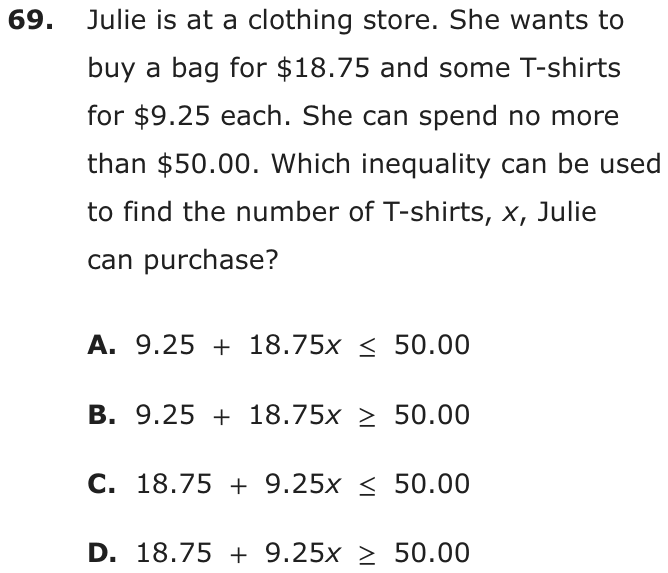
Julie is at a clothing store. She wants to buy a bag for $18.75 and some T-shirts for $9.25 each. She can spend no more than $50.00. Which inequality can be used to find the number of T-shirts, x, Julie can purchase?
- A
- B
- C
- D
Show the answer
Correct answer: C
The question uses the phrase “no more than,” which translates to “less than or equal to” (≤).
Since T-shirts cost $9.25 each and Julie bought x T-shirts, the total cost just for the T-shirts is found by multiplying $9.25 by x, or .
Combining the cost for one bag ($18.75) plus the cost for x T-shirts, the inequality is .
Question analysis
Julie wants to buy one bag and some T-shirts at a clothing store, with a price for each, and can spend no more than $50.00. Students choose the inequality for the number of T-shirts, x, she can buy. It tests writing an inequality from a word problem: the choices swap the two prices and the direction of the sign.
- Grade level
- Grade 7 content, by NYS standard
- Compared with grade 7
- At grade 7 Writing an inequality for a budget with one fixed cost and a cost per item is standard grade 7 work. With choices given, the task is to match each price to its role and the phrase to its symbol.
- Estimated difficulty
- Straightforward: two steps or one careful reading.
- Thinking it demands
- Depth of knowledge 2, skills and concepts · mainly apply
- What makes it hard
- Turning words into math moderate
- A very close wrong answer minor
- Solution
- 2 steps
- Reading level
- Question and choices: about grade 3, 43 words.
- Students, last 30 days
- Not enough answers yet to show (it takes 10).
Why it is hard, traps and wrong answers (shows the answer)
Why it is hard
The choices form a grid of two decisions: which price goes with x, and which way the symbol points. The prices appear in the order they are used, bag first, so the expression is the easier half and most lost points come from the symbol. Pricing the bag with 2 T-shirts, $37.25, and with 3, $46.50, shows that 9.25 is the amount that repeats with each shirt.
Turning words into math moderate Understanding the question
The $18.75 bag is bought once and the $9.25 is paid for each of x T-shirts, and “no more than $50.00” has to become ≤, which allows spending exactly $50.00. (Hegarty, Mayer & Monk, 1995; Koedinger & Nathan, 2004)
A very close wrong answer minor Choosing the answer
The choices 18.75 + 9.25x ≤ 50.00 and 18.75 + 9.25x ≥ 50.00 match term for term and differ only in the direction of the symbol. (Embretson & Wetzel, 1987; Gorin & Embretson, 2006; Ascalon et al., 2007)
Strategy: Price one bag and 2 T-shirts by hand to see which price is multiplied by x, then translate “no more than” into an inequality symbol.
Traps
- Misreads the question: Misses or misreads a condition or a word in the question: "at least", "each", "remaining", "not".
- Misunderstands the concept: A wrong belief about a concept: that percents can be added, that area grows like length, that averages can be averaged, that a bigger denominator means a bigger fraction.
The wrong answers, classified
A Misunderstands the concept (Smith, diSessa & Roschelle, 1993; De Bock et al., 1998; Ni & Zhou, 2005)
Keeps the right symbol but multiplies the number of T-shirts by $18.75 and adds $9.25 once, putting the bag’s price where the price per shirt belongs.
B Misunderstands the concept (Smith, diSessa & Roschelle, 1993; De Bock et al., 1998; Ni & Zhou, 2005)
Puts x on the $18.75 bag and also turns “no more than $50.00” into ≥, so both the expression and the symbol are wrong.
D Misreads the question (Hegarty, Mayer & Monk, 1995)
Builds the total, 18.75 + 9.25x, correctly but reads “no more than $50.00” as at least, so ≥ would make Julie spend $50.00 or more.
Worked solution, step by step
Formulas used
- Total cost
- The one-time cost is paid once, like one bag. The price each is paid again for every item, so it is multiplied by the number bought. Add them to get the total. Use it when one cost happens once and another repeats.
- Spending limit
- The total is what Julie spends, and the limit is $50.00. The sign ≤ means less than or equal to. So the total can be under the limit or exactly equal to it, but never over. That is what the words “no more than” mean.
Sort out the question
Julie buys one bag for $18.75. She also buys some T-shirts for $9.25 each. x is the number of T-shirts. She can spend no more than $50.00. You need the right inequality. An inequality is a math sentence that uses a sign like ≤ instead of =.
Write the cost of the T-shirts
Each T-shirt costs $9.25. For x T-shirts, she pays $9.25 x times.
The bag is bought only once. So its $18.75 is not multiplied by x.
Watch out: putting x on 18.75 prices x bags and one T-shirt. That gives choices A and B.
Add to get the total
Use the total cost formula. The bag is the one-time cost.
Test it with 2 T-shirts: dollars. That is one bag and two shirts, as it should be.
Choose the sign
“She can spend no more than $50.00” means she can spend less than $50.00, or exactly $50.00. That is less than or equal to, the sign ≤.
Watch out: ≥ means greater than or equal to. Choice D says she must spend $50.00 or more, the opposite. So the answer is C, .
Check your answer
Test whole numbers of T-shirts. With 3, the total is 18.75 + 27.75 = 46.50 dollars. That is not over $50.00. With 4, it is 18.75 + 37.00 = 55.75 dollars, too much. Choice C allows 3 T-shirts and rules out 4, which fits.
More questions like this
The original DOE question