Also in 2025 Practice Test A Math, question 11.
Question
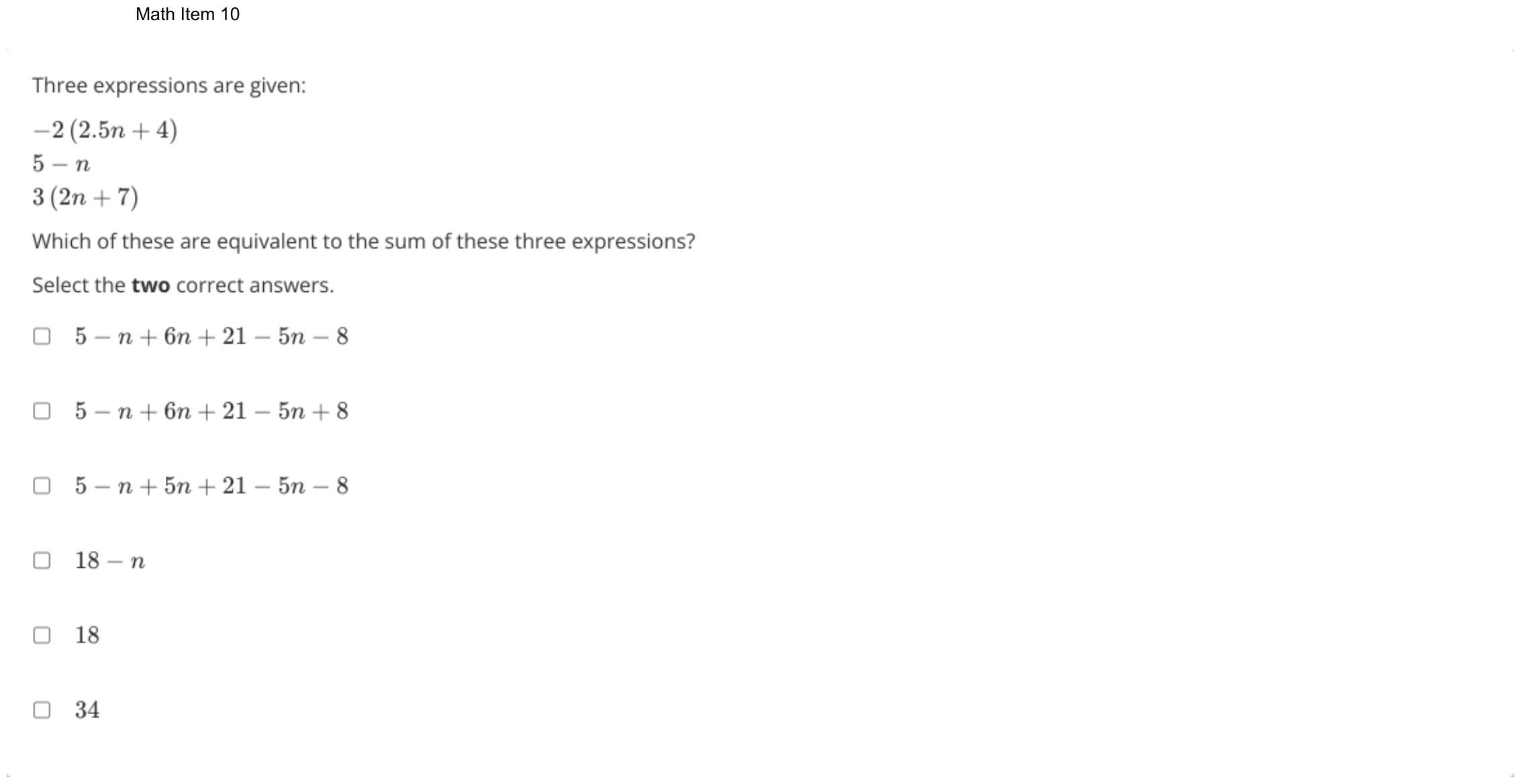
Three expressions are given:
Which of these are equivalent to the sum of these three expressions?
Select the two correct answers.
Choose every answer that is correct, then check. The DOE has not published how answers with several parts are scored; this site counts one right only when every part is right.
- A
- B
- C
- D
- E18
- F34
Show the answer
Correct answer: A and E
Add the three expressions: .
Distribute 3 and −2: .
Combine the variable terms and combine the constants: .
Question analysis
This algebra question gives three expressions, one with a decimal coefficient and a negative factor, and asks which two of six choices are equivalent to their sum. It tests distributing, combining like terms and recognizing equivalent expressions. Signs from the negative factor are easy to lose, and several choices are built from exactly those slips.
- NYS standards
- Grade level
- Grade 7 content, by NYS standard
- Compared with grade 7
- At grade 7 Expanding and combining linear expressions with a negative factor and a decimal coefficient is standard grade 7 work. Choosing the two equivalent ones out of six, where each common slip appears as a choice, takes more care than one simplification.
- Estimated difficulty
- Moderate: several steps, or a close reading with one strong distractor.
- Thinking it demands
- Depth of knowledge 1, recall and reproduction · mainly apply
- What makes it hard
- Error-prone arithmetic moderate
- A very close wrong answer moderate
- Many steps minor
- An answer in an unexpected form minor
- Solution
- 4 steps
- Reading level
- Question and choices: about grade 8, 28 words.
- Students, last 30 days
- Not enough answers yet to show (it takes 10).
Why it is hard, traps and wrong answers (shows the answer)
Why it is hard
The six choices form three consistent pairs, each an expansion with its simplified total: the right pair, a pair built on a sign slip with −2 × 4 that totals 34, and a pair built on 3 × 2n read as 5n that totals 18 − n. A student who makes either slip finds two choices that agree with each other and seem to confirm the work. The question rewards one careful simplification and the confidence to accept a sum with no n left.
Error-prone arithmetic moderate Working it out
The first expression puts a negative factor in front of a decimal term: −2 times 2.5n is −5n, and the −2 must reach the 4 as well, giving −8, not +8. (Brown & Burton, 1978; Junker & Sijtsma, 2001)
A very close wrong answer moderate Choosing the answer
The first two expansions are identical except for their last sign, − 8 against + 8, and the third differs from the first only in 5n for 6n, so only a term-by-term check separates them. (Embretson & Wetzel, 1987; Gorin & Embretson, 2006; Ascalon et al., 2007)
Many steps minor Working it out
Two distributions come first, then the n terms and the constants are collected separately, and six choices are compared with the result; both right ones must be picked to score. (Daniel & Embretson, 2010; Enright, Morley & Sheehan, 2002)
An answer in an unexpected form minor Choosing the answer
One right answer is the expansion before any terms are combined and the other is the plain number 18, which has to be accepted as equal to a sum in which every expression held n. (Enright, Morley & Sheehan, 2002)
Strategy: Distribute each factor across its parentheses, keeping the sign with every product, then combine the n terms and the constants separately and test each of the six choices against the result.
Traps
- Order of operations: Working left to right, or distributing a minus sign wrongly, gives a choice.
- Misunderstands the concept: A wrong belief about a concept: that percents can be added, that area grows like length, that averages can be averaged, that a bigger denominator means a bigger fraction.
- Answer in another form: The right answer is written differently from the way you worked it out.
The wrong answers, classified
B Order of operations (Brown & Burton, 1978)
Gives the minus of −2 to 2.5n but not to 4, expanding −2(2.5n + 4) as −5n + 8 instead of −5n − 8, so this expansion totals 34.
C Wrong operation (Hegarty, Mayer & Monk, 1995; King et al., 2004)
Expands 3(2n + 7) as 5n + 21, adding 3 and 2 instead of multiplying them, so the n terms no longer cancel and leave −n.
D Misunderstands the concept (Smith, diSessa & Roschelle, 1993; De Bock et al., 1998; Ni & Zhou, 2005)
Expects a sum of expressions in n to keep an n term, so it doubts the plain 18 and takes 18 − n, which the 5n expansion also simplifies to.
F Order of operations (Brown & Burton, 1978)
Takes −2 × 4 as +8, so the constants add to 5 + 21 + 8 = 34 while −n + 6n − 5n still cancels, leaving no n term.
Worked solution, step by step
Formulas used
- The distributive property
- a is the number in front of the parentheses, and b and c are the terms inside. You multiply a by every term inside, not only the first one. If a is negative, its minus sign goes into every product. It works because a groups of b + c is a groups of b plus a groups of c.
- Multiplying signed numbers
- a and b are positive numbers, so −a is negative. A negative number times a positive number is negative. Use it whenever a minus sign sits in front of the parentheses: −2 times 4 is −8, not 8.
- Combining like terms
- Like terms have the same letter part, such as 6n and −5n. a and b are their coefficients, the numbers in front of n. Add the coefficients and keep the n. Constants, the plain numbers, combine only with other constants.
Sort out the question
An expression is a math phrase made of numbers, letters and signs, with no equal sign. The sum of the three expressions means you add all of them:
You need the two choices that are equivalent to this sum. Equivalent means equal for every value of n. Some choices show the sum before it is simplified. Others show the result.
Distribute the 3
To distribute means to multiply the number outside the parentheses by each term inside.
Watch out: 3 times 2n is 6n. Adding 3 and 2 instead gives 5n. That slip leads to choice C, and then to 18 − n, choice D.
Distribute the −2
Now multiply −2 by both terms. A negative times a positive is negative, so both products are negative.
Watch out: the −2 multiplies the 4 too. Writing +8 instead of −8 leads to choice B. That sum works out to 34, choice F.
Write the whole sum
Put the three pieces together, starting with 5 − n:
This matches choice A exactly, term by term. So A is one of the answers.
Combine like terms
Gather the n terms first. Remember that −n means −1 times n.
Then gather the constants:
The n terms cancel out, so the whole sum is just 18.
Watch out: a sum with no n left is fine. Keeping an extra −n leads to choice D.
Pick the two answers
Choice A is the sum before you combine like terms. Choice E, 18, is the sum after you combine them. Both equal the sum for every value of n. So the answers are A and E.
Check your answer
Try a value, such as n = 2, in each expression. . . . The sum is , which matches E. Choice D would give 18 − 2 = 16 instead.
More questions like this
The original DOE question