Also in 2026 Practice Test B Math, question 40; 2025 Practice Test B Math, question 47.
Question
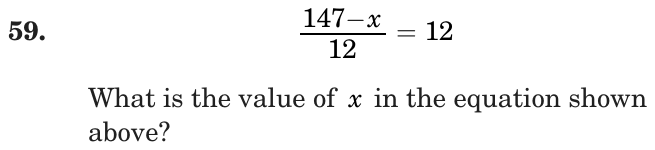
What is the value of in the equation shown above?
Grid-in question: work out the answer and enter it as a number.
Show the answer
Correct answer: 3
Question analysis
This grid-in asks students to solve a two-step linear equation in which an expression containing x is divided by 12 and set equal to 12. The algebra is short, but x is being subtracted from 147, so undoing the operations in the right order and keeping the minus sign straight is where students slip.
- NYS standards
- 7.EE.4a two-step equations
- Grade level
- Grade 7 content, by NYS standard
- Compared with grade 7
- At grade 7 This is exactly the two-step equation practice of grade 7: undo a division, then undo a subtraction. The only twist is that the unknown is being subtracted, so the last step needs care with its sign.
- Estimated difficulty
- Routine: one familiar step, little to misread.
- Thinking it demands
- Depth of knowledge 1, recall and reproduction · mainly apply
- What makes it hard
- Error-prone arithmetic minor
- Solution
- 2 steps
- Reading level
- Question and choices: about grade 6, 12 words.
- Students, last 30 days
- Not enough answers yet to show (it takes 10).
Why it is hard, traps and wrong answers (shows the answer)
Why it is hard
This is a two-move equation that most students finish quickly: multiply both sides by 12, then find what must be taken from 147 to leave 144. Points are lost only at the last move, where the minus sign in front of x invites 144 − 147 or 147 + 144. Substituting the result back into the fraction catches either slip in a few seconds.
Error-prone arithmetic minor Working it out
After multiplying by 12, the unknown sits behind a minus sign in 147 − x = 144, so students must ask what is taken from 147 rather than subtract in the order the numbers appear. (Brown & Burton, 1978; Junker & Sijtsma, 2001)
Strategy: Multiply both sides by 12 to clear the fraction, then ask what number must be taken away from 147 to leave that product.
Traps
- Negatives and direction: Arithmetic with negative numbers, the order of a subtraction, or direction on a number line. (Moving a term across the equals sign without changing its sign is a faulty procedure.)
The wrong answers, classified
-3 Negatives and direction (Brown & Burton, 1978)
Reaches 147 − x = 144 but subtracts in the order the numbers appear, writing x = 144 − 147.
146 Wrong operation (Hegarty, Mayer & Monk, 1995; King et al., 2004)
Divides the right side by 12 instead of multiplying, so sets 147 − x equal to 1 and gets 146.
291 A faulty procedure (Brown & Burton, 1978; Tatsuoka, 1983)
Moves 147 across the equals sign without changing its sign and drops the minus on x, so x = 144 + 147.
Worked solution, step by step
Formulas used
- Undoing division
- a is the top of the fraction, b is the bottom, and c is the result. Division and multiplication undo each other. So if a divided by b gives c, then b times c gives back a. This is the same as multiplying both sides by b.
Read the equation in words
The equation says: start with 147, take away a mystery number x, then divide by 12. The result is 12.
You need to find x. To get x alone, undo the steps in reverse order. Dividing by 12 was done last, so undo it first.
Undo the division by 12
Multiply both sides by 12. Whatever you do to one side, you must do to the other. That keeps the equation balanced.
Watch out: Do not divide 12 by 12. That gives 147 − x = 1 and the wrong answer 146.
Find what was taken away
Now ask: 147 minus what number leaves 144? The gap between the two numbers is x.
Watch out: Do not work out 144 − 147. That gives −3. Since 147 is bigger than 144, x must be positive.
So you would grid 3.
Check your answer
Put 3 back in for x. First, . Then . That matches the right side of the equation, so x = 3 is correct.
More questions like this
The original DOE question