Also in 2026 Practice Test B Math, question 5; 2025 Practice Test B Math, question 6.
Question
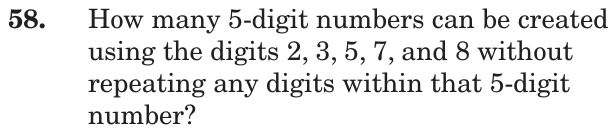
How many 5-digit numbers can be created using the digits 2, 3, 5, 7, and 8 without repeating any digits within that 5-digit number?
Grid-in question: work out the answer and enter it as a number.
Show the answer
Correct answer: 120
There are 5 choices for the first digit, 4 choices for the second digit, 3 choices for the third digit, 2 choices for the fourth digit, and 1 choice for the final digit.
The total number of possibilities is
5 × 4 × 3 × 2 × 1 = 120
Question analysis
This grid-in counting question asks how many different 5-digit numbers can be made from five given digits when no digit may repeat. It tests the counting principle for arrangements rather than arithmetic. The catch is the no-repeat rule: each place has one fewer digit to choose from, and ignoring that gives a far larger count.
- NYS standards
- 7.SP.8b sample spaces for compound events
- Grade level
- Grade 7 content, by NYS standard
- Compared with grade 7
- Above grade 7 Grade 7 probability work builds sample spaces with lists and tree diagrams for two or three stages. This needs the multiplication principle with a shrinking number of choices across five places, which listing cannot reach.
- Estimated difficulty
- Moderate: several steps, or a close reading with one strong distractor.
- Thinking it demands
- Depth of knowledge 2, skills and concepts · mainly apply
- What makes it hard
- Solution
- 2 steps
- Reading level
- Question and choices: about grade 11, 19 words.
- Students, last 30 days
- Not enough answers yet to show (it takes 10).
Why it is hard, traps and wrong answers (shows the answer)
Why it is hard
The arithmetic is tiny; the difficulty is knowing that arrangements are counted by multiplying, and that the no-repeat rule removes one digit for each later place. Students who have met the counting principle finish in seconds, while those who start listing numbers run out of time or guess a product they half remember. With no choices to check against, the 3,125 that comes from ignoring the rule looks as convincing as the right count.
Something you must already know moderate Working it out
Nothing in the stem names the counting principle: students must already know to multiply the digits left for each place, 5 × 4 × 3 × 2 × 1, because listing 5-digit numbers by hand cannot finish. (Anderson & Krathwohl, 2001)
An answer in an unexpected form minor Choosing the answer
As a grid-in there are no choices to compare with, so a count of 3,125 or 25 cannot be caught by noticing that it is missing from a list. (Enright, Morley & Sheehan, 2002)
Strategy: Fill the five places from left to right, write how many digits are still available for each place, and multiply those five counts together.
Traps
- Without replacement: In a second pick there is one fewer item, which changes the probability.
The wrong answers, classified
3125 Without replacement (Fischbein & Schnarch, 1997)
Uses the counting principle but lets digits repeat, multiplying 5 × 5 × 5 × 5 × 5 instead of using one fewer digit for each later place.
25 Numbers taken from the question (Hegarty, Mayer & Monk, 1995)
Multiplies the five digits by the five places, 5 × 5, as if each digit simply took each position once.
15 Wrong operation (Hegarty, Mayer & Monk, 1995; King et al., 2004)
Sees that the choices shrink from 5 to 1 but adds them, 5 + 4 + 3 + 2 + 1, instead of multiplying.
Worked solution, step by step
Formulas used
- Counting principle
- a is the number of choices for the first spot, b for the second, c for the third, and so on. Multiply them to get every possible way. It works because each choice for one spot can go with each choice for the next spot.
Sort out the question
You have five digits: 2, 3, 5, 7 and 8. A digit is one of the symbols 0 to 9. You build 5-digit numbers from them.
“Without repeating” means each digit is used only once in a number. So 23578 is allowed, but 22578 is not.
You need to find how many different numbers you can make.
Count the choices for each spot
Think of the number as five empty spots. Fill them from left to right.
- First spot: any of the 5 digits, so 5 choices.
- Second spot: one digit is used up, so 4 are left.
- Third spot: 3 are left.
- Fourth spot: 2 are left.
- Last spot: only 1 is left.
Multiply the choices together
Use the counting principle. Each choice for one spot works with every choice for the next spot. So you multiply. You do not add.
There are 120 different numbers.
Watch out: Adding 5 + 4 + 3 + 2 + 1 gives 15, which is far too small. Using 5 choices for every spot gives 3,125. That count lets digits repeat, which the question does not allow.
So you would grid 120.
Check your answer
Try a smaller case you can list. With the digits 2, 3 and 5, the rule gives numbers. The list is 235, 253, 325, 352, 523 and 532. That is 6, so the rule works.
More questions like this
The original DOE question