Question
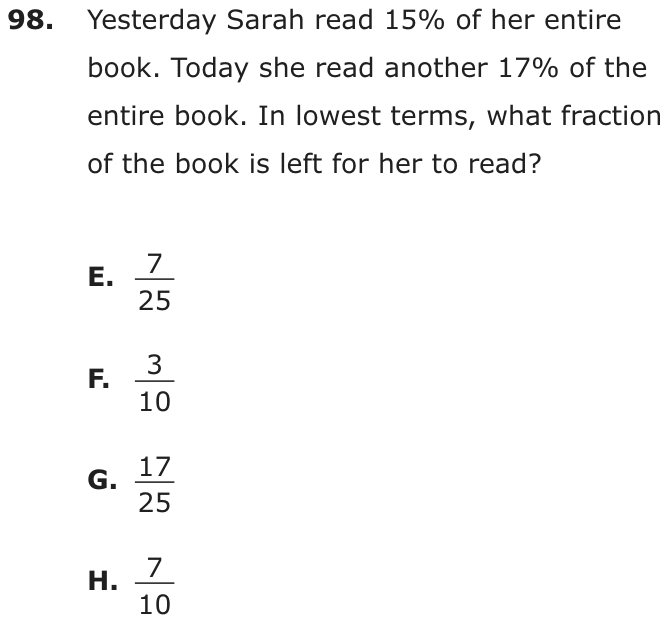
Yesterday Sarah read 15% of her entire book. Today she read another 17% of the entire book. In lowest terms, what fraction of the book is left for her to read?
- A
- B
- C
- D
Show the answer
Correct answer: C
So far, Sarah has read of the entire book. That means she has left to read.
Question analysis
This percent word problem says Sarah read 15% of her book yesterday and 17% today, and asks what fraction of the book she still has to read, in lowest terms. Students combine percents of the same whole, find the part remaining, and convert a percent to a simplified fraction. Rounding, or giving the part already read, leads to wrong choices.
- Grade level
- Grade 7 content, by NYS standard
- Compared with grade 7
- Below grade 7 Grade 7 percent work often takes a percent of a percent or finds a percent change. Here both percents are of the same whole book, so they combine directly; the rest is a subtraction and simplifying a fraction, lighter than typical.
- Estimated difficulty
- Straightforward: two steps or one careful reading.
- Thinking it demands
- Depth of knowledge 2, skills and concepts · mainly apply
- What makes it hard
- Solution
- 3 steps
- Reading level
- Question and choices: about grade 5, 33 words.
- Corrected from the DOE handbook
- Missing percent signs in the explanation were restored.
- Students, last 30 days
- Not enough answers yet to show (it takes 10).
Why it is hard, traps and wrong answers (shows the answer)
Why it is hard
The percent work is a sum and a subtraction from 100, so the question mostly tests the last step, writing 68% as a fraction in lowest terms. Students who round to 30% read and 70% left to get a friendlier fraction land on a listed choice, as do those who give the part read. Dividing 68 and 100 by their common factor 4 keeps the answer exact.
Turning words into math minor Understanding the question
Both percents are “of the entire book,” so they simply add to 32%, and “left for her to read” asks for the rest, 100% − 32%, not the part already read. (Hegarty, Mayer & Monk, 1995; Koedinger & Nathan, 2004)
An answer in an unexpected form minor Choosing the answer
The result has to be written as a fraction in lowest terms, so 68/100 must be divided by 4 to reach a form that appears among the choices. (Enright, Morley & Sheehan, 2002)
Strategy: Add the two percents, since both are of the whole book, subtract the total from 100%, then write the result over 100 and simplify it fully.
Traps
- Rounds too early: Rounds a value partway through, or rounds the wrong way, so the final answer drifts from the exact one.
- Answers a different question: A choice is right for another quantity: the other unknown, the rest instead of the part, the part instead of the whole.
The wrong answers, classified
A Little reason to choose it (Haladyna & Downing, 1993; Rodriguez, 2005)
No sum or difference of 15% and 17% gives 28%, so 7/25 mostly draws students who match the right fraction's 25 without checking the numerator.
B Answers a different question (King et al., 2004; Hegarty, Mayer & Monk, 1995)
Gives the part already read rather than the part left, and rounds that 32% to 30% to write it as 3/10.
D Rounds too early (King et al., 2004)
Finds that 68% is left but rounds it to 70% to make an easier fraction, giving 7/10 instead of simplifying 68/100 exactly.
What was corrected from the DOE handbook, and why
- Explanation: The handbook writes “So far, Sarah has read 15 + 17 = 32 of the entire book. That means she has 100 − 32 = 68 left to read.” (p. 143, question 98), with no percent signs, so 32 and 68 read as amounts of the book (pages, say) that the question never gives. The question gives 15% and 17%, and the handbook’s next line begins “68% =”, so the site now reads 15% + 17% = 32% and 100% − 32% = 68%. The answer, 17/25, is unchanged.
Worked solution, step by step
Formulas used
- Percent as a fraction
- p is the percent. Percent means “out of 100,” so p percent is p hundredths. For example, 50% is 50 out of 100, which is one half.
- Simplifying a fraction
- a is the top number, b is the bottom, and n is a number that divides both evenly. Dividing the top and bottom by the same number keeps the value the same. A fraction is in lowest terms when no number bigger than 1 divides both.
Sort out the question
Sarah read 15% of her book yesterday and 17% today. Both are percents of the whole book. You need the part still left to read, as a fraction in lowest terms. That means a fraction that can’t be simplified any more.
Find how much she has read
Both percents are of the same whole book, so you can add them. She has read 32% of it.
Find how much is left
The whole book is 100%.
Watch out: 32% is the part she has read, not the part left. Rounding 32% to 30% gives , choice B.
Write 68% as a fraction
This fraction is not in lowest terms yet, because 68 and 100 are both even.
Write it in lowest terms
The number 4 divides both 68 and 100 evenly.
Watch out: don’t round 68% to 70%. That gives , choice D. So the answer is C, .
Check your answer
Turn the answer back into a percent: , which is 68%. Then 68% + 32% = 100%, the whole book. Also, 17 and 25 share no factor except 1, so the fraction is in lowest terms.
More questions like this
The original DOE question