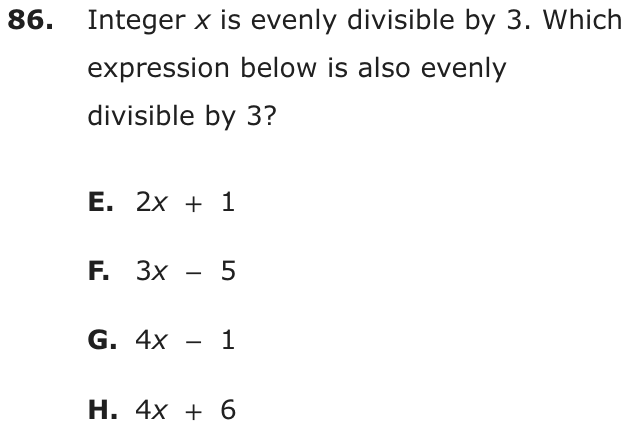
Question
Integer x is evenly divisible by 3. Which expression below is also evenly divisible by 3?
- A
- B
- C
- D
Show the answer
Correct answer: D
Since integer x is evenly divisible by 3, substitute 3 for x in the answer options to determine which expression is also divisible by 3:
Let .
Option A:
Option B:
Option C:
Option D:
Option D is the only value that is divisible by 3.
Question analysis
This number properties question says an integer x is divisible by 3 and asks which of four linear expressions in x is also divisible by 3, whatever multiple of 3 the integer is. Students can test a multiple of 3 in each expression or think about remainders. Testing a value that is not a multiple of 3 can make a wrong expression look right.
- Grade level
- Grade 7 content, by NYS standard
- Compared with grade 7
- At grade 7 Grade 7 students rewrite and evaluate linear expressions, but they seldom ask whether one is divisible by 3 for every allowed value. One well-chosen substitution settles it, so the demand is about typical for grade 7.
- Estimated difficulty
- Straightforward: two steps or one careful reading.
- Thinking it demands
- Depth of knowledge 2, skills and concepts · mainly analyze
- What makes it hard
- Variables instead of numbers moderate
- Every choice must be checked minor
- Solution
- 2 steps
- Reading level
- Question and choices: about grade 13, 18 words.
- Students, last 30 days
- Not enough answers yet to show (it takes 10).
Why it is hard, traps and wrong answers (shows the answer)
Why it is hard
The algebra is light; the question turns on choosing a test value that obeys the condition. The habit of trying x = 1 backfires here, because 1 is not a multiple of 3 and it makes two wrong expressions come out divisible. Students who substitute 3, or who see that 4x and 6 are both multiples of 3 whenever x is, settle it quickly, and a second multiple such as 6 confirms it.
Variables instead of numbers moderate Understanding the question
Nothing pins x down except that it is a multiple of 3, so each expression must be judged for every such x, and any test value has to be a multiple of 3 itself, such as 3 or 6. (Koedinger & Nathan, 2004; Enright, Morley & Sheehan, 2002)
Every choice must be checked minor Choosing the answer
The four expressions differ only in their coefficients and constants, from 2x + 1 to 4x + 6, so none can be dismissed at a glance; each needs a test or a look at its terms. (Embretson & Wetzel, 1987)
Strategy: Substitute a multiple of 3, such as 3 or 6, for x in every expression and keep the one whose value divides evenly by 3; a second multiple confirms it.
Traps
- Misreads the question: Misses or misreads a condition or a word in the question: "at least", "each", "remaining", "not".
- Numbers taken from the question: Combines the numbers in the question without a model of the situation, or is simply a number that appears in the question.
The wrong answers, classified
A Misreads the question (Hegarty, Mayer & Monk, 1995)
Tests x = 1, which is not a multiple of 3, finds that 2(1) + 1 = 3 divides evenly, and stops at the first choice; with x = 3 it gives 7.
B Numbers taken from the question (Hegarty, Mayer & Monk, 1995)
Sees the 3 in 3x and takes the whole expression to be a multiple of 3, overlooking that subtracting 5 spoils it: with x = 3 it gives 4.
C Misreads the question (Hegarty, Mayer & Monk, 1995)
Tries a value that is not a multiple of 3, such as x = 4, where 4x − 1 = 15 divides evenly, though x = 3 gives 11.
Worked solution, step by step
Formulas used
- Adding multiples of 3
- a and b are whole numbers, so 3a and 3b are multiples of 3. A multiple of 3 is a number that 3 divides evenly, with nothing left over. Adding two multiples of 3 always gives another multiple of 3, because you can pull the 3 out of both parts.
Sort out the question
“Evenly divisible by 3” means 3 goes into the number with nothing left over. Such a number is called a multiple of 3, like 3, 6, 9 or 12.
You know that x is a multiple of 3. You need the expression that is a multiple of 3 every time, whatever multiple of 3 x is.
Test x = 3 in every choice
Pick a number for x that follows the rule. The easiest one is 3. Put it into each expression.
Choice Work Divisible by 3? A No B No C No D Yes Watch out: your test number must be a multiple of 3. With x = 1, choice A gives 3 and looks right. That leads to the wrong choice, A.
See why D always works
One test could be lucky, so see why D works for every x. Since x is a multiple of 3, 4x is one too. For example, 4 × 3 = 12 and 4 × 6 = 24. The number 6 is also a multiple of 3, since 6 = 3 × 2.
So 4x + 6 is a multiple of 3 plus a multiple of 3. That is always a multiple of 3.
Rule out the other choices
Watch out: choice B starts with 3x, but then it subtracts 5. The 5 is not a multiple of 3, so it spoils the result, and 3(3) − 5 = 4. Choices A and C also add or take away a number that is not a multiple of 3.
So the answer is D, .
Check your answer
Try two more multiples of 3. With x = 6, choice D gives , and 30 ÷ 3 = 10. With x = 9, it gives , and 42 ÷ 3 = 14. Both divide evenly, so D keeps working.
More questions like this
The original DOE question