Question
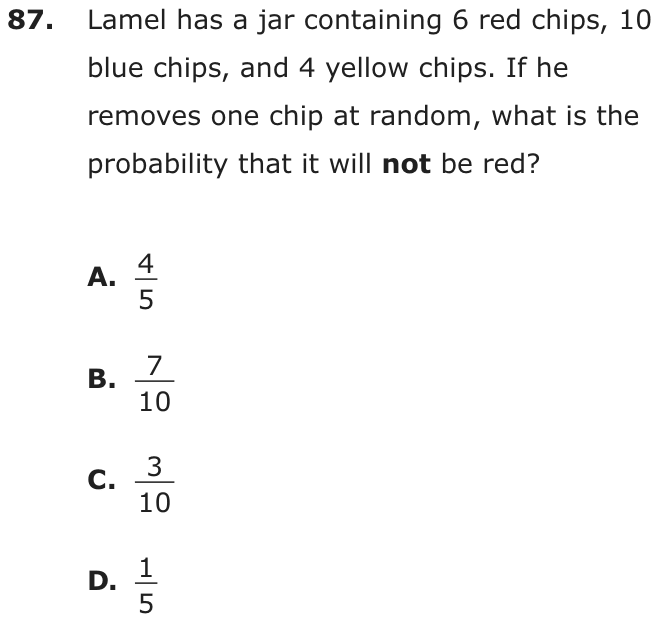
Lamel has a jar containing 6 red chips, 10 blue chips, and 4 yellow chips. If he removes one chip at random, what is the probability that it will not be red?
- A
- B
- C
- D
Show the answer
Correct answer: B
There are currently 20 chips in the jar (). Of those chips, 14 are not red. So the probability of choosing a chip that is not red is .
Question analysis
In this probability word problem, Lamel's jar holds red, blue and yellow chips, and students find the chance that one chip drawn at random is not red. It tests counting the favorable outcomes against the total and writing the probability as a fraction. Missing the bold word not, or counting the wrong colors, leads to tempting wrong fractions.
- NYS standards
- 6.SP.8a uniform probability models
- Grade level
- Grade 6 content, by NYS standard
- Compared with grade 7
- Below grade 7 Probability of a single event with equally likely outcomes is grade 6 content in New York. Students add three counts and form one fraction, and the only extra care is the bold word not, so it sits below grade 7.
- Estimated difficulty
- Straightforward: two steps or one careful reading.
- Thinking it demands
- Depth of knowledge 2, skills and concepts · mainly apply
- What makes it hard
- Solution
- 2 steps
- Reading level
- Question and choices: about grade 5, 33 words.
- Students, last 30 days
- Not enough answers yet to show (it takes 10).
Why it is hard, traps and wrong answers (shows the answer)
Why it is hard
This is a one-event probability with small whole numbers, so the bold not carries the question. A student who skims past it computes the chance of red, a tidy fraction that is waiting among the choices. The other wrong fractions come from removing the wrong color or keeping only one of the two colors that are not red. Adding blue and yellow first, then dividing by all 20 chips, avoids each of them.
Turning words into math minor Understanding the question
The bold not turns the question around: the chips that count are the 10 blue and 4 yellow ones, 14 in all, or equivalently 1 minus the red share of 6/20. (Hegarty, Mayer & Monk, 1995; Koedinger & Nathan, 2004)
An answer in an unexpected form minor Choosing the answer
The count of 14 out of 20 matches no choice until it is reduced to 7/10, so a correct fraction left unsimplified can look missing from the list. (Enright, Morley & Sheehan, 2002)
Strategy: Add all the chips for the total, then count the chips that are blue or yellow, or subtract the chance of red from 1, and simplify the fraction.
Traps
- Misreads the question: Misses or misreads a condition or a word in the question: "at least", "each", "remaining", "not".
- Answers a different question: A choice is right for another quantity: the other unknown, the rest instead of the part, the part instead of the whole.
The wrong answers, classified
A Answers a different question (King et al., 2004; Hegarty, Mayer & Monk, 1995)
Leaves out the 4 yellow chips instead of the 6 red ones, finding the chance of not yellow, 16/20 = 4/5.
C Misreads the question (Hegarty, Mayer & Monk, 1995)
Overlooks the bold not and gives the chance that the chip is red, 6 out of 20, which reduces to 3/10.
D Answers a different question (King et al., 2004; Hegarty, Mayer & Monk, 1995)
Counts only the 4 yellow chips as not red and forgets the 10 blue ones, so it finds 4/20 = 1/5, the chance of yellow alone.
Worked solution, step by step
Formulas used
- Probability
- P is the probability, the chance that something happens. The top counts the outcomes you want. The bottom counts every outcome that could happen. It works when each outcome is equally likely, like pulling one chip without looking.
Sort out the question
Lamel’s jar holds 6 red chips, 10 blue chips and 4 yellow chips. He takes one chip without looking. You need the probability that it is not red. That means the chip is blue or yellow.
Count all the chips
There are 20 chips in all. That is the bottom of the fraction, because any of the 20 could come out.
Count the chips that are not red
The blue and yellow chips are the ones that are not red.
So 14 chips are not red. Watch out: the question asks for not red. Counting the 6 red chips gives , choice C. Counting only the 4 yellow chips gives , choice D.
Find and simplify the probability
Dividing the top and bottom by 2 puts the fraction in lowest terms. So the answer is B, .
Check your answer
A chip is either red or not red, so the two chances must add up to 1. The chance of red is . Then . It works.
More questions like this
The original DOE question