Question
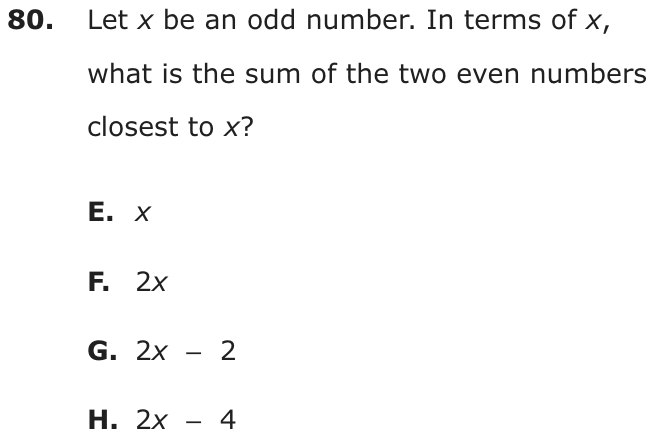
Let x be an odd number. In terms of x, what is the sum of the two even numbers closest to x?
- A
- B
- C
- D
Show the answer
Correct answer: B
If x is odd, then the two even numbers closest to x are and . Find the sum of these two expressions:
Question analysis
An algebra question about odd and even numbers: x is odd, and students write the sum of the two even numbers closest to x in terms of x. It tests representing neighboring integers with expressions and adding them. Deciding exactly which even numbers are closest to an odd number is where errors start.
- NYS standards
- Grade level
- Grade 7 content, by NYS standard
- Compared with grade 7
- At grade 7 Grade 7 students write and combine linear expressions; here the expressions describe neighboring integers, a familiar idea from consecutive-integer problems. Two short steps and a quick number check put it at typical grade 7 demand.
- Estimated difficulty
- Straightforward: two steps or one careful reading.
- Thinking it demands
- Depth of knowledge 2, skills and concepts · mainly apply
- What makes it hard
- Variables instead of numbers moderate
- Turning words into math minor
- Solution
- 2 steps
- Reading level
- Question and choices: about grade 3, 26 words.
- Students, last 30 days
- Not enough answers yet to show (it takes 10).
Why it is hard, traps and wrong answers (shows the answer)
Why it is hard
The algebra is a single addition, so the work is in naming the right two numbers. An odd x sits between two even numbers, one step away on each side, and the minus one and plus one cancel. Wrong choices come from picking both neighbors below x, from treating x as even, or from giving the middle of the pair; a test value catches each of them.
Variables instead of numbers moderate Understanding the question
Here x stands for any odd number, so the two even neighbors must be written as x − 1 and x + 1; trying x = 7, with neighbors 6 and 8, makes it concrete. (Koedinger & Nathan, 2004; Enright, Morley & Sheehan, 2002)
Turning words into math minor Understanding the question
The phrase "the two even numbers closest to x" means one just below and one just above x, not two in a row on the same side. (Hegarty, Mayer & Monk, 1995; Koedinger & Nathan, 2004)
Strategy: Substitute a real odd number such as 7 for x, find its two closest even numbers and their sum, then see which expression gives that sum.
Traps
- Misreads the question: Misses or misreads a condition or a word in the question: "at least", "each", "remaining", "not".
- Answers a different question: A choice is right for another quantity: the other unknown, the rest instead of the part, the part instead of the whole.
The wrong answers, classified
A Answers a different question (King et al., 2004; Hegarty, Mayer & Monk, 1995)
Finds the number midway between the two even neighbors, x itself, which is their mean rather than their sum.
C Misreads the question (Hegarty, Mayer & Monk, 1995)
Treats x as if it were even and adds it to the even number below it, x + (x − 2), ignoring that x is odd.
D Misreads the question (Hegarty, Mayer & Monk, 1995)
Takes the two even numbers just below x, x − 1 and x − 3, instead of the closest one on each side.
Worked solution, step by step
Formulas used
- Neighbors of a number
- x is any whole number. The number just below it is x − 1, and the number just above it is x + 1. Whole numbers take turns being odd and even. So if x is odd, both of its neighbors are even.
- Combining like terms
- Like terms have the same letter, such as x and 2x. To add them, add the numbers in front. x by itself means 1x, so x + x is 2x, which is two x’s.
Sort out the question
x is an odd number. You need the sum of the two even numbers closest to x. Sum means the result of adding. In terms of x means write the answer using the letter x.
Try a real number first
Pick an odd number, like 7. The even numbers closest to 7 are 6 and 8, one on each side.
Notice that 14 is .
Write the neighbors with x
Odd and even numbers take turns. So both numbers right next to an odd x are even.
For x = 7, these are 6 and 8. Watch out: take one even number below x and one above. Using two even numbers below x, and , gives , choice D.
Add the two neighbors
The −1 and the +1 cancel, and . Watch out: x is the number in the middle, not the sum, so choice A is wrong. So the answer is B, .
Check your answer
Try another odd number, 11. Its even neighbors are 10 and 12, and . The answer 2x gives . They match.
More questions like this
The original DOE question