Question
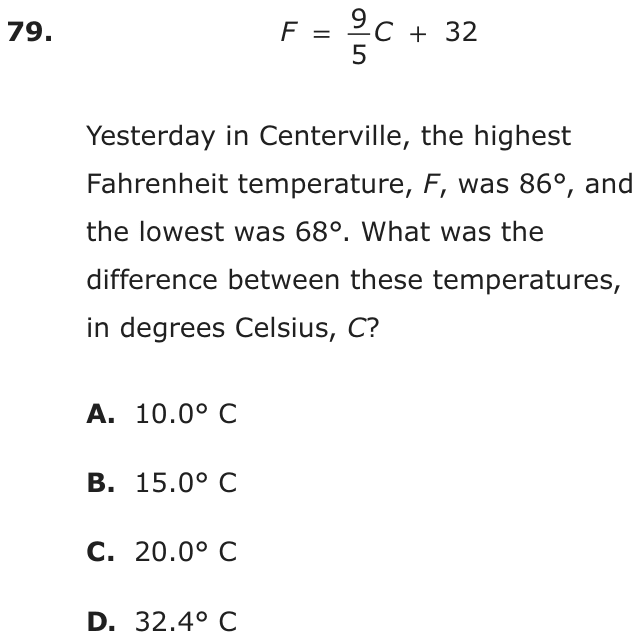
Yesterday in Centerville, the highest Fahrenheit temperature, F, was 86°, and the lowest was 68°. What was the difference between these temperatures, in degrees Celsius, C?
- A10.0° C
- B15.0° C
- C20.0° C
- D32.4° C
Show the answer
Correct answer: A
The highest temperature was 86° F.
Subtract 32 from both sides of the equation:
Multiply both sides of the equation by :
The lowest temperature was 68° F.
The difference, in degrees Celsius, is 30 minus 20.
Question analysis
A formula question: given F = 9/5 C + 32 and a day's high and low of 86 and 68 degrees Fahrenheit, students find the difference between the two temperatures in degrees Celsius. It tests solving a two-step equation with a fraction coefficient. Answering with the difference, in the right scale, is what to watch.
- Grade level
- Grade 7 content, by NYS standard
- Compared with grade 7
- At grade 7 Solving equations of the form px + q = r with fraction coefficients is grade 7 work. Doing it twice and comparing the results is a typical multistep grade 7 task, with extra care over which scale the answer is in.
- Estimated difficulty
- Moderate: several steps, or a close reading with one strong distractor.
- Thinking it demands
- Depth of knowledge 2, skills and concepts · mainly apply
- What makes it hard
- Many steps moderate
- Error-prone arithmetic minor
- Solution
- 4 steps
- Reading level
- Question and choices: about grade 7, 29 words.
- Corrected from the DOE handbook
- A stray term in the explanation’s working was removed.
- Students, last 30 days
- Not enough answers yet to show (it takes 10).
Why it is hard, traps and wrong answers (shows the answer)
Why it is hard
The formula is written to give Fahrenheit from Celsius, and the question runs it the other way, twice. Plugging 86 and 68 straight into the right-hand side is the tempting misuse, and it produces a listed choice. A shortcut avoids most of the work: the 18-degree Fahrenheit gap times 5/9 is the Celsius gap, because the 32 cancels when two readings are subtracted.
Many steps moderate Working it out
Each Fahrenheit reading needs its own two-step solve, subtracting 32 and multiplying by 5/9, and then the two Celsius values must be subtracted. (Daniel & Embretson, 2010; Enright, Morley & Sheehan, 2002)
Error-prone arithmetic minor Working it out
Multiplying 54 and 36 by 5/9 is easy only if the division by 9 comes first; multiplying by 5 first leaves 270/9 and 180/9 to reduce. (Brown & Burton, 1978; Junker & Sijtsma, 2001)
Strategy: Solve the formula for C at 86° and at 68° by subtracting 32 and multiplying by 5/9, then subtract; or convert the 18-degree gap directly with 5/9.
Traps
- Wrong operation: Adds instead of multiplying, divides the wrong way round, turns a ratio or rate upside down, or undoes a step in the wrong direction (subtracts what should be added back).
- Answers a different question: A choice is right for another quantity: the other unknown, the rest instead of the part, the part instead of the whole.
The wrong answers, classified
B Little reason to choose it (Haladyna & Downing, 1993; Rodriguez, 2005)
No conversion route gives 15; the gap is 18 × 5/9 by any method, so 15 needs a slip such as 54 ÷ 9 = 7, and it mostly draws guesses.
C Answers a different question (King et al., 2004; Hegarty, Mayer & Monk, 1995)
Converts the low reading, 68°F, to 20°C and gives that temperature instead of the difference between the two readings.
D Wrong operation (Hegarty, Mayer & Monk, 1995; King et al., 2004)
Converts in the wrong direction, multiplying the 18-degree gap by 9/5 instead of 5/9, the same as putting 86 and 68 in for C.
What was corrected from the DOE handbook, and why
- Explanation: After “Subtract 32 from both sides of the equation,” the handbook writes “86 − 32 = (9/5)C = 32”. The extra “= 32” would mean (9/5)C = 32, which is false: 86 − 32 = 54, and the next line is 54 = (9/5)C. The site now reads 86 − 32 = (9/5)C, as the handbook writes the same step for 68°.
Worked solution, step by step
Formulas used
- Changing Celsius to Fahrenheit
- F is a temperature in degrees Fahrenheit. C is the same temperature in degrees Celsius. Multiply the Celsius number by 9 fifths, then add 32. To go the other way, undo each step: subtract 32, then multiply by 5 ninths.
Sort out the question
Fahrenheit and Celsius are two ways to measure temperature. The formula changes Celsius, C, into Fahrenheit, F. Yesterday’s high was 86° F and the low was 68° F. You need the difference between them in degrees Celsius. So change each one to Celsius, then subtract.
Undo the + 32 for the high
Put 86 in for F. Then subtract 32 from both sides. That keeps the equation balanced.
Solve for the high in Celsius
To undo times , multiply both sides by . That is its reciprocal, the fraction flipped upside down.
Dividing 54 by 9 first gives 6, which keeps the numbers small. The high was 30° C.
Change the low to Celsius
Do the same with 68.
The low was 20° C. Watch out: 20° C is the low, not the difference. That is choice C.
Subtract to find the difference
The difference is 10 degrees Celsius. Watch out: do not multiply the 18-degree Fahrenheit gap by . That goes the wrong way and gives 32.4, choice D. So the answer is A, 10.0° C.
Check your answer
A shortcut: the gap in Fahrenheit is degrees. The + 32 moves both temperatures the same, so it does not change the gap. Multiply the gap by : . Same answer.
More questions like this
The original DOE question