Question
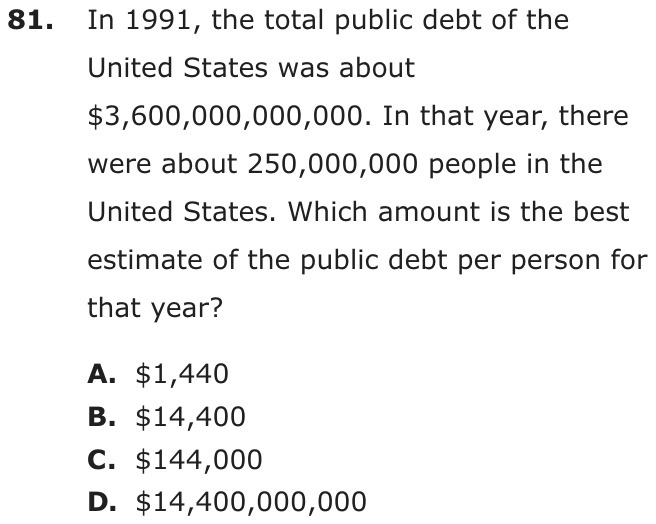
In 1991, the total public debt of the United States was about $3,600,000,000,000. In that year, there were about 250,000,000 people in the United States. Which amount is the best estimate of the public debt per person for that year?
- A$1,440
- B$14,400
- C$144,000
- D$14,400,000,000
Show the answer
Correct answer: B
The question asks for the amount of the public debt per person, so divide the total public debt by the number of people.
The amount of the public debt per person was about $14,400.
Question analysis
An estimation question with very large numbers: the 1991 United States public debt of about 3.6 trillion dollars and a population of about 250 million. Students find the debt per person. The choices differ by powers of ten, so cancelling zeros and keeping track of place value is the whole challenge.
- Grade level
- Grade 6 content, by NYS standard
- Compared with grade 7
- Below grade 7 Dividing large whole numbers and using place value are grade 5 and 6 skills. Grade 7 work goes further with rational numbers; this asks only for one careful division, with counting zeros as the main risk.
- Estimated difficulty
- Straightforward: two steps or one careful reading.
- Thinking it demands
- Depth of knowledge 2, skills and concepts · mainly apply
- What makes it hard
- Error-prone arithmetic moderate
- A very close wrong answer minor
- Solution
- 2 steps
- Reading level
- Question and choices: about grade 5, 37 words.
- Corrected from the DOE handbook
- A misprinted number in the explanation was corrected.
- Students, last 30 days
- Not enough answers yet to show (it takes 10).
Why it is hard, traps and wrong answers (shows the answer)
Why it is hard
The division itself is easy once the zeros are handled, and the question is built to punish miscounting them. Three choices carry the same digits, 144, at different sizes, so a student who loses or gains one zero still finds a match. A quick estimate in powers of ten, 3.6 trillion over a quarter of a billion, confirms that the answer is in the tens of thousands.
Error-prone arithmetic moderate Working it out
The debt has 13 digits and the population 9; cancelling seven zeros from each leaves 360,000 ÷ 25, and losing or adding one zero shifts the answer tenfold. (Brown & Burton, 1978; Junker & Sijtsma, 2001)
A very close wrong answer minor Choosing the answer
Three choices share the digits 144 and differ only by powers of ten, so getting the digits right does not settle it; only exact place value does. (Embretson & Wetzel, 1987; Gorin & Embretson, 2006; Ascalon et al., 2007)
Strategy: Cancel the same number of zeros from the debt and the population, then divide the smaller numbers that remain; check the size by estimating with powers of ten.
Traps
- An arithmetic slip: The right method with a plausible arithmetic error: a digit, a place value or a times-table fact.
- A faulty procedure: A systematic but wrong procedure: adding fractions straight across, applying an exponent to each term of a sum, dropping a sign when moving a term.
The wrong answers, classified
A An arithmetic slip (Junker & Sijtsma, 2001)
Cancels one zero too many while dividing and ends with $1,440, a per-person amount ten times too small.
C An arithmetic slip (Junker & Sijtsma, 2001)
Cancels one zero too few from the debt and ends with $144,000, a per-person amount ten times too large.
D A faulty procedure (Brown & Burton, 1978; Tatsuoka, 1983)
Divides the debt by 250 alone, dropping the six zeros that follow 250 in the population without removing any from the debt.
What was corrected from the DOE handbook, and why
- Explanation: The handbook’s first division writes the debt as “3,6000,000,000,000”, with an extra zero. The question gives $3,600,000,000,000, and the handbook’s next line (where the zeros are cancelled) uses 3,600,000,000,000, so the site now reads 3,600,000,000,000 ÷ 250,000,000. The answer, $14,400, is unchanged.
Worked solution, step by step
Formulas used
- Amount per person
- The total is the whole amount, here the debt in dollars. Dividing by the number of people shares it out equally. The result is how much goes with each one person.
- Canceling zeros
- a and b are any numbers, and b is not zero. Dividing the top and bottom of a fraction by 10 does not change its value. So you can cross off a zero at the end of the top and one at the end of the bottom, as a pair.
Sort out the question
The debt was about $3,600,000,000,000, which is 3.6 trillion dollars. There were about 250,000,000 people, which is 250 million. You need the debt per person. Per person means the amount for each one person.
Set up the division
Share the debt equally by dividing it by the number of people. The debt goes on top, and the people go on the bottom.
Cancel zeros in pairs
Count the zeros at the end of each number. The debt ends in 11 zeros. The population ends in 7. Cross off 7 zeros from each. Each pair you cross off divides the top and bottom by 10.
Watch out: cross off the same number from each. One too many from the debt gives $1,440, choice A. One too few gives $144,000, choice C.
Divide what is left
Dividing by 25 is the same as dividing by 100 and then multiplying by 4. That is because 4 groups of 25 make 100.
The debt was about $14,400 per person. Watch out: choice D divides by 250 only and forgets the zeros after it. So the answer is B, $14,400.
Check your answer
Multiply back. First, . Then put back the 7 zeros you crossed off: 3,600,000,000,000. That is the debt, so $14,400 is right.
More questions like this
The original DOE question