Question
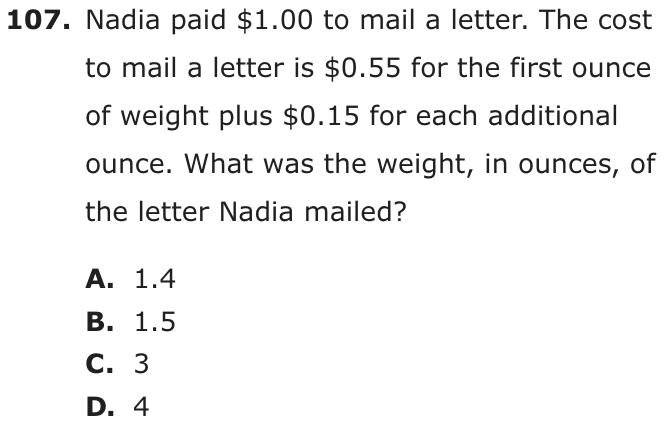
Nadia paid $1.00 to mail a letter. The cost to mail a letter is $0.55 for the first ounce of weight plus $0.15 for each additional ounce. What was the weight, in ounces, of the letter Nadia mailed?
- A1.4
- B1.5
- C3
- D4
Show the answer
Correct answer: D
Let x represent the number of ounces Nadia’s letter weighed. The first ounce costs $0.55, so represents the number of ounces that cost $0.15 each.
Given that the total cost is $1.00, the equation that describes the situation can be written and solved as shown.
So the letter Nadia mailed weighed 4 ounces.
Question analysis
Nadia pays $1.00 to mail a letter, and postage costs $0.55 for the first ounce plus $0.15 for each additional ounce. Students find the weight of the letter in ounces. It tests writing and solving a two-step equation from a pricing rule in which the two prices apply to different ounces.
- Grade level
- Grade 7 content, by NYS standard
- Compared with grade 7
- At grade 7 Grade 7 students solve word problems that lead to equations such as px + q = r. This one takes that form once each price is matched to the right ounces, a step that makes it a little more demanding than routine practice.
- Estimated difficulty
- Moderate: several steps, or a close reading with one strong distractor.
- Thinking it demands
- Depth of knowledge 2, skills and concepts · mainly apply
- What makes it hard
- Turning words into math moderate
- Error-prone arithmetic minor
- Solution
- 3 steps
- Reading level
- Question and choices: about grade 4, 35 words.
- Students, last 30 days
- Not enough answers yet to show (it takes 10).
Why it is hard, traps and wrong answers (shows the answer)
Why it is hard
Pricing the letter ounce by ounce, $0.55, $0.70, $0.85, $1.00, reaches the total at the fourth ounce without any algebra. The equation route works too, but the first ounce is easy to lose: dividing the $0.45 left by $0.15 counts only the ounces after the first. The two decimal choices come from merging the two prices or from treating dollars as ounces.
Turning words into math moderate Understanding the question
“$0.55 for the first ounce of weight plus $0.15 for each additional ounce” makes the cost 0.55 + 0.15(x − 1), so the $0.15 covers every ounce except the first. (Hegarty, Mayer & Monk, 1995; Koedinger & Nathan, 2004)
Error-prone arithmetic minor Working it out
The money is in decimals, $1.00 − $0.55 = $0.45 and then $0.45 ÷ $0.15 = 3, and dividing by a decimal invites a misplaced point. (Brown & Burton, 1978; Junker & Sijtsma, 2001)
Strategy: Write the cost of a letter weighing x ounces, $0.55 plus $0.15 for each ounce after the first, set it equal to $1.00 and solve, then check by pricing the letter ounce by ounce.
Traps
- Stops one step early: A choice is a number from partway through the solution.
- Numbers taken from the question: Combines the numbers in the question without a model of the situation, or is simply a number that appears in the question.
- Units or scale: The answer is wanted in other units, or a rate or scale must be converted first.
The wrong answers, classified
A Numbers taken from the question (Hegarty, Mayer & Monk, 1995)
Merges the two prices into $0.70 for every ounce and divides $1.00 by $0.70, about 1.43, which rounds to 1.4.
B Units or scale (King et al., 2004)
Counts the first ounce, then treats the $0.45 left over as 0.45 ounce, getting 1.45 ounces, which rounds to 1.5.
C Stops one step early (King et al., 2004; Gierl et al., 2017)
Finds the 3 additional ounces that the $0.45 left over pays for, 0.45 ÷ 0.15 = 3, and stops before adding the first ounce.
Worked solution, step by step
Formulas used
- Cost to mail a letter
- C is the cost in dollars. w is the weight in ounces. The first ounce costs $0.55. Each ounce after the first costs $0.15, and there are w − 1 of them. Subtracting 1 leaves out the first ounce, which is already paid for.
- Keeping an equation balanced
- a and b are the two equal sides. c is any number, but not 0 when you divide. Doing the same thing to both sides keeps them equal, like a balanced scale. Use it to get the unknown by itself.
Sort out the question
Nadia paid $1.00 to mail a letter. The first ounce costs $0.55. Each additional ounce, meaning each ounce after the first, costs $0.15. You need the weight of the letter in ounces.
Write the equation
Let w be the weight in ounces. The first ounce is 1 of the w ounces. So the extra ounces number w − 1. The cost is $1.00.
Take off the first ounce’s cost
Subtract 0.55 from both sides. This keeps the equation balanced.
So $0.45 pays for the extra ounces.
Find the extra ounces
Divide both sides by 0.15. Multiply both numbers by 100 to make them whole.
There are 3 extra ounces after the first one.
Add back the first ounce
The letter weighed 4 ounces. Watch out: 3 counts only the ounces after the first. It is choice C. Also, don’t join $0.55 and $0.15 into one price. is about 1.4, choice A. So the answer is D, 4 ounces.
Check your answer
Price the letter one ounce at a time. 1 ounce: $0.55. 2 ounces: $0.70. 3 ounces: $0.85. 4 ounces: $1.00. The cost reaches $1.00 at 4 ounces. That matches.
More questions like this
The original DOE question