Also in 2026 Practice Test B Math, question 26; 2025 Practice Test B Math, question 31.
Question
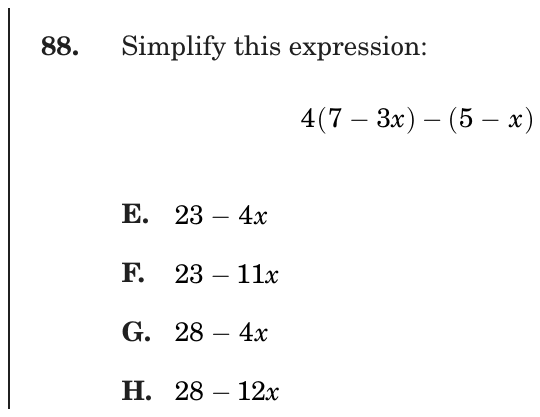
Simplify this expression:
- A
- B
- C
- D
Show the answer
Correct answer: B
4( 7 − 3x ) −( 5 − x) = 28 − 12x − 5 + x = 23 − 11x
Question analysis
This question asks students to simplify an algebraic expression by distributing a number into one set of parentheses, subtracting another set, and combining like terms. It checks the distributive property with a minus sign in front of parentheses. The usual slip is subtracting only the first term inside the second parentheses, which changes the sign of an x term.
- NYS standards
- 7.EE.1 linear expressions with rational coefficients
- Grade level
- Grade 7 content, by NYS standard
- Compared with grade 7
- At grade 7 Expanding and combining linear expressions is core grade 7 work. This is a standard example, two distributions and one subtraction, with nothing beyond what a grade 7 lesson on the distributive property would cover.
- Estimated difficulty
- Straightforward: two steps or one careful reading.
- Thinking it demands
- Depth of knowledge 1, recall and reproduction · mainly apply
- What makes it hard
- Error-prone arithmetic moderate
- Many steps minor
- A very close wrong answer minor
- Solution
- 3 steps
- Reading level
- Question and choices: about grade 16+, 8 words.
- Students, last 30 days
- Not enough answers yet to show (it takes 10).
Why it is hard, traps and wrong answers (shows the answer)
Why it is hard
Every step is routine, but subtracting a whole group is where students go wrong: the minus sign has to reach the −x as well as the 5. Each choice pairs a constant with an x coefficient, so getting the constant right only narrows the field to two. The question rewards writing out both distributions in full rather than doing them mentally.
Error-prone arithmetic moderate Working it out
The minus sign in front of (5 − x) must change both terms, so −x becomes +x and then combines with −12x from the first group. (Brown & Burton, 1978; Junker & Sijtsma, 2001)
Many steps minor Working it out
Two distributions, then collecting the constants 28 and −5 and the x terms separately: four small operations, each a place where a sign can slip. (Daniel & Embretson, 2010; Enright, Morley & Sheehan, 2002)
A very close wrong answer minor Choosing the answer
23 − 4x shares the right constant with 23 − 11x, so getting 23 does not settle it; only the x coefficient, −12x + x rather than −3x − x, separates them. (Embretson & Wetzel, 1987; Gorin & Embretson, 2006; Ascalon et al., 2007)
Strategy: Rewrite the subtraction as adding −1 times the second group, distribute both multipliers, then collect the constant terms and the x terms separately.
Traps
- Order of operations: Working left to right, or distributing a minus sign wrongly, gives a choice.
- Stops one step early: A choice is a number from partway through the solution.
The wrong answers, classified
A Order of operations (Brown & Burton, 1978)
Applies each multiplier to the first term only, the 4 to 7 but not −3x and the minus to 5 but not −x, so 28 − 3x − 5 − x = 23 − 4x.
C Little reason to choose it (Haladyna & Downing, 1993; Rodriguez, 2005)
Pairs 4 × 7 = 28 with −3x − x = −4x and loses the −5 altogether; no single consistent mistake produces this expression.
D Stops one step early (King et al., 2004; Gierl et al., 2017)
Distributes the 4 correctly to get 28 − 12x and stops there, never subtracting the second group, 5 − x.
Worked solution, step by step
Formulas used
- The distributive property
- a is the number in front of the parentheses. b and c are the terms inside. You multiply a by each term inside, not only the first one. This works because a groups of (b − c) is a groups of b take away a groups of c.
- Subtracting a group
- b and c are the terms inside the parentheses. A minus sign in front means take away the whole group. So you change the sign of each term inside. Taking away a minus c is the same as adding c.
Sort out the question
You need to simplify . Simplify means write it in the shortest way. A term is one piece of the expression, like 7 or . Like terms have the same letter part, so and are like terms. Plain numbers are like terms too.
Multiply the 4 into the first group
Use the distributive property. The 4 multiplies both terms inside.
Watch out: the 4 must multiply the too. Writing only is the first slip that leads to choice A.
Take away the second group
The minus sign in front of means subtract the whole group. So change the sign of each term inside.
Taking away a minus gives plus .
Watch out: if you stop before this step, you get . That is choice D.
Combine the like terms
Now you have . Put the plain numbers together. Then put the terms together.
So the expression simplifies to .
Give the answer
The plain number is 23, and the term is . So the answer is B, .
Check your answer
Put in an easy number, like . The original gives . Choice B gives . They match. Choice A would give , which does not match.
More questions like this
The original DOE question