Also in 2026 Practice Test B Math, question 27; 2025 Practice Test B Math, question 32.
Question
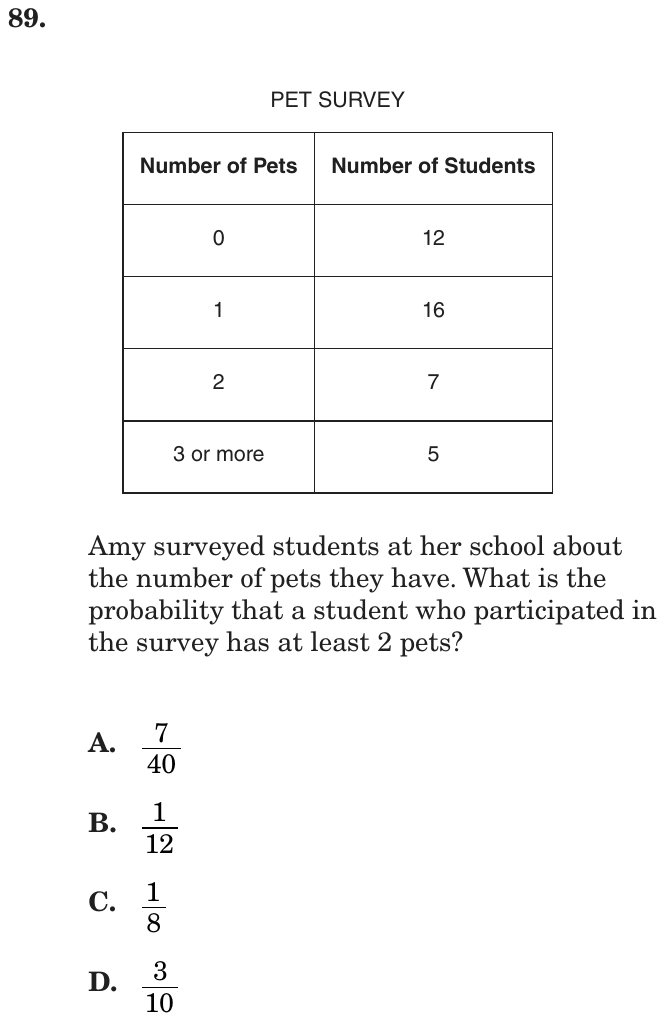
PET SURVEY
| Number of Pets | Number of Students |
| 0 | 12 |
| 1 | 16 |
| 2 | 7 |
| 3 or more | 5 |
Amy surveyed students at her school about the number of pets they have. What is the probability that a student who participated in the survey has at least 2 pets?
- A
- B
- C
- D
Show the answer
Correct answer: D
First, add the number of students for each category to find out how many total students were in the survey:
12 + 16 + 7 + 5 = 40
The number of students who had at least 2 pets are the ones who have 2 pets (7) plus the ones who have 3 or more (5). The total number of students with at least 2 pets is
7 + 5 = 12
The probability of a student in the survey having at least two pets is:
Question analysis
Amy's pet survey table shows how many pets each student has, and the question asks for the probability that a randomly chosen student has at least 2 pets. It tests finding a probability from survey data. The tricky part is reading "at least 2" correctly and using the right total as the denominator.
- Grade level
- Grade 6 content, by NYS standard
- Compared with grade 7
- Below grade 7 Simple probability from a frequency table is grade 6 work in New York. The only extra demand is interpreting "at least" and adding a column, two short steps a grade 7 student should handle easily.
- Estimated difficulty
- Straightforward: two steps or one careful reading.
- Thinking it demands
- Depth of knowledge 2, skills and concepts · mainly apply
- What makes it hard
- Solution
- 3 steps
- Reading level
- Question and choices: about grade 5, 43 words.
- Students, last 30 days
- Not enough answers yet to show (it takes 10).
Why it is hard, traps and wrong answers (shows the answer)
Why it is hard
The arithmetic is light, so the question is decided by the phrase "at least 2" and by remembering that the denominator is everyone surveyed. Students who include only one of the two qualifying rows reach an answer with the right denominator, which makes the mistake hard to notice. Rereading the condition before choosing is the main safeguard.
Turning words into math minor Understanding the question
"At least 2 pets" has to be turned into two rows of the table, the 2-pet row and the 3-or-more row, not one. (Hegarty, Mayer & Monk, 1995; Koedinger & Nathan, 2004)
Reading a figure, table or graph minor Understanding the question
The denominator is not printed anywhere; it has to be built by adding all four rows of the table, 12 + 16 + 7 + 5 = 40. (Lesh, Post & Behr, 1987; Kirsch & Mosenthal, 1990)
Strategy: Total the students in every row to get the denominator, then add the counts for each row that satisfies "at least 2" and simplify the fraction.
Traps
- Misreads the question: Misses or misreads a condition or a word in the question: "at least", "each", "remaining", "not".
The wrong answers, classified
A Misreads the question (Hegarty, Mayer & Monk, 1995)
Reads "at least 2 pets" as exactly 2, counting only the 7 students in that row and leaving out the 5 with 3 or more.
B Numbers taken from the question (Hegarty, Mayer & Monk, 1995)
Writes 1 over 12, apparently from the 12 qualifying students or the 12 in the 0-pet row, with no total in the denominator.
C Misreads the question (Hegarty, Mayer & Monk, 1995)
Reads "at least 2" as more than 2, counting only the 5 students with 3 or more pets: 5/40 = 1/8.
Worked solution, step by step
Formulas used
- Probability
- P is the probability, the chance that something happens. The top counts the results you want. The bottom counts every possible result. Use it when each result is equally likely, like picking one at random.
Sort out the question
The table shows how many students have each number of pets. You pick one student who took the survey. You need the chance that the student has “at least 2 pets”.
At least 2 means 2 or more. So two rows count: the 2 pets row and the 3 or more row.
Find the total number of students
The bottom of the fraction is everyone in the survey. Add all four rows.
There are 40 students in all.
Count the students you want
Add the 2 pets row and the 3 or more row.
So 12 students have at least 2 pets.
Watch out: using only the 7 students with exactly 2 pets gives , choice A. Using only the 5 with 3 or more gives , choice C.
Write and simplify the probability
Use the probability formula.
Divide the top and bottom by 4, since 4 goes into both.
So the answer is D, .
Check your answer
The students with fewer than 2 pets are . Then , so every student is counted once. Also, 12 out of 40 is a bit less than a third. So is .
More questions like this
The original DOE question