Question
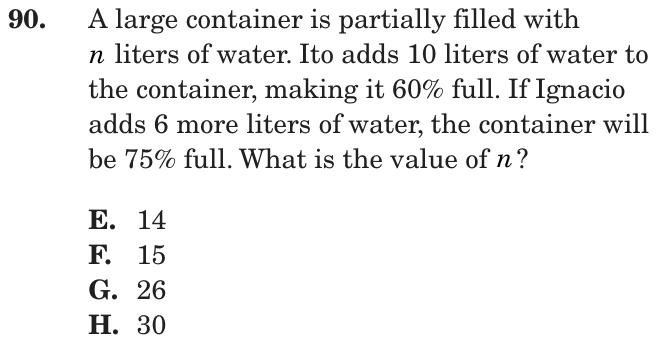
A large container is partially filled with liters of water. Ito adds 10 liters of water to the container, making it 60% full. If Ignacio adds 6 more liters of water, the container will be 75% full. What is the value of ?
- A14
- B15
- C26
- D30
Show the answer
Correct answer: A
Let be the total number of liters the container can hold.
First, solve each equation for :
Equation 1:
Equation 2:
Now, set the two equations equal to each other and solve for .
Question analysis
Water is poured into a large container in two stages: 10 liters make it 60% full, and 6 more liters bring it to 75% full. Students must work out how much water was in it to begin with. This percent word problem hides two unknowns, the starting amount and the capacity, and several in-between numbers look like answers.
- Grade level
- Grade 7 content, by NYS standard
- Compared with grade 7
- Above grade 7 Grade 7 percent problems usually give the whole and ask for a part. Here the whole is unknown and must be found from the change between two percents before a second step reaches the answer.
- Estimated difficulty
- Hard: combines ideas, needs a plan, and has more than one tempting wrong answer.
- Thinking it demands
- Depth of knowledge 3, strategic thinking · mainly analyze
- What makes it hard
- Turning words into math major
- No obvious method moderate
- Many steps moderate
- A very close wrong answer minor
- Solution
- 4 steps
- Reading level
- Question and choices: about grade 7, 40 words.
- Students, last 30 days
- Not enough answers yet to show (it takes 10).
Why it is hard, traps and wrong answers (shows the answer)
Why it is hard
The container's size is the hidden key, and nothing in the stem names it. Students who write an equation for each fill level, or who notice that 6 liters equal 15 percent, get there; others grab a number from the story or stop at the 75% level. Because every wrong choice is a number that appears in the problem or arises while solving it, a careless finish is rewarded with a match.
Turning words into math major Understanding the question
Two percent-full statements about a container of unknown size have to become equations, n + 10 = 60% of the capacity and n + 16 = 75% of it, and the capacity is never given. (Hegarty, Mayer & Monk, 1995; Koedinger & Nathan, 2004)
No obvious method moderate Working it out
The quick route is to see that Ignacio's 6 liters raise the level by 15 percentage points, which fixes the capacity at 40 liters; the wording does not point to it. (Schoenfeld, 1985)
Many steps moderate Working it out
After the capacity, the solution still needs the 60% amount, 24 liters, and a subtraction of Ito's 10 liters, so two unknowns are chased through four steps. (Daniel & Embretson, 2010; Enright, Morley & Sheehan, 2002)
A very close wrong answer minor Choosing the answer
15 sits one unit from the right 14, so a rough estimate of the starting amount cannot choose between them; only solving exactly, 24 − 10, separates them. (Embretson & Wetzel, 1987; Gorin & Embretson, 2006; Ascalon et al., 2007)
Strategy: Compare the two fill levels: the extra 6 liters account for the change in percent, which gives the capacity. Then use the 60% level to work back to the starting amount.
Traps
- Answers a different question: A choice is right for another quantity: the other unknown, the rest instead of the part, the part instead of the whole.
- Numbers taken from the question: Combines the numbers in the question without a model of the situation, or is simply a number that appears in the question.
- Wrong operation: Adds instead of multiplying, divides the wrong way round, turns a ratio or rate upside down, or undoes a step in the wrong direction (subtracts what should be added back).
The wrong answers, classified
B Numbers taken from the question (Hegarty, Mayer & Monk, 1995)
Subtracts the percents, 75 − 60 = 15, and gives a gap in percentage points as a number of liters.
C Wrong operation (Hegarty, Mayer & Monk, 1995; King et al., 2004)
Works back from the 30 liters at 75% full but adds Ignacio's 6 liters instead of removing them: 30 + 6 − 10 = 26.
D Answers a different question (King et al., 2004; Hegarty, Mayer & Monk, 1995)
Finds the 40-liter capacity and its 75% level, 30 liters, then gives the amount after both additions instead of the starting amount n.
Worked solution, step by step
Formulas used
- Percent of a number
- p is the percent. The whole is the full amount, here how much the container holds. The part is p percent of it. Percent means out of 100, so you divide p by 100 and then multiply.
Sort out what you know
The container starts with liters of water. Ito adds 10 liters, and it is 60% full. Then 6 more liters make it 75% full. You do not know how much the container holds when full. Call that its capacity. You need , the starting amount.
See what the 6 liters did
The extra 6 liters raised the level from 60% to 75%.
So 6 liters is 15% of the capacity.
Watch out: 15 is a percent, not a number of liters. Picking 15 gives choice B.
Find the full capacity
If 15% is 6 liters, then 1% is liters. A full container is 100%.
The container holds 40 liters when full.
Find the water at 60 percent
Use the percent formula with 60 for p and 40 liters for the whole.
After Ito adds his water, there are 24 liters.
Undo Ito’s 10 liters
Ito added 10 liters to the starting amount. To go back, subtract them.
The container started with 14 liters.
Watch out: 75% of 40 is 30 liters. That is the amount after both people add water, not at the start. It is choice D.
Give the answer
The question asks for , the amount before anyone added water. So the answer is A, 14.
Check your answer
Run the story forward. Start with 14 liters. Add 10 to get 24 liters, and 24 is 60% of 40. Add 6 more to get 30 liters, and 30 is 75% of 40. Both facts match.
More questions like this
The original DOE question