Also in 2025 Practice Test B Math, question 34.
Question
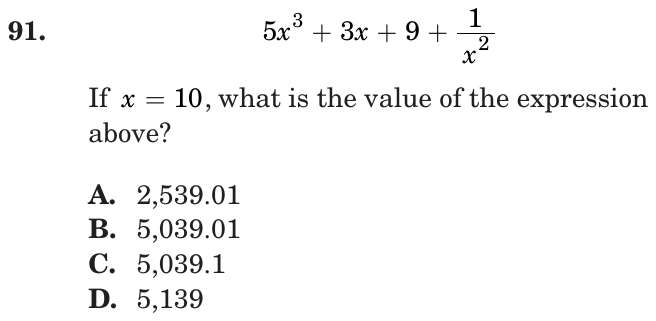
If , what is the value of the expression above?
- A2,539.01
- B5,039.01
- C5,039.1
- D5,139
Show the answer
Correct answer: B
Question analysis
Students substitute 10 for x in an expression with a cube, a linear term, a constant and a fraction with x squared in its denominator, then add the results. It tests evaluating expressions with exponents and decimals. The fraction term is where most slips happen, because its place value is easy to get wrong.
- NYS standards
- Grade level
- Grade 6 content, by NYS standard
- Compared with grade 7
- Below grade 7 Evaluating expressions with whole-number exponents is grade 6 work. The only extra care here is a reciprocal term that turns into a decimal, a single routine substitution that typical grade 7 students handle comfortably.
- Estimated difficulty
- Straightforward: two steps or one careful reading.
- Thinking it demands
- Depth of knowledge 1, recall and reproduction · mainly apply
- What makes it hard
- Error-prone arithmetic moderate
- A very close wrong answer moderate
- Solution
- 3 steps
- Reading level
- Question and choices: about grade 7, 11 words.
- Students, last 30 days
- Not enough answers yet to show (it takes 10).
Why it is hard, traps and wrong answers (shows the answer)
Why it is hard
Substituting 10 is easy; the risk lies in the two unlike terms at the ends. The cube must be applied to x before multiplying by 5, and the reciprocal of 100 must become a hundredth, not a tenth. With choices that differ by a single decimal place, the question rewards writing each term as a number before adding.
Error-prone arithmetic moderate Working it out
The last term, 1/x² at x = 10, is 1/100, which must be written as 0.01 and lined up beside 5,039; one place too far gives 0.1. (Brown & Burton, 1978; Junker & Sijtsma, 2001)
A very close wrong answer moderate Choosing the answer
5,039.1 sits beside the right 5,039.01 and differs only in the hundredths place; only writing 1/100 as 0.01, not 0.1, tells them apart, and estimating cannot. (Embretson & Wetzel, 1987; Gorin & Embretson, 2006; Ascalon et al., 2007)
Strategy: Work term by term: compute 10 cubed, then the reciprocal of 10 squared as a decimal, and line up the place values carefully before adding.
Traps
- Order of operations: Working left to right, or distributing a minus sign wrongly, gives a choice.
The wrong answers, classified
A Order of operations (Brown & Burton, 1978)
Gets 2,500 for the first term, most likely from (5 × 10)², applying the power to the product 5x and squaring instead of cubing.
C An arithmetic slip (Junker & Sijtsma, 2001)
Writes 1/100 as 0.1 instead of 0.01, a place-value slip on the last term that puts the total off by 0.09.
D Misunderstands the concept (Smith, diSessa & Roschelle, 1993; De Bock et al., 1998; Ni & Zhou, 2005)
Evaluates 1/x² as x² = 100 instead of its reciprocal, so it adds 100 rather than 0.01 to 5,039.
Worked solution, step by step
Formulas used
- Exponents
- x is the base number. The small raised 3 is the exponent. It tells how many times to use x in a multiplication. In the same way, x squared, written with a raised 2, means x times x.
Sort out the question
You need the value of when . Put 10 in place of every . Then work out each term, one at a time. A term is a piece joined to the others by a plus sign.
Work out the first term
Do the exponent first. Then multiply by 5.
Watch out: the exponent belongs only to the , not to the 5. Squaring gives 2,500, which leads to choice A.
Work out the middle terms
The next term means 3 times .
The 9 has no in it, so it stays 9.
Work out the last term
First find the bottom. Then divide.
One hundredth is 0.01, with the 1 two places after the decimal point.
Watch out: 0.1 is one tenth, not one hundredth. That slip gives choice C. Adding 100 instead of gives choice D.
Add the four terms
Line up the decimal points and add. The 0.01 goes in the hundredths place.
So the answer is B, 5,039.01.
Check your answer
The first three terms are whole numbers. They add up to 5,039. The last term is a small part of 1. So the answer is just over 5,039. Only B and C fit. The last term is hundredths, so B is right.
More questions like this
The original DOE question