Question
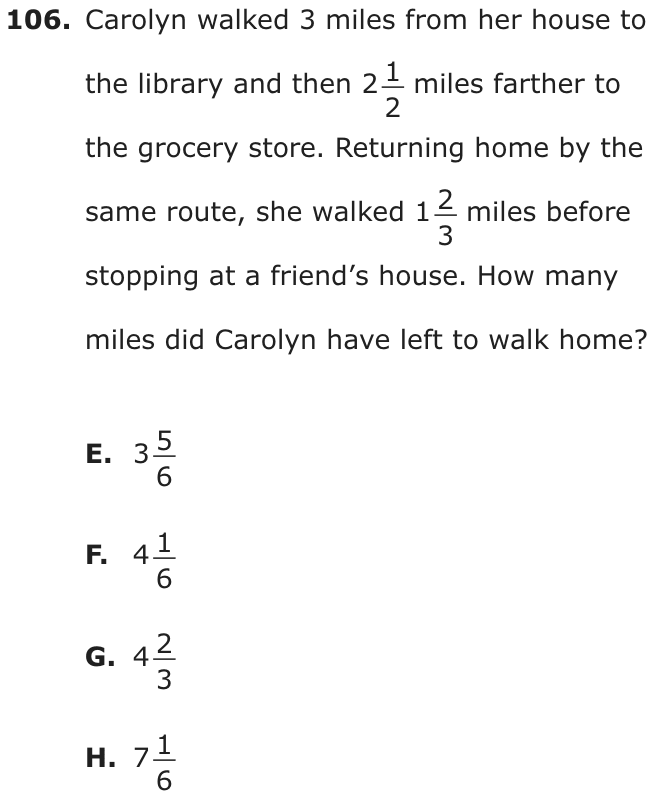
Carolyn walked 3 miles from her house to the library and then miles farther to the grocery store. Returning home by the same route, she walked miles before stopping at a friend’s house. How many miles did Carolyn have left to walk home?
- A
- B
- C
- D
Show the answer
Correct answer: A
The distance from Carolyn’s house to the grocery store is miles.
Carolyn walked miles back, so she still had miles left to walk home.
So Carolyn had miles left to walk home.
Question analysis
Carolyn walks 3 miles from home to the library and 2 1/2 miles more to the grocery store, then heads back the same way and stops at a friend's house after 1 2/3 miles. This fractions word problem asks how far she still has to walk home. Students add and subtract mixed numbers, and the subtraction needs regrouping across unlike denominators.
- Grade level
- Grade 7 content, by NYS standard
- Compared with grade 7
- At grade 7 Grade 7 students solve multi-step word problems with mixed numbers. This one has only positive numbers, but it needs a clear picture of the route and a subtraction that requires regrouping across unlike denominators.
- Estimated difficulty
- Moderate: several steps, or a close reading with one strong distractor.
- Thinking it demands
- Depth of knowledge 2, skills and concepts · mainly apply
- What makes it hard
- Error-prone arithmetic moderate
- A very close wrong answer moderate
- Turning words into math minor
- Solution
- 3 steps
- Reading level
- Question and choices: about grade 6, 48 words.
- Students, last 30 days
- Not enough answers yet to show (it takes 10).
Why it is hard, traps and wrong answers (shows the answer)
Why it is hard
The story needs a quick sketch, but the real test is one mixed-number subtraction in which the second fraction is larger than the first. Many students subtract the fractions the easy way round, which gives a choice close to the right one. Converting both numbers to sixths, 33/6 − 10/6, sidesteps the regrouping, and adding the result to 1 2/3 to get back 5 1/2 is a quick check.
Error-prone arithmetic moderate Working it out
The subtraction 5 1/2 − 1 2/3 needs sixths, 5 3/6 − 1 4/6, and the fraction on top is the smaller one, so a whole must be regrouped. (Brown & Burton, 1978; Junker & Sijtsma, 2001)
A very close wrong answer moderate Choosing the answer
Subtracting the fraction parts the wrong way round gives 4 1/6, only 1/3 away from the answer, so a rough estimate cannot tell the two apart. (Embretson & Wetzel, 1987; Gorin & Embretson, 2006; Ascalon et al., 2007)
Turning words into math minor Understanding the question
The route has to be pictured: the walk back starts at the grocery store, 5 1/2 miles from home, not at the library. (Hegarty, Mayer & Monk, 1995; Koedinger & Nathan, 2004)
Strategy: Sketch the route as a line from home to the library to the store, find the total distance out, then subtract the distance already walked back, using sixths.
Traps
- A faulty procedure: A systematic but wrong procedure: adding fractions straight across, applying an exponent to each term of a sum, dropping a sign when moving a term.
- Answers a different question: A choice is right for another quantity: the other unknown, the rest instead of the part, the part instead of the whole.
The wrong answers, classified
B A faulty procedure (Brown & Burton, 1978; Tatsuoka, 1983)
Subtracts the whole numbers, 5 − 1 = 4, then the fractions the easy way round, 2/3 − 1/2 = 1/6, giving 4 1/6.
C Answers a different question (King et al., 2004; Hegarty, Mayer & Monk, 1995)
On the store-to-library stretch, uses the 1 2/3 miles already walked instead of the 5/6 mile left, then adds the 3 miles home.
D Answers a different question (King et al., 2004; Hegarty, Mayer & Monk, 1995)
Adds all three distances, 3 + 2 1/2 + 1 2/3 = 7 1/6, which is how far she has walked so far, not how far is left.
Worked solution, step by step
Formulas used
- Mixed number to fraction
- a is the whole number part, b is the top of the fraction, and c is the bottom. Each whole holds c pieces, so a wholes hold a times c pieces. Then add the b extra pieces.
- Equivalent fractions
- a is the top of a fraction and b is the bottom. n is any number except 0. Multiplying the top and bottom by the same number gives an equal fraction, cut into smaller pieces. Use it to give two fractions the same bottom before you add or subtract.
- Subtracting fractions with the same bottom
- c is the shared bottom number. a and b are the tops. When the pieces are the same size, you just take away how many pieces you have. The size of the pieces, c, stays the same.
Picture the route
Draw a line: home, then the library, then the store. Home to the library is 3 miles. The library to the store is miles more. Carolyn walks back the same way. After miles she stops at a friend’s house. You need the miles still left to get home.
Find the distance from home to the store
The store is miles from home. She starts back from the store, so this is the full trip home. Watch out: adding all three distances gives , choice D. That is how far she has walked, not how far is left.
Change to improper fractions
The miles left are . An improper fraction has a top bigger than its bottom. Change each mixed number to one.
Use sixths for both
To subtract, the fractions need the same bottom. 2 and 3 both go into 6, so change both to sixths.
Subtract and simplify
23 sixths is 3 wholes (18 sixths) and 5 sixths more. So . Watch out: is less than . Subtracting the fraction parts the wrong way round gives , choice B.
So the answer is A, miles.
Check your answer
Add back: . That is the full distance from the store to home. Also estimate: 5.5 minus about 1.7 is about 3.8, and is about 3.83.
More questions like this
The original DOE question