Question
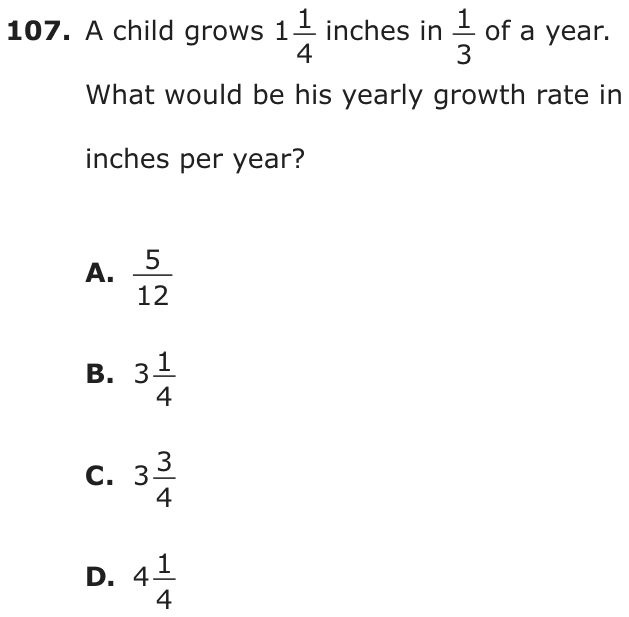
A child grows inches in of a year. What would be his yearly growth rate in inches per year?
- A
- B
- C
- D
Show the answer
Correct answer: C
Set up a proportion to solve.
Question analysis
A child grows 1 1/4 inches in one third of a year, and this unit rate question asks for his growth rate in inches per year. Students divide a mixed number by a fraction, or scale the growth up to a whole year. Choosing between multiplying and dividing, and handling the whole mixed number, are where the wrong rates come from.
- Grade level
- Grade 7 content, by NYS standard
- Compared with grade 7
- At grade 7 Computing a unit rate from a ratio of fractions is the grade 7 standard itself, and this is a typical example: one mixed number over one unit fraction, in two short steps with no extra information.
- Estimated difficulty
- Straightforward: two steps or one careful reading.
- Thinking it demands
- Depth of knowledge 2, skills and concepts · mainly apply
- What makes it hard
- Error-prone arithmetic minor
- A very close wrong answer minor
- Solution
- 2 steps
- Reading level
- Question and choices: about grade 4, 25 words.
- Students, last 30 days
- Not enough answers yet to show (it takes 10).
Why it is hard, traps and wrong answers (shows the answer)
Why it is hard
The idea is simple: three thirds make a year, so the yearly growth is three times the growth in a third. Errors come from the mixed number, where students triple the 1 and leave the 1/4 alone, and from multiplying by 1/3 instead of dividing, which shrinks the rate. A sense check helps, since a yearly rate must be larger than the 1 1/4 inches grown in a third of a year.
Error-prone arithmetic minor Working it out
Dividing 1 1/4 by 1/3 means multiplying by 3, and the mixed number must be multiplied whole, as 5/4 × 3 = 15/4, not just its 1. (Brown & Burton, 1978; Junker & Sijtsma, 2001)
A very close wrong answer minor Choosing the answer
Multiplying only the whole part gives 3 1/4, which differs from the answer only in the fraction's numerator, so a rough size check cannot rule it out. (Embretson & Wetzel, 1987; Gorin & Embretson, 2006; Ascalon et al., 2007)
Strategy: Divide the growth by the time, writing 1 1/4 as 5/4 and dividing by 1/3 as multiplying by 3; or ask how much he grows in three such periods.
Traps
- Wrong operation: Adds instead of multiplying, divides the wrong way round, turns a ratio or rate upside down, or undoes a step in the wrong direction (subtracts what should be added back).
- A faulty procedure: A systematic but wrong procedure: adding fractions straight across, applying an exponent to each term of a sum, dropping a sign when moving a term.
The wrong answers, classified
A Wrong operation (Hegarty, Mayer & Monk, 1995; King et al., 2004)
Multiplies 5/4 by 1/3 instead of dividing by it, getting 5/12, a yearly rate smaller than the growth in a third of a year.
B A faulty procedure (Brown & Burton, 1978; Tatsuoka, 1983)
Triples only the whole-number part of 1 1/4, writing 3 × 1 1/4 as 3 1/4 and leaving the 1/4 unchanged.
D Wrong operation (Hegarty, Mayer & Monk, 1995; King et al., 2004)
Adds 3 to 1 1/4 instead of multiplying it by 3, getting 4 1/4.
Worked solution, step by step
Formulas used
- Rate
- The amount is how much something changed, here inches grown. The time is how long it took, here part of a year. Dividing tells how much it changes in 1 unit of time, here 1 whole year.
- Mixed number to fraction
- a is the whole number part, b is the top of the fraction, and c is the bottom. Each whole holds c pieces, so a wholes hold a times c pieces. Then add the b extra pieces.
- Dividing by a fraction
- a over b is the number you divide. c over d is the number you divide by. To divide by a fraction, multiply by its reciprocal, the fraction flipped upside down. This works because dividing by a number undoes multiplying by it.
Sort out the question
The child grows inches in of a year. You need his growth rate in inches per year. That is how much he would grow in 1 whole year at the same speed. A year has 3 thirds, so the answer should be bigger than .
Set up the rate
Divide the growth by the time to get the inches for 1 whole year.
Change the mixed number to a fraction first.
Divide by multiplying
To divide by a fraction, multiply by its reciprocal, the fraction flipped upside down. The reciprocal of is 3.
Watch out: multiplying by instead gives , choice A. That is less than he grew in a third of a year.Change back to a mixed number
15 quarters is 3 wholes (12 quarters) and 3 quarters more.
He grows inches per year. Watch out: triple all of , not just the 1. Tripling only the whole number gives , choice B.
So the answer is C, .
Check your answer
Think of the year as 3 thirds. He grows inches in each third. Add them: . The wholes make 3, and the quarters make . That is inches, the same answer.
More questions like this
The original DOE question