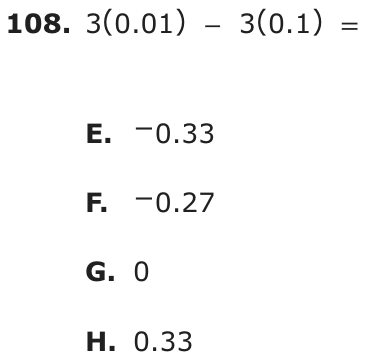
Question
- A−0.33
- B−0.27
- C0
- D0.33
Show the answer
Correct answer: B
Question analysis
This decimal question asks for the value of 3 times 0.01 minus 3 times 0.1. Students multiply each decimal by 3 and subtract, keeping the order of the subtraction as written. The two decimals look alike, so place value and the sign of the result both need care.
- Grade level
- Grade 7 content, by NYS standard
- Compared with grade 7
- At grade 7 Grade 7 students subtract rational numbers and get negative results. This short computation adds place-value care, since 0.01 and 0.1 look alike, but it is a routine two-step grade 7 exercise.
- Estimated difficulty
- Straightforward: two steps or one careful reading.
- Thinking it demands
- Depth of knowledge 1, recall and reproduction · mainly apply
- What makes it hard
- Error-prone arithmetic moderate
- A very close wrong answer minor
- Solution
- 2 steps
- Reading level
- Question and choices: about grade 16+, 1 words.
- Students, last 30 days
- Not enough answers yet to show (it takes 10).
Why it is hard, traps and wrong answers (shows the answer)
Why it is hard
Two quick multiplications leave 0.03 − 0.3, a subtraction whose result is negative. The usual errors are adding the two products, with or without a minus sign, and treating 0.01 and 0.1 as the same number. Rewriting the subtraction as −(0.3 − 0.03) keeps the place values lined up and makes the sign plain.
Error-prone arithmetic moderate Working it out
The products 0.03 and 0.3 have their digits in different places, and taking the larger from the smaller crosses zero, so both alignment and sign need care. (Brown & Burton, 1978; Junker & Sijtsma, 2001)
A very close wrong answer minor Choosing the answer
The choice −0.33 has the right sign and is only 0.06 from the answer, so a sense that the result is a little below zero cannot separate them. (Embretson & Wetzel, 1987; Gorin & Embretson, 2006; Ascalon et al., 2007)
Strategy: Multiply each decimal by 3, then subtract with the place values lined up; or factor out the 3 and compute 3 times (0.01 − 0.1).
Traps
- Negatives and direction: Arithmetic with negative numbers, the order of a subtraction, or direction on a number line. (Moving a term across the equals sign without changing its sign is a faulty procedure.)
- Wrong operation: Adds instead of multiplying, divides the wrong way round, turns a ratio or rate upside down, or undoes a step in the wrong direction (subtracts what should be added back).
The wrong answers, classified
A Negatives and direction (Brown & Burton, 1978)
Sees the result must be negative but adds the sizes, −(0.03 + 0.3) = −0.33, instead of subtracting 0.03 from 0.3.
C Misunderstands the concept (Smith, diSessa & Roschelle, 1993; De Bock et al., 1998; Ni & Zhou, 2005)
Treats 0.01 and 0.1 as equal, since each shows a single 1 after the point, so the two products cancel to 0.
D Wrong operation (Hegarty, Mayer & Monk, 1995; King et al., 2004)
Adds the products, 0.03 + 0.3 = 0.33, instead of subtracting the second from the first.
Worked solution, step by step
Formulas used
- Subtracting a bigger number
- a and b are numbers, and b is the bigger one. When you take a bigger number away from a smaller one, the answer is negative. Its size is the gap between them, b minus a. So subtract the other way, then put a minus sign in front.
Sort out the problem
3(0.01) means 3 times 0.01. A number right next to parentheses means multiply. Then subtract 3 times 0.1. Note that 0.01 is one hundredth, and 0.1 is one tenth. They are not equal. Watch out: treating them as equal makes the two parts cancel to 0, choice C.
Multiply each part
So the problem is . Write 0.3 as 0.30 so both have two decimal places. Now you can see that 0.30 is bigger than 0.03.
Subtract the bigger number
You take a bigger number from a smaller one, so the answer is negative.
Watch out: find the gap between the numbers. Don’t add them. Adding gives 0.33, choice D, or −0.33, choice A.So the answer is B, −0.27.
Check your answer
Pull out the 3 first: . Same answer. Also think of a number line. Start at 0.03, just right of 0. Move 0.30 to the left. You land a little left of 0, at −0.27.
More questions like this
The original DOE question