Question
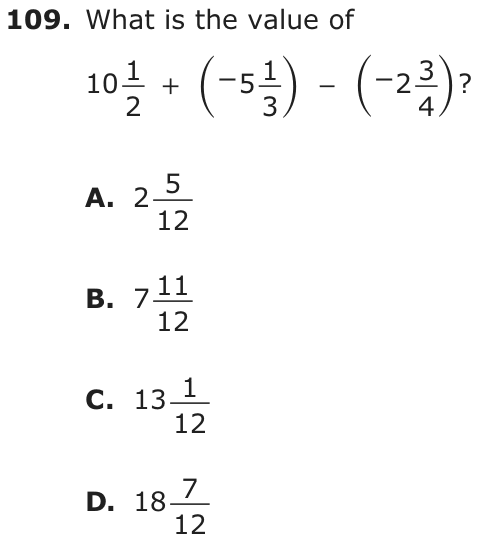
What is the value of ?
- A
- B
- C
- D
Show the answer
Correct answer: B
Rewrite the mixed numbers so that they all have equivalent denominators.
Subtracting a negative is the same as adding.
Group the whole numbers together and the fractions together.
Question analysis
This signed-number question asks for the value of 10 1/2 plus negative 5 1/3 minus negative 2 3/4. It tests adding and subtracting negative mixed numbers with unlike denominators. Turning each sign combination into a plain addition or subtraction, and then working in twelfths, is where students most often go wrong.
- Grade level
- Grade 7 content, by NYS standard
- Compared with grade 7
- At grade 7 Adding and subtracting negative mixed numbers is central grade 7 work. This three-term expression is typical in length, but it needs a common denominator of 12 and two different sign rules: adding a negative and subtracting one.
- Estimated difficulty
- Moderate: several steps, or a close reading with one strong distractor.
- Thinking it demands
- Depth of knowledge 1, recall and reproduction · mainly apply
- What makes it hard
- Error-prone arithmetic moderate
- Many steps minor
- Solution
- 4 steps
- Reading level
- Question and choices: about grade 10, 10 words.
- Students, last 30 days
- Not enough answers yet to show (it takes 10).
Why it is hard, traps and wrong answers (shows the answer)
Why it is hard
The expression is short, but it packs both sign rules for negative numbers into one line, and each misapplication has its own choice. Subtracting a negative is the rule most often broken, and the result is a reasonable-looking mixed number. Estimating with decimals, 10.5 − 5.3 + 2.8 is about 8, separates the answer from every wrong choice.
Error-prone arithmetic moderate Working it out
Two different sign rules meet: adding −5 1/3 means subtracting 5 1/3, while subtracting −2 3/4 means adding 2 3/4, and mixing them up gives a listed value. (Brown & Burton, 1978; Junker & Sijtsma, 2001)
Many steps minor Working it out
After the signs, halves, thirds and quarters become twelfths, and the wholes, 10 − 5 + 2, are combined apart from the fractions, 6/12 − 4/12 + 9/12. (Daniel & Embretson, 2010; Enright, Morley & Sheehan, 2002)
Strategy: Rewrite adding a negative as subtraction and subtracting a negative as addition, convert the fractions to twelfths, then combine the whole numbers and the fractions separately.
Traps
- Negatives and direction: Arithmetic with negative numbers, the order of a subtraction, or direction on a number line. (Moving a term across the equals sign without changing its sign is a faulty procedure.)
The wrong answers, classified
A Negatives and direction (Brown & Burton, 1978)
Handles the added negative but treats subtracting −2 3/4 as subtracting 2 3/4, so 5 1/6 − 2 3/4 = 2 5/12.
C Negatives and direction (Brown & Burton, 1978)
Drops the negative signs inside the parentheses and keeps the operations, 10 1/2 + 5 1/3 − 2 3/4 = 13 1/12.
D Negatives and direction (Brown & Burton, 1978)
Ignores every sign and adds all three mixed numbers, 10 1/2 + 5 1/3 + 2 3/4 = 18 7/12.
Worked solution, step by step
Formulas used
- Adding and subtracting negatives
- a is any number, and b is a positive number, so −b is negative. Adding a negative moves you left on the number line, just like subtracting. Subtracting a negative is like taking away a debt, so you end up with more. It is the same as adding.
- Equivalent fractions
- a is the top of a fraction and b is the bottom. n is any number except 0. Multiplying the top and bottom by the same number gives an equal fraction, cut into smaller pieces. Use it to give two fractions the same bottom before you add or subtract.
Sort out the expression
You need . There are three mixed numbers, and two of them are negative. A mixed number is a whole number plus a fraction. Plan: fix the signs, give the fractions the same bottom, then work with the whole numbers and the fractions one group at a time.
Fix the signs
Adding means subtracting . Subtracting means adding .
Watch out: subtracting a negative is adding. Subtracting instead gives , choice A. Dropping the minus signs gives C or D.Use twelfths for the fractions
The bottoms are 2, 3 and 4. All three go into 12, so change each fraction to twelfths.
Now the problem is .
Combine whole numbers, then fractions
Work with the whole numbers and the fractions one group at a time. Keep each sign.
The fraction part is less than 1, so just put them together: .
So the answer is B, .
Check your answer
Estimate with decimals. is about 7.92. And is also about 7.92, since is almost 1. They match.
More questions like this
The original DOE question