Question
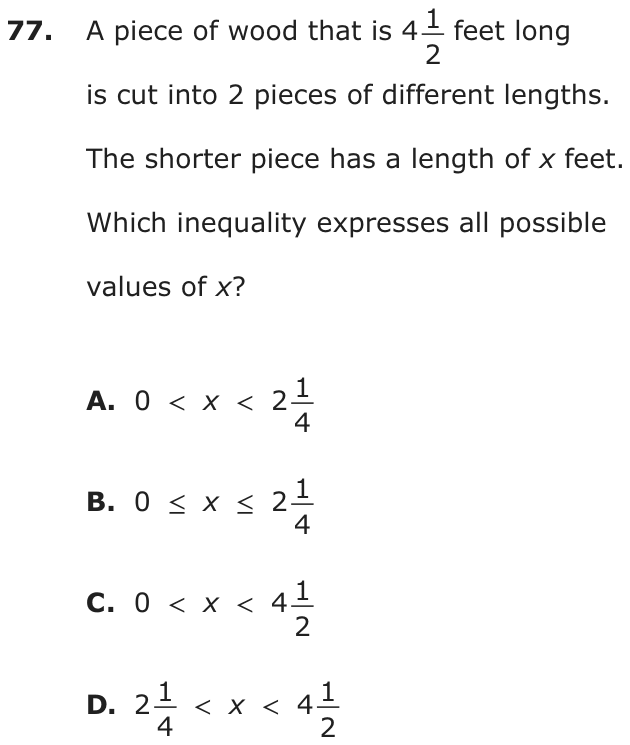
A piece of wood that is feet long is cut into 2 pieces of different lengths. The shorter piece has a length of x feet. Which inequality expresses all possible values of x?
- A
- B
- C
- D
Show the answer
Correct answer: A
The original piece of wood is feet long.
The shorter piece is x feet long, and it must be less than half the length of the original piece of wood.
Since half of is , it follows that .
The shorter piece of wood cannot be 0 feet long, so it follows that .
This gives the compound inequality .
Question analysis
An inequality question: a piece of wood 4½ feet long is cut into two pieces of different lengths, and the shorter piece is x feet long. Students choose the inequality that gives every possible value of x. They must turn each condition in the words into a boundary and decide whether each end of the range is included.
- Grade level
- Grade 7 content, by NYS standard
- Compared with grade 7
- Above grade 7 Grade 7 students solve and graph simple inequalities. Writing a compound inequality from a description, where the words decide whether each end is strict, is less familiar and calls for careful reading of every condition.
- Estimated difficulty
- Moderate: several steps, or a close reading with one strong distractor.
- Thinking it demands
- Depth of knowledge 2, skills and concepts · mainly analyze
- What makes it hard
- Turning words into math moderate
- A very close wrong answer moderate
- Variables instead of numbers minor
- Solution
- 2 steps
- Reading level
- Question and choices: about grade 5, 37 words.
- Students, last 30 days
- Not enough answers yet to show (it takes 10).
Why it is hard, traps and wrong answers (shows the answer)
Why it is hard
Halving 4 1/2 feet is the only computation; the rest is deciding whether each end of the range can actually happen. A shorter piece of 2 1/4 feet would make the two pieces equal, and a piece of 0 feet is no piece at all, so both ends are excluded. Students who find the right bounds but never test the ends are drawn to the version with the inclusive symbols.
Turning words into math moderate Understanding the question
Two phrases set the two ends: "cut into 2 pieces" means x is more than 0, and "of different lengths" with "the shorter piece" means x is less than half of 4 1/2. (Hegarty, Mayer & Monk, 1995; Koedinger & Nathan, 2004)
A very close wrong answer moderate Choosing the answer
The inequalities 0 < x < 2 1/4 and 0 ≤ x ≤ 2 1/4 share both bounds and differ only in their symbols; only checking whether each end can happen separates them. (Embretson & Wetzel, 1987; Gorin & Embretson, 2006; Ascalon et al., 2007)
Variables instead of numbers minor Understanding the question
The question asks for every possible length of the shorter piece, a range rather than one length, so students must picture the cut moving along the board. (Koedinger & Nathan, 2004; Enright, Morley & Sheehan, 2002)
Strategy: Picture cutting the board in different places, find the largest and smallest values the shorter piece could take, and check whether each boundary value is actually possible.
Traps
- Counting the ends: Inclusive or exclusive ends, fence posts, consecutive numbers: an answer that is one too many or too few, or an endpoint drawn open where it belongs closed (or the reverse).
- Misreads the question: Misses or misreads a condition or a word in the question: "at least", "each", "remaining", "not".
- Answers a different question: A choice is right for another quantity: the other unknown, the rest instead of the part, the part instead of the whole.
The wrong answers, classified
B Counting the ends (Brown & Burton, 1978)
Finds the right bounds but includes both ends, allowing a piece of 0 feet or two equal halves, though the stem says 2 pieces of different lengths.
C Misreads the question (Hegarty, Mayer & Monk, 1995)
Ignores that x is the shorter piece and allows any length up to the whole 4 1/2-foot board.
D Answers a different question (King et al., 2004; Hegarty, Mayer & Monk, 1995)
Describes the longer piece, whose length lies between half the board and the whole board, instead of the shorter piece the stem calls x.
Worked solution, step by step
Formulas used
- Two pieces make the whole board
- x is the length of the shorter piece, and L is the length of the longer piece, both in feet. Together they make the whole board. Since x is smaller than L, x must be less than half of the board.
- Inequality signs
- a < b says a is less than b. a ≤ b says a is less than or equal to b, so a can also equal b. A chain like 0 < x < 5 means x is more than 0 and less than 5.
Sort out the question
A board is feet long. It is cut into 2 pieces of different lengths. The shorter piece is x feet long. You need an inequality for every possible value of x. An inequality uses signs like <, less than, to show a range of numbers.
Find the top end for x
If you cut exactly in the middle, each piece is half the board.
But the pieces have different lengths, so the cut is not in the middle. The shorter piece must be less than half.
Find the bottom end for x
The shorter piece can be very small, like 0.1 foot. But it can’t be 0 feet. Then nothing would be cut off, and there would not be 2 pieces.
Put the two ends together
This says x is more than 0 and less than . Watch out: choice B uses ≤, which allows x = 0 or . Neither can happen. Choice C lets x be more than half, so it would not be the shorter piece. Choice D describes the longer piece. So the answer is A, .
Check your answer
Test values. Cut off 1 foot: the pieces are 1 foot and feet. The shorter one is 1, and 1 is between 0 and . If x were 3, the other piece would be feet, so x would not be the shorter one. Choice A leaves 3 out, as it should.
More questions like this
The original DOE question