Question
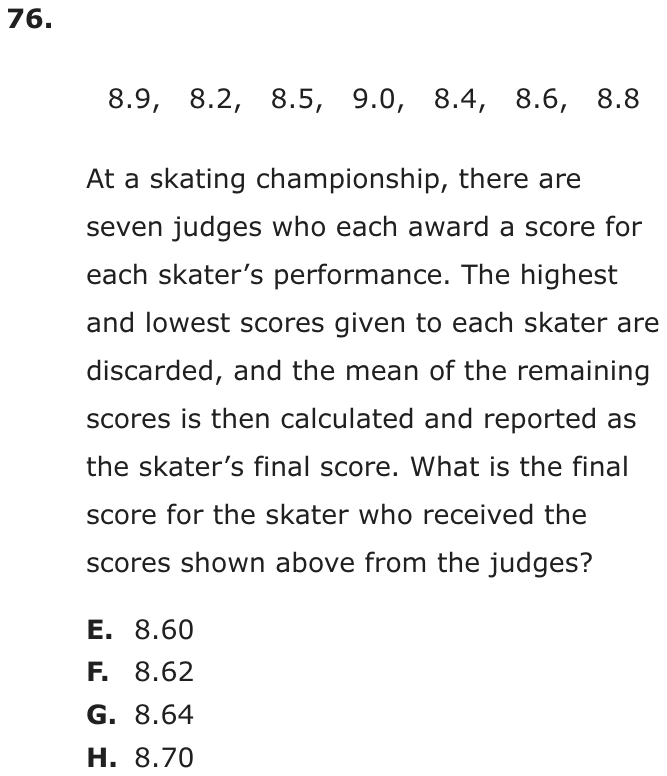
8.9, 8.2, 8.5, 9.0, 8.4, 8.6, 8.8
At a skating championship, there are seven judges who each award a score for each skater’s performance. The highest and lowest scores given to each skater are discarded, and the mean of the remaining scores is then calculated and reported as the skater’s final score. What is the final score for the skater who received the scores shown above from the judges?
- A8.60
- B8.62
- C8.64
- D8.70
Show the answer
Correct answer: C
The highest and lowest scores are discarded: 8.2 and 9.0.
To find the mean, add the remaining scores and then divide that sum by the total number of remaining scores.
Question analysis
A statistics question about a skating championship with seven judges: the highest and lowest of a skater's seven scores are dropped, and the rest are averaged. Students apply that rule to the listed scores, decimals close together. Following the dropping rule exactly and adding the decimals carefully both matter, since the choices are very close.
- Grade level
- Grade 6 content, by NYS standard
- Compared with grade 7
- Below grade 7 Finding a mean is grade 6 content, and this adds only a rule about which scores to drop. Grade 7 statistics usually compares whole data sets, so this is easier, though the close choices demand exact decimal arithmetic.
- Estimated difficulty
- Straightforward: two steps or one careful reading.
- Thinking it demands
- Depth of knowledge 2, skills and concepts · mainly apply
- What makes it hard
- A very close wrong answer moderate
- Error-prone arithmetic minor
- Turning words into math minor
- Solution
- 3 steps
- Reading level
- Question and choices: about grade 9, 62 words.
- Students, last 30 days
- Not enough answers yet to show (it takes 10).
Why it is hard, traps and wrong answers (shows the answer)
Why it is hard
The arithmetic is short, but the choices are spaced so closely that a small slip or a skipped rule lands on a neighbor. Averaging all seven scores, or picking the middle score, gives values within a few hundredths of the answer. The question rewards following the stated rule exactly and adding the five remaining scores with care.
A very close wrong answer moderate Choosing the answer
The choices 8.60, 8.62 and 8.64 lie within 0.04 of one another, so no estimate separates them; only the exact sum of the five kept scores, 43.2, does. (Embretson & Wetzel, 1987; Gorin & Embretson, 2006; Ascalon et al., 2007)
Error-prone arithmetic minor Working it out
Five one-decimal scores must be added and divided by 5; subtracting 8 from each first leaves 0.9, 0.5, 0.4, 0.6 and 0.8, which are easier to add. (Brown & Burton, 1978; Junker & Sijtsma, 2001)
Turning words into math minor Understanding the question
The scoring rule takes two sentences to state: discard the single highest and the single lowest score, then average the five that remain. (Hegarty, Mayer & Monk, 1995; Koedinger & Nathan, 2004)
Strategy: Cross out the single highest and the single lowest score, add the five that remain, and divide that sum by 5.
Traps
- Misreads the question: Misses or misreads a condition or a word in the question: "at least", "each", "remaining", "not".
- Answers a different question: A choice is right for another quantity: the other unknown, the rest instead of the part, the part instead of the whole.
The wrong answers, classified
A Answers a different question (King et al., 2004; Hegarty, Mayer & Monk, 1995)
Gives the median, the middle score 8.6, instead of the mean of the five scores left after the highest and lowest are dropped.
B Misreads the question (Hegarty, Mayer & Monk, 1995)
Averages all seven scores without discarding any, 60.4 ÷ 7 = 8.628…, and takes 8.62, the nearest choice to that mean.
D Misreads the question (Hegarty, Mayer & Monk, 1995)
Drops only the lowest score, 8.2, and averages the other six, (60.4 − 8.2) ÷ 6 = 8.7, keeping the top score of 9.0.
Worked solution, step by step
Formulas used
- Mean, or average
- The mean is the average. The sum is what you get when you add all the scores. Divide it by how many scores you added. It shares the total out evenly, as if every score were the same.
Sort out the rule
Seven judges gave the seven scores shown. The rule has two parts. First, throw out the highest score and the lowest score. Then find the mean of the scores that are left. The mean is the average. That is the final score you need.
Cross out the highest and lowest
The highest score is 9.0. The lowest is 8.2. Cross both out. Five scores are left: 8.9, 8.5, 8.4, 8.6 and 8.8. Watch out: drop both. Dropping only 8.2 gives 8.70, choice D. Keeping all seven gives about 8.63, which is closest to 8.62, choice B.
Add the five scores
A shortcut: each score is 8 plus a bit. The bits are 0.9, 0.5, 0.4, 0.6 and 0.8, and they add to 3.2. Five 8s make 40, and .
Divide by the number of scores
Watch out: do not just take the middle score, 8.6. That is the median, choice A. The question asks for the mean. So the answer is C, 8.64.
Check your answer
Multiply back: , the sum. Also, the mean should sit between the lowest kept score, 8.4, and the highest kept score, 8.9. 8.64 does.
More questions like this
The original DOE question