Question
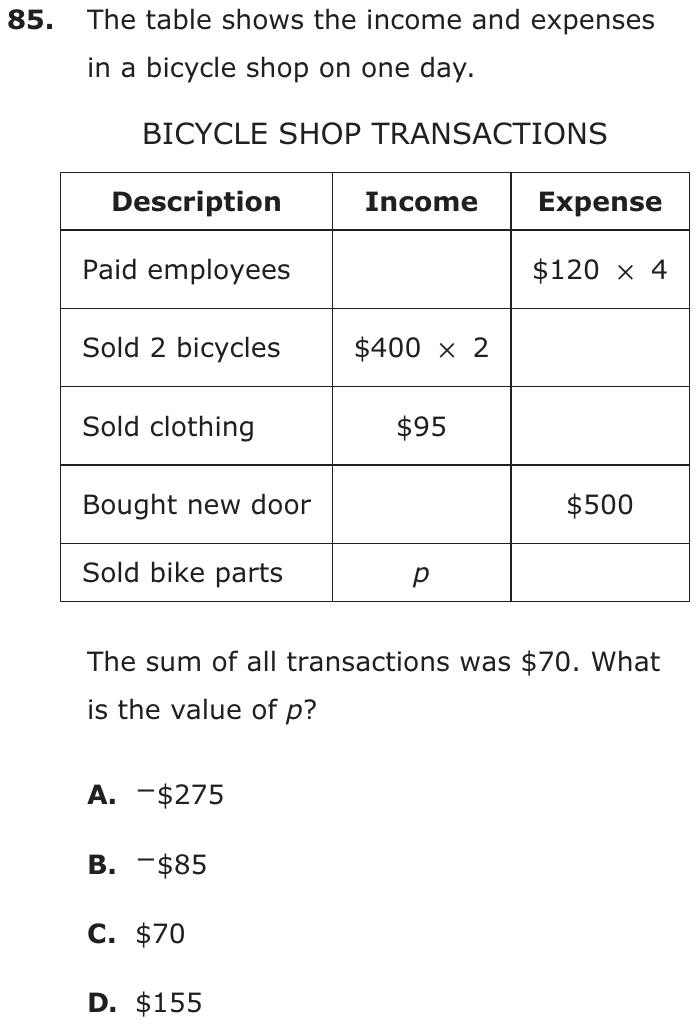
The table shows the income and expenses in a bicycle shop on one day.
BICYCLE SHOP TRANSACTIONS
| Description | Income | Expense |
|---|---|---|
| Paid employees | ||
| Sold 2 bicycles | ||
| Sold clothing | $95 | |
| Bought new door | $500 | |
| Sold bike parts | p |
The sum of all transactions was $70. What is the value of p?
- A−$275
- B−$85
- C$70
- D$155
Show the answer
Correct answer: D
The sum of all transactions ($70) includes the income data (positive values) and the expense data (negative values). Write an equation to determine the value of p by adding all the income data and subtracting all the expense data:
Simplify the expression to determine the value of p:
Question analysis
A table lists one day of income and expenses at a bicycle shop, including two products to work out and an unknown amount, p, from selling bike parts. Given that all the transactions add up to $70, students find p. They must treat income as positive and expenses as negative, then solve an equation.
- Grade level
- Grade 7 content, by NYS standard
- Compared with grade 7
- At grade 7 Grade 7 students solve multi-step money problems with positive and negative amounts. This table adds an unknown income entry, so students treat income as positive and expenses as negative before solving a one-step equation.
- Estimated difficulty
- Moderate: several steps, or a close reading with one strong distractor.
- Thinking it demands
- Depth of knowledge 2, skills and concepts · mainly apply
- What makes it hard
- Turning words into math moderate
- Reading a figure, table or graph minor
- Error-prone arithmetic minor
- Solution
- 4 steps
- Reading level
- Question and choices: about grade 5, 44 words.
- Students, last 30 days
- Not enough answers yet to show (it takes 10).
Why it is hard, traps and wrong answers (shows the answer)
Why it is hard
The table turns a one-variable equation into bookkeeping: each entry must be multiplied out and given a sign by its column before anything is added. The known entries come to a loss of $85, so the bike parts must cover that loss and still leave $70, which is why p is larger than the day's total. Students who stop at the running total, or who copy the $70, never use the equation at all.
Turning words into math moderate Understanding the question
“The sum of all transactions was $70” has to be read with income positive and expenses negative, giving 800 + 95 + p − 480 − 500 = 70. (Hegarty, Mayer & Monk, 1995; Koedinger & Nathan, 2004)
Reading a figure, table or graph minor Understanding the question
Two cells hold products, $120 × 4 and $400 × 2, that must be worked out, and p sits in the Income column beside the sales, so it is added. (Lesh, Post & Behr, 1987; Kirsch & Mosenthal, 1990)
Error-prone arithmetic minor Working it out
The known entries total 895 − 980 = −85, a negative running sum, so p must exceed 70 by 85 rather than fall short of it. (Brown & Burton, 1978; Junker & Sijtsma, 2001)
Strategy: Work out the two products in the table, add the income entries and subtract the expenses, set that total plus p equal to 70, and solve for p.
Traps
- Stops one step early: A choice is a number from partway through the solution.
- Numbers taken from the question: Combines the numbers in the question without a model of the situation, or is simply a number that appears in the question.
The wrong answers, classified
A Little reason to choose it (Haladyna & Downing, 1993; Rodriguez, 2005)
No single mistake gives −275; it takes counting the $95 clothing sale as an expense and then stopping at the known total, 800 − 95 − 480 − 500.
B Stops one step early (King et al., 2004; Gierl et al., 2017)
Totals the known entries correctly, 895 − 980 = −85, and gives that, stopping before solving for the p that brings the sum to $70.
C Numbers taken from the question (Hegarty, Mayer & Monk, 1995)
Picks $70, the stated sum of all the transactions, as the value of the bike parts, without setting up an equation.
Worked solution, step by step
Formulas used
- Sum of all transactions
- A transaction is money coming in or going out. Income is money that comes in, so it counts as plus. Expenses are money that goes out, so they count as minus. The sum is what is left, like money added to and taken from a wallet.
- Keeping an equation balanced
- a and b are the two equal sides. c is any number, but not 0 when you divide. Doing the same thing to both sides keeps them equal, like a balanced scale. Use it to get the unknown by itself.
Sort out the question
The table lists money that came into the shop, called income. It also lists money that went out, called expenses. The bike parts brought in p dollars, an amount you don’t know. All the income minus all the expenses is $70. You need p.
Work out the products in the table
Two cells in the table show multiplication.
So paying the employees cost $480. The 2 bicycles brought in $800.
Write the equation
The income is $800, $95 and p. The expenses are $480 and $500. p sits in the Income column, so it is added.
Combine the known numbers
The known entries come to −85 dollars. That is a loss of $85. Now the equation is shorter:
Watch out: −85 is choice B, but it is not p. You still have to solve for p.
Solve for p
Add 85 to both sides. This keeps the equation balanced.
The bike parts brought in $155. Watch out: $70 is the total for the day, not the bike parts. Don’t just copy it, choice C. So the answer is D, $155.
Check your answer
Put 155 back in. Income: dollars. Expenses: dollars. . That matches. And p should be more than 70, because the bike parts had to cover the $85 loss first.
More questions like this
The original DOE question