Question
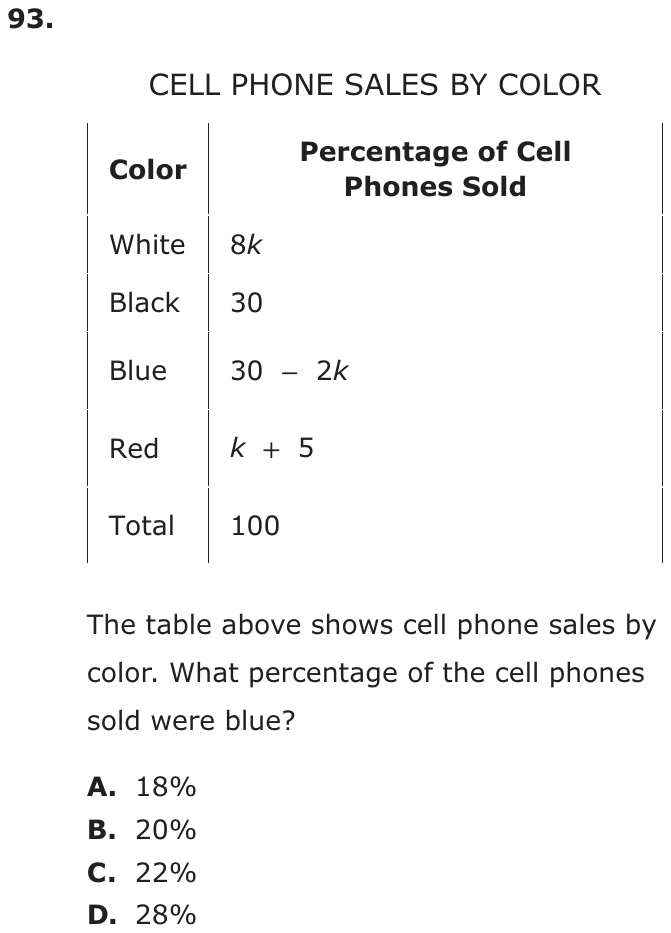
CELL PHONE SALES BY COLOR
| Color | Percentage of Cell Phones Sold |
|---|---|
| White | |
| Black | 30 |
| Blue | |
| Red | |
| Total | 100 |
The table above shows cell phone sales by color. What percentage of the cell phones sold were blue?
- A18%
- B20%
- C22%
- D28%
Show the answer
Correct answer: B
First, use the information given in the table and properties of equations to determine the value of k:
Then, determine the percentage of cell phones sold that were blue by finding the value of the expression (given in the table), when :
The percentage of cell phones sold that were blue is 20%.
Question analysis
A table of cell phone sales by color gives each color's percentage as an expression in k, such as 8k for white and 30 − 2k for blue, with a total of 100. Students write and solve an equation for k, then find the percentage for blue. Combining terms with a negative coefficient, and remembering that k itself is not the answer, both need care.
- Grade level
- Grade 7 content, by NYS standard
- Compared with grade 7
- At grade 7 Grade 7 students solve two-step equations that are written out for them. Here the equation must be built from a table whose percentages total 100, with like terms to combine, and the value found must then be substituted back.
- Estimated difficulty
- Moderate: several steps, or a close reading with one strong distractor.
- Thinking it demands
- Depth of knowledge 2, skills and concepts · mainly apply
- What makes it hard
- Many steps moderate
- Reading a figure, table or graph minor
- Error-prone arithmetic minor
- Solution
- 4 steps
- Reading level
- Question and choices: about grade 4, 36 words.
- Students, last 30 days
- Not enough answers yet to show (it takes 10).
Why it is hard, traps and wrong answers (shows the answer)
Why it is hard
The question hides an equation in a table, and the key insight is that the four percentages must add to 100. After that the algebra is routine, and no listed choice rewards stopping early, since neither k nor any other color's percentage appears. The wrong choices sit near the answer or use the blue expression with k ignored, so students who cannot set up the equation are left guessing.
Many steps moderate Working it out
The answer needs a chain: add the four expressions, set the sum to 100, collect 8k − 2k + k into 7k, solve for k, then substitute into 30 − 2k. (Daniel & Embretson, 2010; Enright, Morley & Sheehan, 2002)
Reading a figure, table or graph minor Understanding the question
No equation is printed; the table's Total row of 100 is what turns the four percentages written in k into one equation to solve. (Lesh, Post & Behr, 1987; Kirsch & Mosenthal, 1990)
Error-prone arithmetic minor Working it out
Collecting like terms includes the negative coefficient in the blue row, −2k, and the constants 30, 30 and 5 have to be gathered too. (Brown & Burton, 1978; Junker & Sijtsma, 2001)
Strategy: Add the four color expressions and set the sum equal to 100, combine like terms to solve for k, then substitute k into the blue row's expression.
Traps
- Numbers taken from the question: Combines the numbers in the question without a model of the situation, or is simply a number that appears in the question.
The wrong answers, classified
A Little reason to choose it (Haladyna & Downing, 1993; Rodriguez, 2005)
No common slip gives k = 6 from 7k + 65 = 100, the value 18% would need; it sits 2 points below the answer and mostly draws guesses.
C Little reason to choose it (Haladyna & Downing, 1993; Rodriguez, 2005)
No usual error in collecting terms or solving yields k = 4, which 22% requires, so this near neighbor of the answer mostly attracts guessers.
D Numbers taken from the question (Hegarty, Mayer & Monk, 1995)
Never solves for k and reads the blue entry 30 − 2k as 30 − 2, as if k were 1, giving 28.
Worked solution, step by step
Formulas used
- Combining like terms
- k is the unknown number. a and b are the numbers in front of k, called coefficients. Terms with the same letter are called like terms. You can add their coefficients, because a groups of k plus b groups of k make a + b groups of k.
- Keeping an equation balanced
- a and b are the two sides of an equation, and c is any number (not 0 when you divide). An equation is like a balanced scale. Doing the same thing to both sides keeps it balanced. Use it to undo each step and get k alone.
Sort out the table
The table gives the percent of phones sold in each color. Some entries use k, a letter that stands for an unknown number. 8k means 8 times k. You need the percent that were blue, . To find it, you first need k.
Write an equation for the total
Every phone sold is one of the four colors. So the four percents add up to the total, 100, as the last row of the table shows.
Combine like terms
Terms with k in them are called like terms, so they can be combined. Group the k terms together and the plain numbers together. A k on its own means 1k.
So the equation becomes . Watch out: the blue row takes away 2k. Keep its minus sign, or the k terms will be wrong.
Solve for k
Undo the adding first, then the multiplying.
So k is 5. But k is not the answer. You still need the blue row.
Find the blue percent
Put 5 in for k in the blue row.
So 20% of the phones sold were blue. Watch out: 2k means 2 times k, not 2. Reading as gives 28%, choice D.
So the answer is B, 20%.
Check your answer
Put k = 5 into every row. White: . Black: 30. Blue: 20. Red: . Now add them: . The total matches the table, so k = 5 is right.
More questions like this
The original DOE question