Question
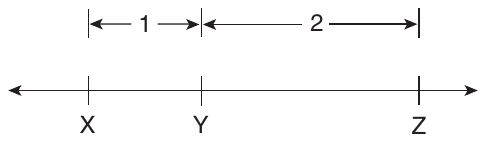
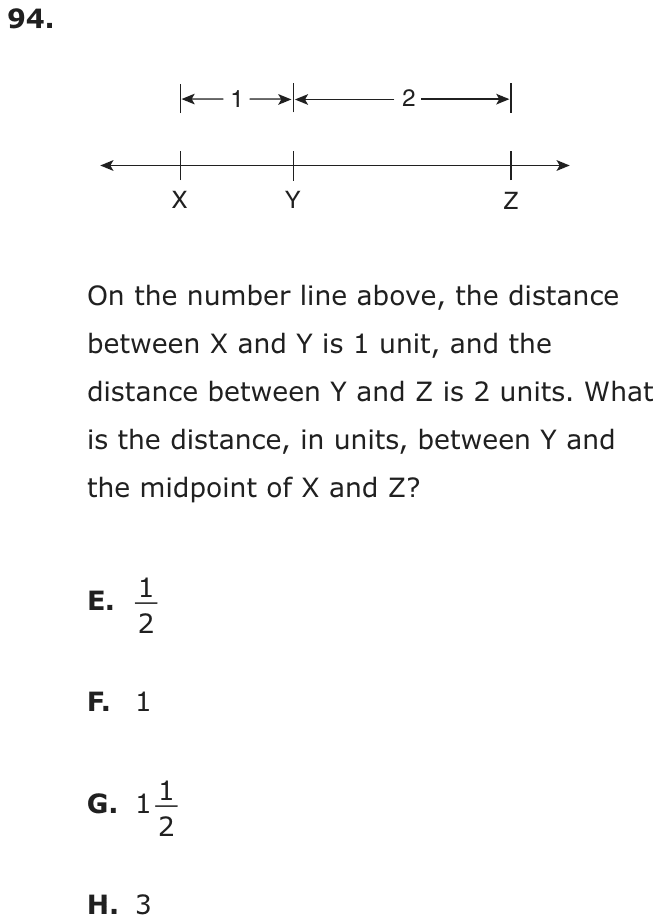
On the number line above, the distance between X and Y is 1 unit, and the distance between Y and Z is 2 units. What is the distance, in units, between Y and the midpoint of X and Z?
- A
- B1
- C
- D3
Show the answer
Correct answer: A
First, find the distance between X and Z by adding the distance between X and Y to the distance between Y and Z.
Since the distance between X and Z is 3, the midpoint between X and Z is units from X.
The midpoint between X and Z is units from X, and the distance between X and Y is 1. The distance between Y and the midpoint of X and Z is .
Question analysis
This number line question shows points X, Y and Z, with 1 unit from X to Y and 2 units from Y to Z, and asks how far Y is from the midpoint of X and Z. Students find the length of XZ, locate its midpoint, and compare it with Y. Each step produces a tempting number, so stopping early is the usual mistake.
- Grade level
- Grade 7 content, by NYS standard
- Compared with grade 7
- Below grade 7 Grade 7 number line problems usually involve negative numbers and fractions as coordinates. This one has no coordinates, only two whole-number distances, and needs three short steps: a total length, a midpoint and a difference.
- Estimated difficulty
- Straightforward: two steps or one careful reading.
- Thinking it demands
- Depth of knowledge 2, skills and concepts · mainly apply
- What makes it hard
- Reading a figure, table or graph minor
- Many steps minor
- Solution
- 3 steps
- Reading level
- Question and choices: about grade 5, 39 words.
- Corrected from the DOE handbook
- An imprecise statement about the midpoint in the explanation was corrected.
- Students, last 30 days
- Not enough answers yet to show (it takes 10).
Why it is hard, traps and wrong answers (shows the answer)
Why it is hard
The arithmetic is light, but every intermediate result is waiting among the choices, so the risk is stopping before the last subtraction. Students also have to keep two midpoints apart: the one asked about lies between X and Z, not halfway along the 2-unit stretch from Y. Marking X at 0 and the midpoint at 1.5 on the drawing makes the half-unit gap visible.
Reading a figure, table or graph minor Understanding the question
The number line has no coordinates, only dimension arrows labeled 1 and 2, so students must assign positions themselves, such as X at 0, Y at 1 and Z at 3. (Lesh, Post & Behr, 1987; Kirsch & Mosenthal, 1990)
Many steps minor Working it out
Three short results come in sequence, the length XZ, the midpoint's distance from X, then its distance from Y, and each is also a listed choice. (Daniel & Embretson, 2010; Enright, Morley & Sheehan, 2002)
Strategy: Place X at 0 so that Y and Z get positions from the given distances, find the midpoint of X and Z as half their distance, then compare it with Y's position.
Traps
- Stops one step early: A choice is a number from partway through the solution.
- Answers a different question: A choice is right for another quantity: the other unknown, the rest instead of the part, the part instead of the whole.
The wrong answers, classified
B Answers a different question (King et al., 2004; Hegarty, Mayer & Monk, 1995)
Halves the 2-unit segment from Y to Z, the midpoint of the wrong pair of points, which is 1 unit from Y; it also matches the labeled XY.
C Stops one step early (King et al., 2004; Gierl et al., 2017)
Finds that the midpoint is 1 1/2 units from X and stops before subtracting the 1 unit between X and Y.
D Answers a different question (King et al., 2004; Hegarty, Mayer & Monk, 1995)
Adds the two labeled distances, 1 + 2 = 3, and gives the whole length XZ rather than any distance to the midpoint.
What was corrected from the DOE handbook, and why
- Explanation: The handbook says “the midpoint between X and Z is 1½” (twice). A midpoint is a point, and this number line has no numbers on it, so the 1½ is the midpoint’s distance from X (half of XZ = 3). Both sentences now say the midpoint is “1½ units from X.” The rest is unchanged: Y is 1 unit from X, so the distance between Y and the midpoint is 1½ − 1 = ½.
Worked solution, step by step
Formulas used
- Adding lengths on a line
- X, Y and Z are points on one line, with Y between X and Z. XY and YZ are the lengths of the two short pieces. XZ is the length of the whole. The two pieces join end to end to make the whole.
- Midpoint of a segment
- A segment is the straight piece of a line between two points, its ends. The midpoint is the point exactly halfway between the ends. It splits the segment into two equal halves. So it is half the length away from each end.
Sort out the picture
The points go X, then Y, then Z, from left to right. X to Y is 1 unit, and Y to Z is 2 units. You need the midpoint of X and Z, the point halfway between them. Then you need how far Y is from that midpoint. The line has no numbers, so measure everything from X.
Find the length from X to Z
X to Z is 3 units. Watch out: 3 is the whole length, choice D. It is not a distance to the midpoint.
Place the midpoint
The midpoint of X and Z is half of 3 units from X.
So the midpoint is units to the right of X. Watch out: this is its distance from X, not from Y. Stopping here gives choice C.
Measure from Y to the midpoint
Y is 1 unit to the right of X. The midpoint is units to the right of X. Subtract to find the gap between them.
Watch out: use the midpoint of X and Z, not of Y and Z. Halving the 2 units from Y to Z gives 1, choice B.So the answer is A, unit.
Check your answer
Give each point a number, with X at 0. Then Y is at 1 and Z is at 3. Halfway between 0 and 3 is . From Y at 1 to is . This fits the picture too: Y sits a little left of the middle of XZ.
More questions like this
The original DOE question