Question
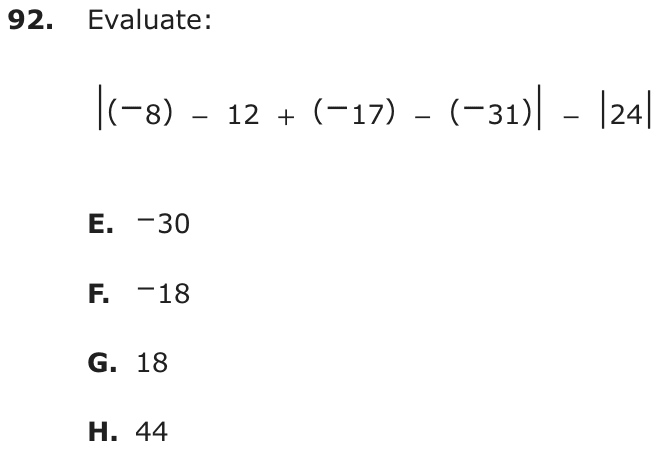
Evaluate:
- A−30
- B−18
- C18
- D44
Show the answer
Correct answer: B
Simplify negatives inside the first absolute value brackets.
Simplify the first absolute value.
Calculate the absolute values.
Perform the final subtraction.
Question analysis
This integer question asks students to evaluate an expression with two absolute values: the first holds four positive and negative numbers, and the second is the absolute value of 24. It tests subtracting negative numbers and understanding absolute value. Subtracting a negative number and handling each pair of bars separately are where most slips happen.
- Grade level
- Grade 7 content, by NYS standard
- Compared with grade 7
- At grade 7 Grade 7 students add and subtract integers and know absolute value as distance from zero. This expression puts four signed terms inside one pair of bars and subtracts a second absolute value, a typical but sign-heavy grade 7 exercise.
- Estimated difficulty
- Moderate: several steps, or a close reading with one strong distractor.
- Thinking it demands
- Depth of knowledge 1, recall and reproduction · mainly apply
- What makes it hard
- Error-prone arithmetic moderate
- A very close wrong answer moderate
- Many steps minor
- Solution
- 4 steps
- Reading level
- Question and choices: about grade 16+, 2 words.
- Students, last 30 days
- Not enough answers yet to show (it takes 10).
Why it is hard, traps and wrong answers (shows the answer)
Why it is hard
Every step is routine, but the question stacks sign decisions, and one slip anywhere produces a clean wrong number. The last step is the subtle one: each pair of bars gives a positive number, but 6 minus 24 is still negative. Students who believe bars guarantee a positive result flip that subtraction, and the choices offer the flipped number beside the right one.
Error-prone arithmetic moderate Working it out
The first bars hold four signed terms, and two must be rewritten, + (−17) as − 17 and − (−31) as + 31, before they combine to −6. (Brown & Burton, 1978; Junker & Sijtsma, 2001)
A very close wrong answer moderate Choosing the answer
The answer, −18, and the choice 18 differ only in sign, so estimating cannot separate them; only doing the last step as 6 − 24 does. (Embretson & Wetzel, 1987; Gorin & Embretson, 2006; Ascalon et al., 2007)
Many steps minor Working it out
Each pair of bars is simplified inside and made positive before the outer subtraction, so three separate jobs must be done in the right order. (Daniel & Embretson, 2010; Enright, Morley & Sheehan, 2002)
Strategy: Rewrite each subtraction of a negative as addition, combine the four numbers inside the first bars, take both absolute values, and only then do the final subtraction.
Traps
- Negatives and direction: Arithmetic with negative numbers, the order of a subtraction, or direction on a number line. (Moving a term across the equals sign without changing its sign is a faulty procedure.)
- Misunderstands the concept: A wrong belief about a concept: that percents can be added, that area grows like length, that averages can be averaged, that a bigger denominator means a bigger fraction.
The wrong answers, classified
A A faulty procedure (Brown & Burton, 1978; Tatsuoka, 1983)
Simplifies the inside to −6 but treats the bars like parentheses, keeping −6, so −6 − 24 = −30.
C Misunderstands the concept (Smith, diSessa & Roschelle, 1993; De Bock et al., 1998; Ni & Zhou, 2005)
Assumes an expression made of absolute values cannot be negative, so subtracts 6 from 24 instead of 24 from 6.
D Negatives and direction (Brown & Burton, 1978)
Reads − (−31) as − 31, so the inside becomes −8 − 12 − 17 − 31 = −68, and 68 − 24 = 44.
Worked solution, step by step
Formulas used
- Adding and subtracting negatives
- a is any number, and b is a positive number, so −b is negative. Adding a negative moves you left on the number line, just like subtracting. Subtracting a negative is like taking away a debt, so you end up with more. It is the same as adding.
- Absolute value
- The bars around a number mean absolute value. a is any number. Its absolute value is how far a is from 0 on the number line. A distance is never negative, so the absolute value of −6 is 6.
Sort out the expression
The expression has two absolute values. The bars mean the distance from 0, so what comes out of them is never negative. Work in this order. First simplify inside the first bars. Then take both absolute values. Last, do the subtraction between them.
Rewrite the signs inside
Two signs inside the first bars are tricky. Adding −17 is the same as subtracting 17. Subtracting −31 is the same as adding 31.
Watch out: minus negative 31 is plus 31. Treating it as minus 31 makes the inside −68. That leads to 44, choice D.Combine the four numbers
Go from left to right, one number at a time.
The inside of the first bars is −6.
Take the absolute values
Now the expression is . Watch out: the bars turn −6 into 6. Keeping −6 gives , choice A.
Do the last subtraction
You take 24 away from 6. Taking a bigger number from a smaller one gives a negative answer. Watch out: absolute values are never negative, but this answer can be. Doing instead gives 18, choice C.
So the answer is B, −18.
Check your answer
Check the inside a new way. The positive part is 31. The negative parts add to . Since , the inside is right. Then, on a number line, start at 6 and move 24 to the left. Six steps reach 0, and 18 more land on −18.
More questions like this
The original DOE question