Question
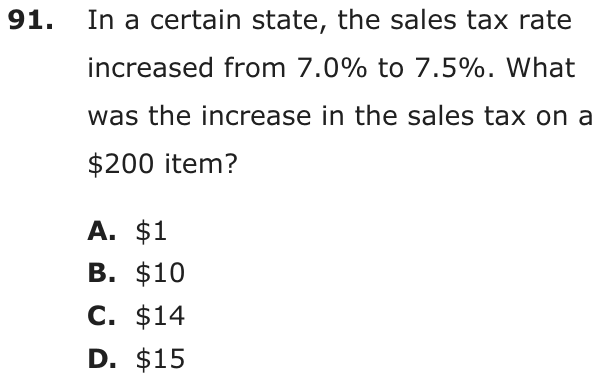
In a certain state, the sales tax rate increased from 7.0% to 7.5%. What was the increase in the sales tax on a $200 item?
- A$1
- B$10
- C$14
- D$15
Show the answer
Correct answer: A
The increase in sales tax percentage is
0.5% of $200 is
Question analysis
This percent word problem says a state's sales tax rate rose from 7.0% to 7.5% and asks how much more tax is charged on a $200 item. Students find the change in the rate and apply it to the price, or compute both taxes and compare. Converting a fraction of a percent to a decimal is where errors creep in.
- Grade level
- Grade 7 content, by NYS standard
- Compared with grade 7
- At grade 7 Sales tax is a standard grade 7 percent topic, usually finding the tax or the total on one price. This one compares two tax rates whose difference is a fraction of a percent, where placing the decimal point is the main hazard.
- Estimated difficulty
- Straightforward: two steps or one careful reading.
- Thinking it demands
- Depth of knowledge 2, skills and concepts · mainly apply
- What makes it hard
- Error-prone arithmetic moderate
- Turning words into math minor
- Solution
- 2 steps
- Reading level
- Question and choices: about grade 4, 22 words.
- Corrected from the DOE handbook
- A dash printed in place of a minus sign in the explanation was corrected.
- Students, last 30 days
- Not enough answers yet to show (it takes 10).
Why it is hard, traps and wrong answers (shows the answer)
Why it is hard
The arithmetic is tiny once 0.5% is written correctly, so the question turns on the decimal point. A percent below 1 is unfamiliar, and moving the point one place instead of two gives a choice ten times too large. Students can sidestep it by finding both taxes, $14 and $15, and subtracting, though either tax on its own is also a listed choice.
Error-prone arithmetic moderate Working it out
The change in rate is half of one percent, and writing 0.5% as a decimal moves the point two places, to 0.005; one place gives 0.05 and a tenfold error. (Brown & Burton, 1978; Junker & Sijtsma, 2001)
Turning words into math minor Understanding the question
The question asks for "the increase in the sales tax", a difference in dollars, while the stem's first sentence is about the two rates themselves. (Hegarty, Mayer & Monk, 1995; Koedinger & Nathan, 2004)
Strategy: Subtract the old rate from the new rate, then take that percent of $200, writing it as a decimal carefully; or find both taxes and subtract.
Traps
- Answers a different question: A choice is right for another quantity: the other unknown, the rest instead of the part, the part instead of the whole.
- An arithmetic slip: The right method with a plausible arithmetic error: a digit, a place value or a times-table fact.
The wrong answers, classified
B An arithmetic slip (Junker & Sijtsma, 2001)
Writes 0.5% as 0.05 instead of 0.005, so 0.05 × 200 = 10, a decimal-place slip that makes the increase ten times too large.
C Answers a different question (King et al., 2004; Hegarty, Mayer & Monk, 1995)
Finds the tax at the old rate, 7% of $200 = $14, and gives that instead of how much the tax went up.
D Stops one step early (King et al., 2004; Gierl et al., 2017)
Finds the tax at the new rate, 7.5% of $200 = $15, and stops before subtracting the $14 charged at the old rate.
What was corrected from the DOE handbook, and why
- Explanation: The handbook writes the subtraction with an em dash, “7.5% — 7.0% = 0.5%”. The site uses a minus sign: 7.5% − 7.0% = 0.5%. Nothing else changes; 0.5% of $200 is $1.
Worked solution, step by step
Formulas used
- Percent of a number
- p is the percent. Percent means out of 100, so p percent is p over 100. The whole is the amount you take the percent of, here the $200 price. The part is the result. To write a percent as a decimal, move the decimal point two places left.
Sort out the question
Sales tax is extra money added to a price. The tax rate went from 7.0% to 7.5%. The item costs $200. You need “the increase in the sales tax” in dollars. That is how much more tax you pay now.
Watch out: the tax at the old rate is $14, choice C. The tax at the new rate is $15, choice D. Neither one is the increase.Find how much the rate went up
Subtract the old rate from the new rate.
The rate went up 0.5%. That is half of one percent.
Find 0.5% of $200
The extra tax is 0.5% of the price. Use the percent formula with p = 0.5 and the whole = 200.
The tax goes up by $1. Watch out: 0.5% is 0.005, not 0.05. Moving the point only one place gives $10, choice B.
So the answer is A, $1.
Check your answer
Find both taxes and subtract. Old tax: , so $14. New tax: , so $15. The difference is , or $1. Both ways give the same answer.
More questions like this
The original DOE question