Question
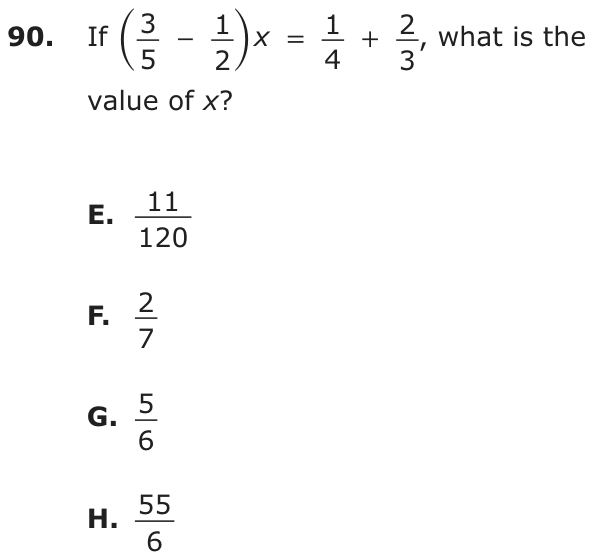
If , what is the value of x?
- A
- B
- C
- D
Show the answer
Correct answer: D
Rewrite with equivalent fractions that have like denominators.
Multiply both sides of the equation by 10.
Question analysis
This equation has fractions on both sides: the coefficient of x is 3/5 minus 1/2, and the right side is 1/4 plus 2/3. Students simplify each side using common denominators, then solve for x. Each step is routine, but four fraction operations in a row leave many places to slip, especially when undoing the coefficient.
- Grade level
- Grade 7 content, by NYS standard
- Compared with grade 7
- At grade 7 Grade 7 students solve equations such as (2/3)x = 4/5 with fractional coefficients. Here both sides must first be simplified over unlike denominators, so four fraction operations come before x is found: on level, but long.
- Estimated difficulty
- Moderate: several steps, or a close reading with one strong distractor.
- Thinking it demands
- Depth of knowledge 1, recall and reproduction · mainly apply
- What makes it hard
- Error-prone arithmetic moderate
- Many steps moderate
- Solution
- 4 steps
- Reading level
- Question and choices: about grade 8, 12 words.
- Corrected from the DOE handbook
- A minus sign printed in place of an equals sign in the explanation was corrected.
- Students, last 30 days
- Not enough answers yet to show (it takes 10).
Why it is hard, traps and wrong answers (shows the answer)
Why it is hard
Nothing here is new, but the question strings together four fraction operations, and the last one runs against habit. Having found that one tenth of x is 11/12, students must multiply by 10; multiplying by 1/10 instead gives a tiny listed value. The size of the answer is a useful check: if a tenth of x is almost 1, then x must be almost 10.
Error-prone arithmetic moderate Working it out
Both sides need common denominators, tenths on the left and twelfths on the right, and the coefficient comes out as 1/10, a fraction to divide by. (Brown & Burton, 1978; Junker & Sijtsma, 2001)
Many steps moderate Working it out
Four operations come before x appears: 3/5 − 1/2, then 1/4 + 2/3, then 11/12 divided by 1/10, then reducing 110/12 to 55/6. (Daniel & Embretson, 2010; Enright, Morley & Sheehan, 2002)
Strategy: Simplify the parentheses on the left and the sum on the right over common denominators, then undo the coefficient by multiplying both sides by its reciprocal.
Traps
- Wrong operation: Adds instead of multiplying, divides the wrong way round, turns a ratio or rate upside down, or undoes a step in the wrong direction (subtracts what should be added back).
- A faulty procedure: A systematic but wrong procedure: adding fractions straight across, applying an exponent to each term of a sum, dropping a sign when moving a term.
The wrong answers, classified
A Wrong operation (Hegarty, Mayer & Monk, 1995; King et al., 2004)
Simplifies both sides correctly but multiplies 11/12 by 1/10 instead of dividing by it, getting 11/120.
B A faulty procedure (Brown & Burton, 1978; Tatsuoka, 1983)
Combines each pair straight across, 3/5 − 1/2 as 2/3 and 1/4 + 2/3 as 3/7, then multiplies them: 2/3 × 3/7 = 2/7.
C Wrong operation (Hegarty, Mayer & Monk, 1995; King et al., 2004)
Adds 3/5 and 1/2 instead of subtracting, so the coefficient is 11/10 and x = 11/12 ÷ 11/10 = 5/6.
What was corrected from the DOE handbook, and why
- Explanation: The handbook writes “(1/10)x − 11/12”, an expression, where the working needs the equation (1/10)x = 11/12: the line before is (6/10 − 5/10)x = 3/12 + 8/12, and the next step multiplies both sides of the equation by 10. The site now reads (1/10)x = 11/12, which gives x = 110/12 = 55/6.
Worked solution, step by step
Formulas used
- Equivalent fractions
- a is the top of a fraction and b is the bottom. n is any number except 0. Multiplying the top and bottom by the same number gives an equal fraction, cut into smaller pieces. Use it to give two fractions the same bottom before you add or subtract.
- Keeping an equation balanced
- a and b are the two sides of an equation, and n is any number. An equation is like a balanced scale. If you multiply both sides by the same number, it stays balanced. Use it to undo a number that multiplies x.
Sort out the equation
An equation says two things are equal. On the left, the subtraction in the parentheses multiplies x. On the right is a sum. You need the value of x. First make each side as simple as you can. Then get x by itself.
Simplify the left side
To subtract, the fractions need the same bottom. Both 5 and 2 go into 10, so use tenths.
Watch out: this is a minus sign. Adding instead gives , and that leads to , choice C.Simplify the right side
Both 4 and 3 go into 12, so use twelfths.
Now the equation is much simpler:
Get x by itself
x is multiplied by . To undo that, multiply both sides by 10. That is the reciprocal of , the fraction flipped upside down.
Watch out: multiplying by does not undo anything. It gives , choice A.Simplify the fraction
Both 110 and 12 are even, so divide the top and the bottom by 2.
So the answer is D, .
Check your answer
Put back in for x. . That matches the right side. Also estimate. A tenth of x is almost 1, so x should be almost 10. is about 9.2.
More questions like this
The original DOE question