Question
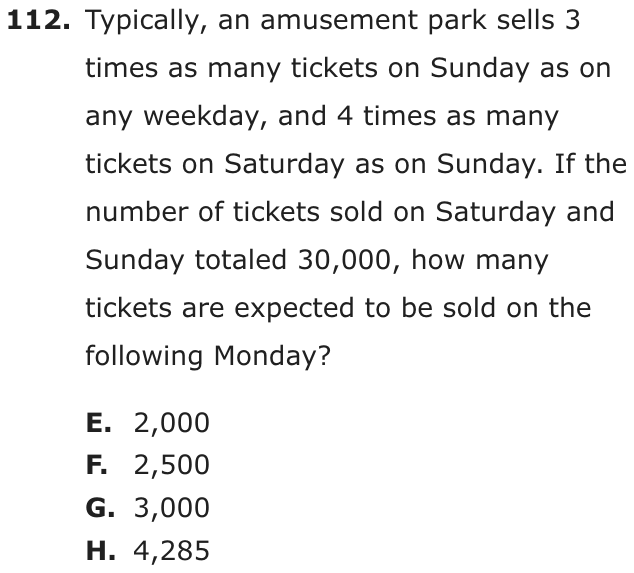
Typically, an amusement park sells 3 times as many tickets on Sunday as on any weekday, and 4 times as many tickets on Saturday as on Sunday. If the number of tickets sold on Saturday and Sunday totaled 30,000, how many tickets are expected to be sold on the following Monday?
- A2,000
- B2,500
- C3,000
- D4,285
Show the answer
Correct answer: A
First, determine the number of tickets sold on Sunday, x, using the total number of tickets sold on Saturday and Sunday, 30,000, and the number of tickets sold on Saturday, .
Then determine the number of tickets expected to be sold on Monday, y, using the number of tickets sold on Sunday, 6,000.
The number of tickets expected to be sold on Monday is 2,000.
Question analysis
An amusement park sells 3 times as many tickets on Sunday as on a weekday and 4 times as many on Saturday as on Sunday. Given the weekend total, students find the expected ticket sales for the following Monday. It tests writing an equation from multiplicative comparisons, and the trap is comparing Saturday with the wrong day.
- Grade level
- Grade 7 content, by NYS standard
- Compared with grade 7
- At grade 7 Writing and solving a one-variable equation from a word problem is grade 7 work. Two linked multiplicative comparisons, with Saturday measured against Sunday rather than a weekday, add a layer of translation, but the equation itself stays simple.
- Estimated difficulty
- Moderate: several steps, or a close reading with one strong distractor.
- Thinking it demands
- Depth of knowledge 2, skills and concepts · mainly apply
- What makes it hard
- Turning words into math moderate
- Much to keep track of minor
- Solution
- 3 steps
- Reading level
- Question and choices: about grade 12, 48 words.
- Students, last 30 days
- Not enough answers yet to show (it takes 10).
Why it is hard, traps and wrong answers (shows the answer)
Why it is hard
The question is two comparisons chained through Sunday, and most wrong answers come from linking them incorrectly. Students who read Saturday's 4 times as 4 weekdays, or who leave Sunday out of the 30,000, find listed answers, one of them from a division that does not come out even. Letting a weekday be one share, so Sunday is 3 and Saturday 12, makes the weekend 15 shares and the check easy.
Turning words into math moderate Understanding the question
"4 times as many tickets on Saturday as on Sunday" compares Saturday with Sunday, not with a weekday, so Saturday is 4 × 3 = 12 weekdays' worth. (Hegarty, Mayer & Monk, 1995; Koedinger & Nathan, 2004)
Much to keep track of minor Working it out
Three days have to be held in relation at once, a weekday, Sunday and Saturday, with the 30,000 covering only the last two. (Sweller, 1988; Carpenter, Just & Shell, 1990)
Strategy: Let Sunday's sales be the unknown, write Saturday as 4 times it, solve the weekend equation for Sunday, then divide Sunday's figure by 3 for a weekday.
Traps
- Misreads the question: Misses or misreads a condition or a word in the question: "at least", "each", "remaining", "not".
- Wrong operation: Adds instead of multiplying, divides the wrong way round, turns a ratio or rate upside down, or undoes a step in the wrong direction (subtracts what should be added back).
The wrong answers, classified
B Misreads the question (Hegarty, Mayer & Monk, 1995)
Makes Saturday 3 × 4 = 12 weekdays' worth but divides all 30,000 by 12, leaving Sunday's 3 shares out of the weekend total.
C Wrong operation (Hegarty, Mayer & Monk, 1995; King et al., 2004)
Adds the multipliers, so Saturday is 3 + 4 = 7 weekdays' worth; with Sunday's 3 the weekend is 10 shares, and 30,000 ÷ 10 = 3,000.
D Misreads the question (Hegarty, Mayer & Monk, 1995)
Reads Saturday as 4 times a weekday rather than 4 times Sunday, so splits 30,000 into 3 + 4 = 7 shares of about 4,285.7.
Worked solution, step by step
Formulas used
- Undoing multiplication
- x is the unknown number. a and b are known numbers. Division undoes multiplication. So if a times x is b, you find x by dividing b by a. This is the same as dividing both sides by a.
Sort out the question
Sunday sells 3 times as many tickets as a weekday. Saturday sells 4 times as many as Sunday. Saturday and Sunday together sell 30,000.
Monday is a weekday. You need Monday’s tickets. Notice that Saturday is compared with Sunday, not with a weekday.
Write an equation for the weekend
Let x be Sunday’s tickets. Then Saturday’s tickets are 4x. Together they make 30,000.
Solve for Sunday
Use the rule for undoing multiplication. Divide both sides by 5.
Sunday sells 6,000 tickets. Saturday sells .
Find Monday’s tickets
Sunday sells 3 times as many as a weekday. Let y be Monday’s tickets.
Watch out: If you read Saturday as 4 times a weekday, you split 30,000 into 7 shares. That gives about 4,285, choice D. Dividing 30,000 by 12 leaves out Sunday and gives 2,500, choice B.
So the answer is A, 2,000.
Check your answer
Think in shares. A weekday is 1 share. Sunday is 3 shares, and Saturday is shares. The weekend is 15 shares, and . It matches.
More questions like this
The original DOE question