Question
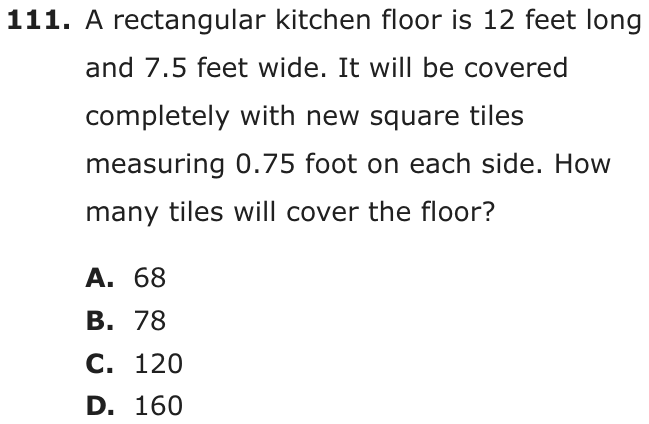
A rectangular kitchen floor is 12 feet long and 7.5 feet wide. It will be covered completely with new square tiles measuring 0.75 foot on each side. How many tiles will cover the floor?
- A68
- B78
- C120
- D160
Show the answer
Correct answer: D
First, determine the area of the kitchen floor in square feet by multiplying the length and width:
Next, determine the area of each square tile:
The number of tiles needed is found by dividing the area of the floor by the area of the tiles:
Question analysis
A rectangular kitchen floor measuring 12 feet by 7.5 feet will be covered with square tiles 0.75 foot on a side. Students find how many tiles are needed. It tests area and division with decimals, and working with a decimal side length while keeping lengths and areas apart is what makes it tricky.
- NYS standards
- Grade level
- Grade 6 content, by NYS standard
- Compared with grade 7
- At grade 7 Area of a rectangle is grade 6 content, but here it combines with dividing by a decimal tile area, or by the tile's side along each wall. Three decimal steps and a tempting shortcut make it typical grade 7 demand.
- Estimated difficulty
- Moderate: several steps, or a close reading with one strong distractor.
- Thinking it demands
- Depth of knowledge 2, skills and concepts · mainly apply
- What makes it hard
- Error-prone arithmetic moderate
- Turning words into math minor
- Solution
- 3 steps
- Reading level
- Question and choices: about grade 6, 31 words.
- Students, last 30 days
- Not enough answers yet to show (it takes 10).
Why it is hard, traps and wrong answers (shows the answer)
Why it is hard
The floor's 90 square feet comes quickly; the trap is what to divide it by. A tile is described by its side, and dividing by 0.75 instead of 0.5625 gives a listed answer that looks reasonable. Counting tiles along each wall, 16 along the length and 10 along the width, avoids both the decimal division and the side-versus-area mistake.
Error-prone arithmetic moderate Working it out
The tile's area, 0.75 × 0.75 = 0.5625 square foot, must divide 90, a decimal division that is easier as 90 × 16/9 or as 16 tiles by 10 tiles. (Brown & Burton, 1978; Junker & Sijtsma, 2001)
Turning words into math minor Understanding the question
The tiles are "square tiles measuring 0.75 foot on each side", a side length, which has to be squared before it can be compared with the floor's area in square feet. (Hegarty, Mayer & Monk, 1995; Koedinger & Nathan, 2004)
Strategy: Find how many tiles fit along the length and how many along the width by dividing each by 0.75, then multiply the two counts.
Traps
- Wrong formula: Uses a related but wrong formula: perimeter for area, diameter for radius, area for volume, or a misremembered one.
- Wrong operation: Adds instead of multiplying, divides the wrong way round, turns a ratio or rate upside down, or undoes a step in the wrong direction (subtracts what should be added back).
The wrong answers, classified
A Wrong operation (Hegarty, Mayer & Monk, 1995; King et al., 2004)
Multiplies the 90-square-foot area by the tile's 0.75-foot side instead of dividing, getting 67.5 and rounding to 68.
B Little reason to choose it (Haladyna & Downing, 1993; Rodriguez, 2005)
No standard working gives 78, which is twice the floor's 39-foot perimeter, 4 × (12 + 7.5), so it mostly draws guesses.
C Wrong formula (King et al., 2004)
Divides the 90 square feet by the tile's side, 0.75 foot, instead of its area, 0.5625 square foot, getting 120 tiles.
Worked solution, step by step
Formulas used
- Area of a rectangle
- A is the area, the flat space inside. l is the length and w is the width. Multiplying counts how many unit squares fit, row by row.
- Area of a square
- A is the area. s is the length of one side. s² means s × s. A square is a rectangle whose length and width are both s.
Sort out the question
The floor is a rectangle 12 feet long and 7.5 feet wide. Each tile is a square, 0.75 foot on each side. You need the number of tiles that cover the whole floor.
Find the floor’s area
Area tells how much flat space the tiles must cover. Use the rectangle formula.
The floor is 90 square feet.
Find one tile’s area
The tile’s side is a length. You need its area to compare it with the floor’s area. Use the square formula.
As a fraction, , so the area is square foot.
Divide the floor by one tile
The number of tiles is the floor’s area divided by one tile’s area. To divide by a fraction, multiply by its reciprocal, the fraction flipped upside down.
Watch out: Dividing 90 by 0.75, the side, gives 120, choice C. You must divide by the tile’s area. Multiplying 90 by 0.75 gives about 68, choice A.
So the answer is D, 160.
Check your answer
Count the tiles in rows. Along the 12-foot length, tiles fit. Along the 7.5-foot width, tiles fit. That makes tiles.
More questions like this
The original DOE question