Question
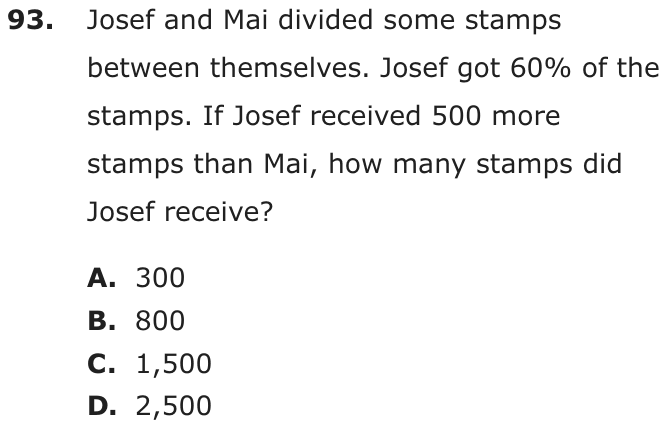
Josef and Mai divided some stamps between themselves. Josef got 60% of the stamps. If Josef received 500 more stamps than Mai, how many stamps did Josef receive?
- A300
- B800
- C1,500
- D2,500
Show the answer
Correct answer: C
Let j be the number of stamps Josef has. Then Mai has stamps. The total number of stamps is . Since Josef has 60% of the stamps, set up an equation to solve for j:
| Cross multiply. | |
| Apply the distributive property; multiply the 60 by and 500. | |
| Apply the additive inverse property; subtract from both sides of the equation. | |
| Apply the multiplicative inverse property; divide both sides of the equation by −20. | |
Question analysis
This percent word problem says Josef and Mai split some stamps, Josef got 60% of them, and he received 500 more than Mai; it asks how many stamps Josef received. Students must connect a difference in counts to a difference in percents. Stopping at the total, or taking a percent of 500, gives tempting wrong answers.
- Grade level
- Grade 7 content, by NYS standard
- Compared with grade 7
- Above grade 7 Grade 7 percent problems usually give the whole and ask for a part. Here neither share nor the total is known; students must link the 500-stamp gap to the gap between two percents before finding the total and then Josef's part.
- Estimated difficulty
- Hard: combines ideas, needs a plan, and has more than one tempting wrong answer.
- Thinking it demands
- Depth of knowledge 2, skills and concepts · mainly apply
- What makes it hard
- Turning words into math moderate
- No obvious method moderate
- Many steps minor
- Solution
- 3 steps
- Reading level
- Question and choices: about grade 4, 26 words.
- Students, last 30 days
- Not enough answers yet to show (it takes 10).
Why it is hard, traps and wrong answers (shows the answer)
Why it is hard
The arithmetic is easy once the 500 is seen as the gap between two percents of one total; seeing that is the hard part. The tempting move is to apply the 60% to the only number given, the 500, which treats a difference as a whole. Students who do find the total must still take Josef's share of it, since the total waits among the choices. Checking that 1,500 and 1,000 differ by 500 confirms the answer.
Turning words into math moderate Understanding the question
The stem describes one split in two ways, Josef's 60% of the total and his 500-stamp lead over Mai, and the link, that the lead is 60% − 40% = 20% of the total, is never stated. (Hegarty, Mayer & Monk, 1995; Koedinger & Nathan, 2004)
No obvious method moderate Working it out
No equation is suggested: the quick route treats the 500 as 20 percentage points and scales up to 100%, while the handbook's route, j over 2j − 500, needs cross-multiplying and a negative coefficient. (Schoenfeld, 1985)
Many steps minor Working it out
Even the short route takes three moves, the 20% gap, the 2,500 total and Josef's 60% of it, and the total is itself a listed choice. (Daniel & Embretson, 2010; Enright, Morley & Sheehan, 2002)
Strategy: If Josef has 60%, Mai has the other 40%, so the 500-stamp difference is a known percent of the total; use it to find the total, then take Josef's share.
Traps
- Stops one step early: A choice is a number from partway through the solution.
- Percent of the wrong amount: Finding the whole from a part, or a percent change measured from the wrong starting amount.
- Numbers taken from the question: Combines the numbers in the question without a model of the situation, or is simply a number that appears in the question.
The wrong answers, classified
A Percent of the wrong amount (Parker & Leinhardt, 1995)
Takes 60% of 500, applying the percent to the difference between the two shares as if the 500 stamps were the whole collection.
B Numbers taken from the question (Hegarty, Mayer & Monk, 1995)
Takes 60% of 500 to get 300 and then adds the 500 extra stamps, combining the stem's numbers without a model of the two shares.
D Stops one step early (King et al., 2004; Gierl et al., 2017)
Sees that the 500-stamp gap is 20% of the total, finds the total of 2,500, and stops before taking Josef's 60% of it.
Worked solution, step by step
Formulas used
- Percent of a number
- p is the percent. The whole is the total amount, and the part is the piece you want. Percent means “out of 100,” so 60% is 60 out of every 100. Use it to find a part, or work backward to find the whole.
Sort out the question
Josef and Mai split some stamps. Josef got 60% of them. He also got 500 more stamps than Mai. You need how many stamps Josef got. You don’t know the total yet, so find it first.
Find Mai’s percent
All the stamps make 100%. Josef has 60%, so Mai has the rest.
Mai has 40% of the stamps.
Find what the 500 stamps are
Josef’s extra 500 stamps are the gap between his share and Mai’s share.
So 500 stamps are 20% of all the stamps.
Find the total number of stamps
There are 2,500 stamps in all. Watch out: that is everyone’s stamps, choice D. Don’t stop here.
Find Josef’s share
Watch out: taking 60% of 500 gives 300, choice A. The 500 is the gap between them, not the total. So the answer is C, 1,500 stamps.
Check your answer
Mai gets 40% of 2,500, which is 1,000 stamps. Josef’s 1,500 minus Mai’s 1,000 is 500, just as the question says. And 1,500 + 1,000 = 2,500, the whole amount.
More questions like this
The original DOE question