Question

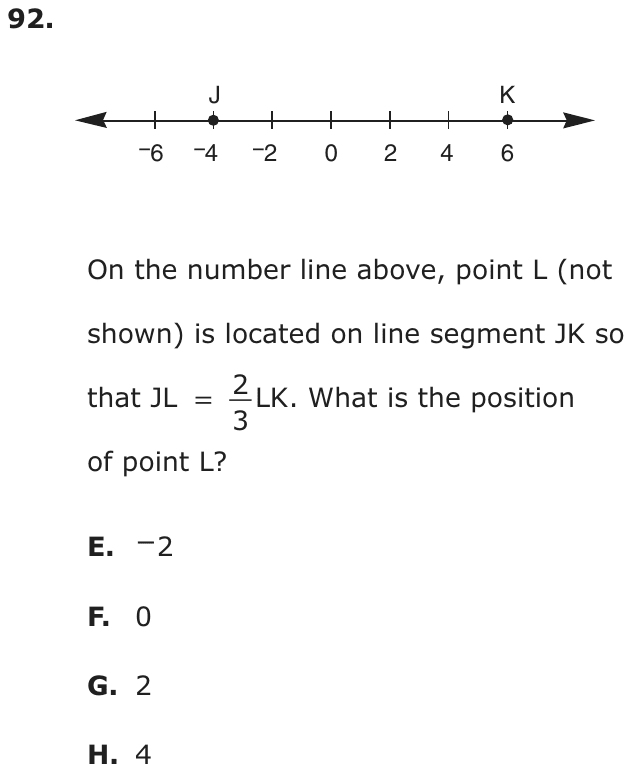
On the number line above, point L (not shown) is located on line segment JK so that . What is the position of point L?
- A−2
- B0
- C2
- D4
Show the answer
Correct answer: B
units. Let . Then . Substitute these expressions in the given equation:
Solve for x:
| Apply the multiplicative inverse property; multiply both sides of the equation by 3. | |
| Apply the distributive property; multiply the 2 by 10 and x. | |
| Apply the additive inverse property; add to both sides of the equation. | |
| Apply the multiplicative inverse property; divide both sides of the equation by 5. | |
So, point L is 4 units to the right of point J: . Point L is located at 0 on the number line.
Question analysis
This number line question puts J at −4 and K at 6 and asks for the position of a point L on segment JK where JL is two thirds of LK. Students find the segment's length, divide it in a 2-to-3 ratio, and turn a distance into a coordinate. Reading the ratio backwards, or giving a distance instead of a position, leads to wrong answers.
- Grade level
- Grade 7 content, by NYS standard
- Compared with grade 7
- At grade 7 Distances on a number line that crosses zero are grade 7 rational-number work, and splitting a length in a given ratio is grade 7 proportional reasoning. Turning a fraction of one part into a split, then into a position, makes a typical multistep task.
- Estimated difficulty
- Moderate: several steps, or a close reading with one strong distractor.
- Thinking it demands
- Depth of knowledge 2, skills and concepts · mainly apply
- What makes it hard
- Turning words into math moderate
- Reading a figure, table or graph minor
- Many steps minor
- Solution
- 3 steps
- Reading level
- Question and choices: about grade 5, 25 words.
- Students, last 30 days
- Not enough answers yet to show (it takes 10).
Why it is hard, traps and wrong answers (shows the answer)
Why it is hard
The ratio is stated between two unknown pieces, which is less familiar than a fraction of a whole, and the final step turns a length into a position. Students who stop at JL's length, read 2/3 the wrong way round, or use its 2 as a distance all reach listed points. Sketching five equal shares of 2 units from −4 to 6, two for JL and three for LK, makes the position plain.
Turning words into math moderate Understanding the question
JL = 2/3 LK compares the two pieces with each other, not a piece with the whole JK, so the 10 units must be split in the ratio 2 : 3, giving JL 4 and LK 6. (Hegarty, Mayer & Monk, 1995; Koedinger & Nathan, 2004)
Reading a figure, table or graph minor Understanding the question
J's position, −4, and K's, 6, are read from the number line, whose labeled ticks run every 2 units, and L itself is not drawn. (Lesh, Post & Behr, 1987; Kirsch & Mosenthal, 1990)
Many steps minor Working it out
Three steps follow in order: the length JK = 6 − (−4), the length JL from the ratio, and finally L's position counted from J rather than from 0. (Daniel & Embretson, 2010; Enright, Morley & Sheehan, 2002)
Strategy: Find the length of JK, split it into five equal shares with two for JL and three for LK, then count JL's length to the right from J.
Traps
- Stops one step early: A choice is a number from partway through the solution.
- Wrong operation: Adds instead of multiplying, divides the wrong way round, turns a ratio or rate upside down, or undoes a step in the wrong direction (subtracts what should be added back).
- Numbers taken from the question: Combines the numbers in the question without a model of the situation, or is simply a number that appears in the question.
The wrong answers, classified
A Numbers taken from the question (Hegarty, Mayer & Monk, 1995)
Takes the 2 in 2/3 as the length of JL and moves 2 units right from J at −4, without relating JL to LK or to JK.
C Wrong operation (Hegarty, Mayer & Monk, 1995; King et al., 2004)
Turns the ratio upside down, making LK two thirds of JL, so JL is 6 and L lands at 2, nearer K than J.
D Stops one step early (King et al., 2004; Gierl et al., 2017)
Finds JL = 4 correctly but gives that length as L's position, stopping before counting the 4 units from J at −4.
Worked solution, step by step
Formulas used
- Distance on a number line
- Subtract the position on the left from the position on the right. The answer is how many units apart the two points are. A distance is never negative.
- Splitting a length in a ratio
- A ratio a : b compares two pieces. If a length is split in the ratio a : b, think of it as a + b equal parts. The first piece gets a of them and the second gets b. Divide the whole length by a + b to find one part.
Sort out the question
Read the number line. Point J is at −4 and point K is at 6. Point L sits somewhere between them. JL is the length from J to L, and LK is the length from L to K. The rule says JL is of LK. You need the position of L.
Find the length of JK
K is on the right, so subtract J’s position from K’s.
Taking away −4 is the same as adding 4. J and K are 10 units apart.
Turn the rule into equal parts
JL is of LK. So for every 2 units in JL, LK has 3 units. That means JK is made of 2 + 3 = 5 equal parts. JL gets 2 parts and LK gets 3.
Each part is 2 units long.
Find the two lengths
Watch out: JL is of LK, not the other way round. Flipping the ratio makes JL 6 and puts L at 2, choice C.
Find the position of L
L is 4 units to the right of J. Start at J’s position, −4, and move 4 to the right.
Watch out: 4 is the length of JL, not where L sits. Answering 4 is choice D. So the answer is B, 0.
Check your answer
Put L at 0 and test the rule. JL = 0 − (−4) = 4, and LK = 6 − 0 = 6. Then , which is JL. Also 4 + 6 = 10, the whole length JK.
More questions like this
The original DOE question