Also in 2026 Practice Test B Math, question 9; 2025 Practice Test B Math, question 10.
Question
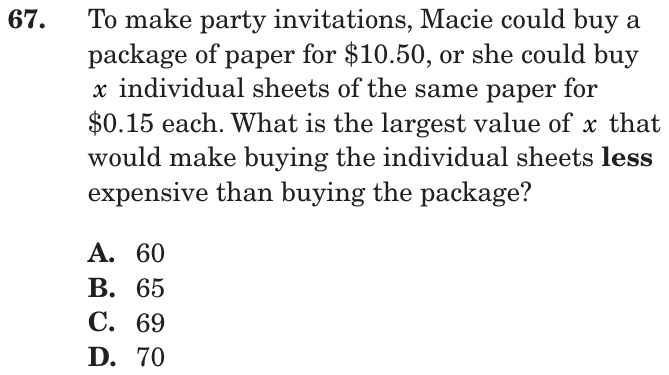
To make party invitations, Macie could buy a package of paper for $10.50, or she could buy x individual sheets of the same paper for $0.15 each. What is the largest value of x that would make buying the individual sheets less expensive than buying the package?
- A60
- B65
- C69
- D70
Show the answer
Correct answer: C
Set up an inequality to compare the costs:
0.15x < 10.50
x < 70
Therefore, 70 individual sheets of paper would cost $10.50, so 69 is the greatest number of individual sheets of paper that Macie can buy that would be less expensive than the package.
Question analysis
This inequality word problem compares buying a package of paper with buying single sheets at 15 cents each, and asks for the largest number of sheets for which the single sheets cost less. Students write and solve an inequality with decimals. The tricky part is interpreting the solution as a whole number of sheets.
- Grade level
- Grade 7 content, by NYS standard
- Compared with grade 7
- At grade 7 Writing and solving an inequality from a real-world situation is a grade 7 standard. This one is short, but it asks students to interpret a strict inequality as a count of sheets, the kind of interpretation grade 7 tests expect.
- Estimated difficulty
- Moderate: several steps, or a close reading with one strong distractor.
- Thinking it demands
- Depth of knowledge 2, skills and concepts · mainly apply
- What makes it hard
- A very close wrong answer moderate
- Turning words into math minor
- Error-prone arithmetic minor
- Solution
- 3 steps
- Reading level
- Question and choices: about grade 10, 45 words.
- Corrected from the DOE handbook
- An inequality sign in the explanation was corrected.
- Students, last 30 days
- Not enough answers yet to show (it takes 10).
Why it is hard, traps and wrong answers (shows the answer)
Why it is hard
The computation leads straight to 70, and the whole question is about what to do with that number. Students who treat the boundary as the answer forget that equal cost is not less cost, while the other choices only catch those who misdivide or ignore the word largest. The question rewards checking the boundary case in the story: 70 sheets cost exactly the package price.
A very close wrong answer moderate Choosing the answer
70 and 69 sheets differ by one, and 70 is exactly where the two costs meet at $10.50; only the strict “less expensive” separates them, ruling out 70. (Embretson & Wetzel, 1987; Gorin & Embretson, 2006; Ascalon et al., 2007)
Turning words into math minor Understanding the question
The words “less expensive than buying the package” must become a strict inequality, 0.15x < 10.50, and “largest value” must then pick the biggest whole number below the boundary. (Hegarty, Mayer & Monk, 1995; Koedinger & Nathan, 2004)
Error-prone arithmetic minor Working it out
Dividing 10.50 by 0.15 means shifting the decimal point in both numbers, a step where a misplaced digit gives a wrong boundary. (Brown & Burton, 1978; Junker & Sijtsma, 2001)
Strategy: Divide the package price by the price of one sheet to see where the two costs meet, then find the largest whole number of sheets that still costs less than $10.50.
Traps
- Counting the ends: Inclusive or exclusive ends, fence posts, consecutive numbers: an answer that is one too many or too few, or an endpoint drawn open where it belongs closed (or the reverse).
The wrong answers, classified
A Misreads the question (Hegarty, Mayer & Monk, 1995)
Checks a round number, 60 sheets for $9.00, sees it is cheaper than the package, and stops without seeking the largest such number.
B An arithmetic slip (Junker & Sijtsma, 2001)
Divides only the $10 by $0.15, about 66.7, ignoring the 50 cents, and settles on the nearest smaller choice.
D Counting the ends (Brown & Burton, 1978)
Solves 0.15x = 10.50 and keeps the boundary 70, but 70 sheets cost exactly $10.50, the same as the package, not less.
What was corrected from the DOE handbook, and why
- Explanation: The handbook sets up 0.15x ≤ 10.50 and x ≤ 70, which would allow 70 sheets, and then says that 70 sheets cost exactly $10.50. Buying the sheets has to be less expensive than the package, so the site uses strict inequalities, 0.15x < 10.50 and x < 70, which make 69 the largest number of sheets.
Worked solution, step by step
Formulas used
- Total cost
- Price of one is what a single sheet costs, here $0.15. Number bought is how many sheets, here x. Multiplying gives the total you pay, because you pay the same price for every sheet.
Sort out the question
The package costs $10.50. Single sheets cost $0.15 each. Macie buys x sheets.
You need the largest x that makes the sheets cost less than the package. Costing the same is not enough.
Write the inequality
An inequality is a math sentence that compares two amounts. The sign < means is less than.
The cost of x sheets is 0.15 times x. It must be less than 10.50.
Find where the costs are equal
First find how many sheets cost exactly $10.50. Divide the package price by the price of one sheet. Multiply both numbers by 100 to clear the decimals.
So 70 sheets cost exactly $10.50.
Pick the largest number below 70
x must be less than 70. You can only buy whole sheets. The largest whole number below 70 is 69.
Watch out: 70 sheets cost the same as the package, not less. That is why choice D is wrong. Choices A and B are cheaper too, but they are not the largest.
So the answer is C, 69.
Check your answer
Test both numbers. , and $10.35 is less than $10.50. But , which is not less. So 69 is the largest number that works.
More questions like this
The original DOE question