Also in 2026 Practice Test B Math, question 10; 2025 Practice Test B Math, question 11.
Question
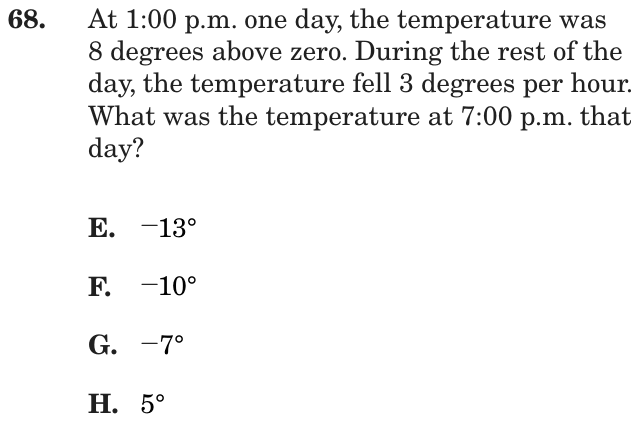
At 1:00 p.m. one day, the temperature was 8 degrees above zero. During the rest of the day, the temperature fell 3 degrees per hour. What was the temperature at 7:00 p.m. that day?
- A−13°
- B−10°
- C−7°
- D5°
Show the answer
Correct answer: B
7:00 p.m. is 6 hours after 1:00 p.m. Calculate the number of degrees the temperature dropped in 6 hours:
3 × 6 = 18 degrees
Subtract that from the starting point (8 degrees) to find the solution:
8 − 18 = −10 degrees
Question analysis
This integer word problem starts with a temperature 8 degrees above zero at 1:00 p.m. and has it fall 3 degrees every hour. Students find the temperature at 7:00 p.m. by counting hours and subtracting into negative numbers. Getting the number of hours between the two times right is the main hurdle.
- Grade level
- Grade 7 content, by NYS standard
- Compared with grade 7
- At grade 7 Grade 7 students use positive and negative numbers for real changes such as temperature. This is a standard three-step example of that skill, with a counting slip as its only real trap.
- Estimated difficulty
- Straightforward: two steps or one careful reading.
- Thinking it demands
- Depth of knowledge 2, skills and concepts · mainly apply
- What makes it hard
- Error-prone arithmetic minor
- Solution
- 3 steps
- Reading level
- Question and choices: about grade 4, 32 words.
- Students, last 30 days
- Not enough answers yet to show (it takes 10).
Why it is hard, traps and wrong answers (shows the answer)
Why it is hard
The arithmetic is light; the question turns on counting the hours from 1:00 to 7:00 correctly. Counting the clock times instead of the gaps between them gives seven hours, starting the drop an hour late gives five, and both errors are built into the choices. Subtracting the times, 7 − 1, is safer than counting on fingers.
Error-prone arithmetic minor Working it out
The total drop of 18 degrees is larger than the starting 8 degrees, so the subtraction crosses zero and the result must be negative. (Brown & Burton, 1978; Junker & Sijtsma, 2001)
Strategy: Count the hours that pass from 1:00 to 7:00 by subtracting the times, multiply by the 3-degree drop, and subtract that total from 8.
Traps
- Counting the ends: Inclusive or exclusive ends, fence posts, consecutive numbers: an answer that is one too many or too few, or an endpoint drawn open where it belongs closed (or the reverse).
The wrong answers, classified
A Counting the ends (Brown & Burton, 1978)
Counts the clock times 1, 2, 3, 4, 5, 6, 7 as seven hours, so subtracts 21 degrees from 8.
C Counting the ends (Brown & Burton, 1978)
Starts the drop at 2:00 instead of 1:00, counting five hours and subtracting 15 degrees from 8.
D Numbers taken from the question (Hegarty, Mayer & Monk, 1995)
Subtracts a single 3-degree drop from 8, combining the two numbers in the question without counting the hours.
Worked solution, step by step
Formulas used
- Total change
- The rate is how much the temperature changes each hour, here 3 degrees down. The time is the number of hours. Multiply them to get the total change, because the same drop happens every hour.
Write down what you know
At 1:00 p.m. it was 8 degrees above zero. Each hour after that, it dropped 3 degrees.
You need the temperature at 7:00 p.m.
Count the hours
Subtract the clock times: 7 − 1 = 6. So 6 hours pass.
Watch out: Do not count the clock numbers 1, 2, 3, 4, 5, 6, 7. That is 7 numbers but only 6 hours. Using 7 hours gives −13°, choice A. Starting the count at 2:00 gives 5 hours and −7°, choice C.
Find the total drop
The temperature drops the same amount each hour, so multiply.
The temperature fell 18 degrees in all.
Subtract from the start
Start at 8 degrees and take away the 18-degree drop.
The drop is bigger than 8, so the temperature goes below zero. A temperature below zero is a negative number. It is 10 degrees below zero.
So the answer is B, −10°.
Check your answer
Count down hour by hour: 8 at 1:00, 5 at 2:00, 2 at 3:00, −1 at 4:00, −4 at 5:00, −7 at 6:00 and −10 at 7:00. You land on −10.
More questions like this
The original DOE question