Also in 2026 Practice Test B Math, question 11; 2025 Practice Test B Math, question 12.
Question
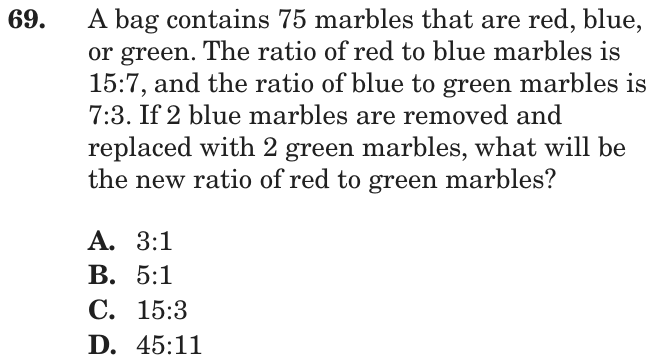
A bag contains 75 marbles that are red, blue, or green. The ratio of red to blue marbles is , and the ratio of blue to green marbles is . If 2 blue marbles are removed and replaced with 2 green marbles, what will be the new ratio of red to green marbles?
- A
- B
- C
- D
Show the answer
Correct answer: D
The ratio of red to blue to green is 15 : 7 : 3.
Find the proportion of blue marbles. Add the numbers of the ratio and use the total sum as the denominator:
Find the proportion of green marbles:
Since there are a total of 75 marbles, the number of blue marbles is
The number of green marbles is
The number of red marbles is
If 2 blue marbles are removed and replaced with 2 green marbles, the number of blue marbles is now 19 and the number of green marbles is now 11. The ratio of red marbles to green marbles is 45 : 11.
Question analysis
This ratio problem describes a bag of 75 marbles with a red-to-blue ratio and a blue-to-green ratio that share the blue term, then swaps 2 blue marbles for 2 green ones. Students combine the ratios, find the actual number of each color, and form a new ratio. The swap at the end is what turns a routine ratio exercise into a long one.
- NYS standards
- 7.RP.3 multistep ratio and percent problems
- Grade level
- Grade 7 content, by NYS standard
- Compared with grade 7
- Above grade 7 Grade 7 ratio problems usually involve one ratio and one scaling step. This links two ratios through a shared term, converts to counts and then changes the counts, a longer chain than typical grade 7 work.
- Estimated difficulty
- Moderate: several steps, or a close reading with one strong distractor.
- Thinking it demands
- Depth of knowledge 2, skills and concepts · mainly apply
- What makes it hard
- Many steps moderate
- Much to keep track of minor
- Turning words into math minor
- Solution
- 5 steps
- Reading level
- Question and choices: about grade 5, 54 words.
- Students, last 30 days
- Not enough answers yet to show (it takes 10).
Why it is hard, traps and wrong answers (shows the answer)
Why it is hard
Each step is easy because both ratios share the 7 for blue, so the work is about keeping the chain going without stopping early. The main danger is doing the swap on the ratio numbers or forgetting it altogether. Two of the wrong choices, 5:1 and 15:3, are the same ratio, so a student who notices that can rule out both before doing any arithmetic.
Many steps moderate Working it out
The chain is long: merge 15:7 and 7:3 into 15:7:3, find that 25 parts make 75 marbles, scale to 45, 21 and 9, then add 2 to the green count. (Daniel & Embretson, 2010; Enright, Morley & Sheehan, 2002)
Much to keep track of minor Working it out
Three colors' counts must be tracked through the swap, which lowers blue and raises green while red stays where it was. (Sweller, 1988; Carpenter, Just & Shell, 1990)
Turning words into math minor Understanding the question
The phrase “2 blue marbles are removed and replaced with 2 green marbles” must be read as changing the actual counts, not the ratio numbers 7 and 3. (Hegarty, Mayer & Monk, 1995; Koedinger & Nathan, 2004)
Strategy: Merge the two ratios into one red-to-blue-to-green ratio, scale it so the parts total 75, make the swap on those counts, then write red to green.
Traps
- Stops one step early: A choice is a number from partway through the solution.
The wrong answers, classified
A Misunderstands the concept (Smith, diSessa & Roschelle, 1993; De Bock et al., 1998; Ni & Zhou, 2005)
Treats the ratio's 3 as the actual number of green marbles and adds the 2 swapped marbles to it, getting 15:5, or 3:1.
B Stops one step early (King et al., 2004; Gierl et al., 2017)
Finds the counts 45 red and 9 green correctly but forgets the swap, giving the original ratio 45:9 in lowest terms.
C Numbers taken from the question (Hegarty, Mayer & Monk, 1995)
Reads red and green straight off the combined ratio 15:7:3, with no counts and no swap; it equals 5:1 anyway.
Worked solution, step by step
Formulas used
- Value of one part
- A ratio like 15:7:3 splits a total into equal parts. The sum of the ratio numbers is how many parts there are. Dividing the total by that sum tells how many marbles are in one part.
Write down what you know
There are 75 marbles: red, blue and green. A ratio compares two amounts. Red to blue is 15:7. Blue to green is 7:3.
Then 2 blue marbles are taken out, and 2 green ones are put in. You need the new ratio of red to green.
Join the two ratios
Blue is 7 in both ratios. So you can join them into one ratio.
This means for every 15 red marbles, there are 7 blue and 3 green.
Find the size of one part
The ratio has parts in all. The 75 marbles fill those 25 parts.
Each part is 3 marbles.
Count each color
Multiply each ratio number by 3 to get the real counts.
So there are 45 red, 21 blue and 9 green. They add to 75, so the counts are right.
Make the swap
Take out 2 blue: blue. Put in 2 green: green. Red does not change. It is still 45.
The new ratio of red to green is 45:11. It cannot be simplified, because 45 and 11 share no factor except 1.
Watch out: 45:9 is the ratio before the swap. It simplifies to 5:1, choice B. Choice C, 15:3, is that same old ratio. Make the swap with the real counts.
So the answer is D, 45:11.
Check your answer
Count the marbles after the swap: . The total is still 75, as it should be. A swap moves marbles in and out but does not change the total.
More questions like this
The original DOE question