Also in 2026 Practice Test B Math, question 25; 2025 Practice Test B Math, question 29.
Question
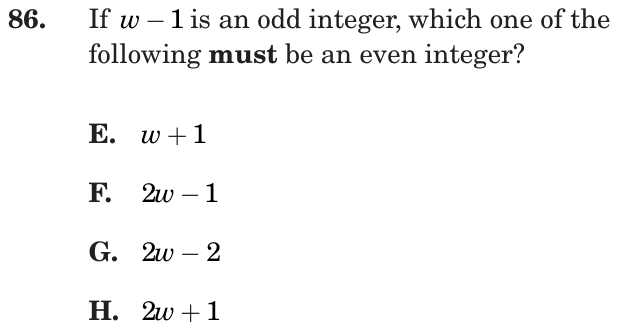
If is an odd integer, which one of the following must be an even integer?
- A
- B
- C
- D
Show the answer
Correct answer: C
One more than an odd integer must be even. One more than is , therefore must be even.
Two times an even integer must be even, therefore is even. An even integer decreased by 2 must be even.
Therefore, must be even.
Question analysis
This algebra question says that w − 1 is an odd integer and asks which of four expressions must be even. It tests reasoning about odd and even numbers written with a variable. The difficulty is that "must be" means even for every allowed value of w, so one example that happens to work is not enough.
- Grade level
- Grade 7 content, by NYS standard
- Compared with grade 7
- At grade 7 Grade 7 work evaluates and rewrites expressions but rarely asks whether one is odd or even for every value. The algebra here is light; the demand is reasoning about parity and reading "must be" carefully.
- Estimated difficulty
- Moderate: several steps, or a close reading with one strong distractor.
- Thinking it demands
- Depth of knowledge 2, skills and concepts · mainly analyze
- What makes it hard
- Variables instead of numbers moderate
- Every choice must be checked moderate
- Something you must already know minor
- Solution
- 2 steps
- Reading level
- Question and choices: about grade 8, 20 words.
- Students, last 30 days
- Not enough answers yet to show (it takes 10).
Why it is hard, traps and wrong answers (shows the answer)
Why it is hard
The question turns on one early inference: since w − 1 is odd, w itself is even. Students who skip that step, or quietly treat w as the odd number, carry the wrong parity into every choice. After that the work is mechanical, because each expression adds an even or an odd amount to an even number. Trying one value, such as w = 4, confirms the choice in seconds.
Variables instead of numbers moderate Understanding the question
The stem gives no number at all: w − 1 is only known to be odd, so the parity of w itself has to be worked out before any choice can be judged. (Koedinger & Nathan, 2004; Enright, Morley & Sheehan, 2002)
Every choice must be checked moderate Choosing the answer
All four choices are built from w or 2w plus or minus 1 or 2, so each one has to be tested for evenness; three of them come out odd for every allowed w. (Embretson & Wetzel, 1987)
Something you must already know minor Working it out
The parity rules are assumed, not stated: one more than an odd number is even, any multiple of 2 is even, and an even number plus or minus 1 is odd. (Anderson & Krathwohl, 2001)
Strategy: Choose a value of w that makes w − 1 odd, evaluate all four expressions, and keep the one that comes out even; then confirm it with a second value.
Traps
- Misreads the question: Misses or misreads a condition or a word in the question: "at least", "each", "remaining", "not".
The wrong answers, classified
A Misreads the question (Hegarty, Mayer & Monk, 1995)
Treats w itself as the odd number, so w + 1 looks even; in fact w − 1 being odd makes w even and w + 1 odd.
B A faulty procedure (Brown & Burton, 1978; Tatsuoka, 1983)
Doubles the odd number w − 1 to make it even but distributes the 2 to w only, writing 2(w − 1) as 2w − 1, which is odd.
D Misunderstands the concept (Smith, diSessa & Roschelle, 1993; De Bock et al., 1998; Ni & Zhou, 2005)
Assumes any expression that starts with 2w is even, overlooking that 2w + 1 is one more than an even number and so always odd.
Worked solution, step by step
Formulas used
- Adding 1 to an odd number
- Odd and even numbers take turns on the number line: 1, 2, 3, 4 and so on. Adding 1 moves you to the next whole number. So the number right after an odd number is always even, and the one after an even number is always odd.
- Doubling makes an even number
- n is any whole number. An even number is one you can split into two equal whole groups. Two times n is always two equal groups of n, so it is always even.
Sort out what you know
You know that is an odd integer. An integer is a whole number, like 3, 0 or −5. An even number can be split into two equal groups, like 4 or 10. An odd number is 1 more than an even number, like 3 or 11.
You need the choice that must be even. Must means it is even for every possible value of , not just one.
Decide whether w is odd or even
The number is 1 more than . One more than an odd number is always even. For example, if is 3, then is 4. So is even.
Watch out: do not treat itself as the odd number. That mistake makes look even and leads to choice A.
Show that 2w − 2 is even
Two times any whole number is even, so is even. Taking 2 away from an even number moves you back two spots. You land on another even number. So is even.
Here is another way to see it. is the same as . That is 2 times a whole number, so it must be even.
Check the other three choices
Each one adds or takes away 1 from an even number. That always gives an odd number.
- A: is even plus 1, so it is odd.
- B: is even minus 1, so it is odd.
- D: is even plus 1, so it is odd.
Watch out: starting with does not make a number even. The +1 in choice D makes it odd.
Give the answer
Only one choice is even for every possible . So the answer is C, .
Check your answer
Pick a number. Let , so , which is odd. Then A is 5, B is 7, C is 6 and D is 9. Only C is even. Try too. You get 11, 19, 18 and 21. C is even again.
More questions like this
The original DOE question