Question
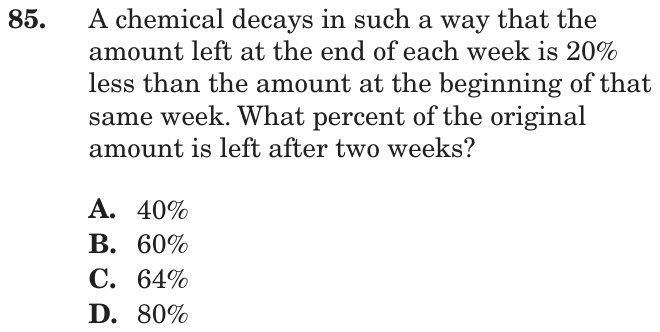
A chemical decays in such a way that the amount left at the end of each week is 20% less than the amount at the beginning of that same week. What percent of the original amount is left after two weeks?
- A40%
- B60%
- C64%
- D80%
Show the answer
Correct answer: C
Let be the original amount of the chemical. It loses 20% after each week, which means 80% of the chemical remains at the end of each week. End of first week:
At the end of the second week, 80% of the amount left at the end of the first week remains. End of second week:
Question analysis
This percent problem describes a chemical that loses 20% of what is present each week and asks what percent of the original amount remains after two weeks. Students apply a percent decrease twice in a row. Deciding which amount each week's 20 percent is taken from is the heart of the problem.
- NYS standards
- 7.RP.3 multistep ratio and percent problems
- Grade level
- Grade 7 content, by NYS standard
- Compared with grade 7
- Above grade 7 Grade 7 percent problems usually apply a single increase or decrease. Applying a decrease twice, each time to the new amount, is an early form of exponential decay that goes beyond typical grade 7 work.
- Estimated difficulty
- Hard: combines ideas, needs a plan, and has more than one tempting wrong answer.
- Thinking it demands
- Depth of knowledge 2, skills and concepts · mainly apply
- What makes it hard
- A very close wrong answer major
- Turning words into math moderate
- Variables instead of numbers minor
- Solution
- 2 steps
- Reading level
- Question and choices: about grade 8, 40 words.
- Students, last 30 days
- Not enough answers yet to show (it takes 10).
Why it is hard, traps and wrong answers (shows the answer)
Why it is hard
This is a two-step percent decrease, and the intuitive answer, 20% plus 20%, is wrong for a reason students rarely check: the second loss is taken from what is left after the first. The stem states this rule in its own words, but quickly. Starting with 100 units and working week by week makes the difference visible, since the second week removes 16 units, not 20.
A very close wrong answer major Choosing the answer
60% and 64% are four points apart, too close for a rough estimate; only seeing that week two's 20% comes from 80, not 100, separates them. (Embretson & Wetzel, 1987; Gorin & Embretson, 2006; Ascalon et al., 2007)
Turning words into math moderate Understanding the question
The stem measures each week's loss against “the amount at the beginning of that same week”, and students must see that this resets the base to 80% for the second week. (Hegarty, Mayer & Monk, 1995; Koedinger & Nathan, 2004)
Variables instead of numbers minor Understanding the question
No starting amount is given, so students must supply one, such as 100 units, or reason directly with a percent of a percent. (Koedinger & Nathan, 2004; Enright, Morley & Sheehan, 2002)
Strategy: Start with 100 units, take away 20 percent of the current amount for the first week, then take 20 percent of what is left for the second week.
Traps
- Percent of the wrong amount: Finding the whole from a part, or a percent change measured from the wrong starting amount.
- Stops one step early: A choice is a number from partway through the solution.
- Answers a different question: A choice is right for another quantity: the other unknown, the rest instead of the part, the part instead of the whole.
The wrong answers, classified
A Answers a different question (King et al., 2004; Hegarty, Mayer & Monk, 1995)
Adds the two 20% losses to get 40% and reports that amount lost, when the question asks how much is left.
B Percent of the wrong amount (Parker & Leinhardt, 1995)
Takes both weeks' 20% from the original amount, 100 − 20 − 20, missing that the second week's loss comes from the smaller 80%.
D Stops one step early (King et al., 2004; Gierl et al., 2017)
Finds the 80% left after one week and stops before applying the second week's decrease.
Worked solution, step by step
Formulas used
- Percent decrease
- p is the percent taken away, here 20. Taking away 20% leaves 80% of the amount, so you multiply by 0.80. Each week starts from the amount left at the end of the week before.
Understand the decay
Each week, the chemical loses 20% of what it had at the start of that week. The amount at the start of each week keeps changing.
So the second week’s 20% is taken from a smaller amount. You need the percent left after two weeks.
Start with 100 units
No amount is given, so pick an easy one. Start with 100 units. Then the number of units left is also the percent left.
Work out week one
20% of 100 is 20, so 20 units are lost.
After week one, 80 units are left. That is 80% of the start.
Watch out: 80% is only one week. Stopping here gives choice D.
Work out week two
Now the week starts with 80 units, not 100. Take 20% of 80.
After two weeks, 64 units are left. That is 64% of the 100 units you started with.
Watch out: Taking 20 away twice from 100 gives 60%, choice B. That uses the old amount in week two.
So the answer is C, 64%.
Check your answer
Use the percent decrease formula. Each week keeps 80%, or 0.80, of the amount. Two weeks gives , which is 64%. The two methods agree.
More questions like this
The original DOE question