Also in 2026 Practice Test B Math, question 32; 2025 Practice Test B Math, question 38.
Question
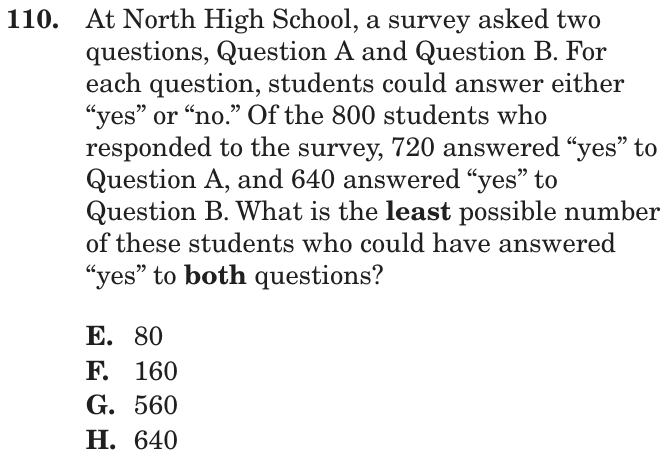
At North High School, a survey asked two questions, Question A and Question B. For each question, students could answer either “yes” or “no.” Of the 800 students who responded to the survey, 720 answered “yes” to Question A, and 640 answered “yes” to Question B. What is the least possible number of these students who could have answered “yes” to both questions?
- A80
- B160
- C560
- D640
Show the answer
Correct answer: C
None of the 80 students (800 − 720) who answered “no” to Question A could have answered “yes” to both questions.
Therefore, the least possible number of students who could have answered “yes” to both questions can be found by subtracting the 80 who answered “no” to Question A from the 640 who answered “yes” to Question B or 640 − 80 = 560.
Question analysis
In a survey of 800 students at North High School, 720 said yes to the first question and 640 said yes to the second. Students must find the smallest possible number who said yes to both. It tests reasoning about overlapping groups, and asking for the least possible overlap rather than an exact count makes it unusual.
- NYS standards
- Grade level
- Grade 7 content, by NYS standard
- Compared with grade 7
- Above grade 7 Grade 7 students work with Venn diagrams and two-way tables when all counts are given. Finding the smallest possible overlap requires reasoning about extremes rather than computing, which is rare in grade 7 and new to most students.
- Estimated difficulty
- Among the hardest on the SHSAT: a non-obvious approach, heavy reading, or a well-hidden trap.
- Thinking it demands
- Depth of knowledge 3, strategic thinking · mainly analyze
- What makes it hard
- No obvious method major
- Turning words into math moderate
- A very close wrong answer minor
- Solution
- 2 steps
- Reading level
- Question and choices: about grade 8, 60 words.
- Corrected from the DOE handbook
- A repeated phrase and a stray comma in the explanation were removed.
- Students, last 30 days
- Not enough answers yet to show (it takes 10).
Why it is hard, traps and wrong answers (shows the answer)
Why it is hard
Most students have never been asked for a smallest overlap, so they fall back on a picture of nested groups and give the largest one. The key move is to push the two yes groups apart as far as possible: only the 80 students who said no to Question A can absorb some of Question B's yes answers. Once that is seen, the arithmetic is one subtraction, so the question rewards reasoning far more than computation.
No obvious method major Working it out
Nothing in the wording points to the method: the smallest overlap appears only when all 80 students who said no to Question A are imagined saying yes to Question B. (Schoenfeld, 1985)
Turning words into math moderate Understanding the question
"The least possible number of these students who could have answered “yes” to both questions" asks for an extreme case, which has to be turned into an arrangement of the 800 students. (Hegarty, Mayer & Monk, 1995; Koedinger & Nathan, 2004)
A very close wrong answer minor Choosing the answer
640 is only 80 above the right 560, so a rough sense of size cannot choose between them; only asking whether the overlap is the least or the greatest separates them. (Embretson & Wetzel, 1987; Gorin & Embretson, 2006; Ascalon et al., 2007)
Strategy: Add the two yes counts and compare the sum with the number of students; any amount above the total must come from students counted in both groups.
Traps
- NOT, LEAST or EXCEPT: The question asks for the exception, the least, or what is not true.
- Stops one step early: A choice is a number from partway through the solution.
- Answers a different question: A choice is right for another quantity: the other unknown, the rest instead of the part, the part instead of the whole.
The wrong answers, classified
A Stops one step early (King et al., 2004; Gierl et al., 2017)
Finds the 80 students who said no to Question A, 800 − 720, and stops before subtracting them from the 640 who said yes to Question B.
B Answers a different question (King et al., 2004; Hegarty, Mayer & Monk, 1995)
Finds the 160 students who said no to Question B, 800 − 640, which bears on the count but is not the overlap asked about.
D Answers a different question (King et al., 2004; Hegarty, Mayer & Monk, 1995)
Assumes everyone who said yes to Question B also said yes to Question A, giving the greatest possible overlap instead of the least.
What was corrected from the DOE handbook, and why
- Explanation: The handbook prints “(800 − 720)” twice in its first sentence, after “80 students” and again after “Question A,” and puts a comma between subject and verb in “the least possible number of students who could have answered “yes” to both questions, can be found.” The site keeps the first “(800 − 720)” and drops the comma.
Worked solution, step by step
Formulas used
- Least overlap of two groups
- a is the size of the first group and b is the size of the second. t is the total number of people. If a + b is more than t, some people must be in both groups. The extra amount is the smallest number that can be in both.
Sort out what you know
There were 800 students. Of them, 720 said yes to Question A and 640 said yes to Question B. You need the least number who could have said yes to both. The overlap is the group in both yes groups. You want the smallest overlap.
Find who said no to A
Students who said no to Question A cannot be in the overlap.
So 80 students said no to Question A.
Watch out: 80 is not the answer. It is only a step, and it is choice A.
Keep the overlap small
To make the overlap as small as you can, put as many B yes answers outside it as possible. The only students outside it are the 80 who said no to A. So pretend all 80 of them said yes to B.
Count the rest of the yes group
The other yes answers to B must come from students who also said yes to A.
So at least 560 students said yes to both.
Watch out: 640 is the most that could say yes to both, not the least. That is choice D.
Give the answer
The fewest students who could say yes to both questions is 560. So the answer is C, 560.
Check your answer
Use the overlap formula: . There are 1,360 yes answers but only 800 students, so 560 students must be counted twice. You can also check the groups. 560 said yes to both, 160 to A only and 80 to B only. That makes .
More questions like this
The original DOE question