Also in 2026 Practice Test B Math, question 45; 2025 Practice Test B Math, question 52.
Question
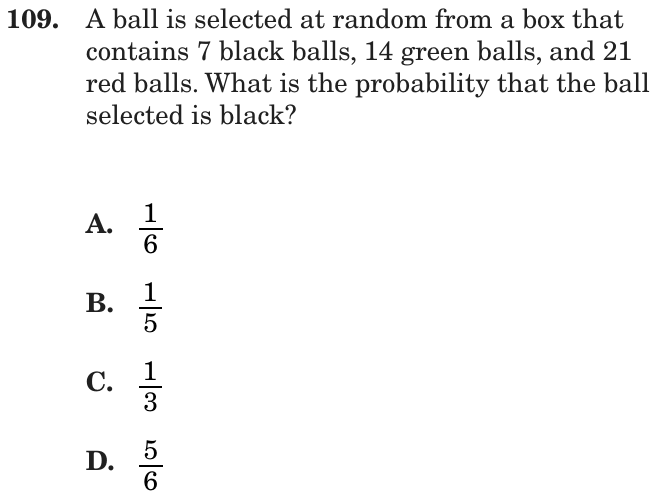
A ball is selected at random from a box that contains 7 black balls, 14 green balls, and 21 red balls. What is the probability that the ball selected is black?
- A
- B
- C
- D
Show the answer
Correct answer: A
The total number of balls in the box is
The probability that the ball is black is
Question analysis
Students find the probability of drawing a black ball at random from a box with 7 black, 14 green and 21 red balls. It tests simple probability as a part of a whole. It is a short question, but the denominator must be chosen with care.
- NYS standards
- 6.SP.8a uniform probability models
- Grade level
- Grade 6 content, by NYS standard
- Compared with grade 7
- Below grade 7 Finding a simple probability from given counts is grade 6 work in New York. This one is a single fraction to simplify, a routine task well below the compound-event problems of grade 7.
- Estimated difficulty
- Routine: one familiar step, little to misread.
- Thinking it demands
- Depth of knowledge 1, recall and reproduction · mainly apply
- What makes it hard
- Solution
- 2 steps
- Reading level
- Question and choices: about grade 4, 32 words.
- Students, last 30 days
- Not enough answers yet to show (it takes 10).
Why it is hard, traps and wrong answers (shows the answer)
Why it is hard
This is a one-formula probability question with friendly numbers, since 7 divides 42 evenly. The wrong answers come from comparing black balls with the other balls only, from treating the three colors as equally likely, or from finding the chance of not drawing black. Students who write the total first rarely miss it.
Something you must already know minor Working it out
The probability of an outcome, favorable balls over all balls, is assumed; nothing in the stem says to add 7 + 14 + 21 for the denominator. (Anderson & Krathwohl, 2001)
A very close wrong answer minor Choosing the answer
1/5 and the right 1/6 are neighboring unit fractions; only counting the 7 black balls in the denominator, 7/42 rather than 7/35, separates them. (Embretson & Wetzel, 1987; Gorin & Embretson, 2006; Ascalon et al., 2007)
Strategy: Add all the balls to get the total, put the number of black balls over that total, and simplify the fraction.
Traps
- Answers a different question: A choice is right for another quantity: the other unknown, the rest instead of the part, the part instead of the whole.
The wrong answers, classified
B Misunderstands the concept (Smith, diSessa & Roschelle, 1993; De Bock et al., 1998; Ni & Zhou, 2005)
Compares the 7 black balls with the 35 others, 7/35 = 1/5, a part-to-part ratio instead of part to whole.
C Misunderstands the concept (Smith, diSessa & Roschelle, 1993; De Bock et al., 1998; Ni & Zhou, 2005)
Treats the three colors as equally likely outcomes, so black gets a 1 in 3 chance however many balls each color has.
D Answers a different question (King et al., 2004; Hegarty, Mayer & Monk, 1995)
Finds the probability that the ball is not black, 35/42 = 5/6, the complement of the event asked about.
Worked solution, step by step
Formulas used
- Probability
- P is the probability, the chance that something happens. The top counts the results you want. The bottom counts every possible result. Use it when each result is equally likely, like picking one at random.
Sort out what you know
The box has 7 black balls, 14 green balls and 21 red balls. One ball is picked at random. That means every ball has the same chance. You need the probability, or chance, that it is black.
Find the total number of balls
The bottom of the fraction is every ball in the box.
There are 42 balls in all.
Write and simplify the probability
Use the probability formula. There are 7 black balls out of 42.
Watch out: comparing black with the other 35 balls gives , choice B. Saying 1 of 3 colors gives , choice C. But the colors have different numbers of balls.
Give the answer
The chance of picking a black ball is 1 out of 6. So the answer is A, .
Check your answer
Notice that 14 is 2 sevens and 21 is 3 sevens. So for every 1 black ball there are 2 green and 3 red. That is 1 black out of every 6 balls. Choice D, , is the chance of not black.
More questions like this
The original DOE question