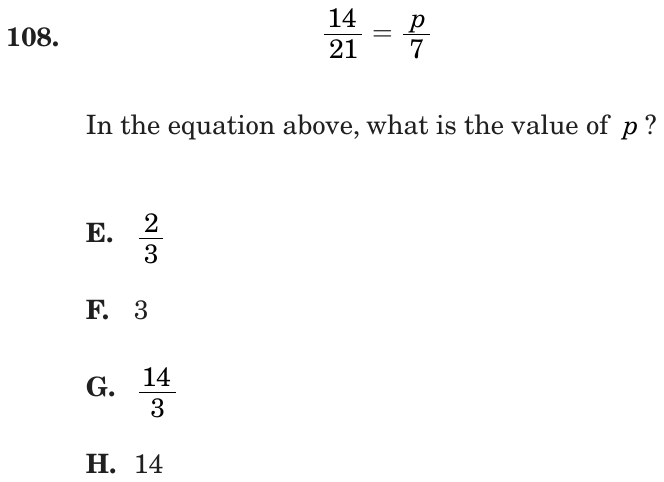
Also in 2026 Practice Test B Math, question 44; 2025 Practice Test B Math, question 51.
Question
In the equation above, what is the value of ?
- A
- B
- C
- D
Show the answer
Correct answer: C
Question analysis
Students solve a proportion that sets 14/21 equal to a fraction with an unknown numerator p over 7. It tests solving a proportion, either by cross-multiplying or by dividing numerator and denominator by the same factor. It is quick, and the main risk is losing track of what p stands for.
- Grade level
- Grade 6 content, by NYS standard
- Compared with grade 7
- Below grade 7 Solving a one-step proportion is grade 6 and 7 ratio work. This one is purely numerical with one or two steps, shorter than the multistep ratio word problems typical of grade 7.
- Estimated difficulty
- Straightforward: two steps or one careful reading.
- Thinking it demands
- Depth of knowledge 1, recall and reproduction · mainly apply
- What makes it hard
- An answer in an unexpected form moderate
- Error-prone arithmetic minor
- Solution
- 2 steps
- Reading level
- Question and choices: about grade 10, 15 words.
- Students, last 30 days
- Not enough answers yet to show (it takes 10).
Why it is hard, traps and wrong answers (shows the answer)
Why it is hard
The method is standard, but the result is not a whole number, and that surprises students who expect the numbers in a proportion to scale evenly. Two intermediate values, the ratio 2/3 and the scale factor 3, appear among the choices. Students who finish the computation and trust a fractional answer get it right.
An answer in an unexpected form moderate Choosing the answer
The answer is the improper fraction 14/3, not a whole number, so students who expect a tidy proportion distrust their result or reach for the factor 3. (Enright, Morley & Sheehan, 2002)
Error-prone arithmetic minor Working it out
Cross-multiplying gives 21p = 98, and 98/21 must be reduced by 7; simplifying 14/21 to 2/3 first and multiplying by 7 is quicker. (Brown & Burton, 1978; Junker & Sijtsma, 2001)
Strategy: Cross-multiply to form an equation in p, divide both sides by p's coefficient, and simplify the fraction you get.
Traps
- Stops one step early: A choice is a number from partway through the solution.
- Answers a different question: A choice is right for another quantity: the other unknown, the rest instead of the part, the part instead of the whole.
The wrong answers, classified
A Stops one step early (King et al., 2004; Gierl et al., 2017)
Simplifies 14/21 to 2/3 and stops, giving the value of the ratio instead of the numerator p over 7.
B Answers a different question (King et al., 2004; Hegarty, Mayer & Monk, 1995)
Notices that 21 is 3 times 7 and gives that scale factor as p instead of dividing 14 by it.
D Numbers taken from the question (Hegarty, Mayer & Monk, 1995)
Copies the left numerator, 14, as if equivalent fractions kept the same numerator when the denominator changes.
Worked solution, step by step
Formulas used
- Cross multiplication
- a and c are the top numbers. b and d are the bottom numbers. When two fractions are equal, the top of each times the bottom of the other gives the same answer. It works because you multiply both sides by b and by d.
Sort out the question
Two fractions are equal: and . An equation like this, with two equal fractions, is called a proportion. You need the value of .
Cross multiply
Use cross multiplication. This gets rid of the fractions. Multiply 21 by , and multiply 14 by 7.
Divide to find p
Divide both sides by 21 to get alone.
Both 98 and 21 can be divided by 7.
Make sense of the fraction
The answer is , which is . It is not a whole number, and that is fine.
Watch out: is the value of , not . That is choice A. The 3 is what 21 was divided by to get 7. That gives choice B.
Give the answer
The top number over 7 must be to keep the two fractions equal. So the answer is C, .
Check your answer
Think about the bottoms. 7 is one third of 21. So must be one third of 14, which is . Check it: . Both ways agree.
More questions like this
The original DOE question