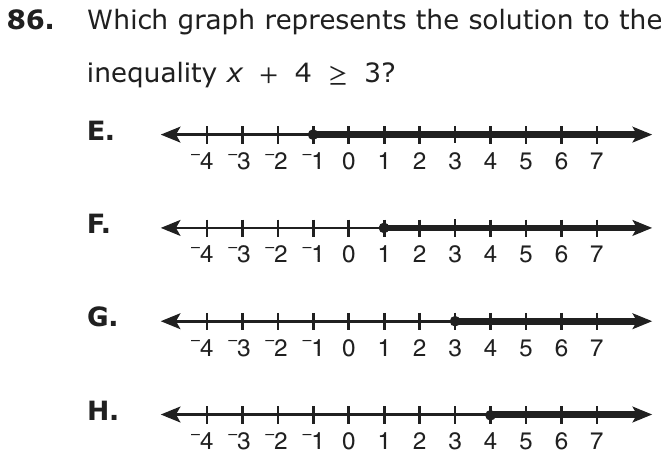
Question
Which graph represents the solution to the inequality ?
- A

- B

- C

- D

Show the answer
Correct answer: A
Use the properties of equations to solve the inequality for x.
Subtract 4 from both sides of the inequality.
The graph of will have a point at −1 and will include all values that are greater than, or to the right of, −1. The greater than or equal sign is used, which indicates that the solution includes −1. So the point at −1 will be solid. Option A is the correct answer.
Question analysis
This inequality question asks which number line graph shows the solution set of x + 4 ≥ 3. Students solve a one-step inequality by undoing the addition, then match the result to a graph. All four graphs use a solid dot and an arrow pointing right, so the whole question rests on where the shaded ray begins.
- Grade level
- Grade 7 content, by NYS standard
- Compared with grade 7
- Below grade 7 Grade 7 inequality work is usually two-step, such as 3x − 5 ≥ 10, and asks students to choose an open or closed dot and a direction. This one needs a single subtraction, and all four graphs share a closed dot and a rightward arrow.
- Estimated difficulty
- Routine: one familiar step, little to misread.
- Thinking it demands
- Depth of knowledge 1, recall and reproduction · mainly apply
- What makes it hard
- Solution
- 2 steps
- Reading level
- Question and choices: about grade 13, 9 words.
- Students, last 30 days
- Not enough answers yet to show (it takes 10).
Why it is hard, traps and wrong answers (shows the answer)
Why it is hard
Solving takes a single subtraction, and the graphs differ only in where the solid dot sits, so the question comes down to 3 − 4. Students who lose the negative sign land on the graph that starts at 1, while those who never isolate x pick a graph that starts at a number printed in the inequality. Testing 0, which satisfies 0 + 4 ≥ 3, shows that the shading must include 0.
Reading a figure, table or graph minor Understanding the question
All four graphs share a closed dot and a rightward arrow, so the only thing to read is where the dot sits, against tick labels printed with raised minus signs. (Lesh, Post & Behr, 1987; Kirsch & Mosenthal, 1990)
Error-prone arithmetic minor Working it out
Undoing the + 4 means computing 3 − 4, the one step that crosses zero; a dropped minus sign moves the dot from −1 to 1. (Brown & Burton, 1978; Junker & Sijtsma, 2001)
Strategy: Subtract 4 from both sides to get x alone, then find the graph whose solid dot sits at that number; test one shaded value in the original inequality to confirm.
Traps
- Negatives and direction: Arithmetic with negative numbers, the order of a subtraction, or direction on a number line. (Moving a term across the equals sign without changing its sign is a faulty procedure.)
- Numbers taken from the question: Combines the numbers in the question without a model of the situation, or is simply a number that appears in the question.
The wrong answers, classified
B Negatives and direction (Brown & Burton, 1978)
Computes 4 − 3 instead of 3 − 4, or drops the minus sign of −1, and starts the shaded ray at positive 1.
C Numbers taken from the question (Hegarty, Mayer & Monk, 1995)
Starts the ray at 3, the number on the right side of the inequality, as if x ≥ 3, without subtracting the 4.
D Numbers taken from the question (Hegarty, Mayer & Monk, 1995)
Starts the ray at 4, the number added to x, reading it off the inequality instead of solving for x.
Worked solution, step by step
Formulas used
- Keeping an inequality balanced
- a and b are the two sides of an inequality, and c is any number. The sign ≥ stands for greater than or equal to. Taking the same number away from both sides keeps the comparison true, like taking the same weight off both pans of a scale. Use it to get x by itself.
Sort out the question
An inequality is a math sentence that compares two amounts. The sign means is greater than or equal to. So says that x plus 4 is 3 or more.
You need the graph that shows every number x that makes this true. All four graphs have a solid dot and an arrow to the right. Only the place where the dot sits is different.
Get x by itself
Right now 4 is added to x. To undo adding 4, subtract 4 from both sides.
So x is −1 or any number greater than −1. Watch out: 3 − 4 is −1, not 1. Dropping the minus sign puts the dot at 1, choice B. Putting the dot at 3 or 4 means you read a number off the inequality without solving. That leads to C or D.
Match the solution to a graph
On a number line, greater numbers are to the right. So the shading starts at −1 and goes right. The arrow shows that it keeps going.
The dot is solid, or filled in, because of the or equal to part. A solid dot means −1 itself is a solution, a number that makes the inequality true.
Graph A has a solid dot at −1 and is shaded to the right. So the answer is A, the graph with a solid dot at −1.
Check your answer
Test a number from the shaded part, such as 0. , and 4 is more than 3. Now test the dot: , and 3 is equal to 3, so −1 works. A number left of the dot, −2, gives . That is less than 3, so −2 should not be shaded, and it isn’t.
More questions like this
The original DOE question