Also in 2025 Practice Test A Math, question 31.
Question
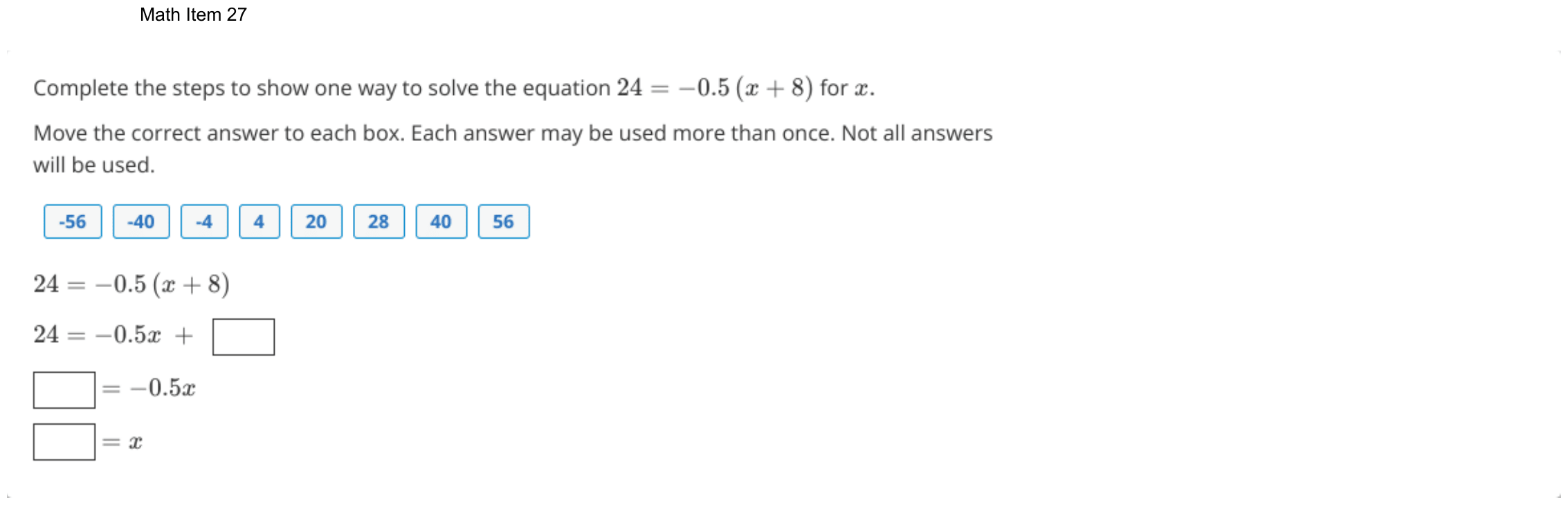
Complete the steps to show one way to solve the equation for x.
Move the correct answer to each box. Each answer may be used more than once. Not all answers will be used.
On the test you drag tiles into the boxes; here, choose each box’s tile from its menu. A tile can be used more than once. The DOE has not published how answers with several parts are scored; this site counts one right only when every part is right.
Show the answer
Correct answer: blank 1: −4; blank 2: 28; blank 3: −56
Solution:
Answer for second equation: −4
Answer for third equation: 28
Answer for fourth equation: −56
Distribute the −0.5 on the right side of the equation: .
Add 4 to both sides of the equation to eliminate the −4 on the right side: .
Divide both sides by −0.5: .
Question analysis
Students complete a step-by-step solution of the equation 24 = −0.5(x + 8) by dragging number tiles into three boxes: one after distributing, one after collecting the constants, and one for x. It tests solving a two-step linear equation with a negative decimal. Tiles may be reused, and many come in positive and negative pairs, so every sign counts.
- Grade level
- Grade 7 content, by NYS standard
- Compared with grade 7
- At grade 7 Solving equations of the form p(x + q) = r with rational numbers is named in the grade 7 standards. Here the steps are laid out, but the negative decimal factor forces a sign decision at every one of the three boxes.
- Estimated difficulty
- Moderate: several steps, or a close reading with one strong distractor.
- Thinking it demands
- Depth of knowledge 1, recall and reproduction · mainly apply
- What makes it hard
- Error-prone arithmetic moderate
- A very close wrong answer minor
- Many steps minor
- An answer in an unexpected form minor
- Solution
- 3 steps
- Reading level
- Question and choices: about grade 3, 39 words.
- Students, last 30 days
- Not enough answers yet to show (it takes 10).
Why it is hard, traps and wrong answers (shows the answer)
Why it is hard
The layout settles the method, so the question comes down to one sign at each box. The printed plus before the first box nudges students toward the positive 4, and the pool then supplies every number that follows from it, down to −40. Students who distribute correctly can still lose the item at the last box by dividing 28 by 0.5. Substituting −56 back, −0.5 × (−48) = 24, confirms the final box.
Error-prone arithmetic moderate Working it out
Two of the three boxes turn on a negative decimal: −0.5 times 8 must give −4, and dividing 28 by −0.5 means multiplying by −2, which doubles the size and makes it negative. (Brown & Burton, 1978; Junker & Sijtsma, 2001)
A very close wrong answer minor Choosing the answer
The pool pairs −4 with 4, −40 with 40 and −56 with 56, so a box filled with the right size and the wrong sign looks just as finished; estimating cannot separate −56 from 56. (Embretson & Wetzel, 1987; Gorin & Embretson, 2006; Ascalon et al., 2007)
Many steps minor Working it out
The three boxes form a chain and all three must be right, so a slip in the first carries through; the pool even holds the whole wrong chain 4, 20 and −40. (Daniel & Embretson, 2010; Enright, Morley & Sheehan, 2002)
An answer in an unexpected form minor Choosing the answer
The second line prints a plus sign before its box, so the distributed −0.5x − 4 must be written as −0.5x + (−4), with the negative tile in the box. (Enright, Morley & Sheehan, 2002)
Strategy: Multiply −0.5 by both x and 8, undo the constant term by doing the opposite operation to both sides, then divide by −0.5, which is the same as multiplying by −2.
Traps
- Order of operations: Working left to right, or distributing a minus sign wrongly, gives a choice.
- Negatives and direction: Arithmetic with negative numbers, the order of a subtraction, or direction on a number line. (Moving a term across the equals sign without changing its sign is a faulty procedure.)
- A faulty procedure: A systematic but wrong procedure: adding fractions straight across, applying an exponent to each term of a sum, dropping a sign when moving a term.
The wrong answers, classified
DEB Order of operations (Brown & Burton, 1978)
Gives the minus of −0.5 to x but not to 8, writing −0.5x + 4, then correctly reaches 20 = −0.5x and x = −40 from that wrong start.
CFH Negatives and direction (Brown & Burton, 1978)
Distributes and adds 4 correctly to reach 28 = −0.5x, then divides 28 by 0.5 instead of −0.5, dropping the negative and entering 56.
CEB A faulty procedure (Brown & Burton, 1978; Tatsuoka, 1983)
Distributes correctly to −4 but moves it to the left side without changing its sign, so 24 − 4 = 20, and 20 ÷ (−0.5) = −40.
Worked solution, step by step
Formulas used
- The distributive property
- a is the number in front of the parentheses, and b and c are the terms inside. Multiply a by each term inside. If a is negative, the minus sign goes into every product. It works because a groups of b + c is the same as a groups of b plus a groups of c.
- Signs when you multiply or divide
- A negative number times a positive number gives a negative result. A negative times a negative gives a positive result. The same rules hold when you divide. Use them at every step where a negative number appears.
- Doing the same to both sides
- a and b are the two sides of an equation, and c is any number (not zero when you divide). An equation is like a balanced scale. Doing the same thing to both sides keeps it level. That is how you get x by itself.
Sort out the question
You solve by filling three boxes:
- Box 1 comes after , once the parentheses are gone.
- Box 2 is the number equal to .
- Box 3 is the value of x.
A tile can be used more than once, and some tiles are not used.
Distribute the −0.5
Multiply −0.5 by each term inside the parentheses. A negative times a positive is negative:
So . The line already shows a plus sign, so box 1 gets −4.
Watch out: the −0.5 multiplies the 8 too. Writing 4 instead starts a wrong chain: 4, then 20, then −40. Every number in that chain is a tile.
Add 4 to both sides
You want −0.5x alone on one side, and the −4 is in the way. Adding 4 undoes subtracting 4, so add 4 to both sides:
Box 2 gets 28.
Watch out: taking 4 away from 24 instead gives 20, another tile.
Divide both sides by −0.5
Now x is multiplied by −0.5. Dividing undoes multiplying, so divide both sides by −0.5:
Dividing by 0.5 is the same as multiplying by 2, since every whole holds two halves. A positive divided by a negative is negative. So .
Watch out: dropping the minus sign gives 56, which is also a tile.
Name the three tiles
From top to bottom, the finished steps read:
So the boxes get −4, 28 and −56, in that order. On the test, you drag each tile into its box. On this site, you choose it from the box’s menu.
Check your answer
Put back into the first equation. . Then , since a negative times a negative is positive. That gives 24, the left side, so −56 is right.
More questions like this
The original DOE question