Also in 2025 Practice Test A Math, question 49.
Question
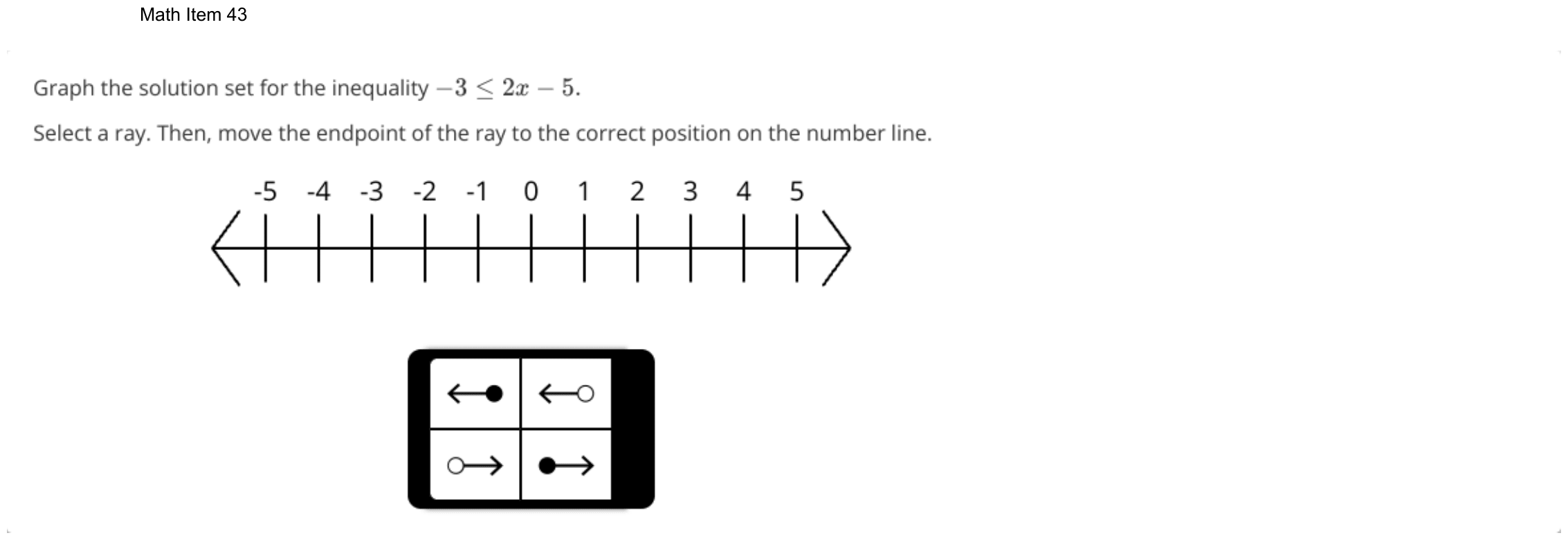
Graph the solution set for the inequality .
Select a ray. Then, move the endpoint of the ray to the correct position on the number line.
On the test you draw the ray on the number line; here, choose its endpoint, whether the endpoint is closed or open, and its direction. The DOE has not published how answers with several parts are scored; this site counts one right only when every part is right.
Show the answer
Correct answer: a ray with a closed endpoint at 1, pointing right
Solution:

Solve the inequality for x, then graph the solution on the number line:
Add 5 to both sides of the inequality:
Divide both sides by 2:
Rewrite the inequality with x on the left side:
The graph of is a closed ray (solid point) beginning at 1 and extending to the right on the number line.
Question analysis
Students graph the solution set of a two-step inequality on a number line by choosing a ray: where it starts, whether its endpoint is open or closed, and which way it points. It tests solving a linear inequality and reading its solution. The variable sits on the right of the inequality symbol, so reading the result the right way round is part of the challenge.
- Grade level
- Grade 7 content, by NYS standard
- Compared with grade 7
- At grade 7 Solving a two-step inequality and graphing its solution set is a named grade 7 skill. This one puts the variable on the right of the symbol and asks students to build the graph themselves rather than pick it from four.
- Estimated difficulty
- Moderate: several steps, or a close reading with one strong distractor.
- Thinking it demands
- Depth of knowledge 1, recall and reproduction · mainly apply
- What makes it hard
- Reading a figure, table or graph moderate
- Many steps minor
- An answer in an unexpected form minor
- Solution
- 3 steps
- Reading level
- Question and choices: about grade 6, 26 words.
- Students, last 30 days
- Not enough answers yet to show (it takes 10).
Why it is hard, traps and wrong answers (shows the answer)
Why it is hard
Solving takes two routine moves; the points are lost in turning 1 ≤ x into a picture. Because x sits on the right, the symbol seems to point left, and a student who shades the way it points draws the values below 1, which all fail. The dot must also be solid, since x = 1 makes both sides −3. Testing x = 2, where 2x − 5 = −1 and −3 ≤ −1 holds, confirms the direction.
Reading a figure, table or graph moderate Understanding the question
The solution comes out as 1 ≤ x, with x on the right, so the ≤ sign points away from the shaded side; it has to be read as x ≥ 1 before the ray is drawn. (Lesh, Post & Behr, 1987; Kirsch & Mosenthal, 1990)
Many steps minor Working it out
Two solving moves, adding 5 and then halving, come before three graph choices, the endpoint, a solid dot and a direction, and a mistake in any of the five loses the item. (Daniel & Embretson, 2010; Enright, Morley & Sheehan, 2002)
An answer in an unexpected form minor Choosing the answer
The ray is built, by picking one of four ray shapes and dragging its endpoint, rather than chosen from four finished graphs, so nothing on screen flags a ray that starts at the right number but points the wrong way. (Enright, Morley & Sheehan, 2002)
Strategy: Undo the subtraction and then the multiplication on both sides, rewrite the result with x first, decide whether the endpoint is included, and test one value on your ray in the original inequality.
Traps
- Negatives and direction: Arithmetic with negative numbers, the order of a subtraction, or direction on a number line. (Moving a term across the equals sign without changing its sign is a faulty procedure.)
- Counting the ends: Inclusive or exclusive ends, fence posts, consecutive numbers: an answer that is one too many or too few, or an endpoint drawn open where it belongs closed (or the reverse).
- A faulty procedure: A systematic but wrong procedure: adding fractions straight across, applying an exponent to each term of a sum, dropping a sign when moving a term.
The wrong answers, classified
1|closed|left Negatives and direction (Brown & Burton, 1978)
Solves to 1 ≤ x but shades the way the ≤ symbol points, a rule that holds only with x on the left, so the ray covers x ≤ 1.
1|open|right Counting the ends (Brown & Burton, 1978)
Finds the right endpoint and direction but draws an open dot, leaving out 1 itself, though the "or equal to" in ≤ includes it.
-4|closed|right A faulty procedure (Brown & Burton, 1978; Tatsuoka, 1983)
Moves the −5 to the left side without changing its sign, writing −3 − 5 = −8 ≤ 2x, so the ray starts at −4.
Worked solution, step by step
Formulas used
- Doing the same to both sides
- a and b are the two sides of an inequality, and c is any number. Adding the same number to both sides keeps the inequality true. So does dividing both sides by the same positive number. Dividing by a negative number would flip the symbol, but that does not happen here.
- Turning an inequality around
- a and b are any two numbers or terms. You may swap the two sides if you also turn the symbol around. The pointed end of the symbol always faces the smaller side. So 1 ≤ x and x ≥ 1 say the same thing.
Sort out the question
The symbol ≤ means is less than or equal to. The solution set is every value of x that makes true. You show it as a ray. A ray is a dot, called the endpoint, with an arrow going one way forever. You need three things: where the dot goes, whether it is closed or open, and which way the ray points.
Add 5 to both sides
The right side is 2x − 5. Adding 5 undoes subtracting 5, so add 5 to both sides:
Watch out: taking 5 away from −3 instead gives −8 ≤ 2x. That wrong move puts the dot at −4.
Divide both sides by 2
Now x is multiplied by 2, so divide both sides by 2. You divide by a positive number, so the symbol stays the same:
Read it with x first
says 1 is less than or equal to x. So x is 1 or any number bigger than 1. With x first, that is:
Bigger numbers are to the right on a number line, so the ray points right.
Watch out: in 1 ≤ x, the symbol seems to point left. Do not follow it. A ray pointing left from 1 shows numbers that do not work.
Choose a closed dot
The words or equal to mean 1 itself is a solution. Check it: , and −3 ≤ −3 is true. So the dot at 1 is closed, which means filled in. An open dot, an empty circle, leaves the endpoint out. Use it only for < or >.
Watch out: an open dot at 1 would leave out a number that works.
Draw the ray
On the test, choose the ray with a filled dot and an arrow pointing right. Then drag its dot to 1. On this site, choose 1 for the endpoint, then closed (filled dot) and pointing right.
So the answer is a closed dot at 1, with the ray pointing right.
Check your answer
Test a number on your ray, such as 3. , and −3 ≤ 1 is true. Now test a number off the ray, such as 0. , and −3 ≤ −5 is false. So the ray points the right way.
More questions like this
The original DOE question