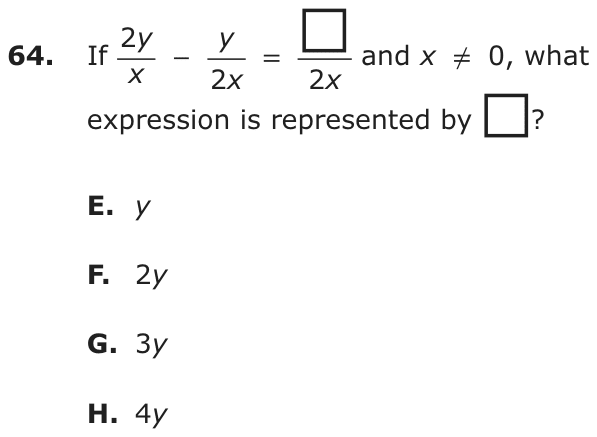
Question
If and , what expression is represented by ?
- A
- B
- C
- D
Show the answer
Correct answer: C
Use properties of equations to determine the missing expression:
The missing expression is .
Question analysis
An algebra question with fractions: two fractions with x and 2x in their denominators are subtracted, and students find the numerator that makes the difference equal a fraction over 2x. It tests rewriting a fraction over a common denominator when the denominators contain a variable. Adjusting only part of a fraction is the common mistake.
- NYS standards
- Grade level
- Grade 7 content, by NYS standard
- Compared with grade 7
- At grade 7 Grade 7 students subtract fractions with unlike denominators and combine like terms, but rarely see a variable in a denominator. The steps are the same two as with numbers, so the demand is typical once the form is familiar.
- Estimated difficulty
- Straightforward: two steps or one careful reading.
- Thinking it demands
- Depth of knowledge 1, recall and reproduction · mainly apply
- What makes it hard
- Variables instead of numbers moderate
- Error-prone arithmetic minor
- Solution
- 2 steps
- Reading level
- Question and choices: about grade 13, 14 words.
- Students, last 30 days
- Not enough answers yet to show (it takes 10).
Why it is hard, traps and wrong answers (shows the answer)
Why it is hard
This is subtraction of fractions with unlike denominators, written with letters. The box over 2x shows the target denominator, which helps, but each wrong choice matches a familiar fraction error: subtracting the tops before matching the bottoms, or rewriting the first fraction and stopping. Students who rewrite 2y/x as 4y/2x and then subtract y from the new numerator finish in seconds.
Variables instead of numbers moderate Understanding the question
The denominators are x and 2x, so the common denominator is built with a letter, and there is no number to check unless students substitute values such as x = 1 and y = 2. (Koedinger & Nathan, 2004; Enright, Morley & Sheehan, 2002)
Error-prone arithmetic minor Working it out
Only the first fraction changes: 2y/x becomes 4y/2x with top and bottom both doubled, while y/2x already has the denominator the box sits over. (Brown & Burton, 1978; Junker & Sijtsma, 2001)
Strategy: Rewrite the first fraction over 2x by multiplying its top and bottom by 2, then subtract the numerators, which now share a denominator.
Traps
- A faulty procedure: A systematic but wrong procedure: adding fractions straight across, applying an exponent to each term of a sum, dropping a sign when moving a term.
- Stops one step early: A choice is a number from partway through the solution.
The wrong answers, classified
A A faulty procedure (Brown & Burton, 1978; Tatsuoka, 1983)
Subtracts the numerators straight away, 2y − y = y, and puts the result over 2x as if the two fractions already shared a denominator.
B A faulty procedure (Brown & Burton, 1978; Tatsuoka, 1983)
Subtracts the numerators over x, (2y − y)/x = y/x, then doubles top and bottom to reach the denominator 2x, giving 2y/2x.
D Stops one step early (King et al., 2004; Gierl et al., 2017)
Rewrites 2y/x as 4y/2x correctly to match the box's denominator, then stops before subtracting the y of the second fraction.
Worked solution, step by step
Formulas used
- Equivalent fractions
- a is the top of the fraction, b is the bottom, and k is any number except zero. Multiplying the top and bottom by the same number does not change the value. It is like multiplying by k over k, which is 1.
- Subtracting fractions with the same bottom
- a and b are the tops, and d is the shared bottom, called the denominator. When two fractions have the same bottom, their pieces are the same size. So subtract the tops and keep the bottom.
Sort out the question
The box, , stands for a missing expression. An expression is a math phrase made of numbers and letters, like 5y. You need what goes in the box to make the two sides equal. means x is not zero, so no fraction divides by zero.
Pick a shared bottom
You can only subtract fractions when their bottoms match. The bottoms here are x and 2x. The box sits over 2x, so use 2x for both. The second fraction, , already has it.
Rewrite the first fraction over 2x
To turn x into 2x, multiply by 2. Multiply the top by 2 as well, so the value stays the same.
Watch out: this is only the first fraction. Stopping here and choosing 4y gives choice D.
Subtract the tops
4y take away y is like 4 apples take away 1 apple. That leaves 3y. Watch out: do not subtract the tops, 2y − y, before the bottoms match. That gives y, choice A.
Match the box
The left side equals . The right side is . The bottoms are the same, so the tops must be equal. The box is 3y. So the answer is C, .
Check your answer
Try numbers. Let x = 1 and y = 2. The left side is . With 3y in the box, the right side is . Both sides are 3, so 3y works.
More questions like this
The original DOE question