2024
This test has the first 120 of the 228 questions that match.
Question 1 of 120
2024 Test A English, question 1Question
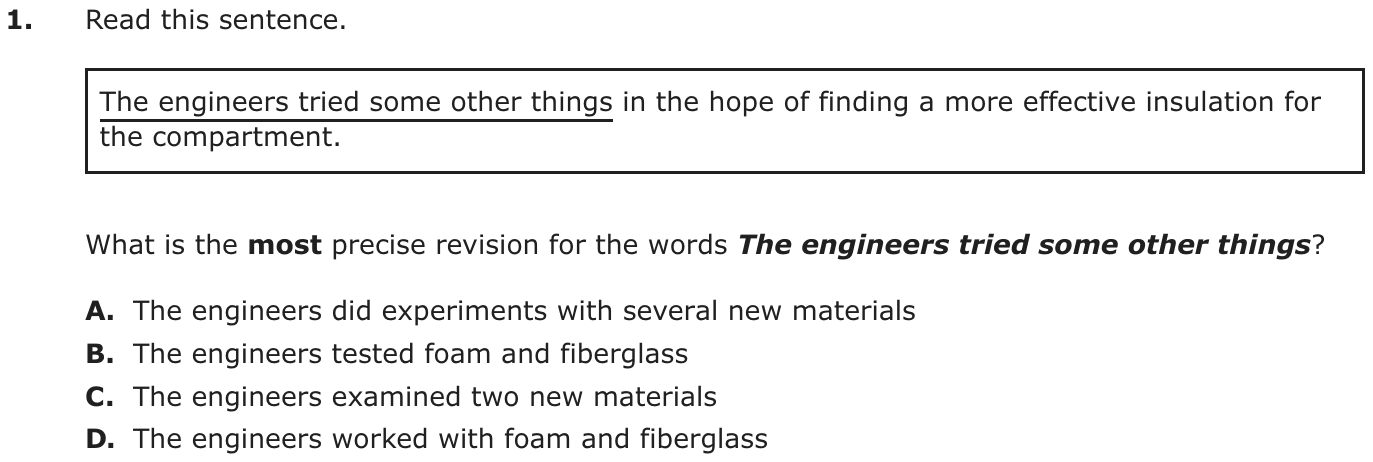
Read this sentence.
The engineers tried some other things in the hope of finding a more effective insulation for the compartment.
What is the most precise revision for the words The engineers tried some other things?
- AThe engineers did experiments with several new materials
- BThe engineers tested foam and fiberglass
- CThe engineers examined two new materials
- DThe engineers worked with foam and fiberglass
Show the answer
Correct answer: B
The question asks for the most precise revision for the words “The engineers tried some other things.”
A. Incorrect. This revision uses the word “materials” rather than precisely identifying what the engineers used.
B. CORRECT. This option revises the words to be more precise by using the specific words “tested” for the verb and “foam and fiberglass” for the materials.
C. Incorrect. This revision uses the word “examined” rather than a word indicating a process of experimental trial and error. The sentence also uses the word “materials” rather than precisely identifying what the engineers used.
D. Incorrect. This revision identifies the materials, but the imprecise verb “worked with” does not specify what the engineers were doing.
Question analysis
This revising question gives one sentence about engineers looking for better insulation for a compartment and asks which rewrite of its vague opening words is the most precise. The tricky part is that some choices sharpen one half of the phrase while leaving the other half as loose as the original.
- NYS standards
- 7L3a precise and concise language
- Grade level
- Grade 7 reading and task
- Compared with grade 7
- Below grade 7 Choosing precise wording is a grade 7 language standard, but this item is a single sentence about an engineering test with everyday words. Typical grade 7 revision asks for the same judgment across a paragraph or a full draft.
- Estimated difficulty
- Straightforward: two steps or one careful reading.
- Thinking it demands
- Depth of knowledge 1, recall and reproduction · mainly evaluate
- What makes it hard
- A very close wrong answer moderate
- Every choice must be checked minor
- Evidence
- Answered from one sentence or line
- Reading level
- Question and choices: about grade 7, 63 words.
- Students, last 30 days
- Not enough answers yet to show (it takes 10).
Why it is hard, traps and wrong answers (shows the answer)
Why it is hard
Precision here has two halves: a verb that names the actual activity and an object that names the actual materials. Most students who miss it stop at the first concrete detail they see, the named materials or the count of two, and never test the verb. Only one rewrite names both an exact action and the exact materials; each of the others leaves one half, or both, nearly as loose as the original.
A very close wrong answer moderate Choosing the answer
The rewrite with “worked with foam and fiberglass” matches the right one word for word except the verb, so only asking whether “worked with” says what the engineers did separates them. (Embretson & Wetzel, 1987; Gorin & Embretson, 2006; Ascalon et al., 2007)
Every choice must be checked minor Choosing the answer
The vague words have two parts, the action “tried” and the object “some other things,” and each rewrite sharpens a different part, so every one must be tested for both. (Embretson & Wetzel, 1987)
Strategy: Split the underlined words into the action and the things acted on, then ask of each revision whether a reader would know exactly what the engineers did and with what.
Traps
- Half right: One half of a two-part choice is right and the other is not.
- Wordy, vague or informal: A revision is grammatical but wordy, imprecise or too casual for the passage.
The wrong answers, classified
A Wordy, vague or informal (Connors & Lunsford, 1988)
Takes “did experiments with” as an exact verb, but the wordier phrase still ends in “several new materials,” which leaves the reader guessing what was tried.
C Wordy, vague or informal (Connors & Lunsford, 1988)
Treats the count “two” as precise detail, though the materials stay unnamed and “examined” suggests looking them over rather than trying them as insulation.
D Half right (King et al., 2004; Thissen, Steinberg & Fitzpatrick, 1989)
Sees that naming foam and fiberglass makes the object exact and stops there, missing that “worked with” is as vague as the original “tried.”
Working it out, step by step
Figure out what the question asks
This question is about precise language. Precise means exact and clear. The words “The engineers tried some other things” are vague. You can’t tell what the engineers did. You also can’t tell what they used. You need the rewrite that tells both.
Learn what makes words precise
Precise writing names the exact action and the exact thing. Vague: She did stuff with food. Precise: She baked bread.
The underlined words have two vague parts. The verb (the action word) is “tried.” The things are “some other things.” A good rewrite must fix both parts.
Think about what the sentence needs
The engineers want “a more effective insulation.” Insulation is material that keeps heat or cold from getting through. To find the best one, they would try out real materials and see how well each works. So the best verb says they tested. The best object names the materials.
Check each choice
- A is wrong. “Did experiments with” is wordy, and “several new materials” still doesn’t say which ones.
- B is right. “Tested” names the exact action. “Foam and fiberglass” names the exact materials.
- C is wrong. “Two new materials” gives a number but no names. “Examined” means looked over, not tried out.
- D is wrong. It names foam and fiberglass. But “worked with” is as vague as “tried.”
Watch out: D is tempting because it names the materials. Always check the verb too.
Choose the answer
Only B fixes both vague parts. The reader learns what the engineers did and what they used. So the answer is B: The engineers tested foam and fiberglass.
Why this answer and not the closest wrong one
D is the closest wrong answer. It matches B word for word except for the verb. “Worked with” could mean cut, built or studied. “Tested” tells you the engineers tried each material to see how well it insulates. That is what the sentence is about, so B is more precise.
More questions like this
The original DOE question
Question 2 of 120
2024 Test A English, question 3Question
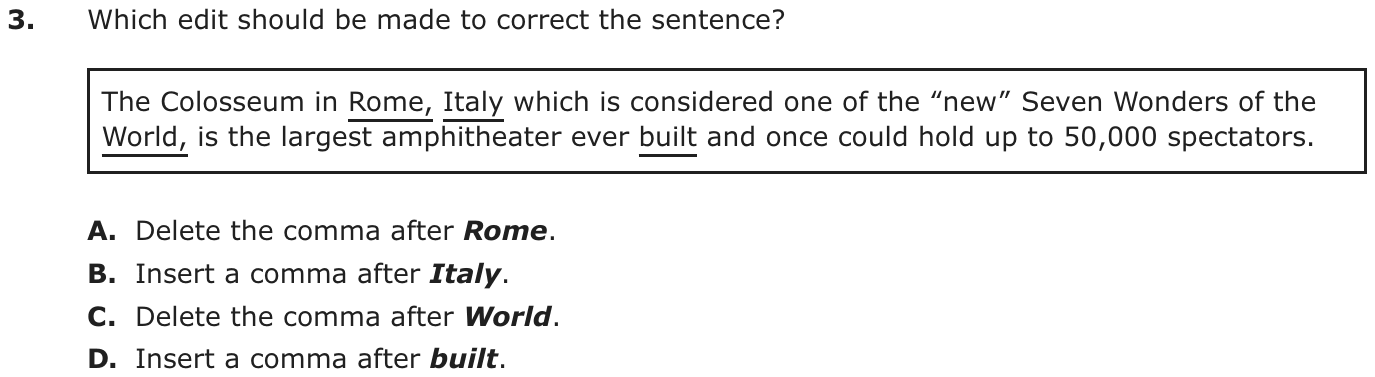
Which edit should be made to correct the sentence?
The Colosseum in Rome, Italy which is considered one of the “new” Seven Wonders of the World, is the largest amphitheater ever built and once could hold up to 50,000 spectators.
- ADelete the comma after Rome.
- BInsert a comma after Italy.
- CDelete the comma after World.
- DInsert a comma after built.
Show the answer
Correct answer: B
The question asks for the correction needed for an error in the sentence.
A. Incorrect. When a place name has more than one element, a comma is used to separate the elements for clarity.
B. CORRECT. The sentence needs a comma to set off the clause “which is considered one of the ‘new’ Seven Wonders of the World,” because the clause is not essential to the meaning of the sentence (nonrestrictive clause). This option is correct because it places a comma where it is needed, after “Italy,” to set off the nonrestrictive clause that follows.
C. Incorrect. This edit would remove the comma at the end of the nonrestrictive clause, which should be set off by commas at the beginning and the end.
D. Incorrect. A comma after “built” would separate the predicate “and once could hold up to 50,000 spectators” from the subject of the main clause. The predicates “is the largest amphitheater ever built” and “once could hold up to 50,000 spectators” both relate to the same subject (“The Colosseum in Rome, Italy”), so a comma should not be used to separate the second predicate from that subject.
Question analysis
This editing question gives one long sentence about the Colosseum in Rome and asks which comma edit corrects it. Students must know how commas work with a city and its country, with a descriptive clause beginning with which, and with two verbs that share one subject, because every choice adds or removes a comma.
- NYS standards
- 7L2 capitalization, punctuation, and spelling
- Grade level
- Grade 6 reading and task
- Compared with grade 7
- Below grade 7 Comma rules for place names and for extra information set off in a sentence are taught by grade 6. Here they are tested in one sentence with four marked spots, lighter than typical grade 7 editing of a whole paragraph.
- Estimated difficulty
- Straightforward: two steps or one careful reading.
- Thinking it demands
- Depth of knowledge 1, recall and reproduction · mainly apply
- What makes it hard
- A rule that doesn't sound wrong moderate
- Complex sentences minor
- Evidence
- Answered from one sentence or line
- Reading level
- Question and choices: about grade 6, 59 words.
- Students, last 30 days
- Not enough answers yet to show (it takes 10).
Why it is hard, traps and wrong answers (shows the answer)
Why it is hard
The which-clause has a closing comma after “World” but no opening one, and the sentence still sounds natural, so many students see the lone comma as the mistake instead of noticing its missing partner. Bracketing the extra description first, from “which” to “World,” exposes the gap quickly. The remaining choices fall to two rules students usually know: city and country are separated, and a second verb sharing the subject takes no comma.
A rule that doesn't sound wrong moderate Working it out
“Rome, Italy which is considered” reads smoothly aloud, yet the comma after “Italy” is needed twice over: to close the city-and-country pair and to open the nonessential which-clause. (Connors & Lunsford, 1988)
Complex sentences minor Understanding the question
Thirty-one words hold a two-part place name, a which-clause wedged between subject and verb, and two verbs, “is” and “once could hold,” sharing one subject, so each comma must be judged against that frame. (Abedi & Lord, 2001; Freedle & Kostin, 1993; Messick, 1989)
Strategy: Strip the sentence down to its main subject and verb, then check every marked spot against that core: what is the comma, or the missing comma, doing there?
Traps
- Punctuation: A comma, semicolon, colon, dash or apostrophe used where it does not belong, or missing where it does.
The wrong answers, classified
A Punctuation (Connors & Lunsford, 1988)
Treats “Rome, Italy” as a single name that should not be broken, not knowing that a comma always separates a city from the country that follows it.
C Punctuation (Connors & Lunsford, 1988)
Applies the sound rule against a comma between a subject and its verb to the comma before “is,” missing that it closes the which-clause and must stay.
D Punctuation (Connors & Lunsford, 1988)
Adds a pause before “and once could hold” because the sentence is long, though that second verb shares the subject, the Colosseum, and takes no comma.
Working it out, step by step
Figure out what the question asks
This is a punctuation question. Punctuation means marks like commas and periods. Four spots are underlined, at “Rome,” “Italy,” “World” and “built.” One edit fixes the sentence. Two comma rules decide it.
Learn the rule for extra information
Some groups of words just add an extra fact. If you take them out, the sentence still works. This is called a nonessential clause. A clause is a group of words with its own verb. A nonessential clause needs a comma before it and a comma after it, like a pair of brackets.
Example: Our school, which is very old, has a new gym. Without the middle part: Our school has a new gym.
Find the extra part
The extra part here starts at “which is considered” and ends at “of the World.” It adds a fun fact. Take it out and the sentence still works: The Colosseum in Rome, Italy, is the largest amphitheater ever built.
The comma after “World” closes the extra part. But nothing opens it. A comma is missing after “Italy.”
Learn the rule for places
A comma goes between a city and its country, as in “Rome, Italy.” If the sentence keeps going, put a comma after the country too. Example: She flew from Lima, Peru, to Miami.
So the comma after “Italy” is needed for two reasons. One comma does both jobs.
Check each choice
- A is wrong. The comma after “Rome” splits the city from the country. It must stay.
- B is right. It adds the missing comma that opens the extra part.
- C is wrong. The comma after “World” closes the extra part. Without it, neither end would be marked.
- D is wrong. The Colosseum “is the largest amphitheater” and “once could hold” many people. These are two verbs with one subject. No comma goes before the second verb. Example: Max swam fast and won a medal.
Watch out: C is tempting. A comma between a subject (who or what the sentence is about) and its verb is usually wrong. Here it is fine, because it is the second comma of a pair.
Choose the answer
With a comma after “Italy,” the extra part has a comma at each end. So the answer is B: insert a comma after Italy.
Why this answer and not the closest wrong one
C is the closest wrong answer. It treats the comma before “is” as the mistake. But that comma ends the extra part about the Seven Wonders. Delete it and nothing marks either end. B adds the missing opening comma, so both ends are marked.
More questions like this
The original DOE question
Question 3 of 120
2024 Test A English, question 4Question
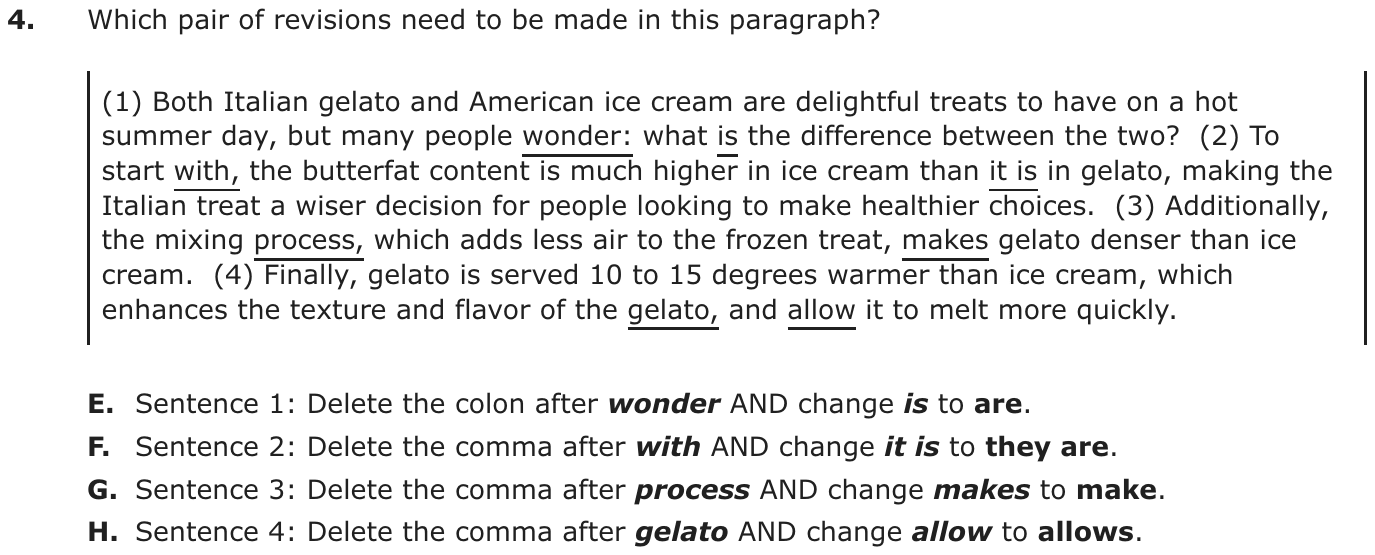
Which pair of revisions need to be made in this paragraph?
(1) Both Italian gelato and American ice cream are delightful treats to have on a hot summer day, but many people wonder: what is the difference between the two? (2) To start with, the butterfat content is much higher in ice cream than it is in gelato, making the Italian treat a wiser decision for people looking to make healthier choices. (3) Additionally, the mixing process, which adds less air to the frozen treat, makes gelato denser than ice cream. (4) Finally, gelato is served 10 to 15 degrees warmer than ice cream, which enhances the texture and flavor of the gelato, and allow it to melt more quickly.
- ASentence 1: Delete the colon after wonder AND change is to are.
- BSentence 2: Delete the comma after with AND change it is to they are.
- CSentence 3: Delete the comma after process AND change makes to make.
- DSentence 4: Delete the comma after gelato AND change allow to allows.
Show the answer
Correct answer: D
The question asks for the revisions that are needed to correct errors in the paragraph.
A. Incorrect. The revisions introduce new errors. The colon after “wonder” is needed to set off the question “what is the difference between the two?” from the rest of the sentence. In addition, changing the verb “is” to “are” would be incorrect with the use of the singular noun “difference,” which is the subject of the question.
B. Incorrect. The revisions introduce new errors. The comma following the introductory phrase “To start with” helps with clarity and is needed to separate the phrase from the rest of the sentence. Changing “it is” to “they are” would be incorrect with the use of the singular noun “butterfat content,” which is what the words “it is” refer to in the sentence.
C. Incorrect. The revisions introduce new errors. The comma following “process” is necessary to set off the nonrestrictive clause “which adds less air to the frozen treat” from the rest of the sentence. This clause is considered a nonrestrictive clause because it provides additional, but not essential, information about the mixing process. Changing the verb “makes” to “make” would be incorrect with the use of the singular noun “mixing process,” which is the subject of the sentence.
D. CORRECT. Deleting the comma after “gelato” would include the clause “and allow it to melt more quickly” with the first part of the clause “which enhances the texture and flavor of the gelato.” The word “and” between the two verb phrases (“enhances the texture and flavor of the gelato” and “allow it to melt more quickly”) indicates that the two verb phrases share a subject, “which” (referring to the act of serving gelato 10 to 15 degrees warmer than ice cream). The two ideas should not be separated by a comma within the clause. The entire clause “which enhances the texture and flavor of the gelato and allow it to melt more quickly” should be separated from the main clause only by the comma after “cream” because the entire clause is a nonrestrictive clause. This clause provides additional, but not essential, information about the purpose of serving gelato at a warmer temperature than ice cream. Changing the verb “allow” to “allows” is also necessary to match the use of the singular pronoun “which.”
Question analysis
This editing question gives a four-sentence paragraph comparing Italian gelato with American ice cream and asks which pair of revisions it needs. Students must check subject-verb agreement, what a pronoun refers to and whether each comma or colon belongs, and since every choice bundles two edits in one sentence, a single right-sounding change is not enough.
- Grade level
- Grade 7 reading and task
- Compared with grade 7
- At grade 7 Subject-verb agreement and commas around added clauses are grade 7 conventions. Eight marked spots across four long sentences make this a fuller check than a one-sentence item, but the demand is still typical of grade 7 editing.
- Estimated difficulty
- Moderate: several steps, or a close reading with one strong distractor.
- Thinking it demands
- Depth of knowledge 2, skills and concepts · mainly apply
- What makes it hard
- A rule that doesn't sound wrong moderate
- Every choice must be checked moderate
- Complex sentences minor
- Evidence
- Answered from one paragraph or stanza
- Reading level
- Question and choices: about grade 9, 160 words.
- Students, last 30 days
- Not enough answers yet to show (it takes 10).
Why it is hard, traps and wrong answers (shows the answer)
Why it is hard
The paragraph's only real errors sit at the end of its longest sentence, where a plural noun pair just before the faulty verb hides the mismatch. Students who do not hear “allow” as wrong start doubting correct marks instead, such as the colon before an embedded question or the comma after “To start with.” Every wrong pair also changes a verb or pronoun that already agrees, so reading each edit back into its sentence rules those pairs out.
A rule that doesn't sound wrong moderate Working it out
In sentence 4 the plural pair “texture and flavor” sits just before “and allow,” so the verb sounds right, but it belongs to “which,” the warmer serving, and must match “enhances.” (Connors & Lunsford, 1988)
Every choice must be checked moderate Choosing the answer
Each pair proposes two edits in one sentence, eight in all, and a pair is right only if both of its edits fix real errors, so every edit has to be tried in place. (Embretson & Wetzel, 1987)
Complex sentences minor Understanding the question
Sentence 4 hangs a which-clause with two verbs onto the main clause, and the comma before “and allow” splits that clause's compound predicate in a way few students hear as wrong. (Abedi & Lord, 2001; Freedle & Kostin, 1993; Messick, 1989)
Strategy: Before reading the choices, find each verb's true subject and test every marked comma yourself; then look for the choice whose two edits both fix errors you found.
Traps
- Fixes what isn't broken: Changes a part of the sentence that was already correct, while the real error stays; or, where the question asks which sentence has an error or should go, picks one that is correct and belongs.
- Agreement: A verb that does not agree with its subject, or a pronoun that does not agree with the word it stands for.
- Punctuation: A comma, semicolon, colon, dash or apostrophe used where it does not belong, or missing where it does.
The wrong answers, classified
A Agreement (Connors & Lunsford, 1988)
Hears “the two” as the subject and wants “are,” and distrusts a colon before a question, though “the difference” is singular and the colon is correct.
B Punctuation (Connors & Lunsford, 1988)
Believes a short opener like “To start with” needs no comma and accepts “they are,” though the pronoun stands for the singular “butterfat content.”
C Fixes what isn't broken (Connors & Lunsford, 1988)
Picks edits to a sentence that is already correct, unbalancing the commas around the which-clause and giving the singular “mixing process” a plural verb.
Working it out, step by step
Figure out what the question asks
Each choice offers two changes to one sentence. Both changes must fix real mistakes. If even one change breaks something that was right, the choice is wrong. So test every change in its own sentence.
Learn the rule for two verbs
A verb (an action word) must match its subject (who or what does the action). One thing takes allows. Two or more things take allow.
When one subject does two actions joined by “and,” no comma goes before “and.” Example: The sun warms the air and dries the grass. Both verbs end in s, because one sun does both.
Find the mistakes in sentence 4
Sentence 4 says gelato is served warmer than ice cream, “which enhances the texture and flavor of the gelato, and allow it to melt more quickly.”
“Which” stands for one thing: serving gelato warmer. That one thing does two actions. It “enhances” (improves) the texture and flavor. It also lets the gelato melt faster. So “allow” should be “allows,” to match “enhances.” And the comma before “and” must go.
Check each choice
- A is wrong. The colon (:) after “wonder” correctly leads into the question. And “is” matches “the difference,” which is one thing.
- B is wrong. The comma after “To start with” sets off an opening phrase. And “it is” stands for “the butterfat content,” which is one thing.
- C is wrong. The commas around “which adds less air to the frozen treat” come in a pair. And “makes” matches “the mixing process,” one thing.
- D is right. Both changes fix real mistakes.
Watch out: “The texture and flavor” comes right before “allow.” Those two things make “allow” sound right. But the subject is “which,” not “texture and flavor.”
Choose the answer
The fixed sentence ends: which enhances the texture and flavor of the gelato and allows it to melt more quickly. So the answer is D.
Why this answer and not the closest wrong one
A is the closest wrong answer. “The two” sits near “is,” so “are” can sound right. But the question asks what “the difference” is. A difference is one thing, so “is” is correct. A would add a mistake. In D, both changes fix mistakes that are really there.
More questions like this
The original DOE question
Question 4 of 120
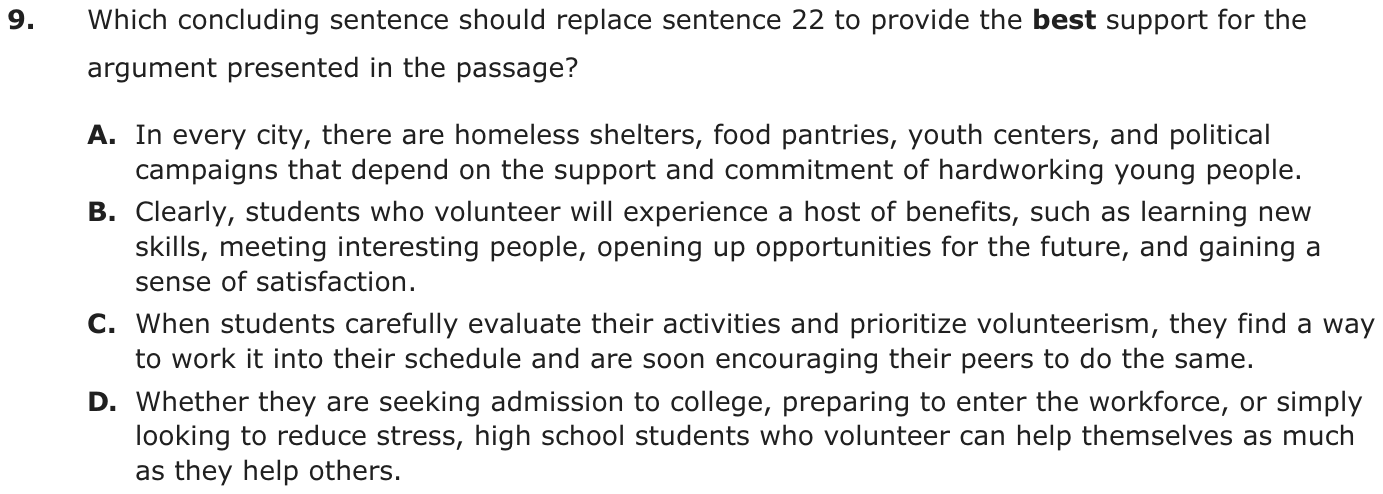
2024 Test A English, question 5Passage The Free College Debate
The Free College Debate
(1) A college degree has become an essential tool in an increasingly competitive job market. (2) Yet the price of higher education, at both private and public universities, continues to rise. (3) Helping students cover the cost of attending college is an important issue.
(4) Many people agree that a college education should be a financially realistic option for those who aspire to obtain a degree. (5) For example, in 2017, the New York State legislature passed a bill creating a program to cover the tuition costs for nearly one million students. (6) The state of Tennessee also has a program that offers all students scholarships and mentoring services if they attend one of the state’s community colleges. (7) Proponents generally believe that these programs are a step in the right direction for making college affordable for students who would have had to take out loans or who would have decided not to pursue higher education at all.
(8) On the other hand, some people oppose bills like the ones in New York and Tennessee because they believe “free” college programs are unsustainable. (9) In order to implement these types of programs, a state pays the college on behalf of the students using funds from the state’s budget, which primarily comes from state taxes. (10) As more students choose to attend college, more funds will be needed to cover the costs. (11) Additionally, many students do not finish college within four years because they switch majors or because they have to work. (12) Critics believe that these circumstances will inevitably lead to an increase in taxes, a decline in the quality of the education offered by the schools, or both. (13) They think narrower college-affordability efforts that target the students who need the most support, such as first-generation college students, may be more effective and viable solutions.
(14) Faculty and students at higher-education institutions can work to keep costs down. (15) In light of increased access to computers, mobile devices, and the Internet, there are more opportunities for students to take courses online, thus reducing the need for and cost of maintaining physical classrooms. (16) Additionally, colleges should account for experience by allowing students to demonstrate their knowledge in order to avoid having to pay to sit through classes on subjects they have already mastered. (17) Similarly, college-bound high school students need to be prepared for college-level work so that they do not have to spend money on remedial classes.
(18) The solutions to the problems associated with rising college costs are not simple. (19) Passing legislation that boosts college affordability will take time, input from experts with different ideas, and careful planning.
Question
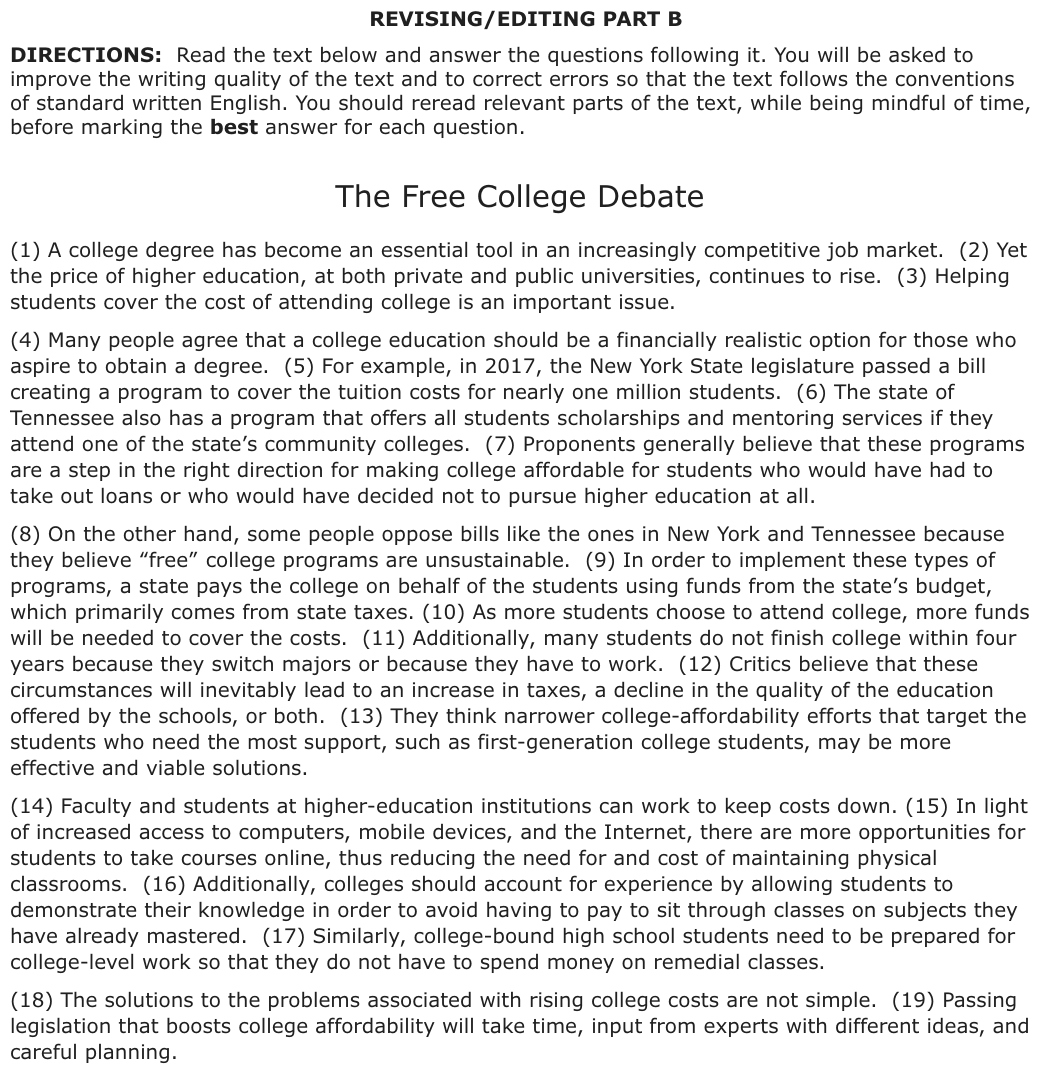
Which sentence should replace sentence 3 to best state the topic of the passage?
- ASeveral states have implemented scholarship programs that allow students to attend public universities and community colleges at a very low tuition rate or for free.
- BDetermining the most effective way to make college affordable is a complex issue, and there are differing opinions about how to approach the problem.
- CHigher-education institutions should reduce the cost of a college education by finding ways to help students avoid paying for unnecessary classes and materials.
- DThe main concern related to the issue of college affordability is that helping students cover tuition could affect the quality of the education they receive.
Show the answer
Correct answer: B
The question asks which sentence should replace sentence 3 to best state the topic of the passage.
A. Incorrect. Although this sentence mentions that “several states have implemented scholarship programs,” it does not clearly introduce the topic of the passage, which is differing opinions about and approaches to solving the problem of the cost of college.
B. CORRECT. This sentence best replaces sentence 3 because it clearly states the topic of “determining the most effective way to make college affordable.” It also provides an introduction to the “differing opinions” of proponents, who believe that states should provide low-cost or free tuition, and opponents, who believe that such state programs are “unsustainable” (sentence 8).
C. Incorrect. This sentence mentions the role of higher-education institutions in helping “reduce the cost of a college education” for students, which is an idea discussed in sentences 14 and 15 in the passage. Although the sentence provides details to support the topic of the passage by referring to “ways to help students avoid paying for unnecessary classes and materials,” it does not state the topic, which is differing opinions about and approaches to solving the problem of the cost of college.
D. Incorrect. Even though this sentence mentions “college affordability,” it is primarily focused on a problem that is related to, but different from, the issue discussed in the passage. The passage is concerned with “the price of higher education” (sentence 2), not how tuition rates “affect the quality of the education [students] receive.”
Question analysis
This revising question uses a passage about the rising cost of college and state programs that cover tuition, and asks which sentence should replace sentence 3 to state the passage's topic. Every choice is about college affordability, so students must tell a sentence that covers the whole passage from one that fits a single paragraph.
- NYS standards
- 7W2a introducing and organizing a topic
- Grade level
- Grade 7 reading and task
- Compared with grade 7
- At grade 7 Choosing a sentence that states a passage's topic is core grade 7 writing work. The passage is formal and five paragraphs long, but each paragraph opens by signalling its part of the subject, so the demand is typical.
- Estimated difficulty
- Straightforward: two steps or one careful reading.
- Thinking it demands
- Depth of knowledge 2, skills and concepts · mainly evaluate
- What makes it hard
- Evidence in several places moderate
- The right answer is reworded minor
- Evidence
- Answered from the whole text
- Reading level
- Passage: about grade 12, 427 words; question and choices: about grade 14, 110 words.
- Corrected from the DOE handbook
- A grammar slip in the explanation was corrected.
- Students, last 30 days
- Not enough answers yet to show (it takes 10).
Why it is hard, traps and wrong answers (shows the answer)
Why it is hard
The replacement must cover a passage that argues both sides of free college and then turns to campus cost-cutting, so a sentence about any one part falls short. Students most often take the state scholarship programs for the topic, because those programs fill the two middle paragraphs. Summing up each paragraph in a few words before reading the choices shows that only a sentence about the debate over how to make college affordable fits them all.
Evidence in several places moderate Working it out
The topic shows only across all five paragraphs: supporters of state programs in sentences 4–7, critics in 8–13, campus cost-cutting in 14–17, and the closing warning that solutions are not simple. (Kirsch & Mosenthal, 1990; Gorin & Embretson, 2006)
The right answer is reworded minor Choosing the answer
The right sentence says “complex issue” and “differing opinions,” words the passage never uses, while wrong ones echo its “scholarship,” “community colleges” and “helping students cover.” (Freedle & Kostin, 1993; Kirsch & Mosenthal, 1990)
Strategy: Note in a few words what each of the five paragraphs does, then choose the sentence that would prepare a reader for all of them rather than for one paragraph's details.
Traps
- Too narrow: A single detail offered as the central idea or a summary, or a summary that keeps minor details and leaves out an essential part.
- Off the point: Adds or keeps something that does not support the paragraph's or the passage's focus, or an introduction or conclusion that misses the main point.
The wrong answers, classified
A Too narrow (King et al., 2004)
Picks the state scholarship programs, which do fill paragraphs 2 and 3, but they are what the two sides argue about, not a topic that also covers paragraph 4.
C Too narrow (King et al., 2004)
Takes paragraph 4's cost-cutting ideas, such as not paying for classes already mastered, as the topic, though they are one approach among several and leave out the debate over state programs.
D Off the point (Halliday & Hasan, 1976)
Echoes the original sentence's “helping students cover” and sounds like a thesis, but it makes the passage about quality, which comes up once, among the critics' fears in sentence 12.
What was corrected from the DOE handbook, and why
- Explanation: In its reason for rejecting choice C, the handbook reads “which is a idea discussed in sentences 14 and 15.” It now reads “an idea.”
Working it out, step by step
Figure out what the question asks
The new sentence 3 should state the topic of the whole passage. The topic is what the passage is about overall. So the sentence must fit every paragraph, not just one part.
Sum up each paragraph
- Paragraph 1 (sentences 1–3): college matters, but it keeps costing more.
- Paragraph 2 (sentences 4–7): some people support state programs that pay for college.
- Paragraph 3 (sentences 8–13): critics say those programs can’t last.
- Paragraph 4 (sentences 14–17): colleges and students can cut costs.
- Paragraph 5 (sentences 18–19): the solutions “are not simple.”
Find the big idea
Put together, the passage is about one problem: how to make college affordable. Affordable means cheap enough to pay for. People disagree about the best way to do it. And the answers are not simple. The right sentence should say that.
Check each choice
- A is wrong. State programs fill paragraphs 2 and 3. But they are only what people argue about. A says nothing about the critics or about cutting costs.
- B is right. “A complex issue” and “differing opinions” cover the whole debate.
- C is wrong. Not paying for classes you don’t need is an idea from paragraph 4 only.
- D is wrong. The worry about quality comes up just once, in sentence 12.
Watch out: A is tempting because the state programs take up so much space. But a topic must cover all of the passage.
Choose the answer
B prepares the reader for both sides of the debate and for the cost-cutting ideas too. So the answer is B.
Why this answer and not the closest wrong one
A is the closest wrong answer. It names the state scholarship programs, which fill two paragraphs. But those programs are one thing people argue about, not the whole topic. A leaves out the critics and the ways to cut costs. B calls the issue “complex” and says opinions differ. That fits every paragraph.
More questions like this
The original DOE question
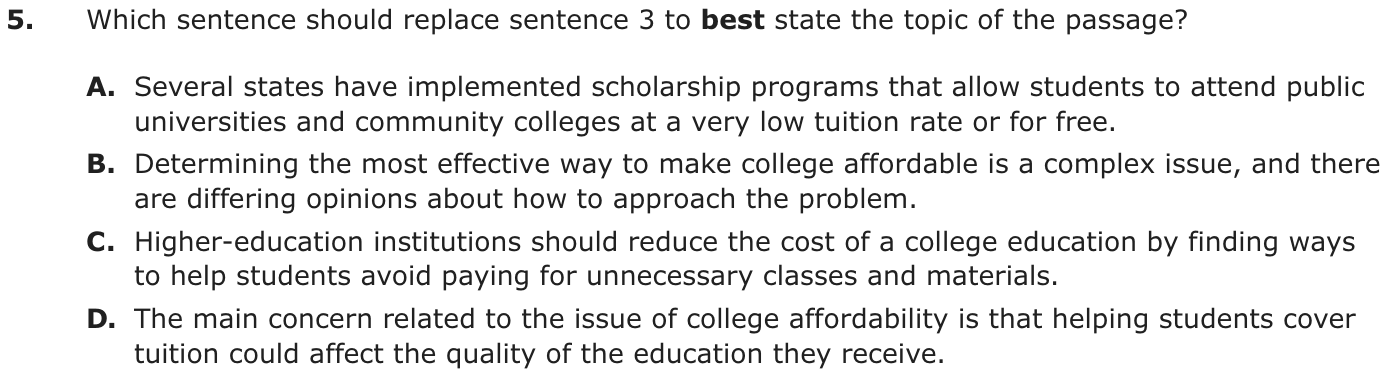
The passage “The Free College Debate” as printed (page 38)
Question 5 of 120
2024 Test A English, question 6Uses the passage above: “The Free College Debate”.
Question
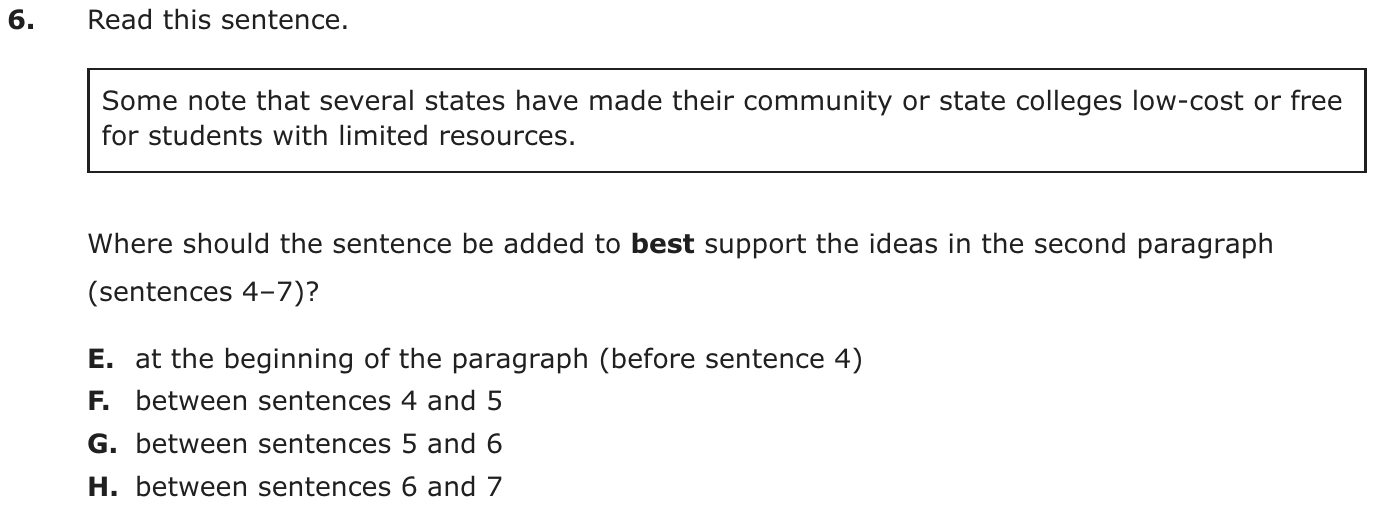
Read this sentence.
Some note that several states have made their community or state colleges low-cost or free for students with limited resources.
Where should the sentence be added to best support the ideas in the second paragraph (sentences 4–7)?
- Aat the beginning of the paragraph (before sentence 4)
- Bbetween sentences 4 and 5
- Cbetween sentences 5 and 6
- Dbetween sentences 6 and 7
Show the answer
Correct answer: B
The question asks where the sentence should be added to best support the ideas in the second paragraph (sentences 4–7).
A. Incorrect. Sentence 4 introduces the main idea of the second paragraph (making college “a financially realistic option for those who aspire to obtain a degree”) and should not be preceded by the added sentence, which focuses more narrowly on the specific ways that some states are implementing that idea.
B. CORRECT. The added sentence provides a proposed solution to the issue stated in sentence 4, that “a college education should be a financially realistic option.” Sentence 5 is an example of the programs discussed in the added sentence.
C. Incorrect. Sentences 5 and 6 offer examples of state governments providing “low-cost or free” tuition. The added sentence introduces this idea in the second paragraph and should come before these specific examples are provided as evidence.
D. Incorrect. Sentence 6 provides an example of the state government of Tennessee providing “low-cost or free” tuition, and sentence 7 further explains the opinion of those in favor of such programs (“a step in the right direction for making college affordable”). However, the ideas in sentences 6 and 7 follow from and support the idea in the added sentence. Therefore, the added sentence should be placed before sentences 6 and 7, which help elaborate its idea.
Question analysis
This revising question gives a sentence noting that several states have made public colleges low-cost or free and asks where it best fits in the paragraph about making college financially realistic. Students must follow how the paragraph moves between general claims and specific examples, since the sentence reads smoothly in more than one place.
- NYS standards
- 7W2a introducing and organizing a topic
- Grade level
- Grade 7 reading and task
- Compared with grade 7
- At grade 7 Placing a sentence so ideas follow logically is grade 7 writing work. The paragraph is only four sentences long and the four positions sit side by side, so this matches a typical grade 7 revision task.
- Estimated difficulty
- Moderate: several steps, or a close reading with one strong distractor.
- Thinking it demands
- Depth of knowledge 2, skills and concepts · mainly analyze
- What makes it hard
- How sentences fit together moderate
- Every choice must be checked moderate
- Evidence
- Answered from one paragraph or stanza
- Reading level
- Passage: about grade 12, 427 words; question and choices: about grade 6, 56 words.
- Students, last 30 days
- Not enough answers yet to show (it takes 10).
Why it is hard, traps and wrong answers (shows the answer)
Why it is hard
This is a general-before-specific question disguised by smooth reading: the added sentence fits grammatically anywhere in the paragraph. What decides it is that New York and Tennessee are examples of states making college low-cost or free, so the claim belongs before them and after sentence 4's broader belief. Students who place it as a summary before “these programs” have noticed a real link but put the claim after its own evidence.
How sentences fit together moderate Working it out
Sentence 5 opens “For example” and sentence 6 says Tennessee “also” has a program, so the claim about several states must come right before the New York example it introduces. (Halliday & Hasan, 1976)
Every choice must be checked moderate Choosing the answer
The new sentence reads smoothly in all four spots, even after the examples, where sentence 7's “these programs” seems to point back to it, so each position has to be tried in context. (Embretson & Wetzel, 1987)
Strategy: Decide whether the new sentence is a general statement or a specific example, then read the paragraph with it in each position and check that every example follows what it illustrates.
Traps
- Sentence in the wrong place: Puts a sentence where it breaks the order of ideas or separates it from what it refers to.
The wrong answers, classified
A Sentence in the wrong place (Halliday & Hasan, 1976)
Rightly treats the new sentence as general, then makes it the opener, ahead of sentence 4, the broader belief that college should be financially realistic.
C Sentence in the wrong place (Halliday & Hasan, 1976)
Drops the claim about several states between the New York and Tennessee examples, splitting the pair and leaving the first example without the statement it illustrates.
D Sentence in the wrong place (Halliday & Hasan, 1976)
Sees that sentence 7's “these programs” could refer back to the new sentence, but placed there it only restates what the New York and Tennessee examples have shown.
Working it out, step by step
Figure out what the question asks
You need the best place for a new sentence in paragraph 2. First ask: is it a general idea or a specific example? A general idea usually comes before the examples that show it.
Look at the new sentence
The new sentence says “several states have made their community or state colleges low-cost or free.” It does not name any state. So it is a general claim. A claim is a statement that something is true.
Look at sentences 4 to 7
- Sentence 4 is the paragraph’s main idea. College should be “a financially realistic option,” or something people can afford.
- Sentence 5 starts “For example” and names New York.
- Sentence 6 says Tennessee “also has a program.”
- Sentence 7 tells what supporters think of “these programs.”
New York and Tennessee are two of the “several states.” So the new sentence belongs right before them.
Check each choice
- A is wrong. Sentence 4 is the broader main idea, so it should stay first.
- B is right. The claim comes after the main idea. Then “For example” leads into New York.
- C is wrong. It splits New York and Tennessee, two examples that belong together.
- D is wrong. It puts the claim after both of the examples that show it.
Watch out: D is tempting, since “these programs” in sentence 7 could point back to it. But there the claim would just repeat what the examples already showed.
Choose the answer
The order should be main idea, then claim, then examples. So the answer is B, between sentences 4 and 5.
Why this answer and not the closest wrong one
D is the closest wrong answer, because the sentence reads smoothly there too. But a general claim should come before the examples that prove it. In B, the reader first hears about “several states.” Then “For example” brings in New York, and Tennessee follows.
More questions like this
The original DOE question
Question 6 of 120
2024 Test A English, question 7Uses the passage above: “The Free College Debate”.
Question
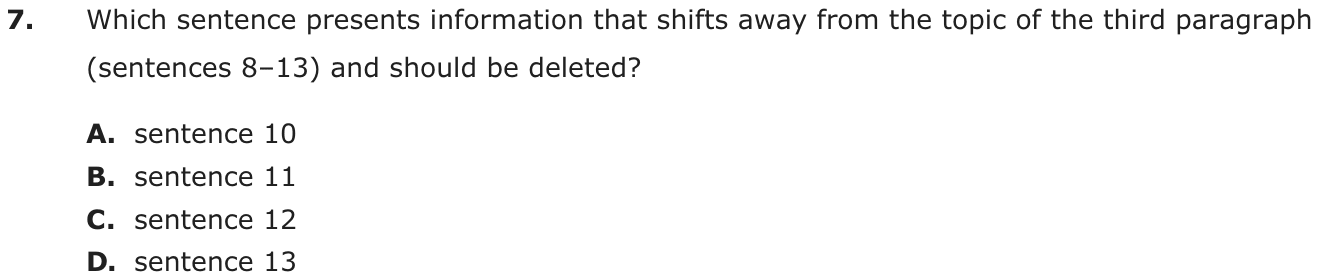
Which sentence presents information that shifts away from the topic of the third paragraph (sentences 8–13) and should be deleted?
- Asentence 10
- Bsentence 11
- Csentence 12
- Dsentence 13
Show the answer
Correct answer: B
The question asks which sentence presents information that shifts away from the topic of the third paragraph (sentences 8–13) and should be deleted.
A. Incorrect. Sentence 9 explains that scholarship funding comes “from the state’s budget, which primarily comes from state taxes.” Sentence 10 logically follows the idea in sentence 9 by explaining that “as more students choose to attend college, more funds will be needed to cover the costs.” Therefore, sentence 10 should not be deleted, because it does not shift away from the topic of the paragraph.
B. CORRECT. Sentence 10 makes the claim that “as more students choose to attend college, more funds will be needed to cover the costs.” Sentence 11 shifts away from this topic by focusing on how switching majors or working affects students’ ability to finish college, rather than on the additional funds that will be needed for scholarship programs. Therefore, sentence 11 should be deleted.
C. Incorrect. Sentence 9 states that scholarship program funding comes “from the state’s budget, which primarily comes from state taxes.” Sentence 10 points out that “as more students choose to attend college, more funds will be needed to cover the costs.” Sentence 12 elaborates on the critics’ opinions discussed in sentences 8–10. It reflects the belief that the “circumstances” described in sentences 9 and 10 “will inevitably lead to an increase in taxes, a decline in the quality of the education offered by the schools, or both.” Thus, sentence 12 should not be deleted, because it does not shift away from the topic of the paragraph.
D. Incorrect. Sentence 13 refers back to the “critics” mentioned in sentence 12 and expands on the critics’ concern about increased taxes mentioned in sentence 12 by stating that “narrower college-affordability efforts . . . may be more effective and viable solutions.” Therefore, sentence 13 should not be deleted because it logically follows the ideas in sentence 12 and serves as a concluding sentence for the paragraph.
Question analysis
This revising question asks which sentence in the paragraph about critics of free-college programs shifts away from the paragraph's topic and should be deleted. All four listed sentences mention students, funding or taxes, so students must follow the critics' chain of reasoning and find the sentence that does not advance it.
- NYS standards
- 7W2b developing a topic
- Grade level
- Grade 7 reading and task
- Compared with grade 7
- At grade 7 Cutting a sentence that strays from a paragraph's focus is standard grade 7 writing work. This paragraph is a six-sentence argument with formal words such as unsustainable and viable, which is typical of grade 7 revision passages.
- Estimated difficulty
- Moderate: several steps, or a close reading with one strong distractor.
- Thinking it demands
- Depth of knowledge 2, skills and concepts · mainly analyze
- What makes it hard
- How sentences fit together moderate
- Every choice must be checked minor
- Evidence
- Answered from one paragraph or stanza
- Reading level
- Passage: about grade 12, 427 words; question and choices: about grade 6, 23 words.
- Students, last 30 days
- Not enough answers yet to show (it takes 10).
Why it is hard, traps and wrong answers (shows the answer)
Why it is hard
Sentence 11 is camouflaged: it starts with a linking word, and a reader can argue that students who take longer to finish cost the state more. The paragraph, though, is about funding and taxes, and sentence 11 turns to why students switch majors or work. Students who cut sentence 13 sense a move toward solutions, but it still voices the critics, and the question rewards checking that each other sentence advances their case.
How sentences fit together moderate Working it out
Sentence 11 opens with “Additionally,” and sentence 12's “these circumstances” can be read as gathering it in, so the stray sentence looks attached to the critics' argument. (Halliday & Hasan, 1976)
Every choice must be checked minor Choosing the answer
Because sentence 11 can be defended, the answer comes mainly from confirming that sentences 10, 12 and 13 each carry the critics' case, which means testing every listed sentence. (Embretson & Wetzel, 1987)
Strategy: State the critics' argument in a few words, then check whether each listed sentence adds a link to that argument or turns aside to a different issue.
Traps
- Fixes what isn't broken: Changes a part of the sentence that was already correct, while the real error stays; or, where the question asks which sentence has an error or should go, picks one that is correct and belongs.
The wrong answers, classified
A Fixes what isn't broken (Connors & Lunsford, 1988)
Cuts sentence 10 as a loose prediction, though more students needing more funds is the link between state funding in sentence 9 and the critics' fear of higher taxes.
C Fixes what isn't broken (Connors & Lunsford, 1988)
Removes sentence 12 as mere opinion, though it states the critics' conclusion, higher taxes or lower quality, which the whole paragraph builds toward.
D Fixes what isn't broken (Connors & Lunsford, 1988)
Senses a turn when the critics propose “narrower college-affordability efforts,” but sentence 13 still reports what “They think,” completing their case rather than leaving it.
Working it out, step by step
Figure out what the question asks
Paragraph 3 (sentences 8–13) has one topic. One sentence wanders away from it. You need to find that sentence. First, say the paragraph’s topic in a few words.
Find the topic of paragraph 3
Sentence 8 says some people think “free” college programs are “unsustainable.” That means they can’t keep going for long. The reason is money. The state pays with tax money (sentence 9). More students means more money is needed (sentence 10). Critics fear higher taxes or worse schools (sentence 12). They want smaller programs instead (sentence 13).
Look at sentence 11
Sentence 11 says many students take more than four years “because they switch majors or because they have to work.” A major is the main subject a student studies. This sentence is about why students take longer. It never says what that costs the state or how it affects taxes. It moves away from the critics’ money argument.
Check each choice
- A is wrong. Sentence 10 links state money to the critics’ fears: more students, more costs.
- B is right. Sentence 11 turns to students’ reasons for taking longer.
- C is wrong. Sentence 12 gives the critics’ main fear: higher taxes or worse schools.
- D is wrong. Sentence 13 still tells what the critics think. It finishes their argument.
Watch out: Sentence 13 brings up a different plan, so D is tempting. But it begins “They think,” so it is still the critics talking.
Choose the answer
Without sentence 11, the paragraph moves smoothly from more costs to higher taxes. So the answer is B, sentence 11.
Why this answer and not the closest wrong one
D is the closest wrong answer, because sentence 13 talks about a different plan. But that plan belongs to the critics, so it stays on topic. Sentence 11 starts with “Additionally,” which makes it look like part of the argument. Yet it talks about switching majors and having jobs, not about the cost to the state.
More questions like this
The original DOE question
Question 7 of 120
2024 Test A English, question 8Uses the passage above: “The Free College Debate”.
Question
Which phrase should be added before sentence 14 to best transition to the ideas in the fourth paragraph (sentences 14–17)?
- ABecause college affordability is a complicated issue,
- BWith so many opinions about how to make college affordable,
- CUntil college becomes more affordable,
- DAlthough some college affordability programs have been successful,
Show the answer
Correct answer: C
The question asks which phrase should be added before sentence 14 to best transition to the ideas in the fourth paragraph (sentences 14–17).
A. Incorrect. Sentence 13 summarizes the viewpoint of opponents, who believe that targeted approaches to funding education “may be more effective and viable solutions,” and sentence 14 serves to introduce how “faculty and students at higher-education institutions can work to keep costs down.” Affordability is “a complicated issue,” but the use of the word “Because” suggests that the ideas that follow in sentences 14–17 will explain a cause-and-effect relationship. However, sentences 14–17 discuss ways faculty and students should work together to keep the cost of college down while waiting for a long-term solution to the problem, not a causal relationship.
B. Incorrect. Sentences 4–13 provide information about the viewpoint of proponents, who believe that “a college education should be a financially realistic option for those who aspire to obtain a degree” (sentence 4), and opponents, who believe free college programs are “unsustainable” (sentence 8). Although the phrase in this option mentions “opinions,” it indicates that the fourth paragraph will discuss why the number of opinions makes affordability a debatable issue. Instead, the fourth paragraph discusses ways faculty and students can help keep costs down until a solution is reached.
C. CORRECT. Sentence 13 summarizes the viewpoint of opponents, who believe that targeted approaches to funding education “may be more effective and viable solutions,” while proponents “generally believe that these [government] programs are a step in the right direction for making college affordable” (sentence 7). However, sentences 14–17 offer three possible solutions that could alleviate the problem in the meantime. Therefore, the phrase in this option should be added before sentence 14 to best transition to the ideas in the fourth paragraph because it suggests that until the issue of affordability is resolved, alternatives are available to help make a college education more affordable.
D. Incorrect. This phrase mentions “college affordability,” a topic discussed in the fourth paragraph. However, the ideas introduced in the phrase do not logically lead into the ideas discussed in sentences 14–17, because the phrase mentions “programs [that] have been successful,” whereas the paragraph states that “faculty and students at higher-education institutions can work to keep costs down” (sentence 14) and that colleges “should account for experience by allowing students to demonstrate their knowledge in order to avoid having to pay to sit through classes on subjects they have already mastered” (sentence 16). Use of the words “can” and “should” in these sentences indicates that the actions or programs mentioned in the paragraph have not been completed.
Question analysis
This revising question asks which introductory phrase should begin the fourth paragraph of a passage on college affordability, linking the debate over state tuition programs to the cost-saving ideas that follow. All four phrases sound natural, so students must work out the relationship between the paragraphs and choose the phrase that signals it accurately.
- NYS standards
- 7W2d transitions in informative writing
- Grade level
- Grade 8 reading and task
- Compared with grade 7
- Above grade 7 Grade 7 transition work usually links two sentences with a word such as however. Here the choices are whole phrases that set up an entire paragraph, and judging them needs a grasp of the full argument, which asks more than typical grade 7 work.
- Estimated difficulty
- Hard: combines ideas, needs a plan, and has more than one tempting wrong answer.
- Thinking it demands
- Depth of knowledge 3, strategic thinking · mainly evaluate
- What makes it hard
- How sentences fit together major
- Reading between the lines moderate
- Every choice must be checked minor
- Evidence
- Answered from several paragraphs or stanzas
- Reading level
- Passage: about grade 12, 427 words; question and choices: about grade 10, 48 words.
- Students, last 30 days
- Not enough answers yet to show (it takes 10).
Why it is hard, traps and wrong answers (shows the answer)
Why it is hard
Every phrase sounds like a reasonable bridge, and the right one can even seem odd at first, since cutting costs is itself a way to make college affordable. The key is seeing paragraph 4 as what campuses can do while the debate over state programs goes on, a reading the passage confirms only at its end. Students who link back to the many opinions, or accept a causal “Because,” have found real ideas from the passage but not the relationship between these two paragraphs.
How sentences fit together major Working it out
The phrase must link paragraph 3's case against state programs to paragraph 4's steps that “can work to keep costs down,” steps that make sense only as help in the meantime. (Halliday & Hasan, 1976)
Reading between the lines moderate Working it out
Nothing says paragraph 4's ideas are stopgaps; that has to be inferred from sentences 18 and 19, which say the solutions “are not simple” and “will take time.” (Graesser, Singer & Trabasso, 1994; Kintsch, 1998)
Every choice must be checked minor Choosing the answer
All four phrases are grammatical and about affordability, so each must be read into sentence 14 and judged by the relationship its first word signals. (Embretson & Wetzel, 1987)
Strategy: Sum up paragraphs 3 and 4 in a few words each, decide how the second relates to the first, then test the relationship each phrase's opening word signals.
Traps
- Wrong transition: A connecting word or phrase that signals the wrong relationship, such as contrast where the idea continues.
The wrong answers, classified
A Wrong transition (Halliday & Hasan, 1976)
Agrees that affordability is complicated, as sentence 18 says, but “Because” makes the complexity the reason faculty and students can cut costs, a cause the paragraph never gives.
B Wrong transition (Halliday & Hasan, 1976)
Rightly looks back to the clashing views of paragraphs 2 and 3, but offers the disagreement as the ground for the steps instead of marking them as help until a solution arrives.
D Wrong transition (Halliday & Hasan, 1976)
Hears “Although” as a natural turn to a new idea, but the passage never says any program has succeeded, and paragraph 4 does not set its steps against such programs.
Working it out, step by step
Figure out what the question asks
You need a phrase to start sentence 14. It should work as a transition: a word or phrase that shows how two ideas connect. Words like “because,” “although” and “until” each show a different link. So first work out how paragraph 4 connects to what came before.
Compare paragraphs 3 and 4
Paragraph 3 ends with the critics’ view of state programs. People still disagree, so there is no fix everyone accepts yet. Paragraph 4 then says “Faculty and students at higher-education institutions can work to keep costs down.” Faculty means teachers. The paragraph lists ways to do it: online classes, skipping classes you’ve mastered, and getting ready in high school.
Use the ending as a clue
Sentences 18 and 19 say the solutions “are not simple” and “will take time.” So a big fix is still far off. That makes paragraph 4’s ideas things to do in the meantime, while people wait. The phrase “Until college becomes more affordable” says exactly that.
Check each choice
- A is wrong. “Because” shows a cause. The issue being complicated is not the reason teachers can cut costs.
- B is wrong. It makes the many opinions the reason for the steps. The passage never links them that way.
- C is right. “Until” shows these are steps to take while waiting for a bigger fix.
- D is wrong. The passage never says any program has been successful.
Watch out: B looks back at the many opinions, which really are in the passage. But it doesn’t show how paragraph 4 relates to paragraph 3.
Choose the answer
Sentence 14 would read: Until college becomes more affordable, faculty and students at higher-education institutions can work to keep costs down. So the answer is C.
Why this answer and not the closest wrong one
B is the closest wrong answer, because the passage does share many opinions. But “With so many opinions” makes the opinions sound like the reason for the cost-cutting steps. They are not. C shows the steps are help for now, while the bigger problem waits to be solved.
More questions like this
The original DOE question
Question 8 of 120
2024 Test A English, question 9Uses the passage above: “The Free College Debate”.
Question
Which concluding sentence should be added after sentence 19 to support the topic of the passage?
- AThe increasing use of technology in college classrooms and the financial support from tuition scholarship programs will make colleges more affordable for many students.
- BStatewide tuition scholarship programs will make college more affordable for many students, but these programs may lead to new problems.
- CUntil the problems associated with the rising cost of college are solved, many students will pursue other options after graduating high school.
- DWhen the issue of college affordability is resolved, students will be able to make decisions about pursuing higher education without cost being the deciding factor.
Show the answer
Correct answer: D
The question asks which concluding sentence should be added after sentence 19 to support the topic of the passage.
A. Incorrect. Although sentence 15 cites “increased access to computers, mobile devices, and the Internet” and states that “there are more opportunities for students to take courses online, thus reducing the need for and cost of maintaining physical classrooms,” the primary topic discussed throughout the passage is that making college affordable is a complex issue on which people hold differing opinions, and sentences 18 and 19 stress that the solutions “are not simple” and “will take time.” The option instead states that technology and scholarship programs will make colleges more affordable. Therefore, the sentence should not be added after sentence 19, because it does not support the topic.
B. Incorrect. Sentence 5 presents the example of the New York State legislature, which “passed a bill creating a program to cover the tuition costs for nearly one million students.” Sentence 12 states that critics of this type of program believe that certain circumstances “will inevitably lead to an increase in taxes” or other issues such as low-quality education. However, the option covers only the statewide programs and their critics (sentences 4–13). It leaves out the ways faculty and students can keep costs down (sentences 14–17) and the closing point that solutions will take time and careful planning (sentences 18 and 19). Therefore, the sentence should not be added after sentence 19, because it does not support the topic.
C. Incorrect. Although sentence 7 states that scholarship programs are helpful “for students who would have had to take out loans or who would have decided not to pursue higher education at all,” the passage does not state that many students will stop pursuing higher education until the affordability issues are solved. In fact, sentence 14 states that there are ways faculty and students can “work to keep costs down.” Therefore, the sentence should not be added after sentence 19, because it does not support the topic.
D. CORRECT. The sentence in this option should be added after sentence 19 to support the topic because it acknowledges that the issue of college affordability discussed throughout the passage is not “resolved” but that when it is, students will be able to make decisions about attending college without concerns about cost. Sentence 18 states that “the solutions to the problems associated with rising college costs are not simple,” and sentence 19 adds that “passing legislation that boosts college affordability will take time,” ideas, and planning.
Question analysis
This revising question asks which concluding sentence should be added after the final sentence of a passage about the debate over making college affordable. Students must keep the whole passage in view and pick the ending that follows from its last paragraph, because several choices repeat real details or offer predictions that sound reasonable.
- NYS standards
- 7W2e concluding informative writing
- Grade level
- Grade 7 reading and task
- Compared with grade 7
- At grade 7 Choosing a conclusion that follows from a passage's central idea is standard grade 7 writing work. The passage is five formal paragraphs that present two sides and then practical steps, which the student must hold together, a typical grade 7 challenge.
- Estimated difficulty
- Moderate: several steps, or a close reading with one strong distractor.
- Thinking it demands
- Depth of knowledge 2, skills and concepts · mainly evaluate
- What makes it hard
- Evidence in several places moderate
- How sentences fit together minor
- Evidence
- Answered from the whole text
- Reading level
- Passage: about grade 12, 427 words; question and choices: about grade 13, 106 words.
- Corrected from the DOE handbook
- The explanation misstated the topic of the passage; that sentence was corrected.
- An inaccurate statement about the passage in the explanation was corrected.
- Students, last 30 days
- Not enough answers yet to show (it takes 10).
Why it is hard, traps and wrong answers (shows the answer)
Why it is hard
The strongest wrong ending is a fair summary of the passage's middle, the state programs and their critics, so it feels like a conclusion. It falls short because it drops the campus steps and the closing point that solutions are slow and complicated. Other endings echo the final paragraph's words or bundle two solutions into a promise, and students who keep the passage's caution in mind reject those quickly.
Evidence in several places moderate Working it out
Judging an ending means holding the whole passage: the debate over state programs in sentences 4–13, the campus cost-cutting in 14–17, and the warning in 18–19 that solutions take time. (Kirsch & Mosenthal, 1990; Gorin & Embretson, 2006)
How sentences fit together minor Working it out
The new sentence follows “will take time,” so an ending that looks ahead to when the problem “is resolved” continues the thought, while a confident promise of affordability contradicts it. (Halliday & Hasan, 1976)
Strategy: State the passage's topic and its final point in your own words, then test each ending: does it follow from both, or does it bring in a claim the passage never supports?
Traps
- Too narrow: A single detail offered as the central idea or a summary, or a summary that keeps minor details and leaves out an essential part.
- Too broad or too strong: A choice overstates, generalizes, or uses absolute words the text does not support.
- Off the point: Adds or keeps something that does not support the paragraph's or the passage's focus, or an introduction or conclusion that misses the main point.
The wrong answers, classified
A Too broad or too strong (King et al., 2004)
Bundles paragraph 4's online courses with the state scholarships and promises they “will make colleges more affordable,” a certainty the passage rejects just before by calling solutions “not simple.”
B Too narrow (King et al., 2004)
Sums up paragraphs 2 and 3 fairly, programs that help and the problems critics foresee, but leaves out the campus cost-cutting and the closing point about time and planning.
C Off the point (Halliday & Hasan, 1976)
Borrows “the problems associated with” rising costs from sentence 18 and adds a prediction about students choosing other paths, which the passage never makes.
What was corrected from the DOE handbook, and why
- Explanation: In rejecting choice A, the handbook says the topic of the passage is that “state and federal governments, not faculty and students, must resolve the issue of college affordability.” The passage never mentions the federal government, and sentences 14–17 are about what faculty and students can do. The topic, as question 5's answer puts it, is that making college affordable is a complex issue with differing opinions about how to approach it. The explanation now says so, and that choice A instead states that technology and scholarships will make college more affordable.
- Explanation: In rejecting choice B, the handbook says “the idea that these types of programs may lead to new problems is not thoroughly discussed in the passage.” Sentences 8–13 discuss exactly that: critics expect higher taxes or lower-quality education. Choice B falls short because it covers only the statewide programs and their critics, leaving out sentences 14–17 (what faculty and students can do) and the closing point that solutions take time and planning. The explanation now says that. The answer, D, is unchanged.
Working it out, step by step
Figure out what the question asks
You need a last sentence for the passage. A good conclusion fits the topic of the whole passage. It should also follow from sentence 19, the sentence right before it.
Recall the topic and the ending
The passage shows that making college affordable is a complex issue. People have different opinions about how to do it. Sentence 18 says the solutions “are not simple.” Sentence 19 says new laws “will take time, input from experts with different ideas, and careful planning.” So the passage ends by saying the problem is not solved yet.
Find the sentence that follows
D begins “When the issue of college affordability is resolved.” Resolved means solved. That fits right after “will take time.” It looks ahead to a day when the problem is fixed. Then cost won’t decide whether a student goes to college.
Check each choice
- A is wrong. It promises that technology and scholarships “will make colleges more affordable.” But the passage just said solutions are not simple.
- B is wrong. It sums up only the state programs and their critics. It leaves out the cost-cutting ideas and the point about time and planning.
- C is wrong. The passage never says students will choose other paths after high school.
- D is right. It fits the topic and follows sentence 19.
Watch out: B is a fair summary of paragraphs 2 and 3. That makes it feel like a conclusion. But it covers only part of the passage.
Choose the answer
D keeps the passage’s careful tone and looks ahead to a time when cost no longer decides. So the answer is D.
Why this answer and not the closest wrong one
B is the closest wrong answer. The passage really does discuss state programs and the problems critics expect. But B leaves out paragraph 4, on cutting costs, and the closing point that solutions take time. D follows “will take time” by looking ahead to when the issue “is resolved.”
More questions like this
The original DOE question
Question 9 of 120
2024 Test A English, question 10Passage Excerpt from “Impressions of an Indian Childhood”
Excerpt from “Impressions of an Indian Childhood”
by Zitkala-Sa
Zitkala-Sa (Gertrude Simmons Bonnin) was a Native American writer, musician, teacher, and political activist who was raised on the Yankton Sioux Reservation in South Dakota. In 1900 she published “Impressions of an Indian Childhood” (the term Indian was commonly used at the time to refer to Native American people) to expose readers to what life is like on a reservation.
Soon after breakfast Mother sometimes began her beadwork. On a bright, clear day, she pulled out the wooden pegs that pinned the skirt of our wigwam1 to the ground, and rolled the canvas part way up on its frame of slender poles. Then the cool morning breezes swept freely through our dwelling, now and then wafting the perfume of sweet grasses from newly burnt prairie.
Untying the long tasseled strings that bound a small brown buckskin2 bag, my mother spread upon a mat beside her bunches of colored beads, just as an artist arranges the paints upon his palette. On a lapboard she smoothed out a double sheet of soft white buckskin; and drawing from a beaded case that hung on the left of her wide belt a long, narrow blade, she trimmed the buckskin into shape. Often she worked upon small moccasins for her small daughter. Then I became intensely interested in her designing. With a proud, beaming face, I watched her work. In [my] imagination, I saw myself walking in a new pair of snugly fitting moccasins. I felt the envious eyes of my playmates upon the pretty red beads decorating my feet.
Close beside my mother I sat on a rug, with a scrap of buckskin in one hand and an awl in the other. This was the beginning of my practical observation lessons in the art of beadwork. From a skein3 of finely twisted threads of silvery sinews my mother pulled out a single one. With an awl she pierced the buckskin, and skillfully threaded it with the white sinew. Picking up the tiny beads one by one, she strung them with the point of her thread, always twisting it carefully after every stitch.
It took many trials before I learned how to knot my sinew thread on the point of my finger, as I saw her do. Then the next difficulty was in keeping my thread stiffly twisted, so that I could easily string my beads upon it. My mother required of me original designs for my lessons in beading. At first I frequently ensnared many a sunny hour into working a long design. Soon I learned from self-inflicted punishment to refrain from drawing complex patterns, for I had to finish whatever I began.
After some experience I usually drew easy and simple crosses and squares. These were some of the set forms. My original designs were not always symmetrical nor sufficiently characteristic, two faults with which my mother had little patience. The quietness of her oversight made me feel strongly responsible and dependent upon my own judgment. She treated me as a dignified little individual as long as I was on my good behavior; and how humiliated I was when some boldness of mine drew forth a rebuke from her!
In the choice of colors she left me to my own taste. I was pleased with an outline of yellow upon a background of dark blue, or a combination of red and myrtle-green. There was another of red with a bluish-gray that was more conventionally used. When I became a little familiar with designing and the various pleasing combinations of color, a harder lesson was given me. It was the sewing on, instead of beads, some tinted porcupine quills, moistened and flattened between the nails of the thumb and forefinger. My mother cut off the prickly ends and burned them at once in the centre fire. These sharp points were poisonous, and worked into the flesh wherever they lodged. For this reason, my mother said, I should not do much alone in quills until I was as tall as my cousin Warca-Ziwin.
Always after these confining lessons I was wild with surplus spirits, and found joyous relief in running loose in the open again. Many a summer afternoon a party of four or five of my playmates roamed over the hills with me. We each carried a light sharpened rod about four feet long, with which we pried up certain sweet roots. When we had eaten all the choice roots we chanced upon, we shouldered our rods and strayed off into patches of a stalky plant under whose yellow blossoms we found little crystal drops of gum. Drop by drop we gathered this nature’s rock-candy, until each of us could boast of a lump the size of a small bird’s egg. Soon satiated with its woody flavor, we tossed away our gum, to return again to the sweet roots.
From “Impressions of an Indian Childhood” by Zitkala-Sa—Public Domain
A BRIEF HISTORY OF BEADWORK IN SOUTH DAKOTA
| Date | Event |
|---|---|
| 1500s | The Dakota use beads made from bones, shells, stones, and animal teeth. European traders bring glass beads to North America. |
| Late 1600s | The Dakota begin trading with the French in Minnesota. |
| 1830s | The Dakota begin using glass beads in clothing, artwork, and decorations in place of Native-made beads. |
| 1862–1865 | The Dakota are expelled from their homelands in Minnesota as a result of the U.S.-Dakota War. |
| 1900s–1920s | The Dakota create items to sell outside their community. |
Source: MNopedia
1wigwam: hut with an arched framework of poles covered with bark, mats, or animal hides
2buckskin: leather made from the skin of a male deer
3skein: coiled length of yarn or other thread loosely wound on a reel
Question
In paragraph 1, the phrases “cool morning breezes swept freely” and “wafting the perfume of sweet grasses” affect the tone of the excerpt by suggesting
- Athe sadness that the author feels reflecting upon her former way of life.
- Bthe enthusiasm with which the author approached her work indoors.
- Cthe fond feelings that the author has toward her childhood experiences.
- Dthe mix of emotions that the author feels toward her work and her mother.
Show the answer
Correct answer: C
The question asks how the phrases “cool morning breezes swept freely” and “wafting the perfume of sweet grasses” affect the tone of the excerpt.
A. Incorrect. Although the author describes in paragraph 1 the setting of her childhood experiences, the positive wording of the phrases the author uses in the paragraph (“swept freely” and “perfume of sweet grasses”) does not suggest a tone of sadness the author feels when she reflects on her former way of life.
B. Incorrect. Although the phrases “cool morning breezes swept freely” and “wafting the perfume of sweet grasses” used in paragraph 1 create a positive tone, the phrases do not suggest an enthusiasm for the author’s work but rather suggest an appreciation of the peaceful beauty of her childhood.
C. CORRECT. In paragraph 1, the phrases “cool morning breezes swept freely” and “wafting the perfume of sweet grasses” are used to describe where the author’s childhood experiences took place. The phrases create a tone of fondness and evoke a feeling of happiness through their lyrical sensory detail: “swept freely” suggests a sense of joyful possibility, while “perfume,” “sweet,” and “cool” convey delight.
D. Incorrect. Although the author describes her mother’s beadwork lessons as “confining” in paragraph 7, the phrases in paragraph 1 do not suggest that the author feels conflicting or mixed emotions toward her work and her mother. Instead, the phrases convey a positive tone by affectionately describing the author’s childhood home.
Question analysis
This reading question asks how two sensory phrases about cool morning breezes and the scent of sweet grasses shape the tone of Zitkala-Sa's 1900 memoir of life on a Sioux reservation. Students must read the feeling behind descriptive language and decide what that feeling is directed at, since the choices pair different emotions with different subjects.
- Grade level
- Grade 7 reading and task
- Compared with grade 7
- At grade 7 Judging how sensory words shape tone is grade 7 reading work. Both phrases are quoted in the question, so little searching is needed, but the 1900 prose keeps the demand at a typical grade 7 level.
- Estimated difficulty
- Straightforward: two steps or one careful reading.
- Thinking it demands
- Depth of knowledge 2, skills and concepts · mainly analyze
- What makes it hard
- Figurative or literary language moderate
- Reading between the lines minor
- Hard words minor
- Evidence
- Answered from one paragraph or stanza
- Reading level
- Passage: about grade 8, 946 words; question and choices: about grade 7, 72 words.
- Corrected from the DOE handbook
- A misstatement of the question in the explanation was corrected.
- Students, last 30 days
- Not enough answers yet to show (it takes 10).
Why it is hard, traps and wrong answers (shows the answer)
Why it is hard
The phrases are so clearly pleasant that the real decision is what the pleasant feeling is about. They describe the wigwam on a clear morning, so the warmth belongs to the author's memory of her childhood, not to the beadwork the rest of the excerpt follows. Students who know the excerpt is about lessons tend to attach the mood to the work, and a few read sadness into any memoir.
Figurative or literary language moderate Understanding the question
The tone comes from sensory images, breezes that “swept freely” and “the perfume of sweet grasses,” which describe air and scent and leave the author's feeling to be read from them. (Graesser, Singer & Trabasso, 1994; Kintsch, 1998)
Reading between the lines minor Working it out
The phrases describe the dwelling, not the author, so her fondness for her childhood has to be inferred from how lovingly she remembers the setting. (Graesser, Singer & Trabasso, 1994; Kintsch, 1998)
Hard words minor Understanding the question
“Wafting” and “perfume,” used for the smell of grasses from newly burnt prairie, are unusual words that must be understood before the tone they create can be judged. (Perfetti, 2007; Freedle & Kostin, 1993)
Strategy: Decide what feeling the quoted words create on their own, then check what they describe: the right choice must match both the feeling and what it is about.
Traps
- Wrong tone or attitude: Misjudges the tone, attitude or point of view, such as reading admiration as criticism, or taking a character's or subject's feelings for the author's.
- Wrong part of the text: A choice is true of another paragraph, stanza or speaker than the one asked about.
The wrong answers, classified
A Wrong tone or attitude (Graesser, Singer & Trabasso, 1994)
Assumes an adult remembering a lost way of life must sound sad, but breezes that sweep freely and the perfume of sweet grasses carry delight, not grief.
B Wrong part of the text (Kirsch & Mosenthal, 1990)
Senses the positive mood but ties it to the beadwork, borrowing the interest the girl shows in paragraph 2, though these phrases describe breezes and scent, not work.
D Wrong part of the text (Kirsch & Mosenthal, 1990)
Brings in the “confining” lessons of paragraph 7 and the rebuke of paragraph 5, feelings that the two morning images of paragraph 1 do not touch.
What was corrected from the DOE handbook, and why
- Explanation: The handbook’s explanation begins by saying the question asks how the two phrases “affect the tone of paragraph 1 in the excerpt.” The phrases are in paragraph 1, but the question asks how they affect the tone of the excerpt, and the answer is about the author’s feelings toward her childhood as a whole. The explanation now reads “affect the tone of the excerpt.”
Working it out, step by step
Figure out what the question asks
This asks about tone. Tone is the feeling or attitude that a writer’s words show. You need the feeling that two phrases from paragraph 1 give the whole excerpt. An excerpt is a part taken from a longer piece.
Find the phrases in paragraph 1
Paragraph 1 describes a clear morning at home. The mother rolls up the side of the wigwam (a hut made of poles and covers). “Then the cool morning breezes swept freely through our dwelling.” A dwelling is a home. The breezes were “now and then wafting the perfume of sweet grasses.”
Work out the feeling
“Wafting” means gently carrying through the air. “Perfume” is a sweet smell. Cool air, sweet smells and breezes moving freely are all pleasant. The author is remembering her childhood home with love. That feeling is fondness, a warm liking for something.
Check each choice
- A is wrong. Nothing in these words is sad. They are bright and pleasant.
- B is wrong. The phrases describe air and smells, not her work.
- C is right. The loving details show warm feelings about her childhood.
- D is wrong. Mixed feelings, like the “confining” lessons, come later, in paragraph 7. These phrases have nothing negative in them.
Watch out: B is tempting, since the excerpt is mostly about beadwork lessons. But these two phrases describe the morning, not the work.
Choose the answer
The phrases make her childhood home feel cool, sweet and free. So the answer is C.
Why this answer and not the closest wrong one
B is the closest wrong answer, because the phrases do sound happy. But a choice must match both the feeling and what the feeling is about. These phrases describe breezes and the smell of grass at her home. That shows fond memories of her childhood, not eagerness to work.
More questions like this
The original DOE question
The passage “Excerpt from “Impressions of an Indian Childhood”” as printed (pages 42–43)
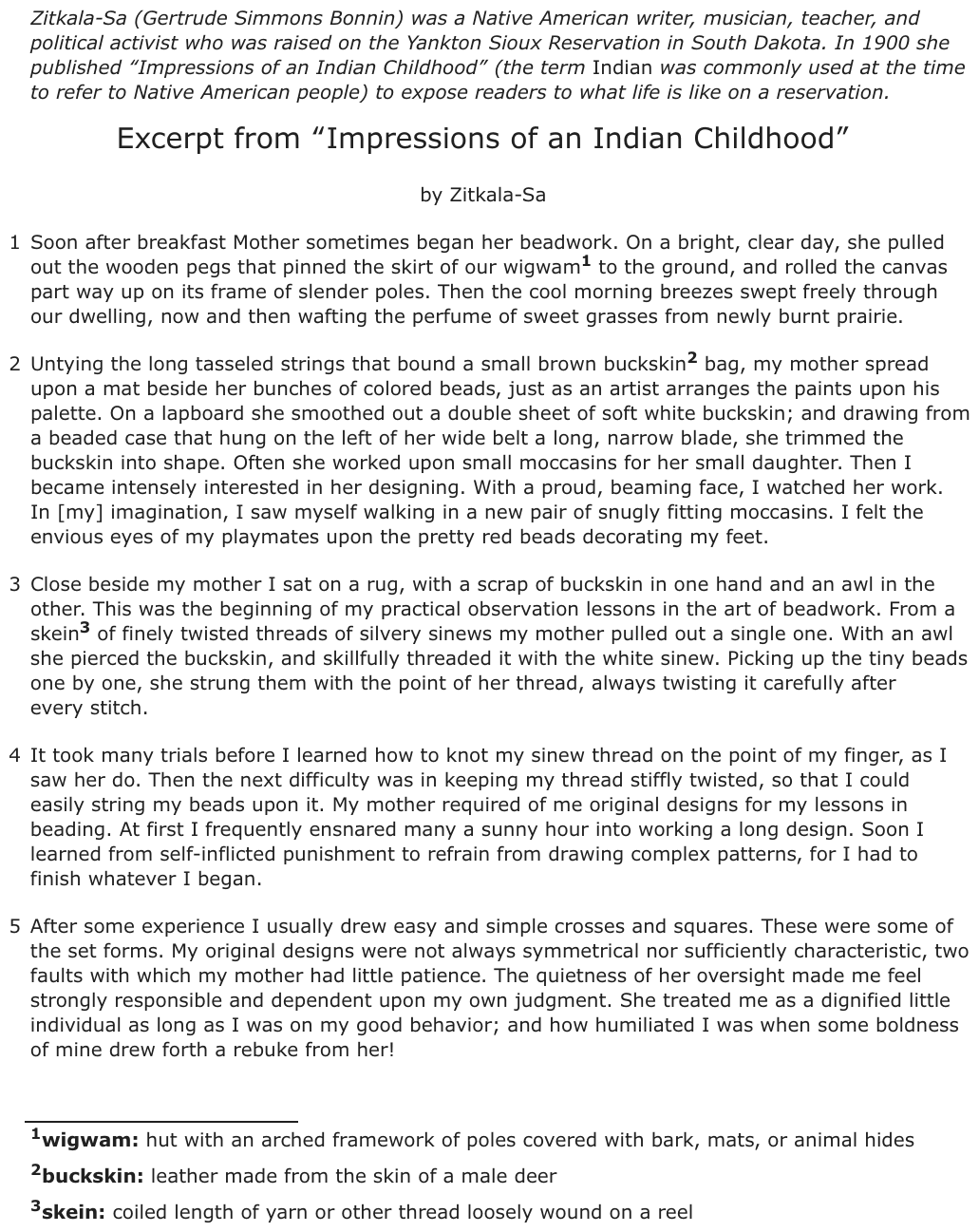
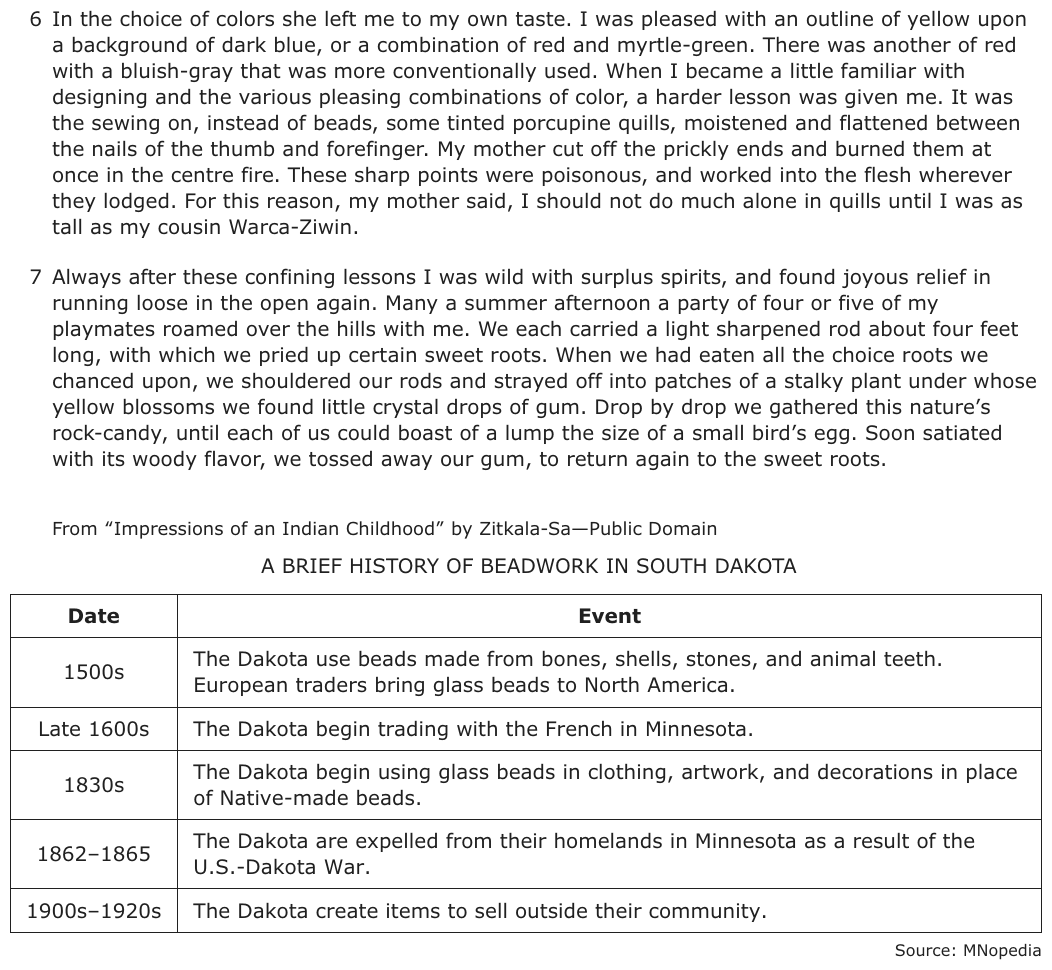
Question 10 of 120
2024 Test A English, question 11Uses the passage above: “Excerpt from “Impressions of an Indian Childhood””.
Question
The author’s use of sequence in paragraphs 1 and 2 contributes to the development of ideas in the excerpt by
- Alisting the many steps that are involved in the process of beading in order to explain its difficulty and complexity.
- Bconveying the importance of following the steps of the beading process in a precise order to work most efficiently.
- Cemphasizing the time required to fully prepare for and execute the many large and small tasks in the activity of beading.
- Ddetailing each step in preparation for beading in order to highlight the author’s enthusiasm for the work.
Show the answer
Correct answer: D
The question asks how the author’s use of sequence in paragraphs 1 and 2 contributes to the development of ideas in the excerpt.
A. Incorrect. In paragraph 2, the author does list the steps her mother takes in preparation to do beadwork, such as “untying the long tasseled strings” of the bag of beads, spreading the beads beside her on a mat, and using “a long, narrow blade” to trim the buckskin into shape. However, the language used to describe this sequence does not indicate that preparing to work with beads is difficult or complex.
B. Incorrect. Although the author’s description of untying the bag of beads, spreading the beads upon a mat, smoothing out a sheet of buckskin, and trimming the buckskin into shape in paragraph 2 indicates that the mother follows a certain routine, it does not place any emphasis on working most efficiently by following the steps of the beading process in a precise order.
C. Incorrect. In paragraph 2, the author describes her mother “untying the long tasseled strings that bound a small brown buckskin bag,” “spread[ing] upon a mat beside her bunches of colored beads,” “smooth[ing] out a double sheet of soft white buckskin; and drawing from a beaded case that hung on the left of her wide belt a long, narrow blade” to trim the buckskin. Although these descriptions do outline the steps in her process for creating beadwork, they do not emphasize the time required to do so, since the author does not mention in the excerpt how long it took her mother to fully prepare for and complete the large and small tasks in the activity of beading.
D. CORRECT. In paragraph 1, the author describes how the morning begins with her mother rolling up the canvas of the wigwam and allowing the breeze to come in. In paragraph 2, the author uses sensory language and precise sequencing to describe the way her mother prepares the beading materials by untying “the long tasseled strings that bound a small brown buckskin bag,” spreading the “bunches of colored beads” beside her, and smoothing out “a double sheet of soft white buckskin.” This combination of sequence and sensory language highlights the author’s enthusiasm for beadwork by emphasizing that the author pays close attention to her mother’s preparations.
Question analysis
This reading question asks how the step-by-step description of a mother preparing her beadwork, in the opening paragraphs of Zitkala-Sa's memoir, contributes to the excerpt's ideas. Every choice agrees that steps are listed, so students must judge which purpose the text actually supports and resist reasons that only sound likely for a craft.
- Grade level
- Grade 8 reading and task
- Compared with grade 7
- Above grade 7 Grade 7 structure questions usually ask what a paragraph adds to a topic. This one asks what an ordered description achieves, in dense 1900 prose where the purpose is never stated outright, which goes beyond typical grade 7 work.
- Estimated difficulty
- Hard: combines ideas, needs a plan, and has more than one tempting wrong answer.
- Thinking it demands
- Depth of knowledge 3, strategic thinking · mainly analyze
- What makes it hard
- How, not what major
- A very close wrong answer moderate
- Reading between the lines moderate
- Complex sentences minor
- Evidence
- Answered from several paragraphs or stanzas
- Reading level
- Passage: about grade 8, 946 words; question and choices: about grade 11, 95 words.
- Corrected from the DOE handbook
- A misquotation of the excerpt in the explanation was corrected.
- Students, last 30 days
- Not enough answers yet to show (it takes 10).
Why it is hard, traps and wrong answers (shows the answer)
Why it is hard
All four choices agree that the paragraphs lay out steps, so the question turns entirely on purpose, and three of the purposes sound like natural reasons to describe a craft. Nothing in paragraphs 1 and 2 calls the work hard, slow or a matter of efficiency; what they do show is a child following every move and becoming intensely interested. Students who look for the narrator's own reaction find the purpose, while those who reason from the steps alone drift to difficulty or time.
How, not what major Working it out
The stem asks what the ordered account of untying the bag, spreading the beads, and smoothing and trimming the buckskin does for the excerpt, a purpose the author never states. (Anderson & Krathwohl, 2001)
A very close wrong answer moderate Choosing the answer
The difficulty choice shares the right one's frame, steps laid out in order to show something, and differs only in what they show: how hard beading is, or how eagerly the girl watched. (Embretson & Wetzel, 1987; Gorin & Embretson, 2006; Ascalon et al., 2007)
Reading between the lines moderate Working it out
The enthusiasm has to be pieced together from the close attention to each step and from “intensely interested” and “a proud, beaming face” in paragraph 2. (Graesser, Singer & Trabasso, 1994; Kintsch, 1998)
Complex sentences minor Understanding the question
Paragraph 2 uses literary word order, as in “my mother spread upon a mat beside her bunches of colored beads,” which slows the reading of the very steps in question. (Abedi & Lord, 2001; Freedle & Kostin, 1993; Messick, 1989)
Strategy: For each choice, look in paragraphs 1 and 2 for words that would prove its purpose; a purpose that no sentence states or shows can be ruled out.
Traps
- Half right: One half of a two-part choice is right and the other is not.
- Wrong purpose or structure: Names a purpose, structure or effect that the part does not serve, or describes what a part says when the question asks what it does.
- Reads too much in: A reasonable-sounding conclusion that goes further than the text allows.
The wrong answers, classified
A Half right (King et al., 2004; Thissen, Steinberg & Fitzpatrick, 1989)
Rightly sees that paragraph 2 lists many preparation steps, then decides the list must show that beading is difficult and complex, which nothing in these paragraphs says.
B Wrong purpose or structure (Anderson & Krathwohl, 2001)
Reads the sequence as instructions about doing the steps in a precise order for efficiency, a purpose a watching child's memories never suggest.
C Reads too much in (Graesser, Singer & Trabasso, 1994)
Reasons that so many steps must take a long time, perhaps recalling the “many a sunny hour” of paragraph 4, but paragraphs 1 and 2 never mention time.
What was corrected from the DOE handbook, and why
- Explanation: In rejecting choice C, the handbook quotes paragraph 2 as “spread[ing them] upon a mat beside her bunches of colored beads.” In the excerpt, the bunches of colored beads are what the mother spreads (“my mother spread upon a mat beside her bunches of colored beads”). The inserted “them” refers to nothing and turns the beads into a place. The quotation now reads “spread[ing] upon a mat beside her bunches of colored beads,” which is how the handbook itself reads the sentence in its reason for rejecting choice A (“spreading the beads beside her on a mat”).
Working it out, step by step
Figure out what the question asks
Sequence means the order in which things happen. Paragraphs 1 and 2 tell the steps of a morning in order. The question asks why the author tells them step by step. What does that careful order help show?
List the steps
In paragraphs 1 and 2, the mother:
- rolls up the side of the wigwam to let in the breeze,
- unties a bag made of buckskin (soft deer leather),
- spreads her beads on a mat,
- smooths out a sheet of buckskin, and
- trims it into shape with a blade.
Find the author’s reaction
Right after the steps, the author tells how she felt. “Then I became intensely interested in her designing. With a proud, beaming face, I watched her work.” Intensely means very strongly. A beaming face has a big, happy smile. She noticed every little step because she was so excited. The details show her enthusiasm, or eager interest.
Check each choice
- A is wrong. The steps are listed, but nothing says beading is hard or complex.
- B is wrong. Nothing says the steps must go in a set order to save effort.
- C is wrong. Paragraphs 1 and 2 never say how long anything takes.
- D is right. The careful details show how closely the girl watched, with eager interest.
Watch out: A is tempting because there are many steps. But many steps don’t prove a task is hard. The author never calls it difficult.
Choose the answer
The step-by-step order shows a child following every move her mother makes. So the answer is D.
Why this answer and not the closest wrong one
A is the closest wrong answer. Like D, it says the steps are listed to show something. But no word in paragraphs 1 and 2 calls beading hard. The author does say she was “intensely interested” and had “a proud, beaming face.” That shows enthusiasm, so D fits better.
More questions like this
The original DOE question
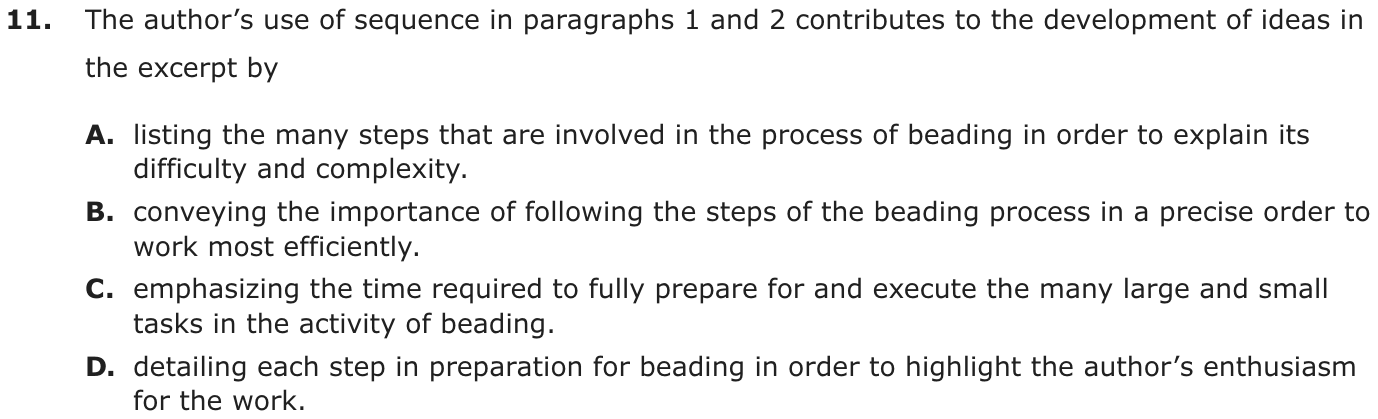
Question 11 of 120
2024 Test A English, question 12Uses the passage above: “Excerpt from “Impressions of an Indian Childhood””.
Question
The phrase “just as an artist arranges the paints upon his palette” in paragraph 2 suggests that
- Abeadwork is a true form of art.
- Bcolor is a source of artistic inspiration.
- Call artistic activities begin with a series of steps.
- Dthe beadworker tries to imitate art.
Show the answer
Correct answer: A
The question asks what the phrase “just as an artist arranges the paints upon his palette” in paragraph 2 suggests in the excerpt.
A. CORRECT. In paragraph 2, by comparing the way her mother arranges the beads to the way a painter “arranges the paints upon his palette,” the author emphasizes that her mother approaches her craft just as a painter does, thus suggesting that beadwork is a true form of art.
B. Incorrect. Although the author mentions “bunches of colored beads” in paragraph 2, this detail does not provide enough evidence for the idea that color inspires beadworkers. The phrase “just as an artist arranges the paints upon his palette” indicates the connection of beadwork to other forms of art in general, not necessarily to the specifics of color as a source of inspiration.
C. Incorrect. In paragraph 2, the author describes her mother “untying the long tasseled strings” and then spreading “upon a mat beside her bunches of colored beads.” However, the phrase “just as an artist arranges the paints upon his palette” does not suggest that all artistic activities begin with a series of steps. There is no mention in the passage of any other artistic activities involving multiple initial steps.
D. Incorrect. In paragraph 2, the author describes how her mother “spread upon a mat beside her bunches of colored beads” as the first step in the artistic process described in the passage. Therefore, the comparison between the mother’s process and a painter arranging paints on a palette suggests that the mother is creating art, not imitating it. There is no indication that the mother is copying a technique she has seen in other art forms.
Question analysis
This reading question asks what the comparison between Zitkala-Sa's mother laying out her colored beads and an artist arranging paints on a palette suggests. It tests reading a simile in context, and the choices include readings that fix on a single word or go further than the comparison itself.
- Grade level
- Grade 6 reading and task
- Compared with grade 7
- Below grade 7 Interpreting a simile is taught by grade 6. The phrase is short and quoted in the question, and one step of interpretation is enough, so this asks less than typical grade 7 work on figurative language.
- Estimated difficulty
- Routine: one familiar step, little to misread.
- Thinking it demands
- Depth of knowledge 2, skills and concepts · mainly understand
- What makes it hard
- Evidence
- Answered from one sentence or line
- Reading level
- Passage: about grade 8, 946 words; question and choices: about grade 6, 45 words.
- Students, last 30 days
- Not enough answers yet to show (it takes 10).
Why it is hard, traps and wrong answers (shows the answer)
Why it is hard
The comparison is quoted in the stem and makes one point: the mother lays out her beads the way a painter lays out paints, so her craft counts as art. Wrong answers fix on the word “paints,” stretch one comparison into a rule about all art, or read the comparison as copying. Asking what the two things being compared have in common settles it.
Figurative or literary language minor Understanding the question
The simile sets the mother laying out bunches of colored beads beside a painter arranging paints, and students must see what that comparison says about beadwork itself. (Graesser, Singer & Trabasso, 1994; Kintsch, 1998)
Strategy: Name the two things being compared and what they share, then choose the idea that comparison supports without adding anything the sentence does not say.
Traps
- Word match: Repeats striking words or phrases from the text, so it looks supported, but its meaning does not fit the question.
- Too broad or too strong: A choice overstates, generalizes, or uses absolute words the text does not support.
- Twists what the text says: Uses the text's topic and ideas but changes what it says: who did it, how much, when, or why.
The wrong answers, classified
B Word match (Freedle & Kostin, 1993)
Links “paints” with the “bunches of colored beads” and decides color is the point, though the simile compares how materials are arranged, not what inspires the artist.
C Too broad or too strong (King et al., 2004)
Turns one comparison about laying out beads into a rule about all artistic activities, a generalization the sentence does not make.
D Twists what the text says (King et al., 2004)
Sees that the simile links beadwork with painting but twists its point, reading it as the mother imitating art rather than practicing it.
Working it out, step by step
Figure out what the question asks
The phrase is a simile. A simile compares two things using “like” or “as.” You need to know what this comparison suggests about the mother’s beadwork.
Read the phrase in paragraph 2
The mother “spread upon a mat beside her bunches of colored beads, just as an artist arranges the paints upon his palette.” The word order is old-fashioned. It means she spread her bunches of colored beads on a mat beside her. A palette is the board a painter uses to hold and mix paints.
Work out what the comparison means
The two things being compared are the mother and a painter. Both lay out their colors before they start to make something. So the author treats her mother like a painter. That means beadwork is real art, just like painting.
Check each choice
- A is right. Comparing the mother to a painter shows that beadwork is a true art.
- B is wrong. The simile is about laying out materials, not about what gives an artist ideas.
- C is wrong. One comparison can’t prove a rule about all art.
- D is wrong. The mother is not copying art. She works the way an artist does, so she is making art.
Watch out: B is tempting because paints and colored beads both bring color to mind. But the simile is about how she arranges them.
Choose the answer
The simile puts the beadworker side by side with a painter. So the answer is A.
Why this answer and not the closest wrong one
B is the closest wrong answer. Paints and colored beads do share color. But the simile compares what the two people do: both arrange their materials before they create. Nothing is said about inspiration, which means where ideas come from. A matches the point that the mother works as an artist does.
More questions like this
The original DOE question

Question 12 of 120
2024 Test A English, question 13Uses the passage above: “Excerpt from “Impressions of an Indian Childhood””.
Question
The details in paragraph 3 convey a central idea of the excerpt by suggesting that
- Athe author was interested in the work because she knew her mother was making something for her.
- Bthe author had difficulty learning through observation but wanted to help her mother.
- Cthe author was determined to behave according to her mother’s standards and sought her approval.
- Dthe author had great admiration for her mother’s precision and mastery of her craft.
Show the answer
Correct answer: D
The question asks how the details in paragraph 3 convey a central idea of the excerpt.
A. Incorrect. In paragraph 2, the author mentions how her mother “worked upon small moccasins for her small daughter” and when she did, the author “became intensely interested in her [mother’s] designing.” However, in paragraph 3, the author is interested in her mother’s work mainly as part of her “lessons in the art of beadwork,” not because she knew her mother was making something for her.
B. Incorrect. In paragraph 3, the author receives “practical observation lessons in the art of beadwork” and describes how “from a skein of finely twisted threads of silvery sinews my mother pulled out a single one” and “pierced the buckskin, and skillfully threaded it with the white sinew.” The author describes the process in such detail that she provides no indication that she had difficulty learning through observation. The author also does not give any indication in the paragraph that she wanted to help her mother; she was there merely to observe and learn.
C. Incorrect. Although the author refers to her beading lessons with her mother as “practical observation lessons in the art of beadwork” and indicates that she sat “close beside” her mother while observing her beadwork, the author provides no indication in the paragraph that she was determined to behave according to her mother’s standards or that she sought her mother’s approval.
D. CORRECT. In paragraph 3, the author describes her mother’s artistry and craftsmanship by using language such as “skillfully threaded,” “picking up the tiny beads one by one,” and “twisting it carefully after every stitch.” These close observations indicate that the author greatly admired her mother’s mastery of her craft and the precision that went into every detail of her work.
Question analysis
This reading question asks how the details in the paragraph where young Zitkala-Sa sits beside her mother, watching her pierce buckskin and string tiny beads, point to a central idea of the excerpt. Several choices name feelings found elsewhere in the memoir, so students must stay with what this one paragraph shows.
- Grade level
- Grade 7 reading and task
- Compared with grade 7
- At grade 7 Linking a paragraph's details to a central idea is grade 7 reading. The answer rests on one short paragraph, but the student must turn its concrete details about thread and beads into an idea, a typical grade 7 demand.
- Estimated difficulty
- Straightforward: two steps or one careful reading.
- Thinking it demands
- Depth of knowledge 2, skills and concepts · mainly understand
- What makes it hard
- Reading between the lines moderate
- The right answer is reworded minor
- Evidence
- Answered from one paragraph or stanza
- Reading level
- Passage: about grade 8, 946 words; question and choices: about grade 9, 73 words.
- Students, last 30 days
- Not enough answers yet to show (it takes 10).
Why it is hard, traps and wrong answers (shows the answer)
Why it is hard
Paragraph 3 is short and concrete, but the feelings named in the choices come from all over the excerpt, so the danger is answering about the excerpt rather than this paragraph. The girl's interest in moccasins made for her belongs to paragraph 2, her struggles to paragraph 4, and good behavior to paragraph 5. Rereading paragraph 3 alone, and noticing how it describes the mother's hands at work, points to the right idea.
Reading between the lines moderate Working it out
Admiration is never named; it has to be inferred from the words chosen for the mother's work: “skillfully threaded,” beads picked up “one by one,” thread twisted “carefully after every stitch.” (Graesser, Singer & Trabasso, 1994; Kintsch, 1998)
The right answer is reworded minor Choosing the answer
The right choice says “precision and mastery,” words absent from paragraph 3, while wrong choices echo the excerpt's own “observation” lessons, its “difficulty” with thread, and the moccasins made for the daughter. (Freedle & Kostin, 1993; Kirsch & Mosenthal, 1990)
Strategy: Reread paragraph 3 by itself and note what its verbs and describing words emphasize, then match that emphasis to a choice and reject ideas drawn from other paragraphs.
Traps
- Wrong part of the text: A choice is true of another paragraph, stanza or speaker than the one asked about.
- Twists what the text says: Uses the text's topic and ideas but changes what it says: who did it, how much, when, or why.
The wrong answers, classified
A Wrong part of the text (Kirsch & Mosenthal, 1990)
Recalls that paragraph 2 makes the girl “intensely interested” when the moccasins are for her, but paragraph 3 presents the watching as the start of her lessons.
B Twists what the text says (King et al., 2004)
Pairs the “observation lessons” of paragraph 3 with the difficulty of paragraph 4 and adds a wish to help, though the girl struggles with her own thread, not with watching.
C Wrong part of the text (Kirsch & Mosenthal, 1990)
Draws on paragraph 5, where the mother treats her with dignity “as long as I was on my good behavior,” but paragraph 3 says nothing about standards or approval.
Working it out, step by step
Figure out what the question asks
Look only at paragraph 3. A central idea is an important message of the whole excerpt. You need the idea that the details in paragraph 3 show.
Find the details in paragraph 3
The girl sits “close beside” her mother and watches. The mother “skillfully threaded it with the white sinew.” Sinew is a strong cord made from an animal’s body. She picks up “the tiny beads one by one.” She keeps “twisting it carefully after every stitch.”
Work out what the details show
Words like “skillfully” and “carefully” show the mother is an expert. She works with precision, which means being exact. Her mastery, or great skill, shows in every small move. The girl notices each one. You watch someone this closely when you admire them, or think highly of them.
Check each choice
- A is wrong. The moccasins made for her come from paragraph 2. Paragraph 3 is about her lessons.
- B is wrong. Her trouble with thread comes in paragraph 4. Nothing says she wants to help.
- C is wrong. Good behavior comes up in paragraph 5, not paragraph 3.
- D is right. The careful details show admiration for her mother’s skill.
Watch out: A, B and C all use ideas from other paragraphs. Stay inside paragraph 3.
Choose the answer
Paragraph 3 shows a girl who watches her mother’s expert hands with wonder. So the answer is D.
Why this answer and not the closest wrong one
A is the closest wrong answer, because the girl really was “intensely interested” when her mother made moccasins for her. But that is in paragraph 2. Paragraph 3 calls the watching “the beginning of my practical observation lessons.” Its details praise how skillfully and carefully the mother works. That fits D.
More questions like this
The original DOE question
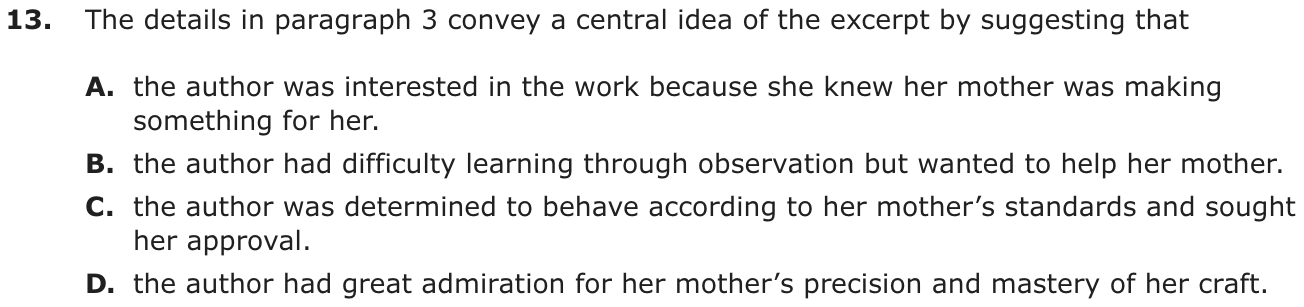
Question 13 of 120
2024 Test A English, question 14Uses the passage above: “Excerpt from “Impressions of an Indian Childhood””.
Question
How does the author distinguish her point of view from that of her mother?
- Aby describing their techniques for knotting sinew thread (paragraph 4)
- Bby describing their approaches to beadwork design (paragraph 5)
- Cby stating her mother’s instructions on working with quills (paragraph 6)
- Dby stating her mother’s ideas about activities after lessons (paragraph 7)
Show the answer
Correct answer: B
The question asks how the author distinguishes her point of view from that of her mother.
A. Incorrect. In paragraph 4, the author explains that “it took many trials before I learned how to knot my sinew thread on the point of my finger, as I saw her do” and that the “difficulty was in keeping my thread stiffly twisted, so that I could easily string my beads upon it.” Although this explanation describes the author’s difficulty in performing the same task as her mother, it does not distinguish her point of view from that of her mother. In fact, they seem to share the same point of view regarding the importance of the technique the author is attempting to learn.
B. CORRECT. In paragraph 5, the author distinguishes her point of view from that of her mother by describing their approaches to beadwork design. In the paragraph, the author states, “I usually drew easy and simple crosses and squares” and “My original designs were not always symmetrical nor sufficiently characteristic, two faults with which my mother had little patience.” The author also distinguishes her point of view from that of her mother by stating that “the quietness of [my mother’s] oversight made me feel strongly responsible and dependent upon my own judgment.”
C. Incorrect. In paragraph 6, the author states, “My mother cut off the prickly ends and burned them at once in the centre fire. These sharp points were poisonous, and worked into the flesh wherever they lodged. For this reason, my mother said, I should not do much alone in quills until I was as tall as my cousin Warca-Ziwin.” Although these instructions explain the importance of having experience and skill when working with quills, they do not distinguish the author’s point of view from that of her mother.
D. Incorrect. In paragraph 7, the author describes her beadwork lessons as “confining” and states that she liked to roam “over the hills” with her playmates after the lessons. However, she makes no mention of her mother in paragraph 7; the activities and ideas stated there belong to the author, not the mother.
Question analysis
This reading question asks how Zitkala-Sa separates her own point of view from her mother's in an excerpt about learning beadwork as a girl. Each choice points to a different paragraph, so students must revisit all four and find where the two perspectives actually differ, not just where one person speaks or acts.
- Grade level
- Grade 7 reading and task
- Compared with grade 7
- At grade 7 Analyzing how an author sets her view apart from another person's is a grade 7 standard. The memoir's sentences are long and old-fashioned, but its paragraphs are short and concrete, so the demand is typical of grade 7 reading.
- Estimated difficulty
- Moderate: several steps, or a close reading with one strong distractor.
- Thinking it demands
- Depth of knowledge 2, skills and concepts · mainly analyze
- What makes it hard
- Every choice must be checked moderate
- How, not what moderate
- Hard words minor
- Evidence
- Answered from several paragraphs or stanzas
- Reading level
- Passage: about grade 8, 946 words; question and choices: about grade 9, 51 words.
- Corrected from the DOE handbook
- A word-order slip in the explanation was corrected.
- Students, last 30 days
- Not enough answers yet to show (it takes 10).
Why it is hard, traps and wrong answers (shows the answer)
Why it is hard
Every paragraph named shows mother and daughter together, or the daughter alone, so each looks like a candidate until it is tested for an actual difference in outlook. The struggle to knot sinew is a difference in skill, not in view, and the warning about quills gives only the mother's side. Paragraph 5 is the one place where the girl's own designs and her mother's impatience with their faults are set side by side.
Every choice must be checked moderate Choosing the answer
Each choice points to a different paragraph, 4 through 7, so all four have to be reread and tested for two outlooks that actually differ, not just one person's action or advice. (Embretson & Wetzel, 1987)
How, not what moderate Working it out
The question asks how the author sets her view apart, so students must find where two outlooks meet and clash: her simple, imperfect designs against the faults her mother “had little patience” with. (Anderson & Krathwohl, 2001)
Hard words minor Understanding the question
The key sentence turns on “not always symmetrical nor sufficiently characteristic,” formal words that must be understood to see the mother's standards behind them. (Perfetti, 2007; Freedle & Kostin, 1993)
Strategy: For each paragraph named, ask whether it shows both the mother's view and the narrator's and sets them against each other; a paragraph with one perspective cannot be the answer.
Traps
- True but not the answer: A choice says something accurate about the text that does not answer this question.
- Wrong part of the text: A choice is true of another paragraph, stanza or speaker than the one asked about.
The wrong answers, classified
A True but not the answer (King et al., 2004; Embretson & Wetzel, 1987)
Sees the girl struggle to knot sinew the way her mother does, a real contrast in skill, but she learns the same method “as I saw her do,” so their views do not differ.
C True but not the answer (King et al., 2004; Embretson & Wetzel, 1987)
Picks the mother's warning about poisonous quills because it states her view, but the narrator reports it without setting any opinion of her own against it.
D Wrong part of the text (Kirsch & Mosenthal, 1990)
Credits the mother with ideas about play after lessons, though paragraph 7 gives only the narrator's own “joyous relief,” and the mother does not appear in it.
What was corrected from the DOE handbook, and why
- Explanation: The handbook reads “The author also distinguishes her point of view from that her of mother.” It now reads “from that of her mother,” as earlier in the same explanation.
Working it out, step by step
Figure out what the question asks
A point of view is how a person sees or judges something. You need a place where the author shows that she and her mother see things differently. Each choice names a different paragraph. Check each one for two views that don’t match.
Find two views in paragraph 5
The girl “usually drew easy and simple crosses and squares.” Then she says: “My original designs were not always symmetrical nor sufficiently characteristic, two faults with which my mother had little patience.”
Work out what it means
Symmetrical means the same on both sides. “Sufficiently characteristic” means typical enough of the usual style. The girl kept her designs easy and simple. Her mother cared about something else. She saw “faults,” or mistakes, in them. Having “little patience” means being quickly annoyed. So the two judge the designs differently.
Check each choice
- A is wrong. In paragraph 4 the girl learns to knot thread “as I saw her do.” She learns her mother’s way, so their views match.
- B is right. Paragraph 5 sets the girl’s designs against her mother’s standards.
- C is wrong. Paragraph 6 gives only the mother’s warning about quills. The girl does not disagree.
- D is wrong. The mother doesn’t appear in paragraph 7 at all.
Watch out: A is tempting because the girl struggles with something her mother can do. But that is a difference in skill, not in point of view.
Choose the answer
Paragraph 5 is the one place where the two views are set side by side. So the answer is B.
Why this answer and not the closest wrong one
A is the closest wrong answer. The girl does struggle to knot thread the way her mother does. But they agree on how it should be done. In paragraph 5, the girl’s simple designs meet her mother’s impatience with their “faults.” That is a real difference in how they see the work.
More questions like this
The original DOE question
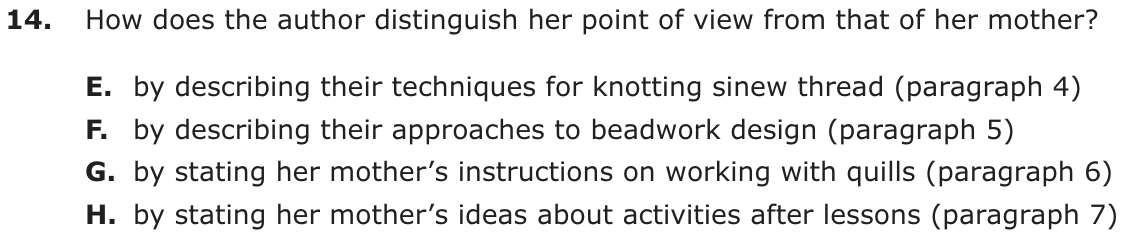
Question 14 of 120
2024 Test A English, question 15Uses the passage above: “Excerpt from “Impressions of an Indian Childhood””.
Question
Read this sentence from paragraph 7.
Always after these confining lessons I was wild with surplus spirits, and found joyous relief in running loose in the open again.
Which sentence best describes how this sentence fits into the overall structure of the excerpt?
- AIt introduces a shift from the author’s demanding relationship with her mother to her more relaxed relationships with friends.
- BIt signals a change from the challenging aspects of life on the reservation to the advantages of living on the prairie.
- CIt highlights a contrast between the focus and control required while working and the freedom of having fun outside.
- DIt concludes the progression of events in the narrative by describing the sequence of events at the end of the author’s day.
Show the answer
Correct answer: C
The question asks which sentence best describes how the sentence from paragraph 7 fits into the overall structure of the excerpt.
A. Incorrect. Though the author feels humiliated “when some boldness of mine drew forth a rebuke from” her mother (paragraph 5) and characterizes her lessons with her mother as “confining” (paragraph 7), the overall passage does not portray a demanding relationship between the author and the mother. The shift introduced in the sentence from paragraph 7 is not from one of the author’s relationships to another; it is from work to play.
B. Incorrect. In paragraph 6, the author explains how working with porcupine quills is difficult because the “sharp points were poisonous, and worked into the flesh wherever they lodged.” Although this sentence suggests that working with porcupine quills was challenging, the sentence from paragraph 7 does not signal a change from the challenging aspects of life on the reservation to the advantages of living on the prairie. Most of paragraph 6 describes the author’s pleasure in creating designs in different colors.
C. CORRECT. In the sentence from paragraph 7, the author refers to her beadwork lessons as “confining” and states that after the lessons, she “was wild with surplus spirits” and “found joyous relief” in being outside and running around. The phrases “surplus spirits” and “joyous relief” highlight a sense of freedom that stands in strong contrast to the “confining” nature of the author’s beadwork lessons, which required intense focus and control.
D. Incorrect. In paragraph 7, the author describes how “many a summer afternoon” after her beadwork lessons, she and her friends used “a light sharpened rod” to gather “sweet roots” and “little crystal drops of gum.” She then explains that they later “tossed away our gum, to return again to the sweet roots.” However, the sentence from paragraph 7 does not conclude the progression of events in the narrative by describing the sequence of events at the end of the author’s day; the sentence appears at the beginning of paragraph 7 and provides a contrast with events from the previous paragraph.
Question analysis
This reading question quotes the sentence that opens the last paragraph of Zitkala-Sa's excerpt, where she tells how she felt after her beadwork lessons, and asks how it fits the overall structure. Several choices describe a turn or a contrast, so students must pin down exactly what is being set against what.
- Grade level
- Grade 7 reading and task
- Compared with grade 7
- At grade 7 Explaining how one sentence fits a text's structure is grade 7 reading. The sentence is quoted and its wording is vivid, but the student must connect it to the paragraphs on both sides of it, a typical grade 7 demand.
- Estimated difficulty
- Moderate: several steps, or a close reading with one strong distractor.
- Thinking it demands
- Depth of knowledge 2, skills and concepts · mainly analyze
- What makes it hard
- How, not what moderate
- A very close wrong answer moderate
- Hard words minor
- Evidence
- Answered from several paragraphs or stanzas
- Reading level
- Passage: about grade 8, 946 words; question and choices: about grade 10, 123 words.
- Students, last 30 days
- Not enough answers yet to show (it takes 10).
Why it is hard, traps and wrong answers (shows the answer)
Why it is hard
The sentence clearly marks a change, and every choice names some change, so the work lies in saying exactly what is set against what. The excerpt contrasts careful, controlled work with free play, and the word “confining” carries that contrast. Students lose the point by making the turn about people, reading one rebuke as a hard relationship, or about the day's timeline, when the sentence describes what always happened after lessons.
How, not what moderate Working it out
The stem asks how the sentence works in the excerpt's structure, so students must name the turn it marks, from the “confining” lessons of paragraphs 3–6 to running loose outdoors. (Anderson & Krathwohl, 2001)
A very close wrong answer moderate Choosing the answer
The relationships choice also describes a move from lessons with her mother to play with friends, and differs from the right one only in calling the bond with her mother demanding. (Embretson & Wetzel, 1987; Gorin & Embretson, 2006; Ascalon et al., 2007)
Hard words minor Understanding the question
Old-fashioned phrasing such as “wild with surplus spirits” and “joyous relief” has to be decoded as a burst of energy after hours of holding still. (Perfetti, 2007; Freedle & Kostin, 1993)
Strategy: Compare paragraph 6 with paragraph 7 and name what changes between them in a few words, then pick the choice whose two halves match both sides of that change.
Traps
- Half right: One half of a two-part choice is right and the other is not.
- Twists what the text says: Uses the text's topic and ideas but changes what it says: who did it, how much, when, or why.
- Wrong purpose or structure: Names a purpose, structure or effect that the part does not serve, or describes what a part says when the question asks what it does.
The wrong answers, classified
A Half right (King et al., 2004; Thissen, Steinberg & Fitzpatrick, 1989)
Notices the move from lessons with her mother to play with friends, but the excerpt shows a quiet, respectful teacher, not a demanding relationship; the turn is from work to play.
B Twists what the text says (King et al., 2004)
Inflates the move outdoors into a contrast between hardships of reservation life and the prairie's advantages, a far broader claim than one sentence about lessons supports.
D Wrong purpose or structure (Anderson & Krathwohl, 2001)
Takes the sentence as closing a day's events, since the excerpt begins after breakfast and paragraph 7 turns to afternoons, though it opens its paragraph with a contrast.
Working it out, step by step
Figure out what the question asks
This asks how one sentence fits the structure of the excerpt. Structure means how the parts are put together. You need to know what change this sentence marks.
Read the sentence closely
The sentence opens paragraph 7: “Always after these confining lessons I was wild with surplus spirits, and found joyous relief in running loose in the open again.” Confining means keeping you shut in or held still. “Surplus spirits” means extra energy. “Joyous relief” is a happy feeling of being free at last.
Compare what comes before and after
Paragraphs 3 to 6 show the lessons. The girl sits still and works with care. She learns to knot thread, plan designs and handle sharp quills. The rest of paragraph 7 shows her roaming the hills with friends. So this sentence turns from careful work to free play.
Check each choice
- A is wrong. The mother is a quiet, respectful teacher, not a demanding one. The shift is from work to play.
- B is wrong. The sentence sets lessons against play. It says nothing about reservation life being hard or the prairie being better.
- C is right. “Confining” lessons are set against “running loose in the open.”
- D is wrong. The sentence starts paragraph 7 and tells what always happened after lessons. It doesn’t end the story.
Watch out: A is tempting because the girl goes from her mother to her friends. But the sentence contrasts how she felt during lessons and after them.
Choose the answer
The sentence contrasts the focus that work needs with the freedom of playing outside. So the answer is C.
Why this answer and not the closest wrong one
A is the closest wrong answer. It also sees a move from lessons with her mother to play with friends. But A calls the relationship demanding. The mother teaches quietly and treats her daughter “as a dignified little individual” (paragraph 5). The real contrast is in the word “confining,” which sets held-still work against free play. That is C.
More questions like this
The original DOE question
Question 15 of 120
2024 Test A English, question 16Uses the passage above: “Excerpt from “Impressions of an Indian Childhood””.
Question
Which sentence best summarizes the process of beading that is described in the excerpt?
- ATake a buckskin bag full of beads and spread them out on a mat in different colors like a paint palette; take a double sheet of buckskin and smooth it out on a table; take a sinew and awl and thread the beads onto the buckskin in a desired pattern.
- BCut the double sheet of buckskin into a shape; take a skein of sinew and pierce the buckskin with an awl; thread the sinew with beads of many different colors in a simple or complex pattern; twist the sinew to keep it tight after every stitch into the buckskin.
- CArrange the beads into groups of colors on a mat; smooth out a double sheet of buckskin and cut it to shape; take a single thread of sinew; pierce the buckskin with an awl; thread the buckskin with the sinew and string it with beads, carefully twisting after every stitch.
- DGather beads, buckskin, sinew, and awl and place them on a mat; cut the buckskin into the desired shape; decide on a pattern for the beads and create it using the sinews and the awl; thread the beads onto the sinew in the desired pattern and twist it tight.
Show the answer
Correct answer: C
The question asks which sentence best summarizes the process of beading that is described in the excerpt.
A. Incorrect. In paragraphs 2 and 3, the author describes how at the beginning of the process her mother “smoothed out a double sheet of soft white buckskin” on a lapboard (paragraph 2) and how she strings the beads into a pattern. However, this sentence does not describe the steps that take place between the preparation and the stringing of the beads. Thus, this sentence does not best summarize the beading process.
B. Incorrect. In paragraphs 2 and 3, the author describes the process her mother uses to string the beads with “the point of her thread, always twisting it carefully after every stitch” (paragraph 3). While this sentence includes some of the steps in the beading process, it does not describe the necessary preparation, namely spreading the beads out on a mat and smoothing out the buckskin on a lapboard. Thus, this sentence does not best summarize the beading process.
C. CORRECT. This sentence best summarizes the process of beading that is described in the excerpt because it includes details about each step in the process. In paragraph 2, the author explains how her mother “spread upon a mat beside her bunches of colored beads” and how “on a lapboard she smoothed out a double sheet of soft white buckskin; and drawing from a beaded case that hung on the left of her wide belt a long, narrow blade, she trimmed the buckskin into shape.” The author continues her description in paragraph 3, stating, “From a skein of finely twisted threads of silvery sinews my mother pulled out a single one. With an awl she pierced the buckskin, and skillfully threaded it with the white sinew. Picking up the tiny beads one by one, she strung them with the point of her thread, always twisting it carefully after every stitch.”
D. Incorrect. In paragraphs 2 and 3, the author describes the process her mother uses as she “smoothed out a double sheet of soft white buckskin” (paragraph 2) on a lapboard before stringing the beads. While this sentence includes most of the steps in the beading process, it excludes the step of piercing the buckskin. This sentence also provides few details about the process of beading and uses vague wording to describe each step. Therefore, the sentence does not best summarize the beading process.
Question analysis
This reading question asks which sentence best summarizes the beadwork process Zitkala-Sa watches her mother carry out, from laying out the materials to stringing the beads. Each choice is a long list of steps, so students must compare them detail by detail with the excerpt and notice what each one adds, leaves out or misplaces.
- Grade level
- Grade 8 reading and task
- Compared with grade 7
- Above grade 7 Summarizing a process is grade 7 reading, but the four summaries are long and nearly alike, and checking them against two paragraphs of 1900 prose with words like awl, sinew and skein is heavier than usual.
- Estimated difficulty
- Hard: combines ideas, needs a plan, and has more than one tempting wrong answer.
- Thinking it demands
- Depth of knowledge 2, skills and concepts · mainly understand
- What makes it hard
- Every choice must be checked major
- A lot to read moderate
- Hard words minor
- Evidence
- Answered from several paragraphs or stanzas
- Reading level
- Passage: about grade 8, 946 words; question and choices: about grade 16+, 212 words.
- Corrected from the DOE handbook
- An inaccurate detail about the excerpt in the explanation was corrected.
- Students, last 30 days
- Not enough answers yet to show (it takes 10).
Why it is hard, traps and wrong answers (shows the answer)
Why it is hard
This question is won by bookkeeping, not insight: list the mother's steps from the two paragraphs, then hold each long summary against the list. The most tempting wrong summary reads like a sensible craft routine in a sensible order, yet it never has the buckskin pierced and puts every tool on the mat. Others open with a familiar image or close with precise stitching while skipping steps, so students who check only the beginning or only the end are caught.
Every choice must be checked major Choosing the answer
Each summary is a chain of four to six steps, so all four must be checked step by step against paragraphs 2 and 3 for steps missing, added or out of order. (Embretson & Wetzel, 1987)
A lot to read moderate Understanding the question
The four choices together run to about 200 words of semicolon-linked steps, and the text they summarize is two paragraphs of dense 1900 prose. (Kintsch, 1998; Gorin & Embretson, 2006; Freedle & Kostin, 1993)
Hard words minor Understanding the question
Words like awl, sinew, skein and lapboard name the tools and materials, and a student unsure of them cannot tell which steps a summary has dropped. (Perfetti, 2007; Freedle & Kostin, 1993)
Strategy: List the mother's steps from paragraphs 2 and 3 in order, then check each choice against your list for a missing step, an invented detail or a step out of place.
Traps
- Too narrow: A single detail offered as the central idea or a summary, or a summary that keeps minor details and leaves out an essential part.
The wrong answers, classified
A Too narrow (King et al., 2004)
Keeps the familiar palette image but leaves out trimming the buckskin, piercing it with the awl and twisting the thread, and even moves the smoothing onto a table.
B Too narrow (King et al., 2004)
Matches paragraph 3's piercing and twisting closely but leaves out the preparation, laying out the beads and smoothing the buckskin, and starts the process with cutting.
D Too narrow (King et al., 2004)
Accepts a tidy, well-ordered outline that keeps most steps but leaves out smoothing the buckskin and piercing it with the awl, and piles every tool onto the mat.
What was corrected from the DOE handbook, and why
- Explanation: In rejecting choice B, the handbook says the choice leaves out the preparation, “namely spreading the beads and the buckskin out on a table.” The excerpt mentions no table: in paragraph 2 the mother spreads the beads on a mat and smooths out the buckskin on a lapboard. The explanation now says so. (Choice A’s “on a table” is part of a wrong answer and is left as printed.)
Working it out, step by step
Figure out what the question asks
You need the summary that best matches the beading steps in the excerpt. A summary is a short retelling of the main points. The best one keeps every main step, in order, and adds nothing new.
List the steps from paragraphs 2 and 3
Paragraphs 2 and 3 give the mother’s steps in order. The last one ends with her “always twisting it carefully after every stitch.”
- Spread the beads on a mat.
- Smooth out a double sheet of buckskin on a lapboard (a board held on the lap).
- Trim the buckskin into shape with a blade.
- Pull out a single sinew, a strong thread.
- Pierce (poke a hole in) the buckskin with an awl, a pointed tool.
- Thread the sinew through the buckskin.
- String the beads, twisting the thread after every stitch.
Check each choice against the list
- A is wrong. It skips trimming, piercing and twisting. It also says “on a table,” but she used a lapboard.
- B is wrong. It starts with cutting. It skips spreading the beads and smoothing the buckskin.
- C is right. It has every step, in the same order.
- D is wrong. It never says to smooth the buckskin or pierce it. It also puts every tool on the mat, but only the beads went there.
Watch out: D sounds like a sensible plan in a sensible order. But a summary must match the excerpt, not just sound right. Check it step by step.
Choose the answer
Only C follows the mother’s steps from start to finish. So the answer is C.
Why this answer and not the closest wrong one
D is the closest wrong answer. It is neat and keeps most of the steps. But it skips smoothing the buckskin and never says to pierce it with the awl. It also piles every tool onto the mat. C matches the excerpt step for step, so it is the best summary.
More questions like this
The original DOE question
Question 16 of 120
2024 Test A English, question 17Uses the passage above: “Excerpt from “Impressions of an Indian Childhood””.
Question
The idea that mastering moccasin design and creation requires experience is best illustrated in the excerpt through
- Athe information about the advanced technique of incorporating porcupine quills into a design.
- Bthe descriptions of the special materials that must be used to make decorated moccasins.
- Cthe descriptions of the various color combinations that make an attractive moccasin design.
- Dthe example of the author successfully and independently using a sharpened rod.
Show the answer
Correct answer: A
The question asks how the idea that mastering moccasin design and creation requires experience is best illustrated in the excerpt.
A. CORRECT. In paragraph 6, the author states that when she became more familiar with elements of design, “a harder lesson was given me.” According to the author, sewing on porcupine quills is a much more difficult task to master because it requires experience in handling the poisonous porcupine quills, which is why her mother told her not to “do much alone in quills” until she was older (paragraph 6). This information best illustrates the idea that mastering moccasin design and creation requires experience.
B. Incorrect. Although the author provides detailed descriptions of the materials used to make decorated moccasins (“colored beads” [paragraph 2]; “a skein of finely twisted threads of silvery sinews” [paragraph 3]; “tinted porcupine quills, moistened and flattened between the nails of the thumb and forefinger” [paragraph 6]), these descriptions do not illustrate the experience that is needed to gain mastery of moccasin design and creation.
C. Incorrect. Although the author describes the color combinations she used in making moccasins (“I was pleased with an outline of yellow upon a background of dark blue, or a combination of red and myrtle-green. There was another of red with a bluish-gray that was more conventionally used” [paragraph 6]), this information mainly illustrates the author’s satisfaction with her moccasin design, not the importance of experience in mastering the creation and design of moccasins.
D. Incorrect. In paragraph 7, the author tells of using a sharpened rod to dig for roots. She explains that she and her playmates used the rods to “[pry] up certain sweet roots,” which they ate before going off to gather gum from a stalky plant. The detail of the sharpened rod is from a recollection about the playtime that followed the “confining lessons” of moccasin making. However, the sharpened rod was not used to create moccasins.
Question analysis
This reading question asks which part of Zitkala-Sa's account of learning to bead moccasins best illustrates the idea that mastering the craft takes experience. The choices point to materials, color combinations, a technique and outdoor play, so students must find the detail that ties skill to practice rather than one that simply describes the craft.
- NYS standards
- 7R1 textual evidence and inferences
- Grade level
- Grade 7 reading and task
- Compared with grade 7
- At grade 7 Choosing the detail that best illustrates an idea is grade 7 evidence work. The idea is stated plainly in the question and each paragraph of the excerpt keeps to one topic, so the demand matches typical grade 7 tasks.
- Estimated difficulty
- Straightforward: two steps or one careful reading.
- Thinking it demands
- Depth of knowledge 2, skills and concepts · mainly evaluate
- What makes it hard
- Evidence
- Answered from one paragraph or stanza
- Reading level
- Passage: about grade 8, 946 words; question and choices: about grade 12, 69 words.
- Corrected from the DOE handbook
- An inaccurate account of the excerpt in the explanation was corrected.
- Students, last 30 days
- Not enough answers yet to show (it takes 10).
Why it is hard, traps and wrong answers (shows the answer)
Why it is hard
The idea of experience is spelled out in paragraph 6, where quillwork is a harder lesson given only after some practice and kept from the girl until she is older. The wrong choices describe things the excerpt really contains, materials, colors and a tool, so they look supported until each is asked whether it shows a learner needing practice. Students who put that one question to every choice find this a quick item.
Evidence in several places minor Working it out
The stem names no paragraph, so students must find where each choice's detail sits, from the beads and sinew of paragraphs 2 and 3 to the rods of paragraph 7. (Kirsch & Mosenthal, 1990; Gorin & Embretson, 2006)
Reading between the lines minor Working it out
The link to experience is implied in paragraph 6: quills come as “a harder lesson” once she is “a little familiar with designing,” and she must wait until she is “as tall as my cousin.” (Graesser, Singer & Trabasso, 1994; Kintsch, 1998)
Strategy: For each choice, find the part of the excerpt it refers to and ask whether it shows a learner needing practice before doing something, not just what the craft involves.
Traps
- Supports only part of the claim: In a question about evidence: a line that backs one half of the claim but not the other, or a related point rather than the claim itself.
- Wrong part of the text: A choice is true of another paragraph, stanza or speaker than the one asked about.
The wrong answers, classified
B Supports only part of the claim (King et al., 2004; Thissen, Steinberg & Fitzpatrick, 1989)
Picks the descriptions of beads, sinew and buckskin, which show what moccasins are made from but say nothing about the experience needed to master making them.
C Supports only part of the claim (King et al., 2004; Thissen, Steinberg & Fitzpatrick, 1989)
Points to the color combinations of paragraph 6, which come just before the quill lesson but show the girl's own taste and freedom to choose, not a skill that takes practice.
D Wrong part of the text (Kirsch & Mosenthal, 1990)
Seizes on the girl using a sharpened rod on her own, but the rods belong to her play in paragraph 7, digging sweet roots, and have nothing to do with moccasins.
What was corrected from the DOE handbook, and why
- Explanation: In rejecting choice D, the handbook says the author used a sharpened rod “to spear gum from trees” and that the children pried up sweet roots “to find the gum.” In paragraph 7 the rods are used to pry up sweet roots, which the children eat; afterwards they stray off to a stalky plant and find drops of gum under its yellow blossoms. Nothing is speared and no trees are mentioned. The explanation now says the rods were used to dig for roots, sweet roots the children ate before going off to gather gum from a stalky plant. The reason for rejecting D, that the rod was not used to make moccasins, is unchanged.
Working it out, step by step
Figure out what the question asks
You need the part of the excerpt that best shows one idea. The idea is that you need experience to master making moccasins. Experience means practice over time. Look for a learner who must practice before doing something harder.
Find the evidence in paragraph 6
Paragraph 6 says: “When I became a little familiar with designing and the various pleasing combinations of color, a harder lesson was given me.” The harder lesson was sewing on porcupine quills. Then her mother said “I should not do much alone in quills until I was as tall as my cousin Warca-Ziwin.”
Work out what it means
Quills are the sharp spines of a porcupine. Their points were “poisonous,” so they were dangerous. The girl got this lesson only after she knew the basics. Even then, she could not do much alone with quills until she was as tall as her cousin. That shows skill grows with experience.
Check each choice
- A is right. Quillwork is a harder skill she must earn through practice.
- B is wrong. The materials show what moccasins are made of, not how skill is gained.
- C is wrong. The colors show her own taste. Her mother “left me to my own taste.”
- D is wrong. The rods were for digging up sweet roots during play. They had nothing to do with moccasins.
Watch out: C comes right before the quills in paragraph 6, so it is easy to pick. But the colors show what she liked, not a skill she had to build up.
Choose the answer
The quill lesson comes only after practice, and working alone comes only once she has grown. So the answer is A.
Why this answer and not the closest wrong one
C is the closest wrong answer, since the colors come just before the quill lesson. But the girl was free to pick the colors she liked. That shows her taste, not a need for experience. The quills are called “a harder lesson,” given only once she knew the basics. That fits A.
More questions like this
The original DOE question
Question 17 of 120
2024 Test A English, question 18Uses the passage above: “Excerpt from “Impressions of an Indian Childhood””.
Question
The table after paragraph 7 expands on a central idea in the excerpt because it shows that
- Athe craft the author was learning was a tradition that endured through many generations and changes.
- Bthe author’s family incorporated traditional materials into their craft as a way of resisting the influence from European traders.
- Cthe uniqueness of the cultural tradition that the author learned as a child was eventually recognized in Europe.
- Dthe author was able to incorporate color into her craftwork as a result of trade with other peoples.
Show the answer
Correct answer: A
The question asks how the table after paragraph 7 expands on a central idea in the excerpt.
A. CORRECT. The table provides the chronology from the 1500s, when the Dakota created beadwork using “beads made from bones, shells, stones, and animal teeth,” to the 1830s, when the Dakota began “using glass beads,” and the 1900s, when they created items to “sell outside their community.” Thus, the table helps expand on a central idea by showing that the craft the author was learning is a tradition that has endured through many generations.
B. Incorrect. Although the table shows that the Dakota used “beads made from bones, shells, stones, and animal teeth” in the 1500s and that by the 1830s began “using glass beads in clothing, artwork, and decorations in place of Native-made beads,” it does not provide any information about the type of materials used by the author’s family.
C. Incorrect. While the information included in the table states that “European traders [brought] glass beads to North America” in the 1500s and that by the 1920s the Dakota created “items to sell outside their community,” there is no mention of whether the uniqueness of Dakota beadwork was recognized in Europe.
D. Incorrect. The table indicates that by the late 1600s the Dakota began trading with French traders from Europe who brought glass beads to the Americas and that by the 1830s the Dakota were “using glass beads in clothing, artwork, and decorations in place of Native-made beads.” However, the table provides no information about whether this work incorporated color. Therefore, the table does not show that the author was able to incorporate color into her craftwork as a result of trade with other peoples.
Question analysis
This reading question asks how a table titled A Brief History of Beadwork in South Dakota, printed after Zitkala-Sa's excerpt, expands on one of its central ideas. Students must read a short timeline of beads, trade and war and connect it to a girl learning beadwork, while avoiding choices that sound historically likely but go beyond the table.
- Grade level
- Grade 7 reading and task
- Compared with grade 7
- At grade 7 Connecting a table to a text's central idea is grade 7 work. The table is short and plainly worded, and linking a people's history to one girl's lessons is a typical grade 7 step.
- Estimated difficulty
- Moderate: several steps, or a close reading with one strong distractor.
- Thinking it demands
- Depth of knowledge 3, strategic thinking · mainly analyze
- What makes it hard
- Reading a figure, table or graph moderate
- Combines ideas moderate
- Reading between the lines minor
- Evidence
- Answered from several paragraphs or stanzas
- Reading level
- Passage: about grade 8, 946 words; question and choices: about grade 11, 87 words.
- Corrected from the DOE handbook
- A date in the explanation was corrected to match the table.
- Students, last 30 days
- Not enough answers yet to show (it takes 10).
Why it is hard, traps and wrong answers (shows the answer)
Why it is hard
The table holds plenty of tempting raw material: European traders, glass beads, sales outside the community. Wrong answers build unsupported stories out of it, about resistance, European recognition or the arrival of color, and the last is the hardest to resist because the excerpt is full of colored beads. Students who sum up the table in one phrase, a craft carried on through centuries of change, can check each choice against what the rows actually say.
Reading a figure, table or graph moderate Understanding the question
The table runs from the 1500s to the 1920s, and its point appears only when the five rows are read as a timeline: new beads, trade, war and expulsion, yet the beadwork goes on. (Lesh, Post & Behr, 1987; Kirsch & Mosenthal, 1990)
Combines ideas moderate Working it out
Students must join the table's history of the Dakota to one girl's lessons in paragraphs 3–6 and see that the craft she learns belongs to that long line. (Embretson, 1998; Daniel & Embretson, 2010)
Reading between the lines minor Working it out
Endurance is never stated; it has to be drawn from a beadwork history that spans four centuries, from bone and shell beads to items made for sale, through every change between. (Graesser, Singer & Trabasso, 1994; Kintsch, 1998)
Strategy: Read the table from top to bottom and say in a few words what it shows over time, then pick the choice that fits that pattern and also connects to the excerpt.
Traps
- Reads too much in: A reasonable-sounding conclusion that goes further than the text allows.
- Outside knowledge: A choice is plausible in the real world but not supported by this text.
- Twists what the text says: Uses the text's topic and ideas but changes what it says: who did it, how much, when, or why.
The wrong answers, classified
B Twists what the text says (King et al., 2004)
Imagines the family holding to traditional materials to resist traders, though the 1830s row shows the Dakota taking up glass beads in place of Native-made ones.
C Reads too much in (Graesser, Singer & Trabasso, 1994)
Joins the European traders of the first row to the sales outside the community in the last and concludes that Europe recognized the craft, which no row states.
D Outside knowledge (King et al., 2004; Recht & Leslie, 1988)
Links the excerpt's colored beads to the glass beads traders brought and assumes trade supplied the color, but the table never mentions color, so that link comes from outside it.
What was corrected from the DOE handbook, and why
- Explanation: In rejecting choice D, the handbook says that “by 1830” the Dakota were using glass beads in clothing, artwork and decorations. The table places that change in the 1830s (“The Dakota begin using glass beads …”), and the handbook’s own reason for rejecting choice B says “by the 1830s.” The explanation now reads “by the 1830s.”
Working it out, step by step
Figure out what the question asks
The excerpt ends with a table, a chart of facts in rows. You need to see how the table adds to a central idea of the excerpt. A central idea is an important message.
Read the table as a timeline
- 1500s: the Dakota make beads from bones, shells, stones and teeth.
- Late 1600s: they begin trading with the French.
- 1830s: they use glass beads “in place of Native-made beads.”
- 1862–1865: a war forces them out of their homelands.
- 1900s–1920s: they make items to sell outside their community.
Find the pattern
The beads change. Trade begins. A war drives the people from their land. But through all of it, the beadwork goes on for hundreds of years. The girl in the excerpt is learning this same craft from her mother. So the table shows her craft is a tradition, a custom passed down through many generations.
Check each choice
- A is right. The craft lasted through many changes over hundreds of years.
- B is wrong. The table shows the Dakota took up glass beads, not that they resisted traders.
- C is wrong. No row says Europe ever praised the craft.
- D is wrong. The table never mentions color.
Watch out: D is tempting because the excerpt is full of colored beads, and traders brought glass beads. But the link to color is a guess. The table doesn’t say it.
Choose the answer
The table shows beadwork lasting through centuries of change, just like the craft the girl learns. So the answer is A.
Why this answer and not the closest wrong one
D is the closest wrong answer. Traders did bring glass beads, and the girl’s beads are colorful. But no row of the table says trade gave the Dakota color. Nothing ties it to the author’s own work either. A sums up what the rows actually show: a craft that went on through change.
More questions like this
The original DOE question
Question 18 of 120
2024 Test A English, question 19Passage At Dusk
At Dusk
by Natasha Trethewey
At first I think she is calling a child,
my neighbor, leaning through her doorway
at dusk, street lamps just starting to hum
the backdrop of evening. Then I hear
the high-pitched wheedling1 we send out
to animals who know only sound, not
the meanings of our words—here here—
nor how they sometimes fall short.
In another yard, beyond my neighbor’s
sight, the cat lifts her ears, turns first
toward the voice, then back
to the constellation of fireflies flickering
near her head. It’s as if she can’t decide
whether to leap over the low hedge,
the neat row of flowers, and bound
onto the porch, into the steady circle
of light, or stay where she is: luminous
possibility—all that would keep her
away from home—flitting before her.
I listen as my neighbor’s voice trails off.
She’s given up calling for now, left me
to imagine her inside the house waiting,
perhaps in a chair in front of the TV,
or walking around, doing small tasks;
left me to wonder that I too might lift
my voice, sure of someone out there,
send it over the lines stitching here
to there, certain the sounds I make
are enough to call someone home.
“At Dusk” from NATIVE GUARD by Natasha Trethewey, published by Houghton Mifflin Company. Copyright © 2006 by Natasha Trethewey. All rights reserved.
1wheedling: speaking in a flattering manner
Question
Which lines from the poem best support the idea that the neighbor’s efforts to call the cat home directly affect the speaker?
- A“At first I think she is calling a child, / my neighbor” (lines 1–2)
- B“the high-pitched wheedling we send out / to animals who know only sound” (lines 5–6)
- C“I listen as my neighbor’s voice trails off. / She’s given up calling for now” (lines 20–21)
- D“left me to wonder that I too might lift / my voice, sure of someone out there” (lines 25–26)
Show the answer
Correct answer: D
The question asks for the best textual support for the idea that the neighbor’s actions in calling the cat directly affect the speaker of the poem.
A. Incorrect. Lines 1–2 show that the speaker has noticed the neighbor’s calling and guessed the reason for it. The speaker at first believes that the neighbor is “calling a child,” but then the speaker notices a sound associated with the time of day—the “street lamps just starting to hum / the backdrop of evening” (lines 3–4). However, the poem does not describe any direct effects on the speaker’s own opinions or behavior caused by these aspects of the surroundings.
B. Incorrect. The “high-pitched wheedling” sound the speaker mentions in line 5 might be assumed to have an annoying effect. However, the poem includes no indication that the sound has any direct effect on the speaker or that the speaker has any personal reaction to the sound. Instead, in lines 6–7, the speaker concentrates on explaining the reason people make the sound: to communicate with “animals who know only sound, not / the meanings of our words.”
C. Incorrect. In lines 20–21, the speaker actively listens “as my neighbor’s voice trails off,” which could be interpreted as an effect of the neighbor’s call. However, the speaker’s listening soon comes to an end because the neighbor has “given up calling for now,” and the poem does not describe any direct effects on the speaker’s own opinions or behavior caused by listening. Therefore, lines 20–21 do not best support the idea that the neighbor’s actions directly affect the speaker of the poem.
D. CORRECT. In lines 25–26, after observing the neighbor calling the cat, the speaker begins to reflect on the speaker’s own behavior and motivations, wondering if, like the neighbor, the speaker “might lift” the speaker’s voice to call someone who is surely “out there.” The speaker’s description of being left “to wonder” indicates that the speaker’s thoughts are a direct effect of observing the neighbor’s efforts to call the cat.
Question analysis
This reading question asks which lines from Natasha Trethewey's poem At Dusk best support the idea that a neighbor's efforts to call her cat home directly affect the speaker. Every option quotes lines connected to the calling, so students must tell lines that merely describe the scene from lines that show its effect on the person watching.
- NYS standards
- 7R1 textual evidence and inferences
- Grade level
- Grade 7 reading and task
- Compared with grade 7
- At grade 7 Choosing lines that support an idea is grade 7 evidence work. The quotations are short and the poem's language is plain, but each must be checked against a specific claim, a typical grade 7 task.
- Estimated difficulty
- Moderate: several steps, or a close reading with one strong distractor.
- Thinking it demands
- Depth of knowledge 2, skills and concepts · mainly evaluate
- What makes it hard
- Reading between the lines moderate
- Every choice must be checked moderate
- Evidence
- Answered from one sentence or line
- Reading level
- Passage: 236 words (a poem; reading level not measured); question and choices: about grade 5, 79 words.
- Students, last 30 days
- Not enough answers yet to show (it takes 10).
Why it is hard, traps and wrong answers (shows the answer)
Why it is hard
Every quotation shows the speaker noticing the call in some way, so the question is how strong a connection “directly affect” requires. The listening lines are the trap: they stop one line short of “left me,” where the effect begins. Students who ask what the calling makes the speaker think or want find the lines in which the speaker imagines calling out too.
Reading between the lines moderate Working it out
Students must decide what counts as an effect on the speaker: hearing and listening are reactions, but only lines 25–26 show the calling changing what the speaker thinks or wants. (Graesser, Singer & Trabasso, 1994; Kintsch, 1998)
Every choice must be checked moderate Choosing the answer
All four quotations involve the speaker and the calling, from “I think” to “we send out” to “I listen,” so each has to be tested for an effect, not just a connection. (Embretson & Wetzel, 1987)
Strategy: For each quotation, ask what the speaker does, thinks or feels because of the calling; lines that only report a sound or an event show no effect.
Traps
- Supports only part of the claim: In a question about evidence: a line that backs one half of the claim but not the other, or a related point rather than the claim itself.
- True but not the answer: A choice says something accurate about the text that does not answer this question.
The wrong answers, classified
A Supports only part of the claim (King et al., 2004; Thissen, Steinberg & Fitzpatrick, 1989)
Takes the speaker's first guess, that a child is being called, as an effect, but the lines only record how the speaker interpreted the sound, not any change it caused.
B True but not the answer (King et al., 2004; Embretson & Wetzel, 1987)
Chooses the lines on the “high-pitched wheedling,” which explain how people call animals in general and show no personal reaction from the speaker.
C Supports only part of the claim (King et al., 2004; Thissen, Steinberg & Fitzpatrick, 1989)
Treats “I listen” as the effect, but these lines report the voice fading and the neighbor stopping, and the speaker's response begins only with “left me” after them.
Working it out, step by step
Figure out what the question asks
You need the lines that best show the neighbor’s calling has a direct effect on the speaker. The speaker is the “I” who tells the poem. An effect here is a change in what the speaker thinks, feels or does.
Find where the effect begins
In line 20 the neighbor’s voice “trails off.” She has given up calling, and that “left me” with new thoughts. First it “left me / to imagine her inside the house waiting” (lines 21–22). Then it “left me to wonder that I too might lift / my voice, sure of someone out there” (lines 25–26).
Work out what the lines mean
“I too” means the speaker now thinks of doing what the neighbor did. The speaker imagines calling out to someone, the way the neighbor called the cat. Watching her call has changed the speaker’s own thoughts and wishes. That is a direct effect.
Check each choice
- A is wrong. Lines 1–2 show only the speaker’s first guess about the sound. Nothing changes for the speaker.
- B is wrong. Lines 5–6 explain how people in general call animals. They show no reaction from the speaker.
- C is wrong. Lines 20–21 show the speaker listening as the calling stops. The effect starts after them, with “left me.”
- D is right. The speaker wonders about lifting “my voice” too.
Watch out: C is tempting because “I listen” is a reaction. But hearing a sound is not the same as being changed by it.
Choose the answer
Lines 25–26 show the calling making the speaker want to call out too. So the answer is D.
Why this answer and not the closest wrong one
C is the closest wrong answer. In it the speaker does listen to the neighbor. But the lines only report her voice fading and the calling ending. The speaker’s own response begins with “left me to wonder,” in line 25. There the speaker thinks of calling someone too. That is the direct effect.
More questions like this
The original DOE question
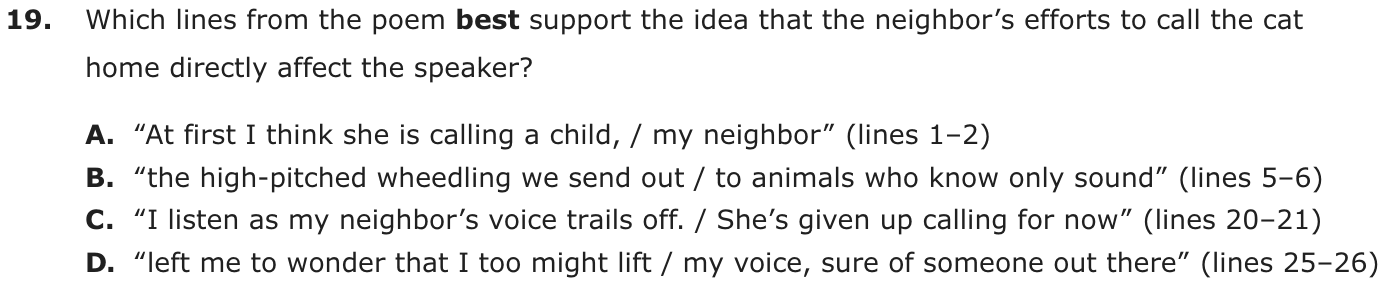
The passage “At Dusk” as printed (page 48)
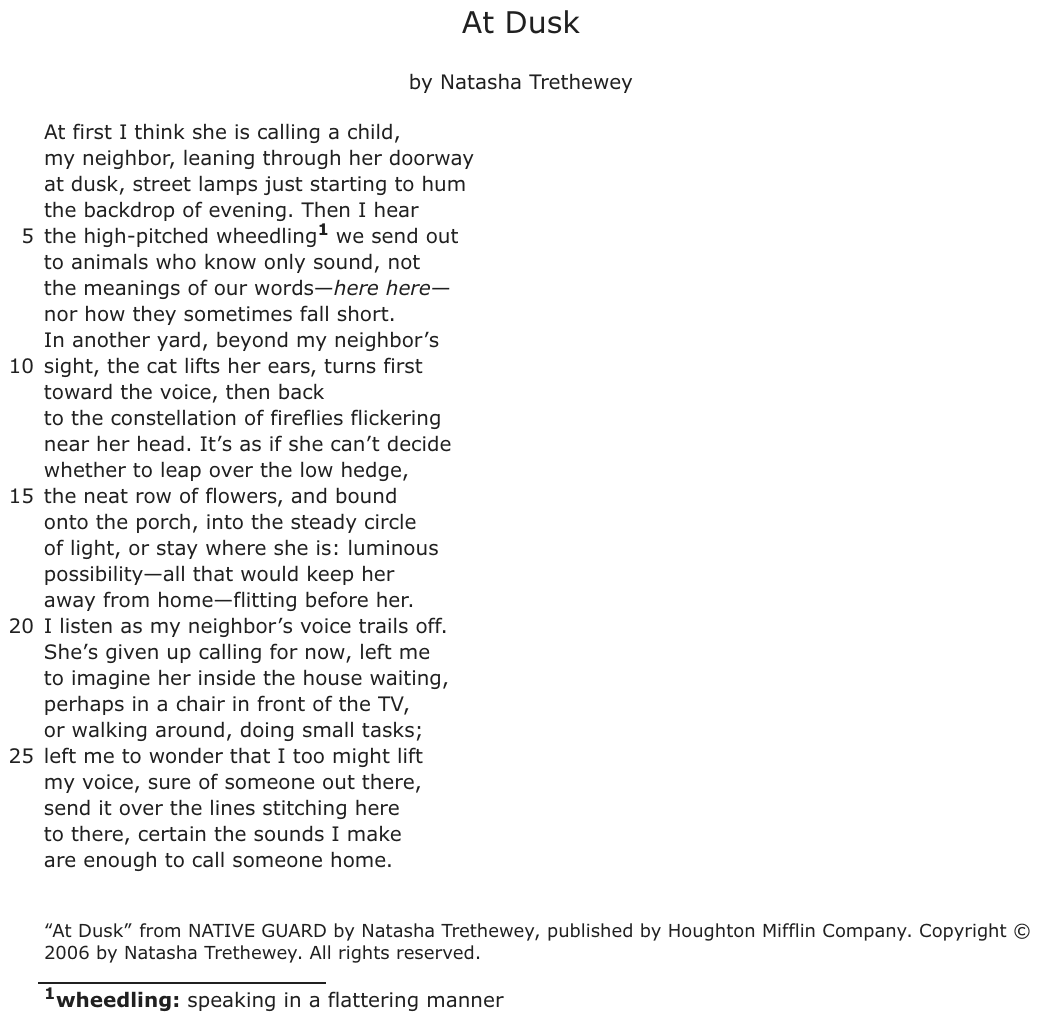
Question 19 of 120
2024 Test A English, question 20Uses the passage above: “At Dusk”.
Question
The isolation of the words “—here here—” in line 7 contributes to the meaning of the poem mainly by
- Ademonstrating how people try to communicate in familiar ways but are still sometimes misunderstood.
- Bshowing how people can feel desperate to connect with others but give up quickly when their first attempts are ignored.
- Cusing the unspoken bond between the neighbor and her cat to highlight the understanding people have with their pets.
- Dillustrating the use of a simple expression to call home those who are loved and missed.
Show the answer
Correct answer: D
The question asks how the isolation of the words “—here here—” in line 7 mainly contributes to the meaning of the poem.
A. Incorrect. The words “—here here—” do interrupt the speaker’s observation in lines 7–8 that “our words . . . / . . . sometimes fall short.” However, in lines 5–7, the speaker observes that the neighbor accompanies her words with a “high-pitched wheedling” that people “send out” because they are aware that animals “know only sound, not / the meanings of our words,” indicating that the neighbor does not actually expect her words to be understood. The description of the cat’s response in lines 10–11 (“the cat lifts her ears, turns first / toward the voice, then back”) does not suggest that the neighbor’s message is misunderstood but rather suggests that the cat prefers not to respond to it.
B. Incorrect. In lines 20–21, the “neighbor’s voice trails off,” and she does give up calling the cat. However, rather than any desperation to connect, the neighbor’s use of a “high-pitched wheedling” (line 5) simply indicates her understanding that the cat, like other animals, understands “only sound, not / the meanings of our words” (lines 6–7) such as “here here.” Furthermore, the neighbor does not give up quickly. In lines 21–22, the speaker says the neighbor has “given up calling for now” but is still “waiting” for the cat.
C. Incorrect. In lines 4–7, the speaker describes the neighbor calling to the cat with a “high-pitched wheedling.” The sound may indicate a bond between the neighbor and the cat because the neighbor does understand that animals “know only sound, not / the meanings of our words” (lines 6–7). However, the use of the words “here here” in line 7 does not indicate that bond, because they are used as an example of the type of words that animals do not understand.
D. CORRECT. The speaker’s initial thought in line 1 that the neighbor is calling a child, rather than a cat, suggests that the neighbor loves and misses the cat. Lines 4–7 then present the speaker’s observation that the neighbor uses a “high-pitched wheedling,” to emphasize the simple words of her call, “—here here—.” The idea that the words are an example of a simple expression used to call home a missed loved one is reinforced in lines 25–29, when the speaker is “left . . . to wonder” whether the speaker, too, “might lift / [his or her] voice” and be able “to call someone home.”
Question analysis
This reading question asks how setting off the words here here with dashes in line 7 adds to the meaning of At Dusk, Natasha Trethewey's poem about a neighbor calling her cat at nightfall. Students must work out what two plain, isolated words contribute to the whole poem, choosing among four readings about how people and animals communicate and connect.
- Grade level
- Grade 8 reading and task
- Compared with grade 7
- Above grade 7 Grade 7 students explain how a line adds to a poem, but here the feature is a tiny typographic choice, and its meaning has to be built from the whole poem rather than nearby lines, which goes beyond typical grade 7 work.
- Estimated difficulty
- Among the hardest on the SHSAT: a non-obvious approach, heavy reading, or a well-hidden trap.
- Thinking it demands
- Depth of knowledge 3, strategic thinking · mainly analyze
- What makes it hard
- A very close wrong answer major
- Evidence in several places moderate
- How, not what moderate
- Evidence
- Answered from the whole text
- Reading level
- Passage: 236 words (a poem; reading level not measured); question and choices: about grade 9, 87 words.
- Corrected from the DOE handbook
- A grammar slip in the explanation was corrected.
- Students, last 30 days
- Not enough answers yet to show (it takes 10).
Why it is hard, traps and wrong answers (shows the answer)
Why it is hard
The words sit inside a sentence about animals not knowing the meanings of our words and about words that “sometimes fall short,” so the nearest lines point toward miscommunication. The poem's frame points elsewhere: it opens with a call that sounds like a parent's, ends with the speaker hoping a voice can “call someone home,” and even repeats “here” in line 27. Students who read only around line 7 choose the misunderstanding; those who connect the isolated call to the first and last lines see what it is for.
A very close wrong answer major Choosing the answer
The misunderstanding choice and the right one agree that “here here” is a familiar way of calling; they part only on what it shows, failed communication or a call home to someone missed. (Embretson & Wetzel, 1987; Gorin & Embretson, 2006; Ascalon et al., 2007)
Evidence in several places moderate Working it out
The right reading rests on lines far from line 7: the speaker's first guess that a child is being called, and the last line's wish “to call someone home.” (Kirsch & Mosenthal, 1990; Gorin & Embretson, 2006)
How, not what moderate Working it out
The question asks what setting two words apart with dashes and italics does for the poem, a typographic choice whose purpose the poem never explains. (Anderson & Krathwohl, 2001)
Strategy: Ask what the two words are meant to do and whom they are aimed at, then keep the choice that the poem's other lines confirm.
Traps
- Wrong purpose or structure: Names a purpose, structure or effect that the part does not serve, or describes what a part says when the question asks what it does.
- Twists what the text says: Uses the text's topic and ideas but changes what it says: who did it, how much, when, or why.
- Reads too much in: A reasonable-sounding conclusion that goes further than the text allows.
The wrong answers, classified
A Wrong purpose or structure (Anderson & Krathwohl, 2001)
Reads the words through line 8's “sometimes fall short” as failed communication, but the cat does hear and turn toward the call, and the ending hopes such sounds can bring someone home.
B Twists what the text says (King et al., 2004)
Sees the neighbor stop calling and calls her desperate and quick to quit, though she has given up only “for now” and is still waiting inside.
C Reads too much in (Graesser, Singer & Trabasso, 1994)
Assumes an owner and a pet share a silent understanding, but “here here” is spoken aloud, and the poem offers it as words animals cannot follow.
What was corrected from the DOE handbook, and why
- Explanation: In rejecting choice C, the handbook reads “the use of the words “here here” in line 7 do not indicate that bond.” It now reads “does not,” to agree with “use.”
Working it out, step by step
Figure out what the question asks
In line 7 the words here here are set apart by dashes and slanted letters (italics). The question asks what this does for the poem’s meaning. Think about what the words are for and who they are aimed at.
Look at line 7
Line 7 reads “the meanings of our words—here here—.” These are the words the neighbor calls to her cat. Setting them apart lets you hear them, as if spoken aloud. They are simple words that mean “come here.” Lines 6–7 say animals know “only sound, not / the meanings of our words.”
Connect to the start and end
In line 1 the speaker first thinks the neighbor “is calling a child.” So the call sounds like a parent calling someone they love. The poem ends with the hope that a voice can be “enough to call someone home” (line 29). So here here is a simple call to bring a loved one home.
Check each choice
- A is wrong. The cat isn’t confused. She “lifts her ears” and turns “toward the voice.” She just doesn’t come yet.
- B is wrong. The neighbor isn’t shown as desperate. She stops only “for now,” and the speaker pictures her waiting inside.
- C is wrong. Here here is spoken out loud. The poem treats it as words animals don’t understand, not a silent bond.
- D is right. It is a simple call to someone loved and missed.
Watch out: Line 8 says words “sometimes fall short,” which points toward A. But read the first and last lines too.
Choose the answer
The two words stand for the simple call people use to bring loved ones home. So the answer is D.
Why this answer and not the closest wrong one
A is the closest wrong answer, because line 8 says our words “sometimes fall short.” But the cat does hear the call and turn toward it. And the poem ends by hoping the sounds “are enough to call someone home.” D links the two words to that wish, and to the first guess that a child is being called.
More questions like this
The original DOE question
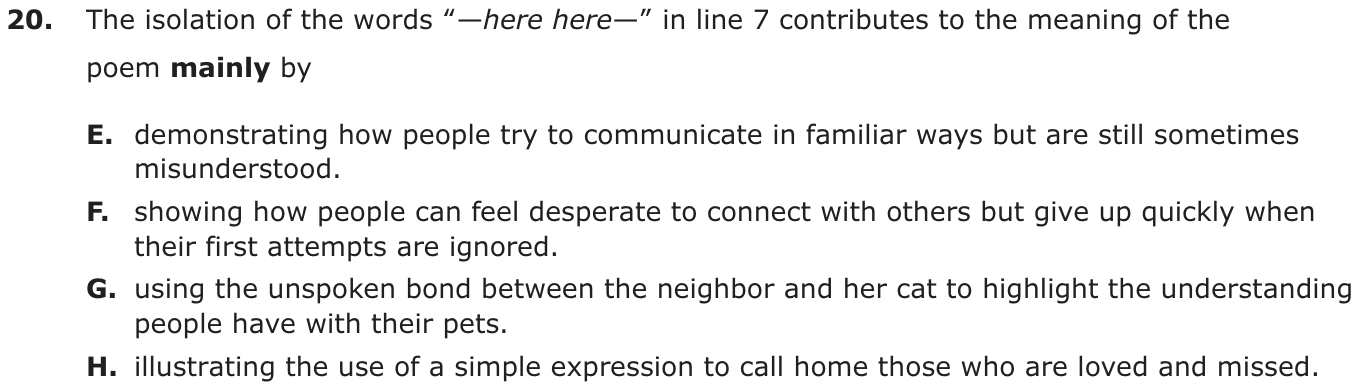
Question 20 of 120
2024 Test A English, question 21Uses the passage above: “At Dusk”.
Question
The details in lines 10–17 about the cat convey a central idea of the poem by
- Ashowing that returning home after experiencing independence is challenging.
- Bsuggesting that caring for others means allowing them to grow and to roam freely.
- Cimplying that expecting to feel at home in the natural world leads to disappointment.
- Demphasizing the conflicting desires to return to the familiar and to explore the unknown.
Show the answer
Correct answer: D
The question asks how the details in lines 10–17 convey a central idea of the poem.
A. Incorrect. In lines 10–17, the speaker says that the cat’s actions—she “turns first / toward the voice, then back”—make the cat seem “as if she can’t decide” whether to return home or to explore “the constellation of fireflies flickering / near her head.” However, while the cat is indecisive, it is not the experience of independence that causes this conflict for the cat but rather the “luminous / possibility . . . flitting before her” (lines 17–19).
B. Incorrect. The neighbor’s calling of the cat indicates that she does allow it to roam outside regularly. However, the details in these lines focus not on whether allowing the cat to roam is an expression of caring but on the cat’s reaction to the neighbor’s calls, “as if she can’t decide” (line 13) whether to return home “into the steady circle / of light” (lines 16–17) or stay and enjoy the “luminous / possibility” (lines 17–18) that the night offers. Furthermore, the neighbor’s “wheedling” (line 5) and the timing of her call, “at dusk” (line 3), introduce the possibility that encouraging others to come home expresses more caring than allowing them to roam freely.
C. Incorrect. Lines 10–17 describe the reactions of the cat, who is exploring the natural world, including a “constellation of fireflies flickering / near her head,” when the neighbor calls to her. The poet describes the cat’s conflict by saying that “It’s as if she can’t decide” whether to stay outdoors or return “into the steady circle / of light” at home with the neighbor. However, the cat’s indecision demonstrates that, rather than being a disappointment, the natural world is as appealing as home.
D. CORRECT. Lines 10–11 describe how the cat “turns first / toward the voice, then back,” indicating that the cat is experiencing a conflict. To the speaker, the cat seems “as if she can’t decide” (line 13) between exploring “the constellation of fireflies” (line 12) outdoors and returning to the familiar “steady circle / of light” (lines 16–17) indoors. This central idea that someone might experience a conflict between exploring and returning to the familiar is suggested again in lines 28–29 when the speaker wonders whether “the sounds I make / are enough to call someone home.”
Question analysis
This reading question asks how the lines describing a cat in another yard, as the neighbor calls from her doorway, convey a central idea of Natasha Trethewey's poem At Dusk. Students must turn a concrete picture of an animal's behavior into a general idea and check each proposed lesson against what the cat actually does in these lines.
- Grade level
- Grade 7 reading and task
- Compared with grade 7
- At grade 7 Showing how specific lines convey a central idea is grade 7 work. The cat's behavior is concrete and easy to picture, so the step from image to idea is a typical grade 7 poetry task.
- Estimated difficulty
- Moderate: several steps, or a close reading with one strong distractor.
- Thinking it demands
- Depth of knowledge 2, skills and concepts · mainly understand
- What makes it hard
- Figurative or literary language moderate
- Reading between the lines minor
- Evidence
- Answered from one paragraph or stanza
- Reading level
- Passage: 236 words (a poem; reading level not measured); question and choices: about grade 9, 66 words.
- Corrected from the DOE handbook
- A grammar slip in the explanation was corrected.
- Students, last 30 days
- Not enough answers yet to show (it takes 10).
Why it is hard, traps and wrong answers (shows the answer)
Why it is hard
The lines show a cat turning toward the voice and back to the fireflies, then hesitating between the porch light and the night, so the idea is a pull in two directions. The most tempting wrong answer also describes trouble going home but explains it by time spent away, a cause these lines never give. Other choices bring in lessons about caring for pets or about nature letting us down, which the bright images of the night contradict.
Figurative or literary language moderate Understanding the question
The two pulls are images, “the constellation of fireflies flickering” for the unknown and “the steady circle / of light” on the porch for the familiar, and both must be read that way. (Graesser, Singer & Trabasso, 1994; Kintsch, 1998)
Reading between the lines minor Working it out
Students must turn one cat's hesitation in a yard into an idea about people, a step these lines leave to the reader until the speaker's own wish at the end of the poem. (Graesser, Singer & Trabasso, 1994; Kintsch, 1998)
Strategy: Describe in plain words what the cat does in lines 10–17 and why, then choose the general idea that matches that behavior without adding causes the lines never give.
Traps
- Half right: One half of a two-part choice is right and the other is not.
- Outside knowledge: A choice is plausible in the real world but not supported by this text.
- Twists what the text says: Uses the text's topic and ideas but changes what it says: who did it, how much, when, or why.
The wrong answers, classified
A Half right (King et al., 2004; Thissen, Steinberg & Fitzpatrick, 1989)
Rightly sees that going home is hard for the cat but blames a taste of independence, when the lines show her drawn by the fireflies now, not changed by time away.
B Outside knowledge (King et al., 2004; Recht & Leslie, 1988)
Brings in a familiar belief that caring means letting loved ones roam, but lines 10–17 describe the cat's choice, not how the neighbor shows care.
C Twists what the text says (King et al., 2004)
Turns the poem's picture of nature upside down: the fireflies and the “luminous / possibility” make the outdoors appealing, not a source of disappointment.
What was corrected from the DOE handbook, and why
- Explanation: In rejecting choice A, the handbook reads “the cat’s actions—she “turns first / toward the voice, then back”—makes the cat seem.” It now reads “make,” to agree with “actions.”
Working it out, step by step
Figure out what the question asks
Lines 10–17 are about the cat. A central idea is a main message of the poem. You need the idea that these details about the cat show.
Read what the cat does
The cat “lifts her ears, turns first / toward the voice, then back / to the constellation of fireflies flickering / near her head” (lines 10–13). Then the speaker says, “It’s as if she can’t decide” (line 13). She could leap “onto the porch, into the steady circle / of light” (lines 16–17). Or she could “stay where she is” (line 17).
Work out what it means
The porch light is home. It is familiar, something the cat knows well. The fireflies are like a “constellation,” a group of stars. They stand for the unknown night and its wonders. The cat is pulled both ways. Part of her wants home. Part of her wants to stay out and explore.
Check each choice
- A is wrong. Going home is hard for the cat. But the reason is the fireflies near her now. The lines never say she got used to being free.
- B is wrong. These lines are about the cat’s choice. They say nothing about caring for her or letting her roam.
- C is wrong. Nature is not disappointing here. The fireflies make the outdoors glow.
- D is right. The cat is torn between the familiar porch and the unknown night.
Watch out: A sounds close, because the cat really does have trouble going home. But A adds a cause the poem never gives.
Choose the answer
The cat turns toward home and then back to the fireflies. So the answer is D.
Why this answer and not the closest wrong one
A is the closest wrong answer. It is right that going home is hard for the cat. But A blames a taste of freedom from time spent away. The poem says nothing about that. It shows two pulls at once: the voice and light of home, and the fireflies close by. D names both desires.
More questions like this
The original DOE question

Question 21 of 120
2024 Test A English, question 22Uses the passage above: “At Dusk”.
Question
The phrases “luminous possibility” and “all that would keep her / away from home” (lines 17–19) affect the poem by
- Ahighlighting the cat’s lack of concern for the neighbor.
- Bimplying that the speaker finds the cat’s current situation interesting.
- Csuggesting that the cat is compelled by its sense of wonder to remain outdoors.
- Dindicating that the speaker supports the cat’s decision to ignore the neighbor.
Show the answer
Correct answer: C
The question asks how the phrases “luminous possibility” and “all that would keep her / away from home” (lines 17–19) affect the poem.
A. Incorrect. In lines 20–21, the neighbor’s voice “trails off,” and the speaker states that “she’s given up calling for now,” which could be interpreted as a lack of concern. However, these lines describe the neighbor rather than the cat. The phrases from lines 17–19 are used to explain that what keeps the cat from returning home is the allure of “luminous possibility.” The use of the phrase “all that would keep her” suggests that the cat would likely return home to the security of “the steady circle / of light” (lines 16–17) if not for the possibilities offered by the night, implying that the cat usually prefers to be at home with the neighbor. The phrases do not highlight a lack of concern for the neighbor on the part of the cat.
B. Incorrect. While the phrase “luminous possibility” does convey a high degree of interest, it is used to describe why being outside at night appeals to the cat. It does not describe the speaker’s interest in the cat. The speaker observes the cat as it tries to decide between returning home and staying out and then concludes that it is only “luminous / possibility . . . that would keep [the cat] / away from home.”
C. CORRECT. The phrases are used to explain that the cat, though tempted to return home, is also tempted or compelled by “luminous possibility” to remain outdoors. The phrases convey a sense of wonder about what the night may offer, and it is the powerful effect of this sense of wonder (“all that would keep her / away from home”) that ultimately tempts the cat to remain outdoors rather than return to the comforts of home.
D. Incorrect. Lines 17–19 present the speaker’s observations about the cat as it tries to decide whether to stay where it is or return home. The speaker explains that it is only “luminous possibility” that can convince the cat to stay rather than return to the comforts of home. While the speaker then imagines the neighbor indoors, there is no indication that the speaker supports the cat’s decision. The speaker merely notes that the neighbor stops calling to the cat “for now” (line 21), and then the speaker reflects on the possible results of calling someone home.
Question analysis
This reading question asks how the phrases luminous possibility and all that would keep her away from home, which describe what surrounds a cat in a nearby yard, affect the poem At Dusk. Students must interpret abstract, figurative wording and work out whose feelings it conveys: the cat's, the neighbor's or the speaker's.
- Grade level
- Grade 8 reading and task
- Compared with grade 7
- At grade 7 Explaining how word choice affects a poem is grade 7 work. These phrases are abstract and broken across lines, which adds some challenge, but the lines around them are concrete, so the task stays within typical grade 7 demand.
- Estimated difficulty
- Moderate: several steps, or a close reading with one strong distractor.
- Thinking it demands
- Depth of knowledge 2, skills and concepts · mainly analyze
- What makes it hard
- Figurative or literary language moderate
- Reading between the lines minor
- Complex sentences minor
- Evidence
- Answered from one paragraph or stanza
- Reading level
- Passage: 236 words (a poem; reading level not measured); question and choices: about grade 8, 63 words.
- Students, last 30 days
- Not enough answers yet to show (it takes 10).
Why it is hard, traps and wrong answers (shows the answer)
Why it is hard
The phrases belong to the speaker but describe what tempts the cat, and the choices exploit that by offering the speaker's interest or approval, or the cat's indifference to its owner. The words “all that would keep her / away from home” imply that home still pulls at the cat, so only an attraction strong enough to hold her outside fits. Students who first settle whose experience the phrases describe can rule out most choices at once.
Figurative or literary language moderate Understanding the question
“Luminous possibility” is abstract, an unnamed promise glowing in the dusk, and students must see it as what draws the cat, the counterweight to “the steady circle / of light” at home. (Graesser, Singer & Trabasso, 1994; Kintsch, 1998)
Reading between the lines minor Working it out
The phrases are the speaker's words about the cat, so students must work out that they convey the cat's pull, not the speaker's opinion or the neighbor's feelings. (Graesser, Singer & Trabasso, 1994; Kintsch, 1998)
Complex sentences minor Understanding the question
The phrases are broken across lines 17–19 and set off by dashes, so “flitting before her” is separated from “possibility” by the inserted “all that would keep her / away from home.” (Abedi & Lord, 2001; Freedle & Kostin, 1993; Messick, 1989)
Strategy: Decide first who or what the phrases describe, then keep only choices about that same subject and check that the phrases themselves show what each one claims.
Traps
- Wrong tone or attitude: Misjudges the tone, attitude or point of view, such as reading admiration as criticism, or taking a character's or subject's feelings for the author's.
- Reads too much in: A reasonable-sounding conclusion that goes further than the text allows.
The wrong answers, classified
A Reads too much in (Graesser, Singer & Trabasso, 1994)
Reads the cat's staying out as indifference to its owner, though “all that would keep her / away from home” implies home would win without the night's attractions.
B Wrong tone or attitude (Graesser, Singer & Trabasso, 1994)
Notices that “luminous possibility” is the speaker's lyrical phrase and takes it as the speaker's own interest, when it describes the wonder drawing the cat.
D Reads too much in (Graesser, Singer & Trabasso, 1994)
Assumes that describing the night so warmly means the speaker approves of the cat ignoring the neighbor, an opinion the poem never states.
Working it out, step by step
Figure out what the question asks
You need to know what two phrases do in the poem. First decide who they describe. Here they describe the cat and what pulls at her.
Find the phrases in lines 17–19
The cat could go home, “or stay where she is: luminous / possibility—all that would keep her / away from home—flitting before her.”
Work out what the words mean
“Luminous” means glowing with light. “Possibility” means what might happen. “Flitting” means darting quickly about, like the fireflies near her head. So the glowing night is full of exciting chances. It is everything that “would keep her / away from home.” That sense of wonder is what holds the cat outside.
Check each choice
- A is wrong. “All that would keep her / away from home” means home pulls at her too. She isn’t uncaring.
- B is wrong. The phrases describe what draws the cat, not how the speaker feels.
- C is right. The night’s glow and wonder tempt the cat to stay out. “Compelled” means strongly pulled.
- D is wrong. The speaker never says the cat is right to stay out.
Watch out: B is tempting because “luminous possibility” is the speaker’s own beautiful wording. But the speaker uses it to show what the cat sees.
Choose the answer
The phrases show a wonder strong enough to hold the cat outdoors. So the answer is C.
Why this answer and not the closest wrong one
B is the closest wrong answer. The speaker does choose these glowing words. But they describe the night that is “flitting before her,” the cat. They explain what keeps her “away from home.” C fits, because the phrases show the cat drawn by wonder to stay outside.
More questions like this
The original DOE question
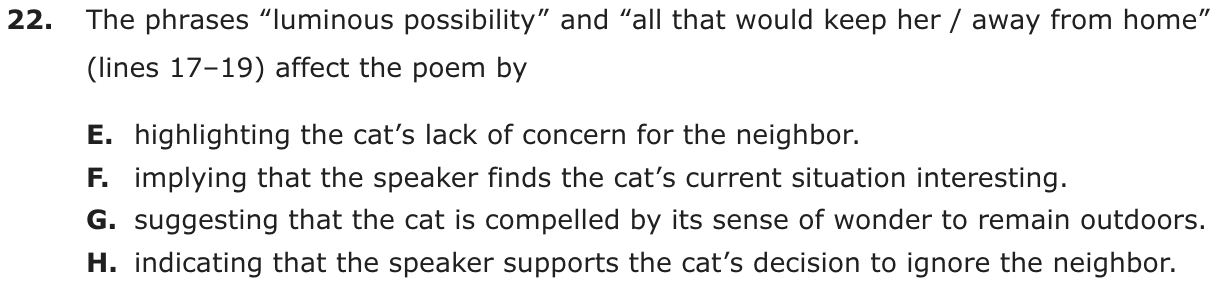
Question 22 of 120
2024 Test A English, question 23Uses the passage above: “At Dusk”.
Question
Read lines 11–13 from the poem.
toward the voice, then back
to the constellation of fireflies flickering
near her head
Which idea from the poem does the imagery in these lines help convey?
- AThe cat lacks a preference for going in or staying out.
- BThe cat is eager to see what will happen next.
- CThe cat wants to understand the unpredictable behavior of the fireflies.
- DThe cat is fascinated by the natural world and finds the indoors unremarkable.
Show the answer
Correct answer: D
The question asks which idea the imagery in lines 11–13 helps convey.
A. Incorrect. Line 13 includes the speaker’s observation that the cat seems “as if she can’t decide” whether to stay outside or go to the neighbor. However, the imagery of the “constellation of fireflies flickering” in line 12 suggests that the cat does have a preference for exploring the more exciting “luminous / possibility” (lines 17–18) of the outdoors.
B. Incorrect. The imagery in lines 10–11 of the cat turning “first / toward the voice, then back” might seem to suggest that the cat is eagerly watching both the neighbor and the fireflies to see what will happen next. However, line 13, in which the cat seems “as if she can’t decide,” indicates that what will happen next is actually under the cat’s control.
C. Incorrect. The imagery in lines 12–13 of the “fireflies flickering / near her head” does indicate the fireflies’ unpredictable behavior. However, the imagery in lines 10–11 of the cat turning “first / toward the voice, then back” establishes that the cat’s attention is split between the fireflies and the “high-pitched wheedling” (line 5) of the neighbor’s voice, rather than being fully captured by wanting to understand the fireflies.
D. CORRECT. The imagery in line 12 of “the constellation of fireflies flickering” suggests that the outdoors holds fascinating attractions, an idea supported by the description in lines 17–18 of the cat’s current location outdoors as one filled with “luminous / possibility.” The imagery in lines 10–11 of the cat turning “first / toward the voice, then back” indicates that the cat has considered but rejected the option of returning indoors, and the description in lines 16–17 of the indoors as offering only a “steady circle / of light” suggests that the indoors seems unremarkable to the cat in comparison to the outdoors.
Question analysis
This reading question quotes three lines from At Dusk in which a cat turns from a calling voice back to fireflies flickering near her head, and asks which idea the imagery helps convey. Students must interpret a visual image in light of the lines around it and judge how far the poem supports each reading of the cat's attention.
- Grade level
- Grade 8 reading and task
- Compared with grade 7
- Above grade 7 Grade 7 students explain what imagery conveys, but this image is brief and the four ideas offered for it differ in subtle ways, so ruling them out takes closer reading than typical grade 7 work.
- Estimated difficulty
- Hard: combines ideas, needs a plan, and has more than one tempting wrong answer.
- Thinking it demands
- Depth of knowledge 3, strategic thinking · mainly analyze
- What makes it hard
- Reading between the lines major
- Figurative or literary language moderate
- Evidence in several places minor
- Evidence
- Answered from one paragraph or stanza
- Reading level
- Passage: 236 words (a poem; reading level not measured); question and choices: about grade 6, 77 words.
- Students, last 30 days
- Not enough answers yet to show (it takes 10).
Why it is hard, traps and wrong answers (shows the answer)
Why it is hard
The answer is the best available rather than a perfect one: its first half is plain in the image of the cat turning back to the fireflies, while its second half rests on the comparison with a steady porch light. Meanwhile the very next words say she “can't decide,” which makes indifference look like the safe reading. The question rewards seeing that being torn is not the same as having no preference, since the image shows which way she turns.
Reading between the lines major Working it out
The quoted lines never mention the indoors, so the claim that the cat finds it unremarkable has to be drawn from the contrast with “the steady circle / of light” in lines 16–17. (Graesser, Singer & Trabasso, 1994; Kintsch, 1998)
Figurative or literary language moderate Understanding the question
“The constellation of fireflies flickering” turns insects into a field of stars beside the cat's head, and that image of wonder is what students are asked to interpret. (Graesser, Singer & Trabasso, 1994; Kintsch, 1998)
Evidence in several places minor Working it out
The words right after the quotation say “It's as if she can't decide,” and the evidence that tips the balance sits in lines 16–19, outside the three lines quoted. (Kirsch & Mosenthal, 1990; Gorin & Embretson, 2006)
Strategy: Picture the cat's movements in these three lines, then test each choice against the words of lines 10–19 and drop any idea the image does not actually show.
Traps
- Twists what the text says: Uses the text's topic and ideas but changes what it says: who did it, how much, when, or why.
- Reads too much in: A reasonable-sounding conclusion that goes further than the text allows.
- Word match: Repeats striking words or phrases from the text, so it looks supported, but its meaning does not fit the question.
The wrong answers, classified
A Twists what the text says (King et al., 2004)
Takes “as if she can't decide” in line 13 to mean the cat has no preference, but being torn means feeling two pulls, and these lines show her turning back to the fireflies.
B Reads too much in (Graesser, Singer & Trabasso, 1994)
Reads the cat's turning back and forth as eager waiting for what will happen, though the lines show attention divided between two pulls, not suspense.
C Word match (Freedle & Kostin, 1993)
Repeats the fireflies' flickering from the image and invents a wish to understand their behavior, when the lines show fascination with the lights, not curiosity about insects.
Working it out, step by step
Figure out what the question asks
Imagery is language that helps you see, hear or feel a scene. You need the idea that the images in lines 11–13 help show.
Picture lines 10–13
The cat “turns first / toward the voice, then back / to the constellation of fireflies flickering / near her head.” A constellation is a group of stars that forms a picture. So the fireflies are like little stars blinking around her. She hears the call, but she turns back to them.
Compare outdoors and indoors
Outside, the night sparkles like stars. Lines 17–18 call it “luminous / possibility,” full of glowing chances. Home is “the steady circle / of light” on the porch (lines 16–17). Steady means it does not change. Next to the flickering stars, that light is plain. Unremarkable means not special.
Check each choice
- A is wrong. The cat “can’t decide,” but that means she feels two pulls. The image shows her turning back to the fireflies.
- B is wrong. She is not waiting for something to happen. Her attention is split between two pulls.
- C is wrong. She is drawn to the fireflies’ glow, not trying to figure out how they act.
- D is right. She is fascinated by the night, and the porch light is plain next to it.
Watch out: A is tempting because of line 13. But being torn is not the same as having no preference.
Choose the answer
The poem never says the cat has made up her mind. But the images make the night magical and home ordinary. That fits D best. So the answer is D.
Why this answer and not the closest wrong one
A is the closest wrong answer, since the next words say “It’s as if she can’t decide.” But a cat with no preference would not care either way. This cat turns back to the fireflies, which shows a strong pull. D fits that pull, and the plain “steady circle / of light” shows why home seems less special.
More questions like this
The original DOE question
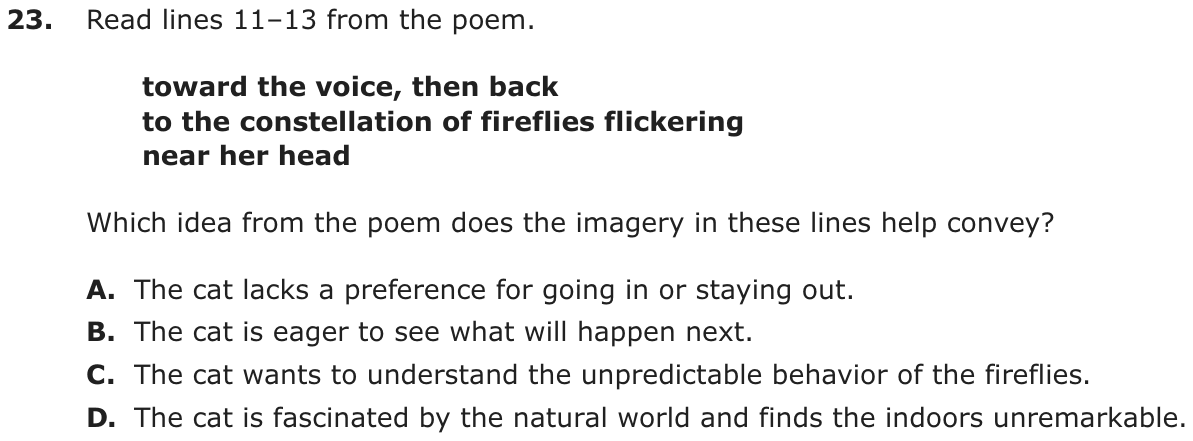
Question 23 of 120
2024 Test A English, question 24Uses the passage above: “At Dusk”.
Question
How does the setting affect the events of the poem?
- AIt enables the speaker to regularly overhear the neighbor calling for her cat at dusk.
- BIt allows the speaker to observe the neighbor quietly without interacting with her.
- CIt shows how living in close proximity helps the speaker feel connected to the neighbor.
- DIt shows how feeling isolated causes the speaker to imagine interactions with the neighbor.
Show the answer
Correct answer: B
The question asks how the setting affects the events discussed in the poem.
A. Incorrect. In line 2, the speaker refers to the woman calling for her cat as “my neighbor,” which clearly suggests that the speaker lives next door to the woman. However, although the two live next door to each other, line 1 suggests that perhaps the speaker does not regularly overhear the neighbor because the speaker initially thinks that the neighbor is “calling a child” and only later realizes the neighbor is calling to a cat. Although the setting places the speaker and the neighbor in close proximity, the poem does not indicate the frequency or regularity with which the speaker overhears the neighbor.
B. CORRECT. In the first four lines, the speaker observes the actions of the neighbor as the neighbor leans out to call for the cat at dusk. Despite the speaker’s observation of the neighbor, there is no indication that the neighbor notices the speaker. The reader can conclude that because of the time of day and the speaker being in the house next door, the speaker can observe the neighbor without being observed by her or having to interact with her.
C. Incorrect. The setting of the poem is a neighborhood at nightfall, as indicated by “at dusk” in line 3, the reference to “another yard” in line 9, and the flickering fireflies in line 12. However, while the speaker is close enough to the neighbor to overhear her calling to the cat, there is no indication that the speaker feels connected to the neighbor. Instead, the speaker expresses curiosity about the neighbor after the neighbor goes inside, and the speaker is “left . . . / to imagine her inside the house waiting” (lines 21–22). The fact the speaker initially thought that the neighbor was calling a child indicates that the speaker is not familiar with the neighbor and her habits, and there is no indication that the speaker feels connected to the neighbor.
D. Incorrect. In lines 22–24, the speaker imagines what the neighbor may be doing while the neighbor is waiting inside for the cat to return, but the speaker is imagining the neighbor’s solitary experience after the neighbor has momentarily “given up” on calling to the cat (line 21). The speaker does not imagine personally interacting with the neighbor but rather briefly imagines what the neighbor is doing at home while the cat is away.
Question analysis
This reading question asks how the setting of At Dusk, a neighborhood at nightfall where a woman leans from her doorway to call her cat, affects the events of the poem. Because so little happens, students must infer the setting's role from small details, and several choices sound reasonable without being supported by the poem.
- Grade level
- Grade 8 reading and task
- Compared with grade 7
- Above grade 7 Grade 7 students analyze how setting shapes events, usually in a story with a clear plot. This poem has almost no action, so the student must reason from a handful of details about place and time, which is harder than typical grade 7 work.
- Estimated difficulty
- Hard: combines ideas, needs a plan, and has more than one tempting wrong answer.
- Thinking it demands
- Depth of knowledge 3, strategic thinking · mainly analyze
- What makes it hard
- A very close wrong answer major
- Reading between the lines moderate
- Evidence
- Answered from the whole text
- Reading level
- Passage: 236 words (a poem; reading level not measured); question and choices: about grade 8, 67 words.
- Students, last 30 days
- Not enough answers yet to show (it takes 10).
Why it is hard, traps and wrong answers (shows the answer)
Why it is hard
Little happens in this poem, so the setting's role must be built from small details: a neighbor at her doorway at dusk, a cat in another yard, a speaker who hears and watches but never speaks. The strongest wrong answer is right about overhearing and wrong only in claiming it happens regularly, which the speaker's first mistaken guess argues against. The other choices supply a feeling of closeness or of isolation that the poem never states.
A very close wrong answer major Choosing the answer
The overhearing choice describes what the setting allows almost as well as the right one and fails on a single word, “regularly,” since the poem records one evening and the speaker first mistakes the call. (Embretson & Wetzel, 1987; Gorin & Embretson, 2006; Ascalon et al., 2007)
Reading between the lines moderate Working it out
The setting's effect is never stated; it has to be inferred from the speaker hearing and watching from nearby while the neighbor, “leaning through her doorway,” never seems to notice anyone. (Graesser, Singer & Trabasso, 1994; Kintsch, 1998)
Strategy: Picture the scene from the speaker's position, then check each choice word by word against the poem and reject any that claims something the poem never states.
Traps
- Too broad or too strong: A choice overstates, generalizes, or uses absolute words the text does not support.
- Reads too much in: A reasonable-sounding conclusion that goes further than the text allows.
- Twists what the text says: Uses the text's topic and ideas but changes what it says: who did it, how much, when, or why.
The wrong answers, classified
A Too broad or too strong (King et al., 2004)
Rightly sees that living next door lets the speaker overhear the call, but “regularly” is unsupported, and the first guess about a child suggests the call is unfamiliar.
C Reads too much in (Graesser, Singer & Trabasso, 1994)
Connects living close by with the poem's interest in connection and the speaker's “I too,” but the speaker never claims to feel close to the neighbor.
D Twists what the text says (King et al., 2004)
Notices the speaker picturing the neighbor indoors and calls it imagined interaction, but the speaker pictures her alone, waiting or doing small tasks, and never mentions feeling isolated.
Working it out, step by step
Figure out what the question asks
The setting is where and when a story or poem takes place. You need to see how the setting shapes what happens in the poem.
Picture the setting
It is “dusk” (line 3), the dim time just after sunset. The neighbor is “leaning through her doorway” (line 2). The cat is “In another yard” (line 9). The speaker is close enough to hear and watch it all. But the speaker never speaks to the neighbor. Nothing shows the neighbor notices the speaker.
Work out the effect
Living next door puts the speaker close by. In the fading light, the speaker can watch quietly. So the speaker sees the neighbor and the cat without joining in. The whole poem is what the speaker sees, hears and imagines from there.
Check each choice
- A is wrong. The word “regularly” is the problem. The poem shows one evening.
- B is right. The speaker watches from nearby and never talks with the neighbor.
- C is wrong. The speaker never says they feel close to the neighbor.
- D is wrong. The poem never says the speaker feels lonely. The speaker pictures the neighbor alone inside, not the two of them talking.
Watch out: A is almost right, since living nearby does let the speaker overhear. One word makes it wrong.
Choose the answer
The setting lets the speaker watch quietly from close by. So the answer is B.
Why this answer and not the closest wrong one
A is the closest wrong answer. Living next door does let the speaker hear the call. But nothing says it happens often. The poem tells about one evening. At first the speaker even thinks a child is being called. B fits what the poem shows: the speaker watches without ever talking to the neighbor.
More questions like this
The original DOE question

Question 24 of 120
2024 Test A English, question 25Uses the passage above: “At Dusk”.
Question
The poet develops a theme about making connections with others mainly through the
- Aexploration of the desires of the speaker and the neighbor.
- Bspeaker’s observations of the sights and sounds in the neighborhood.
- Cspeculations the speaker makes about what the neighbor does inside her house.
- Dspeaker’s explanation of the cat’s thoughts and actions.
Show the answer
Correct answer: A
The question asks for an explanation of how the poet develops a theme about making connections with others.
A. CORRECT. The speaker first describes the neighbor calling the cat in a “high-pitched wheedling” (line 5) voice before giving up and returning indoors. The neighbor’s desire to have the cat return home prompts the speaker to wonder whether the speaker could call out and be “certain the sounds . . . / are enough to call someone home” (lines 28–29). These final lines most develop the theme of connection by conveying a desire to be able to prompt someone’s return.
B. Incorrect. Line 1, in which the speaker at first thinks the sound in the neighborhood is the neighbor “calling a child,” might be assumed to introduce a theme of making connections with others. However, other descriptions of the sights and sounds of the neighborhood, including the time of day—“at dusk, street lamps just starting to hum / the backdrop of evening” (lines 3–4) and “constellation of fireflies flickering” (line 12) near the cat—have no relationship to a theme of connection.
C. Incorrect. In lines 22–24, the speaker imagines the neighbor’s activities inside her house: “perhaps in a chair in front of the TV, / or walking around, doing small tasks.” Although the speaker does imagine the neighbor is doing these things to pass time while “waiting” (line 22) for the cat, the neighbor’s actions—and even the speaker’s imagining—are carried out alone, so they do not develop a theme of connection.
D. Incorrect. Lines 10–19 present the speaker’s observations of the cat, which “turns first / toward the voice, then back” when the neighbor calls, then appears “as if she can’t decide” whether to return to the neighbor or stay outside. Although the cat’s indecision about whether to heed the neighbor’s call might seem to develop a theme about making connections, lines 10–19 focus more on the relative appeal of the cat’s two options—returning to “the steady circle / of light” at home or pursuing the “luminous / possibility . . . flitting before her”—than on any connection between the cat and its owner or between the speaker and the neighbor.
Question analysis
This reading question asks which element of Natasha Trethewey's poem At Dusk mainly develops its theme about making connections with others. All four choices describe something that really happens in the poem, from neighborhood sights to a cat's hesitation, so students must weigh how much each part contributes to that theme.
- Grade level
- Grade 8 reading and task
- Compared with grade 7
- Above grade 7 Analyzing how a theme develops is grade 7 work, but here the student must rank four genuine features of the poem by how much each builds the theme, a comparison that asks more than typical grade 7 work.
- Estimated difficulty
- Hard: combines ideas, needs a plan, and has more than one tempting wrong answer.
- Thinking it demands
- Depth of knowledge 3, strategic thinking · mainly analyze
- What makes it hard
- Every choice must be checked moderate
- Evidence in several places moderate
- The right answer is reworded minor
- Evidence
- Answered from the whole text
- Reading level
- Passage: 236 words (a poem; reading level not measured); question and choices: about grade 8, 53 words.
- Students, last 30 days
- Not enough answers yet to show (it takes 10).
Why it is hard, traps and wrong answers (shows the answer)
Why it is hard
The question asks what mainly carries the theme, and every choice is a real part of the poem, so ruling choices out means ranking them, not spotting errors. The cat takes up the most lines and is the one being called home, which makes it the strongest lure, though its lines are about her choice between two places. What builds the theme is the neighbor's wish to bring the cat home, echoed by the speaker's wish to call someone home.
Every choice must be checked moderate Choosing the answer
All four choices name something that really fills the poem, so each must be weighed by how much it builds the theme of connection, not by whether it is there. (Embretson & Wetzel, 1987)
Evidence in several places moderate Working it out
The theme is built from the two ends of the poem: the neighbor calling and then waiting in lines 1–8 and 20–22, and the speaker's wish in lines 25–29 to send a voice out. (Kirsch & Mosenthal, 1990; Gorin & Embretson, 2006)
The right answer is reworded minor Choosing the answer
The right choice speaks of “desires,” a word the poem never uses, while the wrong ones echo its sounds, the neighbor's house and the cat. (Freedle & Kostin, 1993; Kirsch & Mosenthal, 1990)
Strategy: For each choice, find the lines it refers to and ask how directly they bear on making connections with others; keep the choice whose lines do so most fully.
Traps
- Wrong part of the text: A choice is true of another paragraph, stanza or speaker than the one asked about.
- Too narrow: A single detail offered as the central idea or a summary, or a summary that keeps minor details and leaves out an essential part.
- True but not the answer: A choice says something accurate about the text that does not answer this question.
The wrong answers, classified
B True but not the answer (King et al., 2004; Embretson & Wetzel, 1987)
Picks the poem's sights and sounds, the humming street lamps and the fireflies, which set the scene at dusk but are not where the poem says anything about reaching others.
C Too narrow (King et al., 2004)
Chooses the speaker picturing the neighbor in front of the TV, a real moment of imagining another life, but three lines of solitary tasks cannot carry the theme alone.
D Wrong part of the text (Kirsch & Mosenthal, 1990)
Notices how many lines follow the cat, the one being called home, but they weigh the porch light against the night, not one person reaching toward another.
Working it out, step by step
Figure out what the question asks
A theme is a big message about life. This poem has a theme about making connections, or reaching out to others. You need the part of the poem that mainly builds that theme.
Look at what the neighbor wants
The neighbor wants her cat to come home. She calls out at dusk with a “high-pitched wheedling” (line 5). Wheedling means sweet-talking. When she stops, the speaker pictures her “inside the house waiting” (line 22). Her wish is to reach the cat and bring her back.
Look at what the speaker wants
Her calling “left me to wonder that I too might lift / my voice” (lines 25–26). The speaker hopes the sounds “are enough to call someone home” (line 29). So the speaker wants to reach someone too. Both people wish to call someone back to them. That shared wish builds the theme of connection.
Check each choice
- A is right. The desires, or wishes, of the neighbor and the speaker carry the theme.
- B is wrong. The humming street lamps and the fireflies set the scene. They don’t show anyone reaching out.
- C is wrong. The guesses about the neighbor inside fill only three lines, and they show her alone.
- D is wrong. The cat lines weigh home against the night. They don’t show one person reaching another.
Watch out: D is tempting because the cat fills many lines. But they are about her choice, not about a connection.
Choose the answer
The poem builds its theme through what the neighbor and the speaker both want. So the answer is A.
Why this answer and not the closest wrong one
D is the closest wrong answer, since the cat takes up lines 10–19. But those lines weigh the porch light against the glowing night. The theme of connection comes from two wishes. The neighbor wants to call the cat home. The speaker wants to “call someone home” too. A names those desires.
More questions like this
The original DOE question

Question 25 of 120
2024 Test A English, question 26Passage Champion of the Channel
Champion of the Channel
In 1926 an editor at the London Daily News predicted that Gertrude Ederle, an American swimmer with eighteen world records and three Olympic medals, would fail in her attempt to swim across the English Channel. He claimed that “even the most uncompromising champion of the rights and capacities of women must admit that in contests of physical skill, speed and endurance they must remain forever the weaker sex.” Yet, at only nineteen years old, Ederle not only became the first woman to accomplish this feat, she also broke the men’s record by two hours. Gertrude Ederle’s triumphant swim across the English Channel was a testimony to her determination, innovative spirit, and passion for swimming.
Crossing the English Channel is a daunting task for any swimmer. At its narrowest point, the channel measures twenty-one miles across. Its icy waters hover around sixty degrees Fahrenheit, and its unruly tides and currents toss swimmers about like bobbing corks. Stinging jellyfish, seaweed, and floating debris from shipwrecks and lost cargoes present added hazards.
For decades the channel’s perils have defeated countless swimmers. Ederle, too, failed in her first attempt to cross the channel in 1925. Just six miles short of finishing, she became ill, and her coach had to haul her out of the water. Undeterred, Ederle decided to try again. Ederle knew that if she did not complete the challenge this time, she might never get the opportunity to set this record, because a rival female swimmer was preparing to make her second attempt at the crossing as well.
To prepare for the marathon swim, Ederle found ways to improve her equipment. She and her sister Meg discovered that melted candle wax perfectly sealed goggle edges, effectively waterproofing Ederle’s goggles against hammering waves. The sisters also designed a two-piece silk swimsuit for Ederle. During her first channel-crossing attempt she had worn a standard one-piece swimsuit that, after the lengthy hours of swimming across the channel, had stretched out, filling with water and creating drag, making an already challenging task almost insurmountable. Unlike the cumbersome typical bathing suit, this silk invention weighed little and allowed for easy movement.
On August 6, 1926, Ederle waded into the channel near Cape Gris-Nez, France. At first she shivered in the bone-chilling water even though she had covered her body in eight layers of grease for insulation. Her limbs felt stiff. Her strokes were irregular. Driving forward, she fought to clear her mind and find what she called her “sphere,” a place where the sea became her only companion and the shrieks of gulls and the humming of boat engines faded away. Using a new overhand stroke called the American crawl, Ederle eventually settled into a steady pace, briskly breaking through waves.
Throughout Ederle’s swim, two tugboats accompanied her. One carried newspaper reporters who wired dispatches of her progress to shore. The other, displaying a sign that read “This way, ole kid!” with an arrow pointing forward, transported her coach, family, and friends. Her coach played songs, such as “Yes, We Have No Bananas,” on a phonograph so that Ederle could time her strokes to the rhythm. Using a net, her coach also passed her baby bottles of broth for nourishment.
For hours Ederle swam, dodging debris with an amused smile. However, as she neared the English shore, a sudden fierce storm erupted. The tides and waves forced Ederle backward, and she fought the stubborn swells for several hours. The salty water caused her tongue to swell and inflamed her ears. Yet Ederle felt indescribably happy as she churned through the sea. Finally, as she neared the English shore, the storm abated, and the tide turned. No longer fighting against her, the sea pushed her toward the shore and victory.
After fourteen hours and thirty-one minutes, Ederle, on wobbly legs, stepped onto the English shore. The waiting crowd roared, honked their automobile horns, blasted their tugboat whistles, and set off flares that flashed in the sky. Ederle had swum into history.
When Ederle returned to New York, she received a parade, where thousands of people shouted “Trudy!” Not only were everyday American citizens proud of Ederle, but she also inspired them to be more active. Over the next few years, more than 60,000 people credited her with motivating them to earn their American Red Cross swimming certificates. Gertrude Ederle’s accomplishment proved to the world that with determination and passion, it was possible for a person to achieve his or her goals.
SOLO SWIMS ACROSS THE ENGLISH CHANNEL
|
Earliest Speed Records |
||
| Year | Swimmer | Time |
| 1875 | Matthew Webb (M) | 21 hours, 45 minutes |
| 1923 | Enrico Tiraboschi (M) | 16 hours, 33 minutes |
| 1926 | Gertrude Ederle (F) | 14 hours, 31 minutes |
| 1926 | Arnst Vierkotter (M) | 12 hours, 38 minutes |
| Current Speed Records | ||
| Year | Swimmer | Time |
| 2012 | Trent Grimsey (M) | 6 hours, 55 minutes |
| 2006 | Yvetta Hlavacova (F) | 7 hours, 25 minutes |
Question
What do the newspaper editor’s comments in paragraph 1 reveal about the challenges Ederle faced in attempting her feat?
- ARegardless of her ability, being an American put Ederle at a serious disadvantage over a Londoner, who would be more familiar with the English Channel.
- BAt the time, Ederle still needed more training in order to succeed in the daunting task of swimming the English Channel.
- CWhile Ederle could participate in athletic competition, some people were not comfortable with her attempt to swim the channel because no woman had ever attempted it before.
- DIn spite of her previous achievements, Ederle still experienced social as well as physical obstacles in attempting to swim the channel.
Show the answer
Correct answer: D
The question asks what the newspaper editor’s comments in paragraph 1 reveal about Ederle’s challenges leading up to her attempt to swim across the channel.
A. Incorrect. The idea that Ederle was at a disadvantage because she was American rather than English, and thus less familiar with the channel, was not the basis for the newspaper editor’s comments about the outcome of her swim.
B. Incorrect. The passage establishes that Ederle was a highly accomplished swimmer who had won major world competitions (“Gertrude Ederle, an American swimmer with eighteen world records and three Olympic medals” [paragraph 1]).
C. Incorrect. The newspaper editor’s point was that Ederle would be unsuccessful in her attempt to complete the swim because she was a woman, not that people were uncomfortable with the idea since no woman had attempted it before.
D. CORRECT. The comments reveal a lack of social support since many people believed that a woman, no matter how skilled a swimmer, did not have the strength to overcome the physical challenges that the dangerous channel waters presented (“He claimed that ‘even the most uncompromising champion of the rights and capacities of women must admit that in contests of physical skill, speed and endurance they must remain forever the weaker sex.’ ” [paragraph 1]).
Question analysis
In 1926 a London newspaper editor predicted that Gertrude Ederle would fail to swim the English Channel, and this reading question asks what his comments in the first paragraph reveal about the challenges she faced. Students must infer from the editor's own words what stood in her way, and the wrong choices offer believable obstacles that the passage never connects to him.
- Grade level
- Grade 7 reading and task
- Compared with grade 7
- At grade 7 Reading an opinion for what it shows about a person's situation is everyday grade 7 inference. This question points to both of the editor's sentences rather than quoting just one, so the evidence is in plain view and the work is weighing four readings.
- Estimated difficulty
- Moderate: several steps, or a close reading with one strong distractor.
- Thinking it demands
- Depth of knowledge 2, skills and concepts · mainly understand
- What makes it hard
- A very close wrong answer moderate
- Reading between the lines moderate
- Complex sentences minor
- Evidence
- Answered from one paragraph or stanza
- Reading level
- Passage: about grade 9, 790 words; question and choices: about grade 14, 112 words.
- Students, last 30 days
- Not enough answers yet to show (it takes 10).
Why it is hard, traps and wrong answers (shows the answer)
Why it is hard
Pointing to both of the editor's sentences puts his reason in plain view, so the work lies in naming what kind of obstacle a sexist prediction is. Students who see prejudice but not its stated basis fall for the near miss, which blames the lack of earlier female attempts, though Ederle herself had tried in 1925. The right answer is the only one that pairs that prejudice with the channel's physical dangers, and it rewards reading his words as a judgment about women, not about her.
A very close wrong answer moderate Choosing the answer
The right choice and the one about people being uncomfortable both find a social obstacle despite her skill; they part on its cause, the editor's claim that women are “the weaker sex” or the idea that no woman had tried. (Embretson & Wetzel, 1987; Gorin & Embretson, 2006; Ascalon et al., 2007)
Reading between the lines moderate Working it out
Neither of the editor's sentences names an obstacle, so a prediction of failure and a remark about women's “physical skill, speed and endurance” must be read as prejudice she faced on top of the channel's own dangers. (Graesser, Singer & Trabasso, 1994; Kintsch, 1998)
Complex sentences minor Understanding the question
The editor's quoted claim runs 30 words, opening with “even the most uncompromising champion of the rights and capacities of women” and holding its point, “the weaker sex”, until the end. (Abedi & Lord, 2001; Freedle & Kostin, 1993; Messick, 1989)
Strategy: Put the editor's reasoning into your own words before looking at the choices, then reject any choice whose reason for doubting Ederle is not the one he actually gives.
Traps
- Half right: One half of a two-part choice is right and the other is not.
- Outside knowledge: A choice is plausible in the real world but not supported by this text.
- Word match: Repeats striking words or phrases from the text, so it looks supported, but its meaning does not fit the question.
The wrong answers, classified
A Outside knowledge (King et al., 2004; Recht & Leslie, 1988)
Imagines a rivalry between an American and Londoners who know the channel, a plausible reason for doubt that the editor never gives, since his claim is about women.
B Word match (Freedle & Kostin, 1993)
Picks up “daunting task” from paragraph 2 and reads a prediction of failure as a sign she was undertrained, though the same sentence credits her with eighteen world records.
C Half right (King et al., 2004; Thissen, Steinberg & Fitzpatrick, 1989)
Rightly sees people doubting a woman's attempt but gives the wrong reason; the editor cites women's supposed weakness, and Ederle had already tried the crossing in 1925.
Working it out, step by step
Understand what the question asks
This question asks you to make an inference. An inference is a conclusion you reach from clues when the text does not say it outright. The editor’s comments are in paragraph 1. You need to work out what they show about the problems Ederle had to face.
Find the editor’s two comments
Paragraph 1 says the editor “predicted that Gertrude Ederle, an American swimmer with eighteen world records and three Olympic medals, would fail in her attempt to swim across the English Channel.” Then it gives his reason. He said that women “must remain forever the weaker sex.”
Put his reason in your own words
The editor’s full sentence is long, and its point comes at the very end. He meant that even people who support women must agree that women will always be weaker in sports. His reason had nothing to do with Ederle’s own skill, which her records proved. He doubted her only because she was a woman. That is a social obstacle: a problem that comes from what other people believe.
Add the dangers of the swim
On top of that, the swim itself was dangerous. Paragraph 2 calls the crossing “a daunting task for any swimmer.” Daunting means scary and hard. The paragraph lists “icy waters,” rough tides and “stinging jellyfish.” So Ederle had two kinds of trouble: people’s doubts and the hard swim itself.
Check each choice
- D fits: “in spite of her previous achievements” matches her records, and “social as well as physical obstacles” matches the editor’s doubts plus the rough water.
- A is wrong because the editor never mentions her being American or Londoners knowing the channel.
- B is wrong because nothing says she needed more training, and her eighteen world records show she was well prepared.
- C is wrong because the editor’s reason was that women are weaker, not that no woman had tried.
Watch out: C also spots people doubting her, so it is tempting. But it gives the wrong reason for the doubt. Paragraph 3 even says Ederle herself had tried in 1925.
Choose the answer
The editor’s words show that Ederle faced prejudice against women on top of a dangerous swim. So the answer is D.
Why this answer and not the closest wrong one
C is the choice most likely to fool you. It also sees that some people doubted Ederle. But it blames the doubt on no woman having tried before. The editor’s real reason was his belief that women are “the weaker sex.” D names that social obstacle and adds the physical ones, so D fits best.
More questions like this
The original DOE question
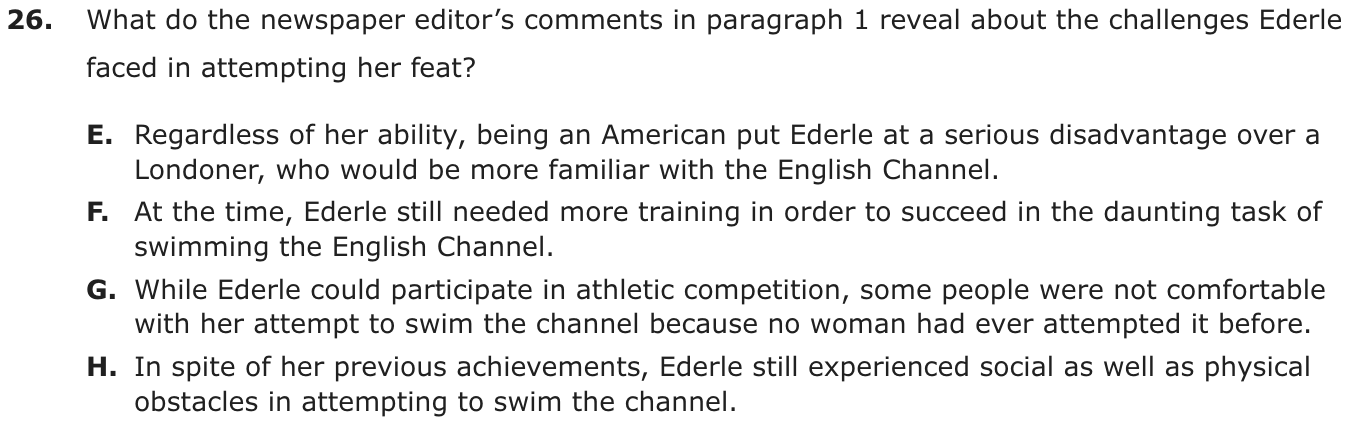
The passage “Champion of the Channel” as printed (pages 56–57)
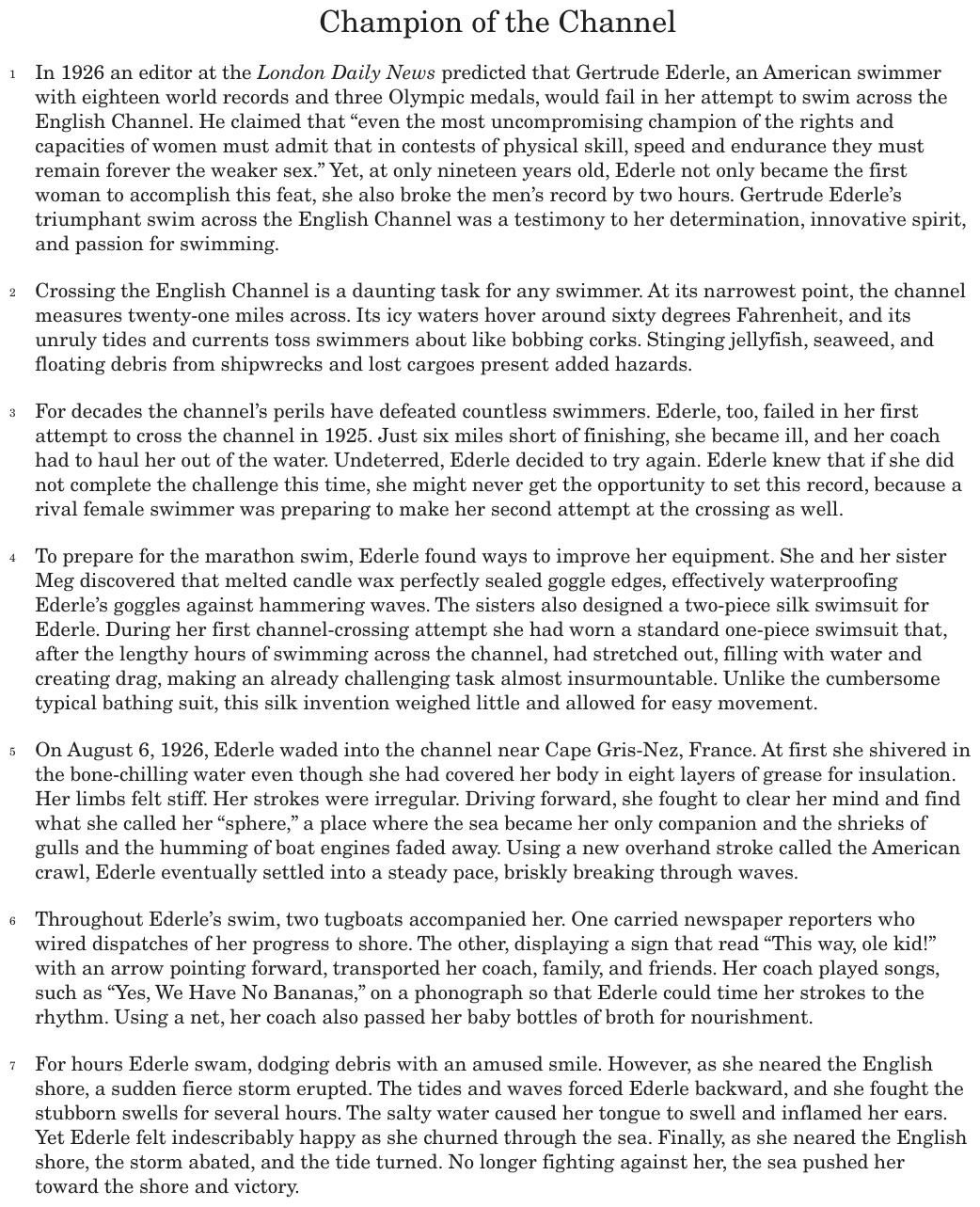
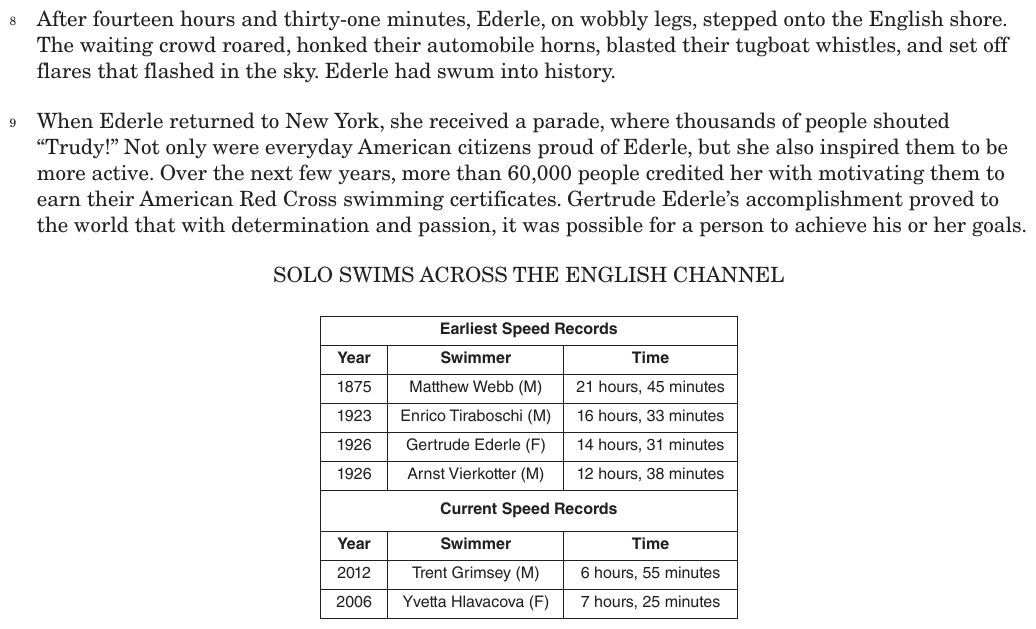
Question 26 of 120
2024 Test A English, question 27Uses the passage above: “Champion of the Channel”.
Question
Read this sentence from paragraph 4.
During her first channel-crossing attempt she had worn a standard one-piece swimsuit that, after the lengthy hours of swimming across the channel, had stretched out, filling with water and creating drag, making an already challenging task almost insurmountable.
The word “insurmountable” is used to highlight
- Ahow the bathing suit made it impossible for Ederle to make it across the channel.
- Bhow Ederle and her sister decided to improve Ederle’s swimming equipment in a creative way.
- Cthat the flaws in Ederle’s bathing suit made a difficult task even more complicated.
- Dthat the swimming equipment Ederle used needed to be custom made for her attempt.
Show the answer
Correct answer: C
The question asks about the effect of the word “insurmountable,” which means “incapable of being overcome,” in paragraph 4.
A. Incorrect. Ederle did not complete her first swim because she became ill (“Just six miles short of finishing, she became ill, and her coach had to haul her out of the water.” [paragraph 3]), not because the suit made it impossible for Ederle to complete her swim.
B. Incorrect. The author uses the word “insurmountable” to draw attention to the increased difficulty caused by the suit, not to draw attention to the sisters’ creativity in solving the problem.
C. CORRECT. The suit Ederle wore during her first attempt to swim the channel “stretched out, filling with water and creating drag” (paragraph 4), which likely contributed to her failed attempt to swim across the channel.
D. Incorrect. The passage does not address whether the original suit was custom made, simply that the suit created additional difficulties for Ederle in a situation that was already difficult.
Question analysis
This vocabulary-in-context question quotes a sentence about the stretched-out swimsuit Gertrude Ederle wore on her first attempt to swim the English Channel and asks what the word insurmountable is used to highlight. Students must decide what point the word stresses in this sentence rather than simply define it, and the choices range from the old suit's effects to the sisters' new equipment.
- Grade level
- Grade 7 reading and task
- Compared with grade 7
- At grade 7 Explaining what a strong word emphasizes in context is standard grade 7 vocabulary work. The sentence is printed in the question, which saves a search, but it is long, with several phrases stacked between the swimsuit and the key word.
- Estimated difficulty
- Moderate: several steps, or a close reading with one strong distractor.
- Thinking it demands
- Depth of knowledge 2, skills and concepts · mainly analyze
- What makes it hard
- Hard words moderate
- A very close wrong answer moderate
- Complex sentences minor
- Evidence
- Answered from one sentence or line
- Reading level
- Passage: about grade 9, 790 words; question and choices: about grade 10, 108 words.
- Students, last 30 days
- Not enough answers yet to show (it takes 10).
Why it is hard, traps and wrong answers (shows the answer)
Why it is hard
The phrase to weigh is “an already challenging task almost insurmountable”, and two small words carry it: “already” says the swim was hard to begin with, and “almost” stops short of impossible. Students who know only the dictionary meaning blame the suit for a failure that paragraph 3 pins on illness. Those who look past the sentence to the sisters' new gear answer a different question, about the fix rather than the problem the word stresses.
Hard words moderate Understanding the question
The question hinges on “insurmountable”, impossible to overcome, which is softened by the “almost” in front of it and set against the “already challenging task” it describes. (Perfetti, 2007; Freedle & Kostin, 1993)
A very close wrong answer moderate Choosing the answer
The right choice and the one saying the suit made the crossing impossible both blame the old suit; they differ only in degree, which is exactly what “almost” decides. (Embretson & Wetzel, 1987; Gorin & Embretson, 2006; Ascalon et al., 2007)
Complex sentences minor Understanding the question
The stem prints all 38 words of the sentence, but between the swimsuit and “insurmountable” come an inserted time phrase, the verb “had stretched out” and two “-ing” phrases, so the link is easy to lose. (Abedi & Lord, 2001; Freedle & Kostin, 1993; Messick, 1989)
Strategy: Say in your own words what the quoted sentence claims about the old swimsuit, then choose the statement that restates that claim, checking each choice against the sentence word by word.
Traps
- Dictionary meaning, not meaning here: A common meaning of the word that does not fit its use in this text.
- Wrong purpose or structure: Names a purpose, structure or effect that the part does not serve, or describes what a part says when the question asks what it does.
- Reads too much in: A reasonable-sounding conclusion that goes further than the text allows.
The wrong answers, classified
A Dictionary meaning, not meaning here (Perfetti, 2007)
Gives “insurmountable” its full dictionary force and drops “almost”, so the suit seems to have made the crossing impossible, though paragraph 3 says she stopped in 1925 because she became ill.
B Wrong purpose or structure (Anderson & Krathwohl, 2001)
Describes what the paragraph goes on to do, the sisters' creative silk suit and waxed goggles, when the quoted sentence and its key word dwell on the old suit's flaws.
D Reads too much in (Graesser, Singer & Trabasso, 1994)
Reasons that because a standard suit failed, her gear had to be custom made, a conclusion the passage never draws and the word does not point toward.
Working it out, step by step
Figure out the word’s job
This question asks why the author chose one word, “insurmountable,” in paragraph 4. First you need to know what the word means. Then you can see which idea it helps the sentence stress.
Break the word into parts
To surmount something is to get over it or on top of it, the way a climber gets to the top of a cliff. The start in- means not, and the end -able means can be. So something insurmountable cannot be gotten over. It is too hard to beat.
Read the words around it
The old suit “had stretched out, filling with water and creating drag.” Drag is a force that pulls back on you and slows you down. This made “an already challenging task almost insurmountable.” Two small words matter a lot. Already tells you the swim was hard even before the suit caused trouble. Almost tells you it came close to impossible, but not all the way.
Decide what the word stresses
Put together, the phrase stresses how much worse the old suit made things. A task that was hard to begin with became even harder. The word does not say the suit by itself made the swim impossible.
Check each choice
- C fits: the suit’s flaws made “a difficult task even more complicated,” just like “already challenging” plus “almost insurmountable.”
- A is wrong because it drops “almost,” and paragraph 3 says her first try ended when she “became ill.”
- B is wrong because the sisters’ clever new gear comes in other sentences, while this word is about the problem.
- D is wrong because the passage never says her gear had to be custom made.
Watch out: A uses the word’s dictionary meaning. Always read the small words around a key word.
Choose the answer
The word shows how the old suit turned a hard swim into a nearly hopeless one. So the answer is C.
Why this answer and not the closest wrong one
A comes closest, since “insurmountable” alone does mean impossible. But the author wrote “almost” in front of it. And paragraph 3 says illness, not the suit, ended her first try. C keeps the exact amount the sentence gives: a hard task made even harder.
More questions like this
The original DOE question
Question 27 of 120
2024 Test A English, question 28Uses the passage above: “Champion of the Channel”.
Question
Which statement describes how the author’s use of a problem-and-solution structure in paragraph 5 contributes to the development of ideas in the passage?
- ADetailing the challenges presented by the cold channel waters highlights the effectiveness of Ederle’s training.
- BDescribing Ederle’s physical difficulties during her swim provides evidence of the team effort required to ensure her safety.
- CExplaining the difficulties that arose early in the effort helps predict the additional obstacles that occurred during Ederle’s attempt.
- DIllustrating Ederle’s process of blocking out her discomfort shows that swimming the channel was both a mental and a physical challenge.
Show the answer
Correct answer: D
The question asks how a problem-and-solution structure in paragraph 5 contributes to the ideas presented in the passage.
A. Incorrect. The details in paragraph 5 do not provide a connection between the cold temperature of the water and the effectiveness of Ederle’s training.
B. Incorrect. The difficulties Ederle encountered were only partially relieved by her team, and her team’s efforts to ensure Ederle’s safety are not explained in the passage.
C. Incorrect. The paragraph does not focus on the relationship between the problems Ederle encountered at the start of her swim and the problems she encountered during or near the end of her swim.
D. CORRECT. The paragraph describes how the water’s temperature made Ederle uncomfortable and made it difficult for her to regulate her stroke. The paragraph continues with the explanation of how she overcame these issues by focusing her mind on the sea and tuning out the distractions in her surroundings (“the sea became her only companion and the shrieks of gulls and the humming of boat engines faded away” [paragraph 5]).
Question analysis
Gertrude Ederle's cold, stiff first hours in the English Channel are told as problem and solution, and this text-structure question asks what that pattern adds to the passage's ideas. Students must spot the troubles she met in the cold water and how she handled them, then pick the abstract statement that accounts for both halves of the pattern.
- Grade level
- Grade 8 reading and task
- Compared with grade 7
- Above grade 7 A problem-and-solution question about one paragraph is familiar grade 7 fare, yet these four answers are general claims about the swim, each tied to a real hardship, so students need a clear map of the paragraph before judging them.
- Estimated difficulty
- Hard: combines ideas, needs a plan, and has more than one tempting wrong answer.
- Thinking it demands
- Depth of knowledge 3, strategic thinking · mainly analyze
- What makes it hard
- How, not what major
- Every choice must be checked moderate
- Figurative or literary language minor
- Evidence
- Answered from one paragraph or stanza
- Reading level
- Passage: about grade 9, 790 words; question and choices: about grade 14, 95 words.
- Students, last 30 days
- Not enough answers yet to show (it takes 10).
Why it is hard, traps and wrong answers (shows the answer)
Why it is hard
The opening halves of the choices are all accurate, which moves the whole decision onto their second halves. Readers who notice only the physical side of the paragraph, the cold and the stiffness, reach for training, teamwork or foreshadowing to explain it. The paragraph's turning point is a mental one, clearing her mind until the noise faded, and only the statement that names both a mental and a physical challenge accounts for the problem and the solution together.
How, not what major Working it out
The question asks what paragraph 5's pairing of problems (bone-chilling water, stiff limbs, irregular strokes) with solutions (finding her “sphere”, the American crawl) does for the passage, so retelling the hardships earns nothing. (Anderson & Krathwohl, 2001)
Every choice must be checked moderate Choosing the answer
Each choice opens with a fair description of paragraph 5, the cold water, her physical difficulties, the early struggle, so only what each claims that description shows can be tested. (Embretson & Wetzel, 1987)
Figurative or literary language minor Understanding the question
The mental half of the solution is told in images, a place where “the sea became her only companion” and gulls and engines “faded away”, which must be read as blocking out discomfort. (Graesser, Singer & Trabasso, 1994; Kintsch, 1998)
Strategy: Sort paragraph 5 into two lists, what went wrong for Ederle early in the swim and what she did about it, then ask what that pairing shows about the swim as a whole.
Traps
- Wrong purpose or structure: Names a purpose, structure or effect that the part does not serve, or describes what a part says when the question asks what it does.
- Outside knowledge: A choice is plausible in the real world but not supported by this text.
- Wrong part of the text: A choice is true of another paragraph, stanza or speaker than the one asked about.
The wrong answers, classified
A Outside knowledge (King et al., 2004; Recht & Leslie, 1988)
Assumes that coping with icy water proves good training, a natural idea from sports, but paragraph 5 never mentions training and credits her focus and her stroke.
B Wrong part of the text (Kirsch & Mosenthal, 1990)
Brings in the tugboat crew of paragraph 6, the coach passing broth and playing songs, though paragraph 5 shows Ederle coping alone and never raises her safety.
C Wrong purpose or structure (Anderson & Krathwohl, 2001)
Treats the early shivering and stiffness as a setup for the storm of paragraph 7, a link the paragraph never makes, since it resolves its own problems with a steady pace.
Working it out, step by step
Learn what the question asks
A problem-and-solution structure tells about a difficulty and then how someone deals with it. The question asks what this pattern in paragraph 5 adds to the ideas of the passage. So first sort the paragraph into problems and solutions.
List the problems in paragraph 5
When Ederle waded in, “she shivered in the bone-chilling water.” Next, “Her limbs felt stiff. Her strokes were irregular.” Limbs are arms and legs. Irregular means uneven, not steady. All of these are troubles with her body.
List her solutions
Ederle “fought to clear her mind.” She looked for what she called her “sphere.” There, “the sea became her only companion and the shrieks of gulls and the humming of boat engines faded away.” In other words, she shut out the noise and her discomfort. Then, using the American crawl, she “settled into a steady pace.”
Connect problems and solutions
The problems were physical, which means of the body. A big part of the fix was mental, which means of the mind. She calmed her thoughts so her body could keep working. So the paragraph shows that the swim tested her mind as well as her body.
Check each choice
- D fits: blocking out her discomfort shows the swim was “both a mental and a physical challenge.”
- A is wrong because paragraph 5 never mentions her training.
- B is wrong because her team on the tugboats appears in paragraph 6, and her safety is never discussed.
- C is wrong because the early troubles are solved inside this paragraph instead of setting up later ones.
Watch out: A storm does hit in paragraph 7, so C may look right. But paragraph 5 does not point ahead to it.
Choose the answer
Only D explains both the problem and the way Ederle solved it. So the answer is D.
Why this answer and not the closest wrong one
C is tempting, since a storm really does strike in paragraph 7. But paragraph 5 never hints at it. The paragraph ends with its problem solved, as Ederle is “briskly breaking through waves.” D explains both halves of the pattern: troubles of the body, eased by the mind.
More questions like this
The original DOE question
Question 28 of 120
2024 Test A English, question 29Uses the passage above: “Champion of the Channel”.
Question
Which sentence best supports the idea that Ederle succeeded in swimming across the channel because of her innovative approach to the challenge?
- A“Yet, at only nineteen years old, Ederle not only became the first woman to accomplish this feat, she also broke the men’s record by two hours.” (paragraph 1)
- B“At first she shivered in the bone-chilling water even though she had covered her body in eight layers of grease for insulation.” (paragraph 5)
- C“Using a new overhand stroke called the American crawl, Ederle eventually settled into a steady pace, briskly breaking through waves.” (paragraph 5)
- D“The other [tugboat], displaying a sign that read ‘This way, ole kid!’ with an arrow pointing forward, transported her coach, family, and friends.” (paragraph 6)
Show the answer
Correct answer: C
The question asks for the best support for the idea that Ederle’s swim across the channel was successful because of her innovative approach to the challenge.
A. Incorrect. The sentence from paragraph 1 shows that Ederle’s performance was groundbreaking but not necessarily innovative.
B. Incorrect. The layers of grease mentioned in the sentence from paragraph 5 primarily served to insulate Ederle (keep her warm) by helping her maintain her body temperature in the cold water; neither the sentence in paragraph 5 nor the surrounding text evidence establishes that this was an innovative practice. Furthermore, the sentence does not show that she succeeded as a result of this approach.
C. CORRECT. The sentence from paragraph 5 explains that Ederle employed a newly developed, or innovative, type of stroke that allowed her to maintain her pace through the rough water.
D. Incorrect. The tugboat carrying Ederle’s supporters referenced in the sentence from paragraph 6 likely provided encouragement during Ederle’s swim, but the sentence does not show that this approach was innovative or that it enabled Ederle’s success.
Question analysis
In this textual-evidence question, students look for the sentence that best backs up a claim about Gertrude Ederle's English Channel swim: that an innovative approach is what made her succeed. The quotations come from four different moments in her story, so each must be checked for something genuinely new and for a real effect on the outcome.
- NYS standards
- 7R1 textual evidence and inferences
- Grade level
- Grade 7 reading and task
- Compared with grade 7
- At grade 7 Finding the sentence that backs a claim is the standard grade 7 evidence task, set here at a typical level: four short quotations labeled by paragraph and a claim with two parts, what was new and what it achieved.
- Estimated difficulty
- Straightforward: two steps or one careful reading.
- Thinking it demands
- Depth of knowledge 2, skills and concepts · mainly evaluate
- What makes it hard
- Evidence
- Answered from several paragraphs or stanzas
- Reading level
- Passage: about grade 9, 790 words; question and choices: about grade 12, 117 words.
- Students, last 30 days
- Not enough answers yet to show (it takes 10).
Why it is hard, traps and wrong answers (shows the answer)
Why it is hard
The claim joins two ideas, an innovative approach and the success it produced, and only one quotation carries both. The record-breaking sentence proves success with no method, the grease is a technique the passage never calls new and that did not stop her shivering, and the tugboat sign shows her supporters, not her approach. The adjective “new” before the American crawl is the clue that settles it.
Every choice must be checked minor Choosing the answer
Each quotation describes a real moment of the crossing, so each has to clear two tests: a method that was new, and a method that moved her toward the English shore. (Embretson & Wetzel, 1987)
Reading between the lines minor Working it out
Even the right sentence never says the crawl won the swim; the student must take “settled into a steady pace, briskly breaking through waves” as what carried her across. (Graesser, Singer & Trabasso, 1994; Kintsch, 1998)
Strategy: Test each quotation twice: does it describe a method that was new or original, and does it show that method helping her finish? Keep only a sentence that passes both tests.
Traps
- Reads too much in: A reasonable-sounding conclusion that goes further than the text allows.
- Supports only part of the claim: In a question about evidence: a line that backs one half of the claim but not the other, or a related point rather than the claim itself.
The wrong answers, classified
A Supports only part of the claim (King et al., 2004; Thissen, Steinberg & Fitzpatrick, 1989)
Chooses the passage's headline result, first woman across and two hours under the men's record, which proves the success half of the claim but shows no new method behind it.
B Reads too much in (Graesser, Singer & Trabasso, 1994)
Treats eight layers of grease as an innovation, though the passage never calls it new and the sentence says she shivered anyway, so it shows neither originality nor success.
D Reads too much in (Graesser, Singer & Trabasso, 1994)
Reads the cheerful “This way, ole kid!” sign as a clever new idea, but the sentence only says who rode in the second tugboat and links nothing to how she swam.
Working it out, step by step
Break the idea into two parts
This asks you to find evidence. Innovative means new and original, a fresh way to do something. The idea has two parts. Ederle used a new approach, and that approach helped her succeed. The best sentence must show both.
Look for something new
Only one choice uses the word “new.” Choice C says she used “a new overhand stroke called the American crawl” (paragraph 5). A stroke is the way you move your arms to pull through the water. So this is a new method.
See whether it helped her
The same sentence says she “settled into a steady pace, briskly breaking through waves.” Briskly means quickly and with energy. A steady, quick pace moved her forward through the rough water. So the new stroke helped her succeed.
Check each choice
- C fits: it shows a new stroke and the steady pace it gave her.
- A is wrong because it proves she succeeded but shows no new method.
- B is wrong because the passage never calls the grease new, and she still “shivered in the bone-chilling water.”
- D is wrong because the sign on the tugboat cheered her on but was not a new way of swimming.
Watch out: B may sound clever, since the grease was meant to keep her warm. But it shows neither something new nor a reason she won.
Choose the answer
Only C shows a new method that helped Ederle get across. So the answer is C.
Why this answer and not the closest wrong one
B is the strongest pull, since grease to keep warm sounds like a smart trick. Yet the passage never presents the grease as new, and it did not stop her shivering. C names a method the passage calls “new” and shows it paying off in a steady, quick pace.
More questions like this
The original DOE question
Question 29 of 120
2024 Test A English, question 31Uses the passage above: “Champion of the Channel”.
Question
Which sentence from the passage best conveys the author’s perspective regarding the impact of Ederle’s accomplishment?
- A“Undeterred, Ederle decided to try again.” (paragraph 3)
- B“For hours Ederle swam, dodging debris with an amused smile.” (paragraph 7)
- C“Yet Ederle felt indescribably happy as she churned through the sea.” (paragraph 7)
- D“Ederle had swum into history.” (paragraph 8)
Show the answer
Correct answer: D
The question asks for the sentence from the passage that best conveys the author’s perspective about the impact of Ederle’s swim.
A. Incorrect. Although this option shows Ederle’s determination to accomplish her goal, it does not convey the author’s perspective. Rather, the option reinforces Ederle’s own perspective about the challenge that she was facing.
B. Incorrect. The sentence presented in this option is incorrect because it relates to Ederle’s state of mind as she came closer to achieving her goal and does not provide details about the author’s opinion of the impact of Ederle’s accomplishment.
C. Incorrect. The sentence presented in this option is incorrect because it simply presents Ederle’s emotional state as she nears her goal and does not provide information about the author’s perspective.
D. CORRECT. This option is correct because, throughout the passage, the author emphasizes that Ederle’s accomplishment was memorable and great, which is best stated in the sentence from paragraph 8.
Question analysis
What did Gertrude Ederle's English Channel swim mean in the author's eyes? This point-of-view question asks which quoted sentence best shows the author's perspective on its impact, and because the quotations all come from the story of her attempts, students must tell the author's judgment apart from sentences reporting what Ederle did or felt.
- Grade level
- Grade 7 reading and task
- Compared with grade 7
- At grade 7 Telling an author's perspective apart from a subject's actions and moods is ordinary grade 7 point-of-view work. Each choice is a single sentence with its paragraph given, so little searching is needed and the demand is typical.
- Estimated difficulty
- Straightforward: two steps or one careful reading.
- Thinking it demands
- Depth of knowledge 2, skills and concepts · mainly analyze
- What makes it hard
- How, not what moderate
- Figurative or literary language minor
- Evidence
- Answered from several paragraphs or stanzas
- Reading level
- Passage: about grade 9, 790 words; question and choices: about grade 11, 52 words.
- Students, last 30 days
- Not enough answers yet to show (it takes 10).
Why it is hard, traps and wrong answers (shows the answer)
Why it is hard
Two tests apply at once: whose view a sentence gives, and whether that view concerns the swim's impact. Three sentences narrate Ederle herself, before the swim and in the water, and the word “Undeterred” can make the first sound like the author's praise. The five-word sentence that closes paragraph 8 is easy to skim past, because it states impact through an image rather than in plain terms.
How, not what moderate Working it out
The question asks for the author's judgment, so sentences that narrate Ederle's choices and moods, her decision to try again, her “amused smile”, her happiness in the storm, have to be set aside. (Anderson & Krathwohl, 2001)
Figurative or literary language minor Understanding the question
The only sentence about impact states it as a figure of speech, “Ederle had swum into history”, which must be read as a claim that the swim earned a lasting place. (Graesser, Singer & Trabasso, 1994; Kintsch, 1998)
Strategy: Ask of each quotation whether it reports Ederle's actions or feelings, or whether it is the author stepping back to judge what the swim meant. Only the second kind answers this question.
Traps
- Wrong tone or attitude: Misjudges the tone, attitude or point of view, such as reading admiration as criticism, or taking a character's or subject's feelings for the author's.
- True but not the answer: A choice says something accurate about the text that does not answer this question.
The wrong answers, classified
A True but not the answer (King et al., 2004; Embretson & Wetzel, 1987)
Hears the author admiring her resolve in “Undeterred”, a real touch of judgment, but it concerns her decision after the 1925 failure, not what her eventual swim meant or changed.
B Wrong tone or attitude (Graesser, Singer & Trabasso, 1994)
Takes Ederle's “amused smile” while dodging debris as the author's opinion, though it records her mood in the water and says nothing about the swim's impact.
C Wrong tone or attitude (Graesser, Singer & Trabasso, 1994)
Reads “indescribably happy” as the author's enthusiasm, but the happiness is Ederle's own, felt while she fought the storm, and it says nothing about lasting effects.
Working it out, step by step
Unpack the key words
A perspective is a point of view, the way someone sees a subject. Impact means the effect something has on the world. So you need a sentence where the author judges what Ederle’s swim meant. A sentence that only tells what Ederle did or felt won’t count.
Test each sentence two ways
Ask two questions about each choice. First, is this the author’s own judgment, or does it just tell what Ederle did or felt? Second, is it about the effect of the swim, or about something else? The right sentence passes both tests.
Check each choice
- A: “Undeterred, Ederle decided to try again” (paragraph 3) tells her choice after failing in 1925, so it comes before the swim and can’t show its effect.
- B: “dodging debris with an amused smile” (paragraph 7) shows her mood in the water.
- C: “Ederle felt indescribably happy” (paragraph 7) tells her own feelings, not the author’s view.
- D: “Ederle had swum into history” (paragraph 8) is the author stepping back to judge what the swim meant.
Watch out: Undeterred means not discouraged, so A can sound like praise from the author. But it is about her decision, not the swim’s effect.
Explain the figure of speech
“Swum into history” is a figure of speech, words that mean more than they literally say. History is not a place you can swim to. The phrase means her swim was so important that people will remember it for a long time. So the sentence judges the swim’s impact.
Choose the answer
Only choice D gives the author’s own view of what the swim achieved. So the answer is D.
Why this answer and not the closest wrong one
A is the closest wrong answer, since the word “Undeterred” holds a note of praise. But the sentence reports Ederle’s choice to try again after she failed. That happened before the big swim, so it can’t show the swim’s impact. D is the author’s own claim that the swim made history.
More questions like this
The original DOE question
Question 30 of 120
2024 Test A English, question 32Uses the passage above: “Champion of the Channel”.
Question
Which sentence is the best summary of the steps that Ederle took to prepare for her second attempt to swim across the English Channel?
- AWorking with her sister, Ederle waterproofed her goggles using melted candle wax to seal the edges and designed a two-piece silk swimsuit that was lightweight and would not stretch out during the long swim.
- BEderle covered her body in numerous layers of grease for insulation and focused on finding her “sphere” during her swim.
- CEderle began training with her coach, who played music while she swam to help her time her strokes to the music.
- DEderle focused on developing better equipment than the standard bathing suit that proved cumbersome during her first attempt to cross the channel.
Show the answer
Correct answer: A
The question asks for the best summary of Ederle’s steps to prepare for her second attempt to swim across the English Channel.
A. CORRECT. Ederle’s preparation is outlined in paragraph 4. This option is correct because it acknowledges the idea that Ederle involved her sister in this process, and it details the efforts the two took to improve Ederle’s equipment, including sealing her goggles with wax and designing a better swimsuit.
B. Incorrect. The option focuses on Ederle’s actions in the moments before her swim (covering her body with grease for insulation) and during her swim (finding her “sphere”), not her overall preparation methods.
C. Incorrect. The option refers to a way that Ederle’s coach helped Ederle keep her strokes in rhythm during her swim. While this option suggests that Ederle and her coach had made thoughtful preparations, it does not address the many other steps that Ederle took to prepare for the swim.
D. Incorrect. The option does not refer to the series of steps that Ederle took to prepare for her swim, but rather to just one of the efforts made (improving equipment), without acknowledging her sister’s contributions.
Question analysis
This summary question asks which sentence best sums up how Gertrude Ederle got ready for her second try at swimming the English Channel. Because the passage also describes what she and her team did during the crossing, students must separate preparation from the swim itself and judge which summary is complete.
- NYS standards
- 7R2 theme or central idea
- Grade level
- Grade 6 reading and task
- Compared with grade 7
- Below grade 7 This is a one-paragraph summary, the kind of task grade 6 standards describe; grade 7 central-idea work usually follows an idea through a whole text. The real demand is telling preparation apart from the swim.
- Estimated difficulty
- Straightforward: two steps or one careful reading.
- Thinking it demands
- Depth of knowledge 2, skills and concepts · mainly understand
- What makes it hard
- A very close wrong answer moderate
- Every choice must be checked minor
- Evidence
- Answered from one paragraph or stanza
- Reading level
- Passage: about grade 9, 790 words; question and choices: about grade 12, 121 words.
- Students, last 30 days
- Not enough answers yet to show (it takes 10).
Why it is hard, traps and wrong answers (shows the answer)
Why it is hard
Paragraph 4 holds all of the preparation, but the passage keeps describing things Ederle and her team did, so getting ready must be told apart from the swim. The grease is the hardest to place, because she put it on before wading in, on the day of the crossing itself. Between the two equipment choices, the one that lists the goggles, the silk suit and her sister's help is the fuller summary of several steps.
A very close wrong answer moderate Choosing the answer
The right summary and the one about better equipment than the standard bathing suit describe the same work; only the waxed goggles and Meg's part, missing from the shorter one, separate them. (Embretson & Wetzel, 1987; Gorin & Embretson, 2006; Ascalon et al., 2007)
Every choice must be checked minor Choosing the answer
Two choices borrow real details from the crossing, the grease she wore and the songs played from the tugboat, so each has to be placed before or during the swim. (Embretson & Wetzel, 1987)
Strategy: Locate the paragraph about getting ready, list each preparation step and who took part, and choose the sentence that covers that list most fully without adding events from another part of the passage.
Traps
- Too narrow: A single detail offered as the central idea or a summary, or a summary that keeps minor details and leaves out an essential part.
- Wrong part of the text: A choice is true of another paragraph, stanza or speaker than the one asked about.
- Twists what the text says: Uses the text's topic and ideas but changes what it says: who did it, how much, when, or why.
The wrong answers, classified
B Wrong part of the text (Kirsch & Mosenthal, 1990)
Takes the grease she wore on the day and her search for her “sphere” in the water, both from paragraph 5's account of the swim, as advance preparation.
C Twists what the text says (King et al., 2004)
Turns the phonograph her coach played from a tugboat during the crossing into training sessions before it, which the passage never describes.
D Too narrow (King et al., 2004)
Captures the idea of better equipment but names only the bathing suit, leaving out the wax-sealed goggles and her sister Meg, so it summarizes one step of several.
Working it out, step by step
Know what a summary needs
A summary retells the main points in a few words. Here you need the steps Ederle took to get ready before her second try. A good summary includes all of those steps. It leaves out things that happened during the swim itself.
Find the getting-ready paragraph
Paragraph 4 opens with “To prepare for the marathon swim, Ederle found ways to improve her equipment.” The word “prepare” signals that this paragraph holds the steps. Equipment means the gear she used.
List each step
- With her sister Meg, she found that “melted candle wax perfectly sealed goggle edges,” so water stayed out of her goggles.
- Together the sisters “designed a two-piece silk swimsuit” to replace her old one.
- The new suit “weighed little and allowed for easy movement,” unlike her old suit, which had stretched and filled with water.
Check each choice
- A fits: it names her sister, the waxed goggles and the light silk suit.
- B is wrong because the grease and her “sphere” belong to paragraph 5, the day of the swim.
- C is wrong because her coach played music from a tugboat during the swim (paragraph 6), not in training.
- D is wrong because it leaves out the goggles and Meg.
Watch out: D is true as far as it goes. But it covers only one step, so it is too narrow to be the best summary.
Choose the answer
Choice A lists all the preparation in paragraph 4, and nothing from the swim itself. So the answer is A.
Why this answer and not the closest wrong one
D comes closest, since improving her equipment is what paragraph 4 is about. But D mentions only the swimsuit. It skips the wax-sealed goggles and her sister’s help. A summary of the steps should include every step, and only A does.
More questions like this
The original DOE question
Question 31 of 120
2024 Test A English, question 33Uses the passage above: “Champion of the Channel”.
Question
The idea that many people were interested in Ederle’s attempt to swim the channel is illustrated in the passage mainly through the
- Ainformation about Ederle’s competition with another female swimmer who was also attempting to cross the channel.
- Bdetails about the reports of Ederle’s progress during the swim and the celebration of her successful completion of the swim.
- Cdetails about how Ederle’s historic swim contributed to an increase in the number of people learning how to swim.
- Dinformation about the resources Ederle used throughout her swim to maintain her motivation and stamina.
Show the answer
Correct answer: B
The question asks how the idea that many people were interested in Ederle’s attempt to swim the channel is mainly illustrated in the passage.
A. Incorrect. While paragraph 3 states that “a rival female swimmer was preparing to make her second attempt at the crossing as well,” which suggests that Ederle’s competitor was interested in Ederle’s attempt to swim the channel, this information does not establish that many people were interested in Ederle’s attempt.
B. CORRECT. Paragraph 6 includes the detail that newspaper reporters followed Ederle on a tugboat and “wired dispatches of her progress to shore,” which suggests that an audience was waiting for news about Ederle’s progress. Paragraph 8 states that when Ederle reached the shore, “the waiting crowd roared, honked their automobile horns, blasted their tugboat whistles, and set off flares that flashed in the sky.” Further, paragraph 9 states that when Ederle returned to New York, “thousands of people” attended a parade in her honor. These details describing the celebration of Ederle’s feat further illustrate the idea that many people were interested in what she had accomplished.
C. Incorrect. While paragraph 9 states that “more than 60,000 people credited [Ederle] with motivating them to earn their American Red Cross swimming certificates,” this detail describes how Ederle’s historic swim influenced people after the fact but does not illustrate the level of public interest during the attempt itself.
D. Incorrect. Paragraph 6 provides details about how Ederle’s “coach, family, and friends” displayed signs, played songs, and “passed her baby bottles of broth” to help her maintain her motivation and stamina. However, these resources do not suggest the idea that people beyond Ederle’s immediate support team were interested in her attempt to swim the channel.
Question analysis
Public interest in Gertrude Ederle's 1926 English Channel swim is the focus of this reading question, which asks which details in the passage mainly illustrate that many people cared about her attempt. Students must gather signs of attention from several paragraphs, and every choice points to real details that involve other people in her story.
- Grade level
- Grade 7 reading and task
- Compared with grade 7
- At grade 7 Matching an idea to the details that develop it is standard grade 7 work. The supporting details are spread across several late paragraphs and must be gathered before the choices can be judged, a typical grade 7 demand.
- Estimated difficulty
- Moderate: several steps, or a close reading with one strong distractor.
- Thinking it demands
- Depth of knowledge 2, skills and concepts · mainly evaluate
- What makes it hard
- Evidence in several places moderate
- Reading between the lines minor
- Evidence
- Answered from several paragraphs or stanzas
- Reading level
- Passage: about grade 9, 790 words; question and choices: about grade 13, 92 words.
- Students, last 30 days
- Not enough answers yet to show (it takes 10).
Why it is hard, traps and wrong answers (shows the answer)
Why it is hard
The idea has two parts, many people and interest in the attempt itself, and each wrong choice satisfies one at most. The strongest pull is the 60,000 swimming certificates, a huge number tied to Ederle but describing what people did in the years afterward. Students who hold both parts in mind, and who remember that paragraph 6 carries reporters as well as family, find the details that answer it.
Evidence in several places moderate Working it out
The right details sit in three places: reporters wiring dispatches from a tugboat in paragraph 6, the roaring crowd and flares in paragraph 8, and the New York parade in paragraph 9. (Kirsch & Mosenthal, 1990; Gorin & Embretson, 2006)
Reading between the lines minor Working it out
No sentence says people were interested; the student must infer an eager audience from reporters sending news to shore and a crowd already “waiting” when she landed. (Graesser, Singer & Trabasso, 1994; Kintsch, 1998)
Strategy: Hold each choice to both parts of the idea in the stem: the details must involve many people, and they must show interest in the attempt itself, not some other link to Ederle.
Traps
- Supports only part of the claim: In a question about evidence: a line that backs one half of the claim but not the other, or a related point rather than the claim itself.
The wrong answers, classified
A Supports only part of the claim (King et al., 2004; Thissen, Steinberg & Fitzpatrick, 1989)
Matches “attempting to cross the channel” to the stem's attempt, but the rival preparing her own crossing in paragraph 3 is one swimmer, not many people following Ederle.
C Supports only part of the claim (King et al., 2004; Thissen, Steinberg & Fitzpatrick, 1989)
Counts the 60,000 people who earned swimming certificates, which shows many people moved by Ederle but describes her influence after the swim, not interest in the attempt itself.
D Supports only part of the claim (King et al., 2004; Thissen, Steinberg & Fitzpatrick, 1989)
Points to the coach, family and friends who played songs and passed broth from the tugboat, people who cared about the attempt but a small circle, not a wide public.
Working it out, step by step
Find the two parts of the idea
This asks you to find the details that best show an idea. The idea has two parts. Many people, not just a few, cared about Ederle. And they were interested in the attempt itself, the swim as it happened. The right choice must show both.
Look for news and crowds
Paragraph 6 says reporters on a tugboat “wired dispatches of her progress to shore.” Dispatches are news reports. In paragraph 8, “The waiting crowd roared” as she stepped onto the English shore. In paragraph 9, “thousands of people shouted” her name at a parade in New York.
See what these details show
Reporters send news only when readers want it. So people on land were following the swim as it happened. The crowd was “waiting” before she even arrived. Then thousands cheered her at home. These details show that a great many people cared about her swim.
Check each choice
- B fits: the reports of her progress and the celebration show many people following the swim.
- A is wrong because the rival swimmer in paragraph 3 is one person, not many people.
- C is wrong because the swimming certificates came in later years, after the swim.
- D is wrong because her coach, family and friends were a small group, not the wider public.
Watch out: C has the biggest number, more than 60,000 people. But it tells what people did after the swim was over.
Choose the answer
Only B shows many people paying attention while Ederle swam and when she finished. So the answer is B.
Why this answer and not the closest wrong one
C is the closest wrong answer, since 60,000 is a huge number of people. But they earned their certificates “over the next few years,” long after the swim. That shows her influence, not interest in the attempt. B shows people following the swim as it happened and cheering when she finished.
More questions like this
The original DOE question
Question 32 of 120
2024 Test A English, question 34Uses the passage above: “Champion of the Channel”.
Question
The table builds on the information in the passage mainly by
- Aemphasizing that people have continued to swim across the channel and have significantly improved the speed record.
- Bsuggesting that Ederle inspired many women to swim across the channel to attempt to break the current speed record.
- Crevealing that other women competed with Ederle to set a record time for swimming across the English Channel.
- Dproviding a comparison between the earliest channel-swimming records and the current record times.
Show the answer
Correct answer: A
The question asks how the table mainly builds on the information in the passage.
A. CORRECT. The table supports the information in the passage by showing that people have continued to swim the channel and have significantly improved on past records. The information in the table about records set by those who came after Ederle builds on the idea that “Gertrude Ederle’s accomplishment proved to the world that with determination and passion, it was possible for a person to achieve his or her goals” (paragraph 9).
B. Incorrect. Even though paragraph 9 states that Ederle “inspired [everyday American citizens] to be more active” and the table presents the time for the current female record holder, there is no indication in the passage or in the table that the subsequent female record holders were inspired to swim across the channel by Ederle.
C. Incorrect. Although paragraph 3 mentions that Ederle had a female rival and the table includes the speed record of another female swimmer, the passage does not provide information about other female swimmers competing with Ederle to set the channel-swim record.
D. Incorrect. Although paragraph 1 mentions that Ederle “broke the men’s record by two hours” and the table allows for comparisons between the earliest speed records and those of the present day, the passage mentions no channel-swim records set after Ederle’s swim, so it says nothing about current record times. The table allows for comparison, but this aspect of the table does not build on the information presented in the passage.
Question analysis
This question asks how a table of English Channel speed records, from Matthew Webb's 1875 crossing to a 2012 record, builds on the passage about Gertrude Ederle. Students must read times from two eras and decide what the table adds to the text, while the choices mix accurate observations about the table with claims neither source supports.
- Grade level
- Grade 8 reading and task
- Compared with grade 7
- Above grade 7 Relating a table to a passage is within grade 7 standards, but here the student must compare records from two eras, connect them to ideas in the text and choose among closely worded statements, well above typical grade 7 demand.
- Estimated difficulty
- Among the hardest on the SHSAT: a non-obvious approach, heavy reading, or a well-hidden trap.
- Thinking it demands
- Depth of knowledge 3, strategic thinking · mainly analyze
- What makes it hard
- A very close wrong answer major
- Reading a figure, table or graph moderate
- How, not what moderate
- Evidence
- Answered from the whole text
- Reading level
- Passage: about grade 9, 790 words; question and choices: about grade 11, 78 words.
- Corrected from the DOE handbook
- A self-contradictory statement in the explanation was corrected.
- Students, last 30 days
- Not enough answers yet to show (it takes 10).
Why it is hard, traps and wrong answers (shows the answer)
Why it is hard
This is one of the hardest questions on the test because a wrong choice describes the table exactly, in its own words. The passage stops with Ederle's 1926 record, and what the table adds is the rest of the story: swimmers kept crossing, and the record fell to under seven hours. Students who describe what the table contains, rather than what it tells a reader who has finished the passage, lose the point.
A very close wrong answer major Choosing the answer
The comparison choice repeats the table's own headings, “Earliest Speed Records” and “Current Speed Records”, and is literally true; only the stem's “builds on the information in the passage” and “mainly” separate it from the choice about the falling record. (Embretson & Wetzel, 1987; Gorin & Embretson, 2006; Ascalon et al., 2007)
Reading a figure, table or graph moderate Understanding the question
The student must compare times across the table's two sections, from Webb's 21 hours 45 minutes in 1875 and Ederle's 14 hours 31 minutes to Grimsey's 6 hours 55 minutes in 2012. (Lesh, Post & Behr, 1987; Kirsch & Mosenthal, 1990)
How, not what moderate Working it out
The question asks what the table adds to a passage that ends in 1926, so the student must say what its later rows extend, not what its layout holds. (Anderson & Krathwohl, 2001)
Strategy: Read both sections of the table and say what it adds to Ederle's story, then keep only a choice that the table shows and that connects to an idea the passage itself develops.
Traps
- Wrong purpose or structure: Names a purpose, structure or effect that the part does not serve, or describes what a part says when the question asks what it does.
- Reads too much in: A reasonable-sounding conclusion that goes further than the text allows.
- Twists what the text says: Uses the text's topic and ideas but changes what it says: who did it, how much, when, or why.
The wrong answers, classified
B Reads too much in (Graesser, Singer & Trabasso, 1994)
Assumes Ederle inspired many women to chase the record, but the table lists one later woman, Yvetta Hlavacova in 2006, and nothing links her or anyone else to Ederle.
C Twists what the text says (King et al., 2004)
Joins the rival female swimmer of paragraph 3 to Hlavacova's 2006 time, inventing a contest among women in Ederle's day that neither the table nor the passage shows.
D Wrong purpose or structure (Anderson & Krathwohl, 2001)
Describes the table's layout, earliest records beside current ones, which is accurate, but stops at what it contains instead of saying what the comparison adds to Ederle's story.
What was corrected from the DOE handbook, and why
- Explanation: In rejecting choice D, the handbook notes that paragraph 1 says Ederle “broke the men’s record by two hours,” and then says “there is no mention in the passage of past, present, or future channel-swim records.” Paragraph 1 does mention a past record: the one Ederle broke. What the passage never mentions is a record set after hers, which is what the table’s “Current Speed Records” add. The explanation now says the passage mentions no channel-swim records set after Ederle’s swim, so it says nothing about current record times. The reason for rejecting D is otherwise unchanged.
Working it out, step by step
Understand the question
To build on something means to add to it. So this asks what the table adds to what the passage already tells you. Don’t just describe what is in the table. Ask what a reader learns from it after finishing the passage.
Read the table’s two parts
The table has two parts, “Earliest Speed Records” and “Current Speed Records.” These rows matter most:
Year Swimmer Time 1875 Matthew Webb 21 hours, 45 minutes 1926 Gertrude Ederle 14 hours, 31 minutes 2012 Trent Grimsey 6 hours, 55 minutes Compare the times
Ederle swam for 14 hours and 31 minutes. Half of her time would be about 7 hours and 15 minutes. Grimsey’s 2012 time, 6 hours and 55 minutes, is even faster than that. So people kept swimming the channel after 1926, and the record got much faster.
See what the passage leaves out
The passage does mention one record. In paragraph 1, Ederle “broke the men’s record by two hours.” But the passage stops in 1926. It never tells of any record set after her swim. The table adds that later part of the story: swimmers kept crossing, and the record kept falling.
Check each choice
- A fits: people kept crossing and “significantly improved the speed record,” and significantly means by a lot.
- B is wrong because nothing links any later woman to Ederle, and the table lists only one later woman.
- C is wrong because Ederle is the only woman of her time in the table, and Hlavacova swam 80 years later, in 2006.
- D is wrong because it only names what the table holds, not what the comparison adds to Ederle’s story.
Watch out: D uses the table’s own headings, so it sounds right. But the question asks what the table adds, not how it is laid out.
Choose the answer
The table carries the story past 1926 and shows the record falling far below Ederle’s time. So the answer is A.
Why this answer and not the closest wrong one
D comes closest, because the table really does set the earliest and current records side by side. But D stops at describing the table. A says what that comparison shows a reader who has finished the passage: the record kept falling, from Ederle’s 14 hours and 31 minutes to under 7 hours.
More questions like this
The original DOE question
Question 33 of 120
2024 Test A English, question 35Passage 5 Reasons Physical Books Might Be Better Than E-Books
5 Reasons Physical Books Might Be Better Than E-Books
by Shaunacy Ferro
Though e-book1 readers have become a more common sight around town, traditional books still have their evangelists.2 According to The New York Times, e-book sales have been falling in 2015. Print definitely isn’t dead. In fact, according to some research, it may actually be a better choice for some readers. While scientists are still trying to tease out exactly how digital reading affects us differently, here are five ways e-books might be inferior to their dead-tree cousins.
E-books can reduce reading comprehension.
In a study of middle schoolers, West Chester University researchers found that students who read on iPads3 had lower reading comprehension than when they read traditional printed books. They discovered that the kids sometimes skipped text in favor of interactive features in the e-books, suggesting that certain multimedia in children’s e-books can be detrimental to the practice of reading itself. However, the researchers noted that some interactive features in e-books are designed to enhance comprehension, and that those might be more helpful than game-type interactive graphics.
Young kids can get distracted by e-books.
Similar results were found by a small study by the Joan Ganz Cooney Center that consisted of 32 kids reading e-books and print books with their parents. It found that “enhanced” e-books might be distracting. Kids who read enhanced e-books—ones with interactive, multimedia experiences—were more engaged with them physically, but in the end they remembered fewer narrative details than those who read print books or basic e-books.
You remember less about a book’s timeline.
Another study of adults also found that e-books can be hard to absorb. The researchers asked 25 people to read a 28-page story on a Kindle4 and 25 to read the story in paperback, then asked the readers to put 14 events from the story in chronological order. Those who read the story on a Kindle performed worse on the chronology test than the book readers, though they performed about the same as print readers in other tests. Earlier research by the same scholars, from Stavanger University in Norway, found that Norwegian 10th graders also remembered more about texts if they read them in print rather than on a computer screen.
They’re not great as textbooks.
While e-book textbooks are often cheaper (and easier to carry) than traditional door-stop5 textbooks, college students often don’t prefer them. In some surveys of college kids, the majority of students have reported preferring print books. However, a 2012 study from the UK’s National Literacy Trust of kids ages 8 to 16 found that more than 50 percent of children reported preferring screen reading.
They’re tiring.
Staring at a lit screen can be tiring for the eyes and the brain. A 2005 study from Sweden found that reading digitally required a higher cognitive workload than reading on paper. Furthermore, staring at LED6 screens at night can disrupt sleep patterns. A 2014 Harvard study found that people who used e-readers with LED screens at night slept worse and were more tired the next day. So, if you’re going to go for an e-book, go for one without the backlight.
The take-away message? If you’re really trying to absorb material, you might want to go for a physical book. And if you’re going to be up all night studying, turn off the backlight.
However, all this may not mean that reading on a Kindle is really going to melt your brain. For instance, reading an e-book on a computer is a much different experience than reading on a Kindle, which is specifically designed for consuming books. So, too, is playing with an interactive e-book on an iPad, compared to using a simpler e-book device that only presents the text, with no opportunities to click away into digital distractions.
And some studies have found that part of the difference between the way people absorb information from e-books versus paper might be due to approaching e-books differently—in one test, participants didn’t regulate their study time with digital books like they did with paper texts, leading to worse performances. It’s possible that our expectations of e-book reading—as well as the different designs of the digital reading experience on a computer or iPad or Kindle—might affect how we approach the text and how much effort we put into studying them. As generations of e-book readers evolve, and people become more accustomed to the idea of sitting down with a digital textbook, these factors could change—for better or for worse.
“5 Reasons Physical Books Might Be Better Than E-Books” by Shaunacy Ferro from MENTAL FLOSS, October 2, 2015. Copyright © 2015 Mental Floss, Inc.
1e-book: an electronic book, a publication made available digitally for reading on a computer or other device
2evangelists: advocates or supporters
3iPads: tablet computers
4Kindle: device for reading e-books
5door-stop: a reference to the idea that some textbooks are large and heavy enough to hold a door open
6LED: Light-emitting diode; LEDs are often used as a backlight for electronic devices such as smart phones and tablets.
Question
The details in paragraph 1 convey a central idea of the passage by noting that
- Afewer people are buying e-books than printed books.
- Bprinted books have some advantages over e-books.
- Cprinted books rely on natural materials more than e-books.
- Dsome people recommend buying printed books over e-books.
Show the answer
Correct answer: B
The question asks how the details in paragraph 1 convey a central idea of the passage. A specific central idea that needs to be identified in order to correctly answer this question is that reading a digital book “might be inferior” (paragraph 1) to reading a traditional book.
A. Incorrect. In paragraph 1, the author notes that despite the popularity of e-books, their sales fell in 2015, leading to the author’s statement that “print definitely isn’t dead.” While these statements suggest that readers still purchase and enjoy printed books, sales information between print and e-books is not compared. Therefore, these details do not convey a central idea of the passage.
B. CORRECT. The author states in paragraph 1 that “according to some research,” reading a traditional book “may actually be a better choice for some readers” because “digital reading affects us differently.” The author then supports this statement throughout the passage, detailing five advantages that printed books have over e-books. This detail helps convey a central idea of the passage.
C. Incorrect. In paragraph 1, the author refers to printed books as “traditional books” and the “dead-tree cousins” of e-books. Although these references suggest that printed books rely on natural materials more than e-books do, the author does not provide additional details in the passage to convey this idea. Therefore, this detail does not help convey a central idea of the passage.
D. Incorrect. Although the author states in paragraph 1 that “traditional books still have their evangelists,” the author does not provide additional statistics or details in the passage to convey the idea that some people recommend buying printed books over e-books. Therefore, this detail does not help convey a central idea of the passage.
Question analysis
This central-idea question asks how the details in the opening paragraph of a magazine article comparing printed books and e-books convey one of the passage's central ideas. Students must connect the introduction to what the rest of the article goes on to develop, while each choice seizes on something the first paragraph mentions.
- Grade level
- Grade 6 reading and task
- Compared with grade 7
- Below grade 7 Connecting an opening paragraph to a central idea is a grade 6 and 7 skill. This article is plainly organized, with a short introduction and bold headings, so the task is lighter than typical grade 7 central-idea work.
- Estimated difficulty
- Straightforward: two steps or one careful reading.
- Thinking it demands
- Depth of knowledge 2, skills and concepts · mainly understand
- What makes it hard
- Evidence
- Answered from one paragraph or stanza
- Reading level
- Passage: about grade 10, 829 words; question and choices: about grade 7, 46 words.
- Students, last 30 days
- Not enough answers yet to show (it takes 10).
Why it is hard, traps and wrong answers (shows the answer)
Why it is hard
Paragraph 1 packs four separate details into five sentences, and three of them become wrong choices: the falling e-book sales, print's “evangelists” and the joke about dead trees. The question rewards checking which detail the rest of the article develops, and the five bold headings that follow each name a way print beats the screen. Students who judge each choice against paragraph 1 alone can find support for all four.
The right answer is reworded minor Choosing the answer
The right choice recasts “may actually be a better choice” and “e-books might be inferior” in new words, while the wrong choices echo “sales”, “evangelists” and “dead-tree cousins”. (Freedle & Kostin, 1993; Kirsch & Mosenthal, 1990)
Figurative or literary language minor Understanding the question
Paragraph 1 is playful, calling print's supporters “evangelists” and paper books “dead-tree cousins”, and both phrases must be read as jokes rather than as claims. (Graesser, Singer & Trabasso, 1994; Kintsch, 1998)
Strategy: Read paragraph 1, then skim the bold headings to see which of its statements the rest of the article develops; a central idea is one the passage keeps returning to.
Traps
- Too narrow: A single detail offered as the central idea or a summary, or a summary that keeps minor details and leaves out an essential part.
- Twists what the text says: Uses the text's topic and ideas but changes what it says: who did it, how much, when, or why.
- Taking figurative language literally: A choice reads a figure of speech or image at face value.
The wrong answers, classified
A Twists what the text says (King et al., 2004)
Reads “e-book sales have been falling” as print outselling e-books, a comparison of sales the paragraph never makes and the rest of the article never mentions.
C Taking figurative language literally (Graesser, Singer & Trabasso, 1994)
Takes “dead-tree cousins” as a point about what books are made of, when it is a joking name for paper books and the article never discusses materials.
D Too narrow (King et al., 2004)
Rests on the opening remark that print still has its “evangelists”, a single detail about supporters that the article drops in favor of research findings.
Working it out, step by step
Know what a central idea is
A central idea is a main point that the whole passage keeps coming back to. So you need a detail in paragraph 1 that the rest of the article develops. A detail that shows up once and is then dropped doesn’t count.
Read paragraph 1 closely
Paragraph 1 makes several points. It says e-book “sales have been falling.” It says print still has its “evangelists,” which the footnote explains means supporters. Then comes the key line: print “may actually be a better choice for some readers.” The paragraph ends by promising “five ways e-books might be inferior,” or worse, compared with paper books.
Use the headings as a map
The bold headings show what the rest of the article is about. Two of them are “E-books can reduce reading comprehension” and “They’re tiring.” Each heading names one way paper books may beat e-books. So the point the article develops is that print has some advantages.
Check each choice
- B fits: the five sections that follow each give one advantage of printed books.
- A is wrong because the paragraph says e-book sales fell, not that fewer e-books than print books are sold.
- C is wrong because “dead-tree cousins” is a joke name for paper books, and the article never discusses materials.
- D is wrong because the supporters are mentioned once, and the article reports research instead of advice.
Watch out: A starts from a real detail but adds a comparison the paragraph never makes.
Choose the answer
The article keeps returning to the ways print may be better than e-books. So the answer is B.
Why this answer and not the closest wrong one
D comes close, because paragraph 1 does say print has supporters. But the article never returns to them. Instead, every section after paragraph 1 gives research showing one way print may beat e-books. That is why B, “printed books have some advantages over e-books,” is the central idea.
More questions like this
The original DOE question
The passage “5 Reasons Physical Books Might Be Better Than E-Books” as printed (pages 58–59)
Question 34 of 120
2024 Test A English, question 36Uses the passage above: “5 Reasons Physical Books Might Be Better Than E-Books”.
Question
Which evidence from the passage best supports the claim that “print definitely isn’t dead” (paragraph 1)?
- AMost college students prefer using paper books to using e-books.
- BScientists are still studying the effects of reading on a screen.
- CPaper books are less disruptive to sleep patterns than e-books are.
- DReading on a screen can affect both the eyes and the brain.
Show the answer
Correct answer: A
The question asks which evidence from the passage best supports the claim in paragraph 1 that “print definitely isn’t dead.”
A. CORRECT. In paragraph 5, the author points out that “while e-book textbooks are often cheaper (and easier to carry) than traditional door-stop textbooks, college students often don’t prefer them.” The author adds that “in some surveys of college kids, the majority of students have reported preferring print books.” As a result, this evidence from the passage supports the claim in paragraph 1 that “print definitely isn’t dead.”
B. Incorrect. In paragraph 1, the author notes that “scientists are still trying to tease out exactly how digital reading affects us differently.” This detail shows that research on reading on a screen is still going on, but it says nothing about whether people still choose print, so it does not support the claim in paragraph 1 that “print definitely isn’t dead.”
C. Incorrect. Although the main idea of paragraph 6 is supported by the 2014 study that showed that “people who used e-readers with LED screens at night slept worse and were more tired the next day,” this detail does not support the claim in paragraph 1 that “print definitely isn’t dead.”
D. Incorrect. The author states in paragraph 6 that “staring at a lit screen can be tiring for the eyes and the brain” and that “reading digitally required a higher cognitive workload.” Although these details illustrate how using e-readers can have negative physical and mental effects, they do not support the claim in paragraph 1 that “print definitely isn’t dead.”
Question analysis
This evidence question takes the claim “print definitely isn't dead” from the opening of an article comparing printed books and e-books and asks which evidence from the passage best supports it. Students must pin down exactly what the claim says before judging the evidence, since all four choices come from the article and sound related.
- Grade level
- Grade 7 reading and task
- Compared with grade 7
- Above grade 7 Grade 7 students judge whether evidence is relevant to a claim, but this claim is a short idiom whose precise meaning must be settled first, and every choice paraphrases a real finding, which makes the comparison finer than typical.
- Estimated difficulty
- Hard: combines ideas, needs a plan, and has more than one tempting wrong answer.
- Thinking it demands
- Depth of knowledge 3, strategic thinking · mainly evaluate
- What makes it hard
- Reading between the lines major
- Figurative or literary language moderate
- The right answer is reworded minor
- Evidence
- Answered from several paragraphs or stanzas
- Reading level
- Passage: about grade 10, 829 words; question and choices: about grade 6, 59 words.
- Corrected from the DOE handbook
- The explanation of one wrong choice discussed a different detail; it now explains that choice.
- Students, last 30 days
- Not enough answers yet to show (it takes 10).
Why it is hard, traps and wrong answers (shows the answer)
Why it is hard
The sentence right after the claim says print “may actually be a better choice”, and the two wrong choices about sleep and tired eyes support exactly that, which makes them feel like the answer. The claim itself is narrower: print is still alive, still chosen by readers. Only one choice reports people choosing print, and its wording overstates the surveys, so students must accept an imperfect paraphrase over accurate findings that prove a different point.
Reading between the lines major Working it out
The article never ties any evidence to “Print definitely isn't dead”; the student must read it as print still being chosen and find that in paragraph 5's surveys, four paragraphs away. (Graesser, Singer & Trabasso, 1994; Kintsch, 1998)
Figurative or literary language moderate Understanding the question
“Isn't dead” is an idiom, and its exact sense, still bought and read rather than still worthwhile, decides between the survey of college students and the findings about sleep and tired eyes. (Graesser, Singer & Trabasso, 1994; Kintsch, 1998)
The right answer is reworded minor Choosing the answer
The right choice turns “in some surveys of college kids, the majority” into “Most college students prefer”, a looser paraphrase careful readers may distrust, while another choice echoes “the eyes and the brain”. (Freedle & Kostin, 1993; Kirsch & Mosenthal, 1990)
Strategy: Put the claim “print definitely isn't dead” into your own words first, then ask whether each choice proves that exact point or a different one made nearby in paragraph 1.
Traps
- Supports only part of the claim: In a question about evidence: a line that backs one half of the claim but not the other, or a related point rather than the claim itself.
- True but not the answer: A choice says something accurate about the text that does not answer this question.
The wrong answers, classified
B True but not the answer (King et al., 2004; Embretson & Wetzel, 1987)
Picks the sentence nearest the claim, that scientists are still working out how digital reading differs, a true remark about unfinished research that says nothing about print surviving.
C Supports only part of the claim (King et al., 2004; Thissen, Steinberg & Fitzpatrick, 1989)
Uses the 2014 Harvard sleep finding, a real advantage of paper that backs the next sentence's “better choice” but not the claim that people still buy and read print.
D Supports only part of the claim (King et al., 2004; Thissen, Steinberg & Fitzpatrick, 1989)
Chooses the finding that a lit screen tires “the eyes and the brain”, a drawback of e-books that argues print is better, not that print remains in use.
What was corrected from the DOE handbook, and why
- Explanation: Choice B is “Scientists are still studying the effects of reading on a screen,” from paragraph 1 (“scientists are still trying to tease out exactly how digital reading affects us differently”). The handbook's explanation of B instead discusses the iPad reading-comprehension study of paragraph 2, apparently left over from an earlier version of the choice. The explanation now addresses B: ongoing research says nothing about whether people still choose print. The answer, A, is unchanged.
Working it out, step by step
Pin down the claim
This asks you to find evidence for a claim. “Print definitely isn’t dead” is an idiom, a saying that doesn’t mean exactly what its words say. Books can’t really die. The claim means printed books are still being bought and read. People still choose them.
Watch for the nearby claim
The very next sentence makes a different claim. It says print “may actually be a better choice for some readers.” Being better is not the same as being alive. So you need evidence that people still choose print, not evidence that print is good for you.
Find people choosing print
Paragraph 5 says that “in some surveys of college kids, the majority of students have reported preferring print books.” A majority means more than half. They pick paper even though e-books are “often cheaper (and easier to carry).” So many readers still choose print, which shows it is still alive.
Check each choice
- A fits: most college students in those surveys prefer paper books.
- B is wrong because research still going on says nothing about whether people still choose print.
- C is wrong because better sleep is a reason print may be better, not proof that people still use it.
- D is wrong because tired eyes and brains are also a reason print may be better.
Watch out: C and D support the “better choice” sentence, not “isn’t dead.”
Choose the answer
Only A shows that many readers still choose paper books today. So the answer is A.
Why this answer and not the closest wrong one
C is the most tempting wrong answer. The finding that lit screens hurt sleep is real, and it favors paper. But it shows print may be better, not that it is still alive. A shows readers still choosing print. It says “Most college students” when the passage reports only “some surveys,” but it is still the best fit.
More questions like this
The original DOE question
Question 35 of 120
2024 Test A English, question 37Uses the passage above: “5 Reasons Physical Books Might Be Better Than E-Books”.
Question
Which sentence from the passage suggests that people in the future will likely choose e-books over print books?
- A“They discovered that the kids sometimes skipped text in favor of interactive features in the e-books, suggesting that certain multimedia in children’s e-books can be detrimental to the practice of reading itself.” (paragraph 2)
- B“However, the researchers noted that some interactive features in e-books are designed to enhance comprehension, and that those might be more helpful than game-type interactive graphics.” (paragraph 2)
- C“Kids who read enhanced e-books—ones with interactive, multimedia experiences—were more engaged with them physically, but in the end they remembered fewer narrative details than those who read print books or basic e-books.” (paragraph 3)
- D“However, a 2012 study from the UK’s National Literacy Trust of kids ages 8 to 16 found that more than 50 percent of children reported preferring screen reading.” (paragraph 5)
Show the answer
Correct answer: D
The question asks which sentence from the passage suggests that people in the future will likely choose e-books over print books.
A. Incorrect. While this sentence from paragraph 2 implies high engagement with the interactive features of e-books, it does not provide explicit evidence indicating that engagement with e-books is a reason for choosing them over print books.
B. Incorrect. While this sentence from paragraph 2 highlights some of the benefits of e-books, such as the potential to “enhance comprehension,” those benefits are not explicitly linked to readers choosing e-books over print books.
C. Incorrect. This sentence from paragraph 3 provides evidence that shows both benefits and drawbacks of reading e-books, including higher engagement but a decreased ability to recall details. Therefore, the sentence does not clarify why readers would choose e-books over print books.
D. CORRECT. In this sentence from paragraph 5, the author cites a 2012 study that found that over 50 percent of 8- to 16-year-olds “reported preferring screen reading.” Since this specific age group will one day influence the future of reading and the results of the study point to a significant percentage preferring screen reading, this sentence provides compelling evidence for what readers will prefer in the future.
Question analysis
Based on a magazine article about e-books and printed books, this question asks which quoted sentence suggests that people in the future will likely choose e-books over print. Students must reason from a present-day research finding to a likely future, while each quoted sentence reports research on children and e-books.
- NYS standards
- 7R1 textual evidence and inferences
- Grade level
- Grade 7 reading and task
- Compared with grade 7
- At grade 7 Drawing a logical inference from a quoted finding is typical grade 7 evidence work. The sentences are printed in the choices, so the reading load is light, but the student must still reason from a study's results to readers' future choices.
- Estimated difficulty
- Straightforward: two steps or one careful reading.
- Thinking it demands
- Depth of knowledge 2, skills and concepts · mainly evaluate
- What makes it hard
- Reading between the lines moderate
- A lot to read minor
- Evidence
- Answered from one sentence or line
- Reading level
- Passage: about grade 10, 829 words; question and choices: about grade 15, 138 words.
- Students, last 30 days
- Not enough answers yet to show (it takes 10).
Why it is hard, traps and wrong answers (shows the answer)
Why it is hard
The question asks for a prediction, but the article only reports studies of the present, so the student has to decide what kind of finding could point to the future. Preference is the link: what children choose now hints at what readers will choose later. Sentences about engagement and well-designed features sound favorable to e-books, yet they describe how e-books work, not whether anyone prefers them.
Reading between the lines moderate Working it out
No sentence mentions the future; the student must see that children of 8 to 16 who prefer screens today are tomorrow's readers, a step the article leaves unstated. (Graesser, Singer & Trabasso, 1994; Kintsch, 1998)
A lot to read minor Understanding the question
Each choice is a full quoted sentence of 26 to 34 words, three of them packed with study details, so comparing the four takes more reading than the short stem suggests. (Kintsch, 1998; Gorin & Embretson, 2006; Freedle & Kostin, 1993)
Strategy: Decide what kind of evidence could predict what people will choose later, then check each sentence for that kind of evidence instead of general praise or criticism of e-books.
Traps
- Reads too much in: A reasonable-sounding conclusion that goes further than the text allows.
- Supports only part of the claim: In a question about evidence: a line that backs one half of the claim but not the other, or a related point rather than the claim itself.
The wrong answers, classified
A Reads too much in (Graesser, Singer & Trabasso, 1994)
Reads kids skipping text “in favor of interactive features” as a liking that will win readers, though the sentence presents the habit as “detrimental” to reading.
B Supports only part of the claim (King et al., 2004; Thissen, Steinberg & Fitzpatrick, 1989)
Takes features “designed to enhance comprehension” as a sign e-books will win out, but the sentence is about what some features might do, not what readers choose.
C Reads too much in (Graesser, Singer & Trabasso, 1994)
Treats children being “more engaged with them physically” as a lasting preference, ignoring that they remembered fewer details and that the study measured engagement and recall, not preference.
Working it out, step by step
Understand the prediction
This asks for evidence that points to the future. But the article reports only studies of the past and present. So you need a clue about today that hints at what readers will choose later.
Think about what predicts a choice
What people will choose later depends on what they like now. So look for a sentence about preference, which means the thing a person likes better. It helps if those people are young, because young readers are the readers of the future.
Find the preference sentence
Choice D quotes a 2012 study of “kids ages 8 to 16.” It found that “more than 50 percent of children reported preferring screen reading.” So more than half of these young readers already like screens better. As they grow up, many of them may keep choosing e-books.
Check each choice
- D fits: young readers already prefer screens, which hints at the future.
- A is wrong because skipping text is called “detrimental,” or harmful, and it shows no one choosing e-books.
- B is wrong because it tells what some features might do, not what readers like.
- C is wrong because the study measured how much kids remembered, not which books they liked.
Watch out: B and C sound good for e-books. But neither one says what readers choose.
Choose the answer
Only D tells what young readers prefer, which points to later choices. So the answer is D.
Why this answer and not the closest wrong one
B comes closest, since features “designed to enhance comprehension” sound like a reason e-books might win. But the sentence only says what some features are meant to do. It says nothing about what readers choose. D reports what more than half of young readers already prefer, and that hints at the future.
More questions like this
The original DOE question
Question 36 of 120
2024 Test A English, question 38Uses the passage above: “5 Reasons Physical Books Might Be Better Than E-Books”.
Question
How does paragraph 7 fit into the overall structure of the passage?
- AIt indicates where the author changes the purpose of the writing.
- BIt introduces the author’s opinion on the issue.
- CIt signals a shift in the position of the author.
- DIt begins the author’s commentary on the preceding information.
Show the answer
Correct answer: D
The question asks for an explanation of the role of paragraph 7 in the overall structure of the passage.
A. Incorrect. The purpose of paragraphs 2–6 is to present reasons physical books might be better than e-books, and paragraph 7 offers summarizing “take-away” advice based on those reasons. As a result, it may seem as though the author’s purpose for writing the entire passage has shifted. However, the author’s advice in paragraph 7, that readers who want to learn from reading “might want to go for a physical book,” makes it clear that paragraph 7, like paragraphs 2–6, continues to serve the same purpose for the passage that the writer expresses in paragraph 1: to inform readers that printed books “may actually be a better choice for some readers” than e-books.
B. Incorrect. In paragraph 7, the author does offer the advice that readers who want to absorb material “might want to go for a physical book” rather than an e-book. Even though the author makes the statement favoring physical books for those who want to learn from their reading, the author is not sharing a personal opinion. Instead, the author offers the advice as a summary of the information presented in paragraphs 2–6, which explore various studies about the advantages of physical books over e-books. Furthermore, the idea that physical books are sometimes a better option is not introduced for the first time in paragraph 7. Instead, it is introduced early in the passage, when the author states in paragraph 1 that physical books “may actually be a better choice for some readers.”
C. Incorrect. Paragraph 7 presents a clear shift in style and content from paragraphs 2–6. Paragraphs 2–6 are each preceded by a heading stating a reason physical books might be a better choice than e-books, and each paragraph provides research evidence. Paragraph 7 shifts to stating a “take-away message”—the author’s advice—which is based on the reasons in paragraphs 2–6. Paragraph 7’s different style and content do not, however, signal a change in the author’s position. Instead, the author’s advice in paragraph 7 (“if you’re really trying to absorb material, you might want to go for a physical book”) actually reinforces the position first introduced in paragraph 1 that physical books “may actually be a better choice for some readers.”
D. CORRECT. The author uses paragraphs 2–6 to present “five ways e-books might be inferior” (paragraph 1) to physical books. Each of paragraphs 2–6 presents one reason for the inferiority of e-books, based on a scientific study. Paragraph 7 indicates a shift because it describes neither a reason e-books might be inferior nor a scientific study. Instead, it presents personal commentary: the “take-away,” or conclusion, the author draws from the studies and evidence presented in paragraphs 2–6. That commentary consists of the author’s own practical advice to readers who want to retain information that they read (“you might want to go for a physical book”) and to those who are “going to be up all night studying” (“turn off the backlight”).
Question analysis
This text-structure question asks how paragraph 7, a two-sentence paragraph that follows the five research sections, fits into the overall structure of an article arguing that printed books might be better than e-books. Students must compare it with the opening claim and the paragraphs around it, and the four choices use similar abstract wording about the author's purpose, opinion and position.
- Grade level
- Grade 8 reading and task
- Compared with grade 7
- Above grade 7 Grade 7 students analyze how sections contribute to a text, but here all four choices are abstract statements about the author's purpose and position, and telling them apart means tracking the argument from the first paragraph to the last.
- Estimated difficulty
- Hard: combines ideas, needs a plan, and has more than one tempting wrong answer.
- Thinking it demands
- Depth of knowledge 3, strategic thinking · mainly analyze
- What makes it hard
- A very close wrong answer major
- How, not what moderate
- Evidence in several places minor
- Evidence
- Answered from the whole text
- Reading level
- Passage: about grade 10, 829 words; question and choices: about grade 8, 49 words.
- Students, last 30 days
- Not enough answers yet to show (it takes 10).
Why it is hard, traps and wrong answers (shows the answer)
Why it is hard
All four choices are abstract claims about the author's purpose and position, so none can be checked against a single sentence. Paragraph 7 does feel like a turn, from studies to advice, which makes the choices about a changed purpose or position tempting, but the advice repeats the view the first paragraph set out. The real hedge comes one paragraph later, and the closest call is whether paragraph 7 introduces a view or comments on evidence already given.
A very close wrong answer major Choosing the answer
The right choice and the one saying paragraph 7 introduces the author's opinion both find the author's own voice there; they part on whether that view is new, and paragraph 1 already said print “may actually be a better choice”. (Embretson & Wetzel, 1987; Gorin & Embretson, 2006; Ascalon et al., 2007)
How, not what moderate Working it out
The question asks what paragraph 7 does in the article, a short take-away after five research sections, so its advice about physical books and backlights matters only for its role. (Anderson & Krathwohl, 2001)
Evidence in several places minor Working it out
Judging the claims of a shift or a change needs both ends of the article, the stance of paragraph 1 and the “However” that opens paragraph 8. (Kirsch & Mosenthal, 1990; Gorin & Embretson, 2006)
Strategy: Compare what paragraph 7 does with what paragraphs 1–6 do: where was the author's view first stated, and what is new in paragraph 7? Then match that role to a choice.
Traps
- Wrong part of the text: A choice is true of another paragraph, stanza or speaker than the one asked about.
- Wrong purpose or structure: Names a purpose, structure or effect that the part does not serve, or describes what a part says when the question asks what it does.
The wrong answers, classified
A Wrong purpose or structure (Anderson & Krathwohl, 2001)
Notices the move from research findings to practical advice and calls it a new purpose, but the advice serves the aim stated in paragraph 1, showing print may be better.
B Wrong part of the text (Kirsch & Mosenthal, 1990)
Rightly hears the author's own voice in the take-away, but introducing that view is what paragraph 1 does; paragraph 7 restates it as advice drawn from the studies.
C Wrong part of the text (Kirsch & Mosenthal, 1990)
Places the article's hedge too early: the author softens the stance only in paragraph 8, “all this may not mean”, while paragraph 7's advice keeps the same position.
Working it out, step by step
Know what the question asks
This asks about the structure of the passage, which means how its parts fit together. You need to name the job paragraph 7 does compared with the paragraphs around it.
Map the passage first
Paragraph 1 states the author’s view: print “may actually be a better choice for some readers.” Paragraphs 2 through 6 each sit under a bold heading. Each one reports research on one way e-books might be worse than print.
Read paragraph 7
It begins, “The take-away message?” A take-away is the lesson you carry away. Then the author advises, “If you’re really trying to absorb material, you might want to go for a physical book.” The author also says to “turn off the backlight” when studying late. Both tips come from the studies just before. So paragraph 7 is the author commenting on that evidence.
Check each choice
- D fits: it “begins the author’s commentary on the preceding information,” and preceding means coming before.
- A is wrong because the purpose doesn’t change, since the advice still shows print may be better.
- B is wrong because the author’s opinion first appears in paragraph 1, not paragraph 7.
- C is wrong because the author softens the view only later, in paragraph 8, with “all this may not mean.”
Watch out: B is tempting because paragraph 7 really is the author’s own voice. But it is not the first time you hear it.
Choose the answer
Paragraph 7 turns the research in the five sections into advice, which is commentary on what came before. So the answer is D.
Why this answer and not the closest wrong one
B comes closest, since paragraph 7 really is the author speaking. But the author’s view already appeared in paragraph 1. Paragraph 7 doesn’t introduce it. It sums up the research before it and turns that research into advice. That is commentary on the preceding information, as D says.
More questions like this
The original DOE question
Question 37 of 120
2024 Test A English, question 39Uses the passage above: “5 Reasons Physical Books Might Be Better Than E-Books”.
Question
Which sentence from the passage best reveals the author’s point of view about e-books?
- A“While scientists are still trying to tease out exactly how digital reading affects us differently, here are five ways e-books might be inferior to their dead-tree cousins.” (paragraph 1)
- B“While e-book textbooks are often cheaper (and easier to carry) than traditional door-stop textbooks, college students often don’t prefer them.” (paragraph 5)
- C“For instance, reading an e-book on a computer is a much different experience than reading on a Kindle, which is specifically designed for consuming books.” (paragraph 8)
- D“So, too, is playing with an interactive e-book on an iPad, compared to using a simpler e-book device that only presents the text, with no opportunities to click away into digital distractions.” (paragraph 8)
Show the answer
Correct answer: A
The question asks which sentence from the passage best reveals the author’s point of view about e-books.
A. CORRECT. The sentence from paragraph 1 best reveals the author’s point of view because it introduces the author’s argument that “e-books might be inferior,” which is illustrated throughout the text.
B. Incorrect. The sentence from paragraph 5 provides a small detail about college students preferring traditional books over e-books despite the fact that e-books may seem ideal by being “cheaper (and easier to carry).” This statement supports one point made in the text but not the author’s broader point of view about e-books in general.
C. Incorrect. In the second sentence from paragraph 8, the author discusses answers to why “all this may not mean that reading on a Kindle is really going to melt your brain” and compares reading on a Kindle with reading on a computer to explain how they are different. The sentence focuses on the experiences with using two types of e-book devices rather than on the author’s broader opinion about e-books.
D. Incorrect. In the last sentence from paragraph 8, the author uses the previous comparison between reading on a Kindle and reading on a computer to illustrate the differences between “playing with an interactive e-book on an iPad” and using “a simpler e-book device that only presents the text” and limits distractions. However, similar to the sentence in Option C, this sentence focuses on the experiences of using two types of e-book devices rather than on the author’s broader point of view about e-books.
Question analysis
This point-of-view question asks which sentence best reveals the author's own view of e-books in a magazine article weighing them against printed books. Students must separate a sentence that states the author's position from sentences that support or qualify it, and the article's later hedging about e-books can blur the picture.
- Grade level
- Grade 7 reading and task
- Compared with grade 7
- At grade 7 Identifying an author's point of view in an informational article is standard grade 7 work. The quotations are labeled by paragraph and the article's stance stays consistent, so the demand matches a typical grade 7 point-of-view item.
- Estimated difficulty
- Straightforward: two steps or one careful reading.
- Thinking it demands
- Depth of knowledge 2, skills and concepts · mainly analyze
- What makes it hard
- How, not what minor
- Complex sentences minor
- Evidence
- Answered from the whole text
- Reading level
- Passage: about grade 10, 829 words; question and choices: about grade 14, 122 words.
- Students, last 30 days
- Not enough answers yet to show (it takes 10).
Why it is hard, traps and wrong answers (shows the answer)
Why it is hard
The article announces its stance in the first paragraph, so the question rewards recognizing the sentence where the author sets up the whole list of reasons. The pull comes from a sentence about college students passing up cheaper e-book textbooks, which agrees with the author but reports one finding. The two sentences from paragraph 8 compare devices, and their mention of “digital distractions” can sound like a verdict without being one.
How, not what minor Working it out
Point of view must be told apart from reported fact: three sentences describe students' habits or devices, and only one carries the author's verdict, “might be inferior”. (Anderson & Krathwohl, 2001)
Complex sentences minor Understanding the question
The right sentence holds its point behind a long “While scientists are still trying to tease out” clause, and paragraph 8's “So, too, is playing with” sentence borrows its meaning from the one before. (Abedi & Lord, 2001; Freedle & Kostin, 1993; Messick, 1989)
Strategy: First decide in a few words what the author thinks about e-books overall, then find the sentence that states that view rather than one piece of support for it.
Traps
- Too narrow: A single detail offered as the central idea or a summary, or a summary that keeps minor details and leaves out an essential part.
- True but not the answer: A choice says something accurate about the text that does not answer this question.
The wrong answers, classified
B Too narrow (King et al., 2004)
Takes the finding that college students pass up cheaper e-book textbooks, one supporting detail for one of the five reasons, as the author's overall view of e-books.
C True but not the answer (King et al., 2004; Embretson & Wetzel, 1987)
Picks paragraph 8's contrast between reading on a computer and on a Kindle, an accurate comparison of two devices that passes no judgment on e-books as such.
D True but not the answer (King et al., 2004; Embretson & Wetzel, 1987)
Hears criticism in “digital distractions”, but the sentence explains how an interactive iPad e-book differs from a text-only device, part of the article's hedge, not its verdict.
Working it out, step by step
Know what point of view means
An author’s point of view is what the author thinks about a topic. You need the sentence that shows how the author sees e-books overall. One small fact, or a comparison of two devices, isn’t enough.
Sum up the author’s view
The title says physical books “Might Be Better Than E-Books.” The article then gives five reasons, one under each bold heading. So the author thinks e-books may be worse than print for some kinds of reading.
Find where the author says it
Choice A comes from paragraph 1. It ends, “here are five ways e-books might be inferior to their dead-tree cousins.” Inferior means worse. “Dead-tree cousins” is a joke name for paper books, since paper is made from trees. This sentence states the author’s view and sets up the whole list.
Check each choice
- A fits: it states the author’s overall view that e-books “might be inferior.”
- B is wrong because it reports one finding about college students, which supports just one reason.
- C is wrong because it compares a computer and a Kindle without judging e-books.
- D is wrong because it explains how an iPad e-book differs from a simpler device, not what the author thinks.
Watch out: B agrees with the author, so it seems right. But it is one small piece of support, not the view itself.
Choose the answer
Choice A is where the author announces the opinion behind the whole article. So the answer is A.
Why this answer and not the closest wrong one
B comes closest, because it fits the author’s view. But it reports what college students prefer, one detail in one section. A is where the author states the opinion the whole article supports: e-books “might be inferior” to print.
More questions like this
The original DOE question
Question 38 of 120
2024 Test A English, question 40Uses the passage above: “5 Reasons Physical Books Might Be Better Than E-Books”.
Question
The studies described in paragraph 6 are important to the author’s observations in paragraphs 7 and 8 because the findings
- Ashow that the author has personal opinions to share beyond the ideas included in the studies.
- Bgive the author the opportunity to reach practical conclusions about reading that are based on scientific evidence.
- Chighlight the author’s statement that digital reading experiences vary based on the individual and the device.
- Dsupport the author’s inference that more studies on more types of devices are needed.
Show the answer
Correct answer: B
The question asks how the findings from the studies described in paragraph 6 are important to the author’s observations in paragraphs 7 and 8.
A. Incorrect. The evidence from the studies mentioned in paragraph 6 is not substantially supported by the personal opinions the author shares in paragraph 7 (“And if you’re going to be up all night studying, turn off the backlight”) or in paragraph 8 (“melt your brain” and “digital distractions”).
B. CORRECT. In paragraph 6, the author cites studies from 2005 and 2014 that found that LED screens can “disrupt sleep patterns” and that “people who used e-readers with LED screens at night slept worse and were more tired the next day.” Then, in paragraph 7, the author suggests that “if you’re going to be up all night studying, turn off the backlight,” and in paragraph 8, the author explains some differences between reading e-books on various devices. This information is not based on a personal opinion; instead, it is based on practical conclusions drawn from scientific evidence.
C. Incorrect. In paragraph 6, the author cites a 2005 study in which researchers found that “reading digitally required a higher cognitive workload than reading on paper.” Then, in paragraph 8, the author concludes that “reading an e-book on a computer is a much different experience than reading on a Kindle, which is specifically designed for consuming books.” Although the findings in paragraph 6 are important, they do not highlight the information presented by the author that digital reading experiences vary based on the reader and the device.
D. Incorrect. The author states in paragraph 8 that “reading an e-book on a computer is a much different experience than reading on a Kindle” and mentions how the same thing is true for “an interactive e-book on an iPad” compared with an e-book on “a simpler e-book device.” Readers may conclude that this statement is meant to indicate the author’s belief that more studies on more types of devices are needed. However, the author does not state or imply this belief in the passage.
Question analysis
This question asks why the studies on screen fatigue and sleep in paragraph 6 of an article about e-books matter to the observations the author makes in the next two paragraphs. Students must trace the connection between the research and the later paragraphs, and each choice describes that link in abstract terms that are easy to confuse.
- Grade level
- Grade 8 reading and task
- Compared with grade 7
- Above grade 7 Tracing how evidence leads to an author's conclusions is grade 7 argument work, but this item spans three paragraphs, and the four explanations of the link are abstract and close in wording, more demanding than typical grade 7 work.
- Estimated difficulty
- Hard: combines ideas, needs a plan, and has more than one tempting wrong answer.
- Thinking it demands
- Depth of knowledge 3, strategic thinking · mainly analyze
- What makes it hard
- How, not what major
- Evidence in several places moderate
- The right answer is reworded minor
- Evidence
- Answered from several paragraphs or stanzas
- Reading level
- Passage: about grade 10, 829 words; question and choices: about grade 11, 80 words.
- Students, last 30 days
- Not enough answers yet to show (it takes 10).
Why it is hard, traps and wrong answers (shows the answer)
Why it is hard
Every choice describes a link between evidence and commentary, so the student has to know both what paragraph 6 found and what paragraphs 7 and 8 do with it. The tempting wrong answer borrows paragraph 8's real point that devices differ and wrongly credits the sleep and workload studies with it. Seeing that the backlight advice comes straight from the Harvard study is what makes the general wording of the right choice convincing.
How, not what major Working it out
The question asks how paragraph 6's findings function for the paragraphs after them, a relationship between evidence and conclusion, so knowing what the sleep and workload studies found is only the first step. (Anderson & Krathwohl, 2001)
Evidence in several places moderate Working it out
The links run across three paragraphs: the Harvard backlight finding becomes “turn off the backlight” in paragraph 7, and the tired brain returns as “melt your brain” in paragraph 8. (Kirsch & Mosenthal, 1990; Gorin & Embretson, 2006)
The right answer is reworded minor Choosing the answer
The right choice names no study, screen or device, speaking only of “practical conclusions” and “scientific evidence”, while two wrong choices echo paragraph 8's talk of devices. (Freedle & Kostin, 1993; Kirsch & Mosenthal, 1990)
Strategy: Note what the paragraph 6 studies found, then find the sentences in paragraphs 7 and 8 that draw on those findings and describe what the author does with them.
Traps
- Half right: One half of a two-part choice is right and the other is not.
- Reads too much in: A reasonable-sounding conclusion that goes further than the text allows.
- Wrong purpose or structure: Names a purpose, structure or effect that the part does not serve, or describes what a part says when the question asks what it does.
The wrong answers, classified
A Wrong purpose or structure (Anderson & Krathwohl, 2001)
Treats the casual phrases of paragraphs 7 and 8, such as “melt your brain”, as opinions beyond the research, when the advice there grows directly out of the studies.
C Half right (King et al., 2004; Thissen, Steinberg & Fitzpatrick, 1989)
Gets paragraph 8's point about devices right but adds variation by individual, which paragraphs 7 and 8 never mention, and the studies in paragraph 6 compare screens with paper, not readers.
D Reads too much in (Graesser, Singer & Trabasso, 1994)
Infers from paragraph 8's device comparisons that the author wants more research on more devices, a sensible thought that the passage never states.
Working it out, step by step
Understand the link asked about
This asks how evidence connects to the author’s comments. First see what the studies in paragraph 6 found. Then see what the author does with those findings in paragraphs 7 and 8.
Read the studies in paragraph 6
A 2005 study found that “reading digitally required a higher cognitive workload.” Cognitive workload means how hard your brain has to work. A 2014 study found that people who read on lit screens at night “slept worse and were more tired the next day.”
See how the author uses them
In paragraph 7 the author advises, “if you’re going to be up all night studying, turn off the backlight.” That tip comes straight from the sleep study. Paragraph 8 then warns you not to take the findings too far. It says they “may not mean that reading on a Kindle is really going to melt your brain.” Both are practical, real-life conclusions drawn from science.
Check each choice
- B fits: the studies let the author reach “practical conclusions” based on “scientific evidence.”
- A is wrong because the advice in paragraphs 7 and 8 grows out of the studies, not out of opinions beyond them.
- C is wrong because nothing says reading changes from person to person, and the studies compare screens with paper.
- D is wrong because the author never says more studies are needed.
Watch out: C is half right. Paragraph 8 does say devices differ, but the part about each person is never stated.
Choose the answer
The findings in paragraph 6 lead straight to the author’s practical advice. So the answer is B.
Why this answer and not the closest wrong one
C comes closest, because paragraph 8 does say a computer and a Kindle feel different. But the studies in paragraph 6 compare screens with paper, and no one says reading changes from person to person. B fits the clear link: a sleep study turned into the advice to turn off the backlight.
More questions like this
The original DOE question
Question 39 of 120
2024 Test A English, question 41Uses the passage above: “5 Reasons Physical Books Might Be Better Than E-Books”.
Question
Which evidence in the passage is most relevant to the author’s claim that “our expectations of e-book reading . . . might affect how we approach the text” (paragraph 9)?
- AStudies found that students used their study time less productively with e-books than with print books.
- BA study found that e-books enhanced with multimedia engaged children to interact physically with the e-books.
- CAdult readers recalled more details from a story read in a print book than in an e-book.
- DOne study found that people who read e-books had poor recall of chronological events.
Show the answer
Correct answer: A
The question asks which evidence in the passage is most relevant to the author’s claim that “our expectations of e-book reading . . . might affect how we approach the text” (paragraph 9).
A. CORRECT. According to information in the passage, “kids sometimes skipped text in favor of interactive features” (paragraph 2) and they “remembered fewer narrative details” (paragraph 3). Additionally, a study found that “participants didn’t regulate their study time with digital books like they did with paper texts, leading to worse performances” (paragraph 9). This information directly demonstrates the author’s claim that expectations of e-book reading might affect how people approach the text.
B. Incorrect. In paragraph 3, the author states that e-books may be physically engaging, but they are also “distracting,” and readers who used them “remembered fewer narrative details.” While this evidence is important in helping readers understand why children who read e-books may comprehend less information than children who read print text, the evidence does not as strongly relate to the author’s claim as the idea in the correct answer does.
C. Incorrect. The author states that one “study of adults also found that e-books can be hard to absorb” (paragraph 4) and that “if you’re really trying to absorb material, you might want to go for a physical book” (paragraph 7). Although the evidence presented here provides support for the idea that retaining information from an e-book is more difficult than from a print book, it does not as strongly relate to the author’s claim as the idea in the correct answer does.
D. Incorrect. The author points out in paragraph 4 that adults “who read the story on a Kindle performed worse on the chronology test than the book readers.” Although this evidence shows how well adults can recall a series of events read in an e-book versus how well adults can recall a series of events read in a print book, the evidence does not as strongly relate to the author’s claim as the idea in the correct answer does.
Question analysis
Near the end of an article about e-books, the author claims that readers' expectations might affect how they approach a text, and this evidence question asks which finding is most relevant to that claim. Students must see exactly what the claim is about, since all four choices report research from the article.
- Grade level
- Grade 7 reading and task
- Compared with grade 7
- At grade 7 Matching evidence to a specific claim is typical grade 7 argument work. The claim sits in the article's densest sentence, cut by an ellipsis, so students must reread it in full, but the evidence itself is short and plainly stated.
- Estimated difficulty
- Moderate: several steps, or a close reading with one strong distractor.
- Thinking it demands
- Depth of knowledge 2, skills and concepts · mainly evaluate
- What makes it hard
- The right answer is reworded moderate
- Reading between the lines minor
- Evidence
- Answered from several paragraphs or stanzas
- Reading level
- Passage: about grade 10, 829 words; question and choices: about grade 9, 89 words.
- Corrected from the DOE handbook
- A reversed statement of the author’s claim in the explanation was corrected.
- Students, last 30 days
- Not enough answers yet to show (it takes 10).
Why it is hard, traps and wrong answers (shows the answer)
Why it is hard
The claim is about cause, what readers expect shaping how they read, so evidence about results, such as weaker recall, does not reach it. The key evidence sits in the same paragraph as the claim, just before it, but the right choice rewords it and generalizes it to “studies” and “students”. The most tempting wrong answer describes children interacting with e-books, a behavior, but one driven by the e-books' features rather than by readers' expectations.
The right answer is reworded moderate Choosing the answer
The right choice turns paragraph 9's “didn't regulate their study time with digital books like they did with paper texts” into “used their study time less productively”, while another choice echoes paragraph 4's chronology test. (Freedle & Kostin, 1993; Kirsch & Mosenthal, 1990)
Reading between the lines minor Working it out
The student must see that how readers manage their study time is a way of approaching a text, and that it reflects what they expect from a screen. (Graesser, Singer & Trabasso, 1994; Kintsch, 1998)
Strategy: Put the quoted claim into your own words, naming what does the affecting and what is affected, then ask which choice is evidence of exactly that relationship.
Traps
- Supports only part of the claim: In a question about evidence: a line that backs one half of the claim but not the other, or a related point rather than the claim itself.
- Twists what the text says: Uses the text's topic and ideas but changes what it says: who did it, how much, when, or why.
The wrong answers, classified
B Supports only part of the claim (King et al., 2004; Thissen, Steinberg & Fitzpatrick, 1989)
Sees children interacting physically with enhanced e-books as a way of approaching the text, but paragraph 3 credits the e-books' features for that, not what readers expected.
C Twists what the text says (King et al., 2004)
Misstates the adult Kindle study, where readers did worse only at putting events in order and about the same on other tests, and reports a result rather than an approach.
D Supports only part of the claim (King et al., 2004; Thissen, Steinberg & Fitzpatrick, 1989)
Accurately recalls the Kindle readers' weaker chronology scores, but a result of e-reading says nothing about the habits or expectations that the claim says shape it.
What was corrected from the DOE handbook, and why
- Explanation: The handbook ends its explanation of choice A by saying the evidence demonstrates “the author’s claim that expectations of e-book reading might be affected by how people approach the text.” The claim in paragraph 9, quoted in the question, runs the other way: “our expectations of e-book reading . . . might affect how we approach the text.” The sentence now reads “might affect how people approach the text.”
Working it out, step by step
Put the claim in plain words
Expectations are what you think something will be like. How you approach a text is the way you go about reading it. So the claim says that what we expect from e-books may change how we read them. The cause is our expectations. The effect is how we read.
Find evidence about how people read
Look just before the claim, in paragraph 9. In one test, “participants didn’t regulate their study time with digital books like they did with paper texts, leading to worse performances.” To regulate means to control or plan. So people handled their study time differently with e-books, and they did worse.
Connect the evidence to the claim
Planning your study time is part of how you approach a text. People planned differently on a screen, perhaps because they expected screen reading to be different. That is the very link the claim describes: what you expect shapes how you read.
Check each choice
- A fits: using study time “less productively,” or less well, is a way of approaching the text.
- B is wrong because the kids played with the e-books because of the books’ features, not their own expectations.
- C is wrong because it misstates the adult study, where e-book readers did worse only at putting events in order.
- D is wrong because poor memory of events is a result, not a way of approaching the text.
Watch out: B and D tell what happened with e-books. But the claim is about readers’ habits and where they come from.
Choose the answer
Only A shows readers going about their reading differently with e-books. So the answer is A.
Why this answer and not the closest wrong one
B comes closest, because touching and playing with an e-book is a kind of behavior. But paragraph 3 credits the books’ interactive features for that, not what readers expected. A shows readers managing their study time differently with screens, which is how they approached the text.
More questions like this
The original DOE question
Question 40 of 120
2024 Test A English, question 42Uses the passage above: “5 Reasons Physical Books Might Be Better Than E-Books”.
Question
What is the best summary of the research into the effects of e-book reading?
- AE-books are disliked by college students and preferred by kids, and their interactive features are distracting.
- BSome e-books can aid comprehension, but most e-book readers remember few details.
- CE-books reduce reading comprehension and increase distraction, and they are tiring for the eyes and brain.
- DEnhanced e-books engage children, but they offer them too many opportunities to be distracted by non-reading activities.
Show the answer
Correct answer: C
The question asks which sentence is the best summary of the research into the effects of e-book reading.
A. Incorrect. In paragraph 5, the author notes that “college students often don’t prefer” e-book textbooks but that more than half the children in a study reported “preferring screen reading.” Paragraph 3 describes a study that showed that “ ‘enhanced’ ” e-books might be distracting for young children. Therefore, this sentence is not the best summary, because it overstates the opinions of college students and implies that college students are distracted by interactive features, which is not discussed in the text.
B. Incorrect. According to the information in paragraph 3, children who read “ ‘enhanced’ ” e-books “remembered fewer narrative details than those who read print books or basic e-books.” A study conducted with a group of tenth graders showed that these students “remembered more about texts if they read them in print rather than on a computer screen” (paragraph 4). Although the author points out in paragraph 2 that “some interactive features in e-books are designed to enhance comprehension,” a study found that “ ‘enhanced’ e-books might be distracting” (paragraph 3). Therefore, this sentence does not provide the best summary of the research about e-book reading, because the author does not show that e-books aid in reading comprehension.
C. CORRECT. The author states in paragraph 2 that studies found that “students who read on iPads had lower reading comprehension than when they read traditional printed books” and that “e-books can be detrimental to the practice of reading itself.” In paragraph 3, the author also points out that a study found that “ ‘enhanced’ e-books might be distracting” and that children “remembered fewer narrative details than those who read print books or basic e-books.” Finally, in paragraph 6, the author states that “staring at a lit screen can be tiring for the eyes and the brain” and that “a 2005 study from Sweden found that reading digitally required a higher cognitive workload than reading on paper.” Therefore, this sentence provides the best summary of the research about e-book reading, because it includes accurate information about the results of the studies discussed in the text.
D. Incorrect. In paragraph 2, the author does point out that “researchers noted that some interactive features in e-books are designed to enhance comprehension, and that those might be more helpful than game-type interactive graphics.” The author also explains in paragraph 3 how children “were more engaged with [e-books] physically.” But because this sentence does not include important details about reading comprehension or the physical toll of e-book reading on readers, it does not provide the best summary of the research about e-book reading.
Question analysis
This summary question asks for the best summary of the research an article reports on the effects of reading e-books instead of printed books. Students must pull findings together from several sections, and the choices differ in how completely and how accurately they reflect what the studies found.
- Grade level
- Grade 7 reading and task
- Compared with grade 7
- At grade 7 Summarizing research spread across an article is grade 7 work. The five bold headings make the findings easy to locate, so the demand is typical: weighing four summaries for accuracy and for how much they cover.
- Estimated difficulty
- Moderate: several steps, or a close reading with one strong distractor.
- Thinking it demands
- Depth of knowledge 2, skills and concepts · mainly understand
- What makes it hard
- Every choice must be checked moderate
- Evidence in several places minor
- Evidence
- Answered from the whole text
- Reading level
- Passage: about grade 10, 829 words; question and choices: about grade 10, 75 words.
- Students, last 30 days
- Not enough answers yet to show (it takes 10).
Why it is hard, traps and wrong answers (shows the answer)
Why it is hard
The right summary practically restates three of the article's bold headings, so students who use the headings as a map can answer quickly. The wrong summaries fail in different ways: one mixes in survey preferences, which are not effects of reading, one stretches a few studies to “most e-book readers”, and one is accurate but covers only the enhanced e-books. Spotting each flaw takes more care than spotting the answer.
Every choice must be checked moderate Choosing the answer
Each summary joins two or three findings, and every part must be checked: “disliked” against “don't prefer”, “most e-book readers” against small studies, “too many opportunities” against one study of 32 kids. (Embretson & Wetzel, 1987)
Evidence in several places minor Working it out
The findings are spread over five sections, but bold headings such as “E-books can reduce reading comprehension” and “They're tiring” make each one easy to find. (Kirsch & Mosenthal, 1990; Gorin & Embretson, 2006)
Strategy: List the main finding under each bold heading, then pick the choice that reflects several of them accurately without adding claims or stretching any single finding.
Traps
- Too narrow: A single detail offered as the central idea or a summary, or a summary that keeps minor details and leaves out an essential part.
- Half right: One half of a two-part choice is right and the other is not.
- Too broad or too strong: A choice overstates, generalizes, or uses absolute words the text does not support.
The wrong answers, classified
A Half right (King et al., 2004; Thissen, Steinberg & Fitzpatrick, 1989)
Gets the distraction finding right but adds readers' preferences, which are survey results rather than effects of reading, and hardens college students' “don't prefer” into “disliked”.
B Too broad or too strong (King et al., 2004)
Turns features “designed to enhance comprehension” into e-books that aid it and stretches a few small studies to “most e-book readers”, a sweep the article never makes.
D Too narrow (King et al., 2004)
Accurately sums up the findings on enhanced, interactive e-books in paragraphs 2 and 3 but leaves out comprehension, timelines, textbooks and tired eyes.
Working it out, step by step
Know what a good summary does
A summary gives the main points in a few words. A good one gets each point right. It doesn’t add new claims or stretch one finding too far. Here you need to sum up what research found about the effects of reading e-books.
Use the bold headings
The headings list the main findings:
- “E-books can reduce reading comprehension.” Comprehension means understanding.
- “Young kids can get distracted by e-books.”
- “You remember less about a book’s timeline.”
- “They’re not great as textbooks.”
- “They’re tiring.”
Match the right choice to the findings
Choice C says e-books “reduce reading comprehension and increase distraction,” and that they “are tiring for the eyes and brain.” That covers three headings: understanding, distraction and tiredness. Each part matches what the studies found.
Check each choice
- C fits: it joins three key findings and states each one correctly.
- A is wrong because what readers prefer is not an effect of reading, and “don’t prefer” is not “disliked.”
- B is wrong because some features are only designed to help, and no study covers “most” e-book readers.
- D is wrong because it covers only enhanced e-books and leaves out comprehension, timelines and tiredness.
Watch out: D is true as far as it goes. But it sums up just one section, so it is too narrow.
Choose the answer
Choice C brings together the main findings from several sections. So the answer is C.
Why this answer and not the closest wrong one
D comes closest, because every word of it is true about enhanced e-books. But a summary of the research has to cover more than one study. C brings together understanding, distraction and tiredness, the findings of several sections, without adding anything the passage doesn’t say.
More questions like this
The original DOE question
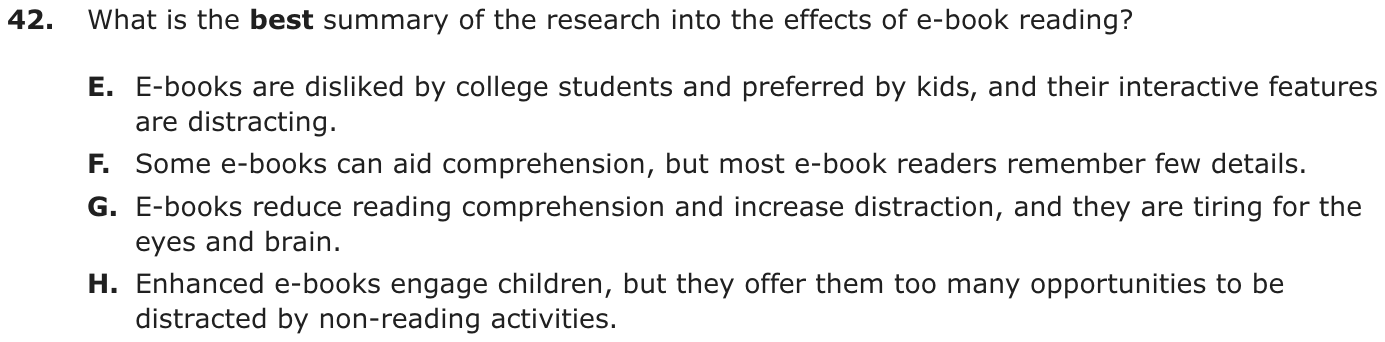
Question 41 of 120
2024 Test A English, question 43Passage Excerpt from The Highest Tide
Excerpt from The Highest Tide
by Jim Lynch
The narrator’s summer job is collecting marine specimens in Puget Sound, Washington. In this excerpt, he is looking for specimens in the mudflats before daybreak. Mudflats, or flats, are coastal landforms created when sediment and silt from tides are deposited as the tides recede.
I rounded the oyster beds, to the far side. . . . It was low tide by then, and I saw the water hesitating at its apex, neither leaving nor returning, patiently waiting for the gravitational gears to shift. Dozens of anxious clams started squirting in unison like they did whenever vibrating grains of sand warned them predators were approaching. I stopped and waited with them, to actually see the moment when the tide started returning with its invisible buffet of plankton for the clams, oysters, mussels and other filter feeders. It was right then, ankle deep in the Sound, feet numbing, eyes relaxed, that I saw the nudibranch.1
In all my time on the flats I’d never seen one before. I’d read about them, sure. I’d handled them at aquariums but never in the wild, and I’d never even seen a photo of one this stunning. It was just three inches long but with dozens of fluorescent, orange-tipped hornlike plumes jutting from the back of its see-through body that appeared to be lit from within.
Nudibranchs are often called the butterflies of the sea, but even that understates their dazzle. Almost everything else in the northern Pacific is dressed to blend with pale surroundings. Nudibranchs don’t bother, in part because they taste so lousy they don’t need camouflage to survive. But also, I decided right then, because their beauty is so startling it earns them a free pass, the same way everyday life brakes for peacocks, parade floats. . . .
The dark mudflats loomed like wet, flattened dunes stretching deep into Skookumchuck Bay in front of our house. From a distance, they looked too barren to support sea life. Up close, they still did, unless you knew where to find the hearty clams, worms and tiny creatures that flourish in mud. . . . I’m not sure why I decided to take a look. It was still an hour before sunrise, and I knew exactly what the bars2 looked like in the moonlight, but for some reason, I couldn’t resist.
I heard it long before I saw it. It was an exhale, a release of sorts, and I instantly wondered if a whale was stranded again. We had a young minke3 stuck out there two summers prior, and it made similar noises until the tide rose high enough for rescuers to help free it. . . . I looked for a hulking silhouette but couldn’t find one. I waited, but there were no more sounds. Still, I went toward what I thought I’d heard, avoiding stepping into the mud until I had to. I knew the flats well enough to know I could get stuck just about anywhere. The general rule was you didn’t venture out past the shells and gravel with an incoming tide. I sank up to my knees twice, and numbing water filled my boots.
. . . I kept stepping toward the one sound I’d heard, a growing part of me hoping I’d find nothing at all. When I stopped to rest and yank up my socks, my headlamp crossed it. My first thought? A giant octopus.
Puget Sound has some of the biggest octopi in the world. They often balloon to a hundred pounds. Even the great Jacques Cousteau4 himself came to study them. But when I saw the long tubular shape of its upper body and the tangle of tentacles below it, I knew it was more than an octopus. I came closer, within fifty feet, close enough to see its large cylindrical siphon5 quiver. I couldn’t tell if it was making any sounds at that point, because it was impossible to hear anything over the blood in my ears. . . .
The creature’s body came to a triangular point above narrow fins that lay flat on the mud like wings, but it was hard to be sure exactly where it all began or ended, or how long its tentacles truly were, because I was afraid to pry my eyes off its jumble of arms for more than half a second. I didn’t know whether I was within reach, and its arms were as big around as my ankle and lined with suckers the size of half-dollars. If they even twitched I would have run. So, I was looking at it and not looking at it while my heart spangled my vision. I saw fragments, pieces, and tried to fuse them in my mind but couldn’t be certain of the whole. I knew what it had to be, but I wouldn’t allow myself to even think the two words. Then I gradually realized the dark shiny disc in the middle of the rubbery mass was too perfectly round to be mud or a reflection.
It was too late to smother my scream. Its eye was the size of a hubcap.6
From THE HIGHEST TIDE by Jim Lynch. Copyright © 2005 by Jim Lynch. Used by permission of Bloomsbury USA. All rights reserved.
1nudibranch: type of sea slug
2bars: sandbars
3minke: species of small whale
4Jacques Cousteau: renowned French oceanographer
5siphon: tube-like organ that is used for drawing in or removing fluids
6hubcap: removable cap over the end of a wheel axle
Question
In paragraph 3, the phrase “the butterflies of the sea” conveys the idea that
- Anudibranchs do not have to work as hard as other animals to survive in the ocean.
- Bnudibranchs have colorful features that make them stand out.
- Cnudibranchs are delicate and have trouble adapting to their environment.
- Dnudibranchs are rare and difficult to find in the ocean.
Show the answer
Correct answer: B
The question asks what idea the phrase “the butterflies of the sea” in paragraph 3 conveys.
A. Incorrect. While the narrator does say that they “taste so lousy they don’t need camouflage to survive” (paragraph 3), the phrase explains that their bright appearance poses no threat to their lives.
B. CORRECT. The narrator describes the vibrant colors of the nudibranch in paragraph 2. Then in paragraph 3, the narrator says that “their beauty is so startling.” The nudibranchs are colorful and unique, just as many butterflies are.
C. Incorrect. The narrator describes the distinct appearance of the nudibranch but does not suggest that nudibranchs struggle to adapt to their environment because of this trait.
D. Incorrect. In paragraph 2, the narrator states, “I’d handled them at aquariums but never in the wild, and I’d never even seen a photo of one this stunning.” Although this suggests that the narrator has rarely encountered a nudibranch in the wild, it does not suggest that they are rare in the wild in general.
Question analysis
This figurative-language question asks what the phrase “the butterflies of the sea” conveys about nudibranchs, the sea slugs the narrator spots on a Puget Sound mudflat in an excerpt from the novel The Highest Tide. Students must use the description around the phrase to decide which quality of butterflies the comparison points to.
- Grade level
- Grade 7 reading and task
- Compared with grade 7
- At grade 7 Interpreting a figurative comparison from context is standard grade 7 language work. The description around the phrase is vivid and close at hand, so the demand is typical, even though the creature itself may be unfamiliar.
- Estimated difficulty
- Straightforward: two steps or one careful reading.
- Thinking it demands
- Depth of knowledge 2, skills and concepts · mainly understand
- What makes it hard
- Figurative or literary language moderate
- An unfamiliar subject minor
- Evidence
- Answered from one paragraph or stanza
- Reading level
- Passage: about grade 6, 902 words; question and choices: about grade 7, 58 words.
- Students, last 30 days
- Not enough answers yet to show (it takes 10).
Why it is hard, traps and wrong answers (shows the answer)
Why it is hard
The nickname is explained in the same sentence, where the narrator says even it “understates their dazzle”, so the question is mostly a matter of reading on a few words. The trap is reading on too far: the next sentences explain why nudibranchs can afford to be showy, a different point. Students who bring their own idea of butterflies as fragile, or who turn the narrator's first sighting into rarity, drift away from what he stresses.
Figurative or literary language moderate Understanding the question
The comparison's point is supplied by the clause right after it, “even that understates their dazzle”, and by paragraph 2's fluorescent, orange-tipped plumes, not by anything butterflies are usually known for. (Graesser, Singer & Trabasso, 1994; Kintsch, 1998)
An unfamiliar subject minor Understanding the question
Few students have seen a nudibranch, footnoted only as a type of sea slug, so the picture of it must be built entirely from paragraph 2's description. (Recht & Leslie, 1988; Kintsch, 1998)
Strategy: Read the phrase with the sentence it sits in and the description of the nudibranch just before it, then decide which quality of butterflies the comparison is pointing to.
Traps
- True but not the answer: A choice says something accurate about the text that does not answer this question.
- Outside knowledge: A choice is plausible in the real world but not supported by this text.
- Reads too much in: A reasonable-sounding conclusion that goes further than the text allows.
The wrong answers, classified
A True but not the answer (King et al., 2004; Embretson & Wetzel, 1987)
Draws on the next sentences, which say nudibranchs taste too lousy to need camouflage, a real point about their survival but not what the butterfly comparison conveys.
C Outside knowledge (King et al., 2004; Recht & Leslie, 1988)
Brings in the familiar idea that butterflies are delicate, which the passage never uses; nothing suggests nudibranchs struggle to adapt, and the comparison is about their dazzle.
D Reads too much in (Graesser, Singer & Trabasso, 1994)
Turns the narrator never having seen one in the wild into a claim that nudibranchs are rare, which reflects his experience, not the meaning of the nickname.
Working it out, step by step
Spot the comparison
This asks about figurative language, words that compare two things to make a point. In paragraph 3, nudibranchs are called “the butterflies of the sea.” You need to decide which quality of butterflies the comparison points to.
Read the rest of the sentence
The sentence goes on: “but even that understates their dazzle.” To understate means to say less than the full truth. Dazzle means bright, eye-catching beauty. So the narrator means nudibranchs are even more dazzling than butterflies.
Look back at paragraph 2
Paragraph 2 describes the one he found. It had “dozens of fluorescent, orange-tipped hornlike plumes.” Fluorescent means glowing with bright color. Plumes are feathery tufts. Its body even seemed “to be lit from within.” Like a butterfly, it is bright and colorful, and it stands out.
Check each choice
- B fits: “colorful features that make them stand out” matches the glowing plumes and the dazzle.
- A is wrong because their bad taste explains how they survive, not what the butterfly phrase means.
- C is wrong because the passage never says nudibranchs are delicate or struggle to fit in.
- D is wrong because the narrator never seeing one in the wild is his own experience, not proof they are rare.
Watch out: A uses real details from the same paragraph. But they answer a different question: why nudibranchs can afford to be showy.
Choose the answer
The butterfly comparison points to the nudibranch’s bright, eye-catching colors. So the answer is B.
Why this answer and not the closest wrong one
A comes closest, since the same paragraph says nudibranchs “don’t need camouflage to survive.” But that explains why they can afford to be bright. The butterfly phrase itself is about their beauty, which even the nickname “understates.” B names that beauty: colorful features that stand out.
More questions like this
The original DOE question

The passage “Excerpt from The Highest Tide” as printed (pages 64–65)
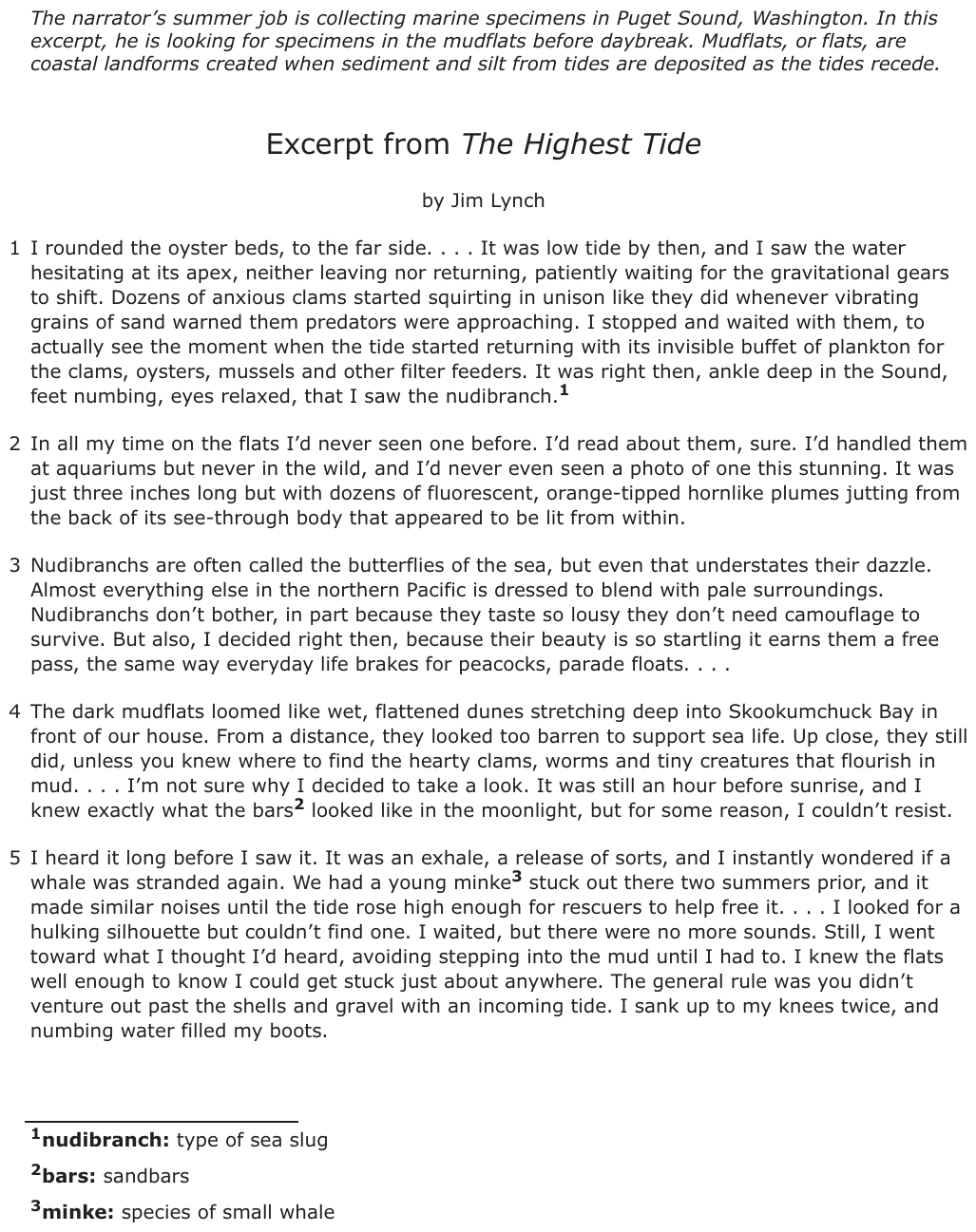
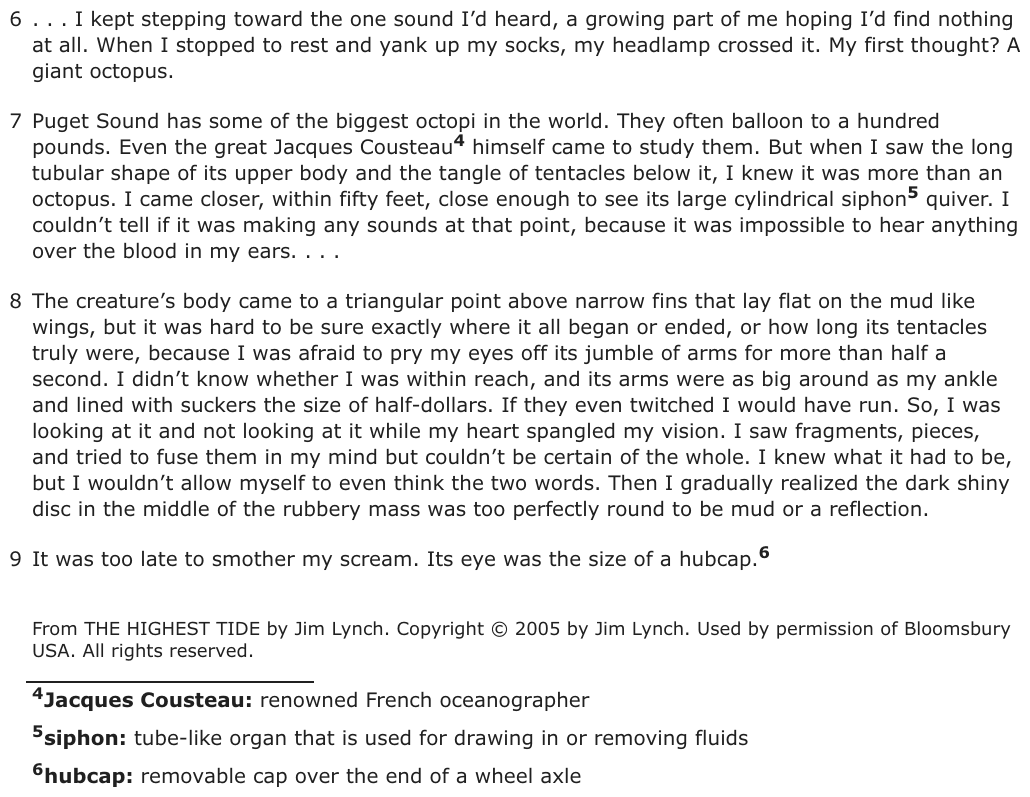
Question 42 of 120
2024 Test A English, question 44Uses the passage above: “Excerpt from The Highest Tide”.
Question
Read these sentences from paragraph 4.
I’m not sure why I decided to take a look. It was still an hour before sunrise, and I knew exactly what the bars looked like in the moonlight, but for some reason, I couldn’t resist.
The sentences contribute to the overall structure of the excerpt by
- Aintroducing the mysterious creature that the narrator discovers.
- Bindicating a shift from the narrator recalling the past to the narrator reflecting on the present.
- Cestablishing a struggle with fear that the narrator must overcome.
- Dbuilding tension through indicating that the narrator is going to see something unexpected.
Show the answer
Correct answer: D
The question asks for an explanation of how selected sentences from paragraph 4 contribute to the overall structure of the excerpt.
A. Incorrect. These sentences set a tense and mysterious tone for what is about to happen in the excerpt, but they do not introduce the creature the narrator discovers.
B. Incorrect. While the narrator reveals that he is familiar with the terrain (“I knew exactly what the bars looked like in the moonlight”), this does not show the narrator recalling the past or reflecting on the present; it demonstrates the narrator’s knowledge of the mudflats.
C. Incorrect. These sentences reveal the narrator’s curiosity, which is his prime motivation for venturing out to the mudflats, and his familiarity with the terrain shows that at this point, he does not feel afraid.
D. CORRECT. The narrator creates a feeling of mystery and suspense with language that shows how the situation is unknown. Phrases such as “I couldn’t resist” and “I’m not sure why” reveal the narrator’s curiosity, as well as the tension of feeling drawn to explore the mudflats in the moonlight.
Question analysis
This text-structure question quotes the narrator's admission that he cannot say why he decided to walk out onto the dark mudflats, and asks how these sentences contribute to the structure of the excerpt from The Highest Tide. Students must judge what the sentences do at this point in the story, not just what they say, and the choices name four quite different jobs.
- Grade level
- Grade 7 reading and task
- Compared with grade 7
- At grade 7 Explaining how a piece of narration shapes a story's structure is grade 7 literary work. The sentences are quoted and short, but the student must look past what they say to the effect they create, a typical grade 7 demand.
- Estimated difficulty
- Moderate: several steps, or a close reading with one strong distractor.
- Thinking it demands
- Depth of knowledge 2, skills and concepts · mainly analyze
- What makes it hard
- How, not what moderate
- Reading between the lines moderate
- Evidence
- Answered from several paragraphs or stanzas
- Reading level
- Passage: about grade 6, 902 words; question and choices: about grade 8, 99 words.
- Students, last 30 days
- Not enough answers yet to show (it takes 10).
Why it is hard, traps and wrong answers (shows the answer)
Why it is hard
The sentences say little on their own, the narrator going out before dawn to a place he knows well, so their purpose shows only from where they sit, right before the sound in paragraph 5. Students who know the ending tend to read the fear and the creature back into this moment, which is why the choices about fear and about introducing the creature pull. The narrator's own puzzlement about why he went is what builds the suspense.
How, not what moderate Working it out
The question asks what the two sentences do in the story, so their content, an early hour and a familiar view of the sandbars, matters only as a setup for what comes next. (Anderson & Krathwohl, 2001)
Reading between the lines moderate Working it out
Nothing is said to be coming; the tension must be inferred from an unexplained pull, “I'm not sure why” and “for some reason, I couldn't resist”, just before the strange sound. (Graesser, Singer & Trabasso, 1994; Kintsch, 1998)
Strategy: Place the two sentences in the order of events, what came before and what comes right after, and ask what job they do for a reader at that point in the story.
Traps
- Wrong part of the text: A choice is true of another paragraph, stanza or speaker than the one asked about.
- Wrong purpose or structure: Names a purpose, structure or effect that the part does not serve, or describes what a part says when the question asks what it does.
The wrong answers, classified
A Wrong part of the text (Kirsch & Mosenthal, 1990)
Jumps ahead to the creature, which is first heard in paragraph 5 and seen in paragraph 6; these sentences only explain why the narrator went out.
B Wrong purpose or structure (Anderson & Krathwohl, 2001)
Notices the present-tense “I'm not sure” and reads it as a shift in time, but it is a passing comment, and the narration around it stays in the past.
C Wrong part of the text (Kirsch & Mosenthal, 1990)
Reads the fear of paragraphs 6 and 8 into this moment, but here the narrator is pulled by curiosity, and fear arrives only when he hopes to find nothing.
Working it out, step by step
Know what the question asks
This asks about structure: what job these two sentences do in the story. Think about where they sit. Then ask how they make a reader feel about what will happen next.
Look at the sentences closely
The narrator says, “I’m not sure why I decided to take a look.” He knows “exactly what the bars looked like in the moonlight.” The bars are sandbars, so there should be nothing new to see. Yet “for some reason, I couldn’t resist.” He can’t explain why he feels pulled out onto the flats.
See what comes right after
The next paragraph begins, “I heard it long before I saw it.” A strange sound leads him to a giant creature. So his mysterious pull comes just before something unexpected. Tension is the nervous feeling of waiting to find out what happens. These sentences build that feeling.
Check each choice
- D fits: the sentences build tension by hinting that something unexpected is coming.
- A is wrong because the creature doesn’t appear yet, since he first hears it in paragraph 5.
- B is wrong because “I’m not sure” is a short comment, and the story stays in the past.
- C is wrong because he is curious here, and fear comes later, when he hopes he will “find nothing at all.”
Watch out: C reads his later fear back into this moment. Right now he is drawn forward, not scared.
Choose the answer
The sentences make you wonder what is waiting out on the flats. So the answer is D.
Why this answer and not the closest wrong one
C comes closest, because the narrator is badly scared by the end. But in these sentences he feels pulled by a curiosity he can’t explain. That unexplained pull, just before a strange sound, builds suspense. D names that job.
More questions like this
The original DOE question
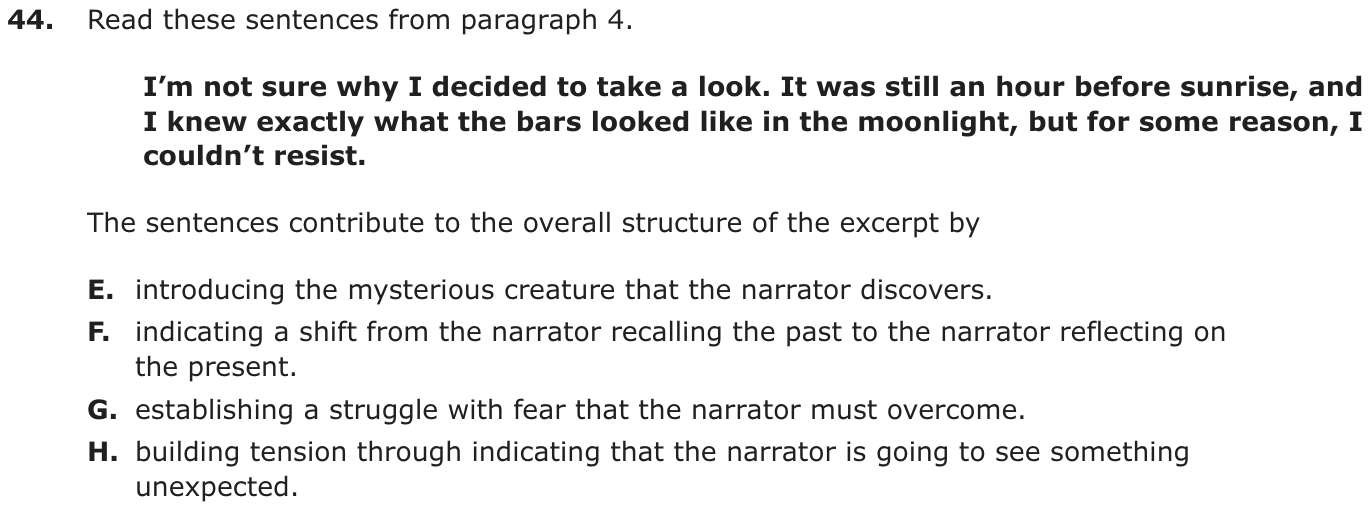
Question 43 of 120
2024 Test A English, question 45Uses the passage above: “Excerpt from The Highest Tide”.
Question
The narrator’s actions in paragraph 5 reveal that he is
- Aexpecting to see the familiar sight of a stranded minke.
- Bconfident about exploring farther into the mudflats.
- Cunconcerned about becoming stuck in the mudflats.
- Ddetermined to discover the source of the sound.
Show the answer
Correct answer: D
The question asks what the narrator’s actions in paragraph 5 reveal about him.
A. Incorrect. The paragraph begins with the narrator wondering “if a whale was stranded again” because of one that had gotten stuck before and had “made similar noises.” However, the narrator explains that he “looked for a hulking silhouette but couldn’t find one” before he “went toward what [he] thought [he’d] heard,” so readers can conclude that he continues to walk through the dangerous mudflats not because he expects to find a whale but because he is curious to find out what made the noise.
B. Incorrect. The fact that the narrator knows about a whale that was stranded on the mudflats “two summers prior” indicates that he is familiar with the area, and he does mention that he has some knowledge of the mudflats. However, in the paragraph, he reveals that his knowledge is of the dangers there: “I knew the flats well enough to know I could get stuck just about anywhere.” He also explains that as he moves, he avoids “stepping into the mud until [he] had to.” The fact that he acknowledges the danger and tries to avoid it indicates that he is cautious rather than confident.
C. Incorrect. In the paragraph, the narrator’s recollection that even though he could not see the silhouette of a whale, “still, [he] went toward what [he] thought [he’d] heard” might make him seem unconcerned about getting stuck. However, even as he continues, he moves carefully, avoiding “stepping into the mud until [he] had to” because he knows the mudflats “well enough to know [he] could get stuck just about anywhere.”
D. CORRECT. In the paragraph, the narrator describes the dangers of walking on the mudflats by stating that he “knew the flats well enough to know [he] could get stuck just about anywhere,” but he continues walking toward the sound. Despite knowing the dangers, he still “went toward what [he] thought [he’d] heard,” and this shows that he is determined to find out what made the sound.
Question analysis
This inference question asks what the narrator's actions reveal about him when he hears a strange sound on the mudflats before dawn and sets off toward it. Students must read what he does alongside what he says he knows about the flats, and several choices fit one detail of the paragraph but not the whole of it.
- Grade level
- Grade 7 reading and task
- Compared with grade 7
- At grade 7 Inferring a character's trait from actions is core grade 7 literary reading. The evidence sits in one paragraph and the actions are concrete, so the item is typical, though the long paragraph mixes memory, rules and movement.
- Estimated difficulty
- Straightforward: two steps or one careful reading.
- Thinking it demands
- Depth of knowledge 2, skills and concepts · mainly understand
- What makes it hard
- Reading between the lines moderate
- Much to keep track of minor
- Evidence
- Answered from one paragraph or stanza
- Reading level
- Passage: about grade 6, 902 words; question and choices: about grade 8, 41 words.
- Students, last 30 days
- Not enough answers yet to show (it takes 10).
Why it is hard, traps and wrong answers (shows the answer)
Why it is hard
Paragraph 5 shows two things at once, a narrator who knows exactly how dangerous the flats are and one who keeps walking toward a sound anyway. Choices that see only the walking call him confident or unconcerned, and the one that sees only his first thought has him expecting a whale. The word “Still”, after his search for a silhouette comes up empty, is the hinge that shows determination.
Reading between the lines moderate Working it out
The trait is never named; it must be drawn from what he does, especially “Still, I went toward what I thought I'd heard” after seeing nothing and hearing nothing more. (Graesser, Singer & Trabasso, 1994; Kintsch, 1998)
Much to keep track of minor Working it out
The paragraph mixes a memory of the stranded minke, a rule about incoming tides and his own steps, and the student must keep his caution and his persistence in view together. (Sweller, 1988; Carpenter, Just & Shell, 1990)
Strategy: List what the narrator does in paragraph 5, step by step, and note what he knows while doing it; then ask what those actions, taken together, say about him.
Traps
- Wrong tone or attitude: Misjudges the tone, attitude or point of view, such as reading admiration as criticism, or taking a character's or subject's feelings for the author's.
- Twists what the text says: Uses the text's topic and ideas but changes what it says: who did it, how much, when, or why.
The wrong answers, classified
A Twists what the text says (King et al., 2004)
Builds on his first thought that a whale was stranded again, but he finds no silhouette and keeps going, and one stranding two summers before hardly makes it a familiar sight.
B Wrong tone or attitude (Graesser, Singer & Trabasso, 1994)
Reads “I knew the flats well” as confidence, but he knew them well enough to know he could get stuck anywhere, which is wariness, not confidence.
C Wrong tone or attitude (Graesser, Singer & Trabasso, 1994)
Takes his pressing on as indifference, ignoring that he avoids stepping into the mud until he has to because he knows how easily he could sink.
Working it out, step by step
Know what the question asks
This asks you to make an inference about a character. You judge what the narrator is like from what he does. The text never names the trait, so look closely at his actions.
List his actions in paragraph 5
He hears a sound and wonders if a whale is stranded. He “looked for a hulking silhouette but couldn’t find one.” He waits, but hears nothing more. Then he says, “Still, I went toward what I thought I’d heard.” He sinks to his knees twice, and cold water fills his boots.
Notice what he knows
He knows the danger. He says, “I knew the flats well enough to know I could get stuck just about anywhere.” The word “Still” matters here. It means even so. Even with no whale in sight and no more sounds, he keeps heading toward the noise.
Check each choice
- D fits: he keeps going toward the sound despite the danger, so he is determined to find its source.
- A is wrong because he finds no whale and keeps going, and one stranding two summers ago is not a familiar sight.
- B is wrong because knowing he could get stuck anywhere makes him careful, not confident.
- C is wrong because he avoids “stepping into the mud until I had to,” so he does worry about getting stuck.
Watch out: B and C notice only that he keeps walking. They miss how carefully he moves.
Choose the answer
He presses on toward the sound even though he knows the mud is dangerous. So the answer is D.
Why this answer and not the closest wrong one
B comes closest, because he says he knows the flats well. But what he knows is how easily he could get stuck, so he is careful, not confident. Pressing on anyway, after seeing nothing and hearing nothing more, shows determination.
More questions like this
The original DOE question
Question 44 of 120
2024 Test A English, question 46Uses the passage above: “Excerpt from The Highest Tide”.
Question
How does the setting affect the plot of the excerpt?
- AThe darkness of the mudflats before sunrise causes the narrator to pay close attention to his surroundings.
- BThe rugged terrain of the mudflats makes it more difficult for the narrator to do his job.
- CThe slow return of the tide along the mudflats forces the narrator to be patient during his journey.
- DThe barren appearance of the mudflats creates a sense of mystery that unsettles the narrator.
Show the answer
Correct answer: A
The question asks how the setting affects the plot of the excerpt.
A. CORRECT. In paragraph 4, the narrator says that it is an hour before sunrise. It is difficult to see because the mudflats are dark, so the narrator, while familiar with the terrain of the mudflats, is cautious.
B. Incorrect. While the terrain of the mudflats is challenging because of the “wet, flattened dunes” (paragraph 4), the narrator is familiar with the terrain and moves carefully. In addition, the excerpt focuses on the narrator’s curiosity and enjoyment as he explores the mudflats, not on his work collecting specimens.
C. Incorrect. In paragraph 1, the narrator watches the water “hesitating at its apex” and “patiently waiting for the gravitational gears to shift.” This illustrates that the narrator is already familiar with the changes in his surroundings, that the tide is slow to move in, and that he can move carefully through the mudflats without the threat of rising water.
D. Incorrect. While the narrator is on the mudflats for the entire excerpt, the phrase “eyes relaxed” in paragraph 1 indicates that the narrator feels comfortable there. The narrator does not show fear until paragraph 6, when a growing fear about the unknown creature arises.
Question analysis
Set on the mudflats of Puget Sound before daybreak, this excerpt from the novel The Highest Tide is the basis for a question about how setting affects plot. Students must link features of the place and time to what the narrator does across the whole excerpt, and each choice pairs a real feature of the setting with an effect that may or may not be in the text.
- Grade level
- Grade 8 reading and task
- Compared with grade 7
- Above grade 7 Analyzing how setting shapes plot is a grade 7 literary standard, but the excerpt never states the link: the effect must be inferred from scattered details, and every choice names a genuine feature of the flats, which is beyond typical work.
- Estimated difficulty
- Hard: combines ideas, needs a plan, and has more than one tempting wrong answer.
- Thinking it demands
- Depth of knowledge 3, strategic thinking · mainly analyze
- What makes it hard
- Reading between the lines major
- The right answer is reworded moderate
- Evidence in several places moderate
- Evidence
- Answered from the whole text
- Reading level
- Passage: about grade 6, 902 words; question and choices: about grade 8, 77 words.
- Corrected from the DOE handbook
- A statement in the explanation that contradicted the excerpt’s introduction was corrected.
- Students, last 30 days
- Not enough answers yet to show (it takes 10).
Why it is hard, traps and wrong answers (shows the answer)
Why it is hard
Every choice names a real feature of the mudflats, so the question turns on which feature the excerpt actually shows shaping events. The darkness never gets a sentence of its own; it is felt in a sound heard before anything is seen, a silhouette that cannot be found and a headlamp beam. The barren look of the flats is the strongest pull, because the scene is eerie, but the narrator knows life hides in the mud and his unease comes from the creature.
Reading between the lines major Working it out
The excerpt never says the darkness changes anything; the effect must be assembled from the hour before sunrise, the sound heard “long before I saw it”, the missing silhouette and the headlamp that finally finds the creature. (Graesser, Singer & Trabasso, 1994; Kintsch, 1998)
The right answer is reworded moderate Choosing the answer
The right choice uses no words from the text, while the wrong ones echo it: the “barren” look of the flats, the water “patiently waiting”, the narrator's summer job. (Freedle & Kostin, 1993; Kirsch & Mosenthal, 1990)
Evidence in several places moderate Working it out
The darkness is established in paragraph 4 and felt in paragraphs 5, 6 and 8, so no single passage shows the setting at work. (Kirsch & Mosenthal, 1990; Gorin & Embretson, 2006)
Strategy: Collect the details of time, place and conditions across the excerpt, then for each choice ask whether the text shows that feature of the setting actually changing what the narrator does.
Traps
- Twists what the text says: Uses the text's topic and ideas but changes what it says: who did it, how much, when, or why.
- Reads too much in: A reasonable-sounding conclusion that goes further than the text allows.
The wrong answers, classified
B Reads too much in (Graesser, Singer & Trabasso, 1994)
Combines the introduction's specimen job with his sinking to his knees to infer a harder workday, though the excerpt follows a strange sound and never shows his work suffering.
C Twists what the text says (King et al., 2004)
Borrows paragraph 1's water “patiently waiting” at low tide and has the tide force the narrator to wait, when he chose to stop and watch it turn.
D Twists what the text says (King et al., 2004)
Joins the flats' barren look from a distance to his later fear, but he knows life hides in the mud, and what unsettles him is the creature, not the landscape.
What was corrected from the DOE handbook, and why
- Explanation: In rejecting choice B, the handbook says “the excerpt shows that the narrator explores the mudflats for curiosity and enjoyment, not work.” But the introduction says the narrator’s summer job is collecting marine specimens and that “in this excerpt, he is looking for specimens in the mudflats before daybreak.” The explanation now says the excerpt focuses on his curiosity and enjoyment as he explores the mudflats, not on his work collecting specimens. That keeps the handbook’s point (the excerpt is not about the terrain making his job harder) without contradicting the introduction.
Working it out, step by step
Know what setting and plot mean
The setting is where and when a story happens. The plot is the chain of events. This asks which part of the setting changes what happens or what the narrator does.
Find the time of day
Paragraph 4 says, “It was still an hour before sunrise.” The narrator is out on the mudflats in the dark. The only light comes from the moon and his headlamp.
See how the dark shapes events
Because it is dark, he must rely on sounds and small clues. He says, “I heard it long before I saw it.” He looks for “a hulking silhouette,” a dark outline, but can’t find one. He spots the creature only when “my headlamp crossed it.” Then he stares hard, trying to make out its shape. The darkness keeps him alert and watching closely.
Check each choice
- A fits: the dark makes him pay close attention to everything around him.
- B is wrong because the excerpt follows a strange sound and never shows the ground making his job harder.
- C is wrong because in paragraph 1 he chooses to stop and watch the tide, and nothing forces him.
- D is wrong because he knows life hides in the mud, and what scares him is the creature.
Watch out: D feels right because the scene is eerie. But the flats’ empty look never troubles him.
Choose the answer
The darkness before sunrise is what keeps the narrator listening and looking so carefully. So the answer is A.
Why this answer and not the closest wrong one
D comes closest, because the dark flats do feel spooky. But the narrator says they only look “too barren to support sea life” from far away, and he knows better. His fear comes from the creature. The darkness, though, shapes every step: he hears before he sees and must watch closely.
More questions like this
The original DOE question
Question 45 of 120
2024 Test A English, question 47Uses the passage above: “Excerpt from The Highest Tide”.
Question
Which sentence from paragraph 5 supports the idea that the narrator is taking a risk?
- A“It was an exhale, a release of sorts, and I instantly wondered if a whale was stranded again.”
- B“I looked for a hulking silhouette but couldn’t find one.”
- C“I waited, but there were no more sounds.”
- D“I knew the flats well enough to know I could get stuck just about anywhere.”
Show the answer
Correct answer: D
The question asks which sentence from paragraph 5 supports the idea that the narrator is taking a risk.
A. Incorrect. In this sentence, the narrator is describing the exhale of a creature and his concern that the sound might be coming from a whale in danger. At no point does the narrator suggest that this is a dangerous situation.
B. Incorrect. This sentence describes a “hulking silhouette” because the narrator is searching for a whale that might be stranded. This expression refers to the size of the whale and not to any danger the narrator might face.
C. Incorrect. The narrator’s words “no more sounds” are used to illustrate his listening for what may be a whale. At this point, the narrator is still concerned about the possibility that a whale may be stranded, not the possibility of being in danger.
D. CORRECT. The idea that the narrator could become stuck in the mud of the flats means that the surroundings pose some danger or difficulty.
Question analysis
Students choose which sentence from one tense paragraph of The Highest Tide shows that the narrator is taking a risk as he follows a strange sound across the mudflats. In this evidence question, all four sentences come from the same scene, so students must tell real danger to the narrator apart from a mood of suspense.
- NYS standards
- 7R1 textual evidence and inferences
- Grade level
- Grade 6 reading and task
- Compared with grade 7
- Below grade 7 Choosing the sentence that supports an idea is a grade 6 and 7 skill. Here all four choices come from one paragraph and only the idea of danger needs matching, a lighter task than typical grade 7 evidence work.
- Estimated difficulty
- Routine: one familiar step, little to misread.
- Thinking it demands
- Depth of knowledge 2, skills and concepts · mainly evaluate
- What makes it hard
- Evidence
- Answered from one paragraph or stanza
- Reading level
- Passage: about grade 6, 902 words; question and choices: about grade 5, 65 words.
- Students, last 30 days
- Not enough answers yet to show (it takes 10).
Why it is hard, traps and wrong answers (shows the answer)
Why it is hard
Only one of the four sentences mentions anything that could happen to the narrator himself, so this is among the easiest questions on the test. The other three build suspense, a strange exhale, a missing silhouette, a silence, and a student who confuses suspense with danger may pick one. Asking who is at risk in each sentence settles it at once.
Reading between the lines minor Working it out
The right sentence states only what the narrator knows, that he could get stuck; it shows a risk because the sentences around it have him walking out onto the mud anyway. (Graesser, Singer & Trabasso, 1994; Kintsch, 1998)
Strategy: Decide what taking a risk would mean for the narrator in this place, then test each sentence for a danger to him rather than a feeling of suspense.
Traps
- Supports only part of the claim: In a question about evidence: a line that backs one half of the claim but not the other, or a related point rather than the claim itself.
- Word match: Repeats striking words or phrases from the text, so it looks supported, but its meaning does not fit the question.
The wrong answers, classified
A Supports only part of the claim (King et al., 2004; Thissen, Steinberg & Fitzpatrick, 1989)
Senses danger in a possibly stranded whale, but the danger would be the whale's, and the sentence shows the narrator only wondering, not exposing himself to anything.
B Word match (Freedle & Kostin, 1993)
Hears menace in “hulking silhouette”, but the phrase describes the size of the whale he expected, and failing to find one puts him in no danger.
C Reads too much in (Graesser, Singer & Trabasso, 1994)
Reads the silence after the sound as ominous, but waiting and listening is a pause in his search, not something that puts him at risk.
Working it out, step by step
Know what the question asks
This asks you to find evidence. Taking a risk means doing something that could hurt you. So look for a sentence that shows a danger to the narrator himself.
Think about the danger on the flats
Mudflats are soft and wet. A person can sink into the mud and get stuck as the water rises. Paragraph 5 even gives a rule: “The general rule was you didn’t venture out past the shells and gravel with an incoming tide.”
Find the sentence about danger
Choice D says, “I knew the flats well enough to know I could get stuck just about anywhere.” So the narrator knows he could get stuck. Yet he keeps walking out toward the sound. That means he is taking a risk.
Check each choice
- D fits: getting stuck is a danger to him, and he goes on anyway.
- A is wrong because a stranded whale would be in danger, not the narrator.
- B is wrong because “hulking silhouette,” a huge dark shape, describes the whale he expected, not a threat.
- C is wrong because waiting in silence builds suspense but puts him in no danger.
Watch out: A, B and C create a spooky mood. But a spooky mood is not the same as a risk.
Choose the answer
Only one sentence names something that could happen to the narrator himself. So the answer is D.
Why this answer and not the closest wrong one
A comes closest, because a stranded whale sounds serious. But the danger in that sentence belongs to the whale. Only D names something that could happen to the narrator: getting stuck in the mud.
More questions like this
The original DOE question
Question 46 of 120
2024 Test A English, question 48Uses the passage above: “Excerpt from The Highest Tide”.
Question
Read this sentence from paragraph 6.
I kept stepping toward the one sound I’d heard, a growing part of me hoping I’d find nothing at all.
How do the narrator’s actions develop a central idea of the excerpt?
- AThe narrator’s concern about the origin of the noise shows dedication to helping preserve sea life in the mudflats.
- BThe narrator’s curiosity about the sea life in the mudflats outweighs any fear about the situation.
- CThe narrator’s knowledge about a variety of sea life encourages a search for more specimens to study.
- DThe narrator’s eagerness about new specimens of sea life outweighs the reality that the area is an unlikely place to find them.
Show the answer
Correct answer: B
The question asks how the narrator’s actions, as described in the sentence from paragraph 6, develop a central idea of the excerpt.
A. Incorrect. The sentence highlights the narrator’s concern about sea life and the creatures living within the flats. However, these ideas do not develop what is being described in the excerpt.
B. CORRECT. The narrator “kept stepping toward the one sound,” indicating a sense of curiosity. However, the words “a growing part of me hoping I’d find nothing” suggest a rising fear or concern. Ultimately, the narrator’s curiosity outweighs his growing fear and is a central idea in the excerpt, as shown by the fact that the narrator does not run away when finally encountering the creature.
C. Incorrect. While the narrator’s descriptions of the nudibranch and other sea life demonstrate a knowledge of these creatures, as well as a desire to discover more in the mudflats, the knowledge the narrator exhibits is not what is being illustrated in the excerpt.
D. Incorrect. The excerpt does describe the narrator’s enjoyment at seeing a nudibranch in paragraph 2, and in paragraph 4, the narrator clearly states that there is an abundance of life in the seemingly barren mudflats, including “hearty clams, worms and tiny creatures that flourish in mud.” However, the sentence demonstrates the narrator’s curiosity in spite of fear, not an eagerness about or fascination with the mudflats.
Question analysis
This central-idea question quotes a sentence in which the narrator keeps walking toward a mysterious sound while part of him hopes to find nothing, and asks how his actions develop a central idea of the excerpt. Students must read the mixed feelings packed into one sentence and connect them to the larger story of his walk on the flats.
- Grade level
- Grade 7 reading and task
- Compared with grade 7
- At grade 7 Connecting a character's actions to a central idea is grade 7 work. The quoted sentence states both the action and the feeling, so the task is typical, though the four choices are long and each names a different motive.
- Estimated difficulty
- Moderate: several steps, or a close reading with one strong distractor.
- Thinking it demands
- Depth of knowledge 2, skills and concepts · mainly analyze
- What makes it hard
- Reading between the lines moderate
- Evidence in several places minor
- Evidence
- Answered from several paragraphs or stanzas
- Reading level
- Passage: about grade 6, 902 words; question and choices: about grade 9, 111 words.
- Students, last 30 days
- Not enough answers yet to show (it takes 10).
Why it is hard, traps and wrong answers (shows the answer)
Why it is hard
The quoted sentence holds both halves of the answer, an action and a wish that pulls against it, but neither is named. The wrong choices each supply a motive the sentence does not show, a rescue, a hunt for specimens, an eagerness for new finds, and two of them borrow real details from elsewhere in the excerpt. Students who split the sentence into what he does and what he hopes avoid all three.
Reading between the lines moderate Working it out
The sentence names neither feeling: curiosity must be read from “kept stepping toward the one sound” and fear from “a growing part of me hoping I'd find nothing at all”. (Graesser, Singer & Trabasso, 1994; Kintsch, 1998)
Evidence in several places minor Working it out
To count as a central idea, the pull between curiosity and fear has to recur, from “I couldn't resist” in paragraph 4 to “If they even twitched I would have run” in paragraph 8. (Kirsch & Mosenthal, 1990; Gorin & Embretson, 2006)
Strategy: Split the quoted sentence into what the narrator does and what part of him feels, then ask which motive behind those actions runs through the rest of the excerpt.
Traps
- Reads too much in: A reasonable-sounding conclusion that goes further than the text allows.
- Twists what the text says: Uses the text's topic and ideas but changes what it says: who did it, how much, when, or why.
The wrong answers, classified
A Reads too much in (Graesser, Singer & Trabasso, 1994)
Links the sound to the minke freed two summers before and assumes a mission to help sea life, but the sentence shows him pressing on while hoping to find nothing.
C Twists what the text says (King et al., 2004)
Draws on his specimen job and his knowledge of nudibranchs to turn this moment into a hunt for specimens, when he is following one strange sound with mixed feelings.
D Twists what the text says (King et al., 2004)
Copies the right answer's pattern of one force outweighing another, but pits eagerness for specimens against an “unlikely place” that paragraph 4 says only looks barren from a distance.
Working it out, step by step
Know what the question asks
This asks how the narrator’s actions build a central idea, a main point that runs through the whole excerpt. Start by splitting the sentence into what he does and what he feels.
Split the sentence in two
What he does: “I kept stepping toward the one sound I’d heard.” He keeps moving forward. What he feels: “a growing part of me hoping I’d find nothing at all.” Part of him is afraid of what he might find, and that fear is growing.
Weigh the two feelings
He is scared, but he keeps going anyway. So his curiosity, his wish to know, is stronger than his fear. This pull runs through the excerpt. In paragraph 4 he “couldn’t resist” going out. In paragraph 8 he stays and stares at the creature, though he admits, “If they even twitched I would have run.”
Check each choice
- B fits: his curiosity “outweighs any fear,” since his steps forward win out over his wish to find nothing.
- A is wrong because nothing shows he wants to protect sea life, and he even hopes to find nothing.
- C is wrong because he is following one strange sound, not hunting for specimens to study.
- D is wrong because paragraph 4 says the flats only look empty from far away.
Watch out: D copies B’s pattern of one thing outweighing another. But its details don’t match the excerpt.
Choose the answer
The narrator’s steps show curiosity winning out over a growing fear. So the answer is B.
Why this answer and not the closest wrong one
A comes closest, because two summers earlier a stranded whale had needed help. But in this sentence the narrator hopes to find nothing at all. Someone set on a rescue would not hope that. B explains both halves: he is afraid, yet his curiosity keeps him walking.
More questions like this
The original DOE question
Question 47 of 120
2024 Test A English, question 49Uses the passage above: “Excerpt from The Highest Tide”.
Question
Read these sentences from paragraph 8.
So, I was looking at it and not looking at it while my heart spangled my vision. I saw fragments, pieces, and tried to fuse them in my mind but couldn’t be certain of the whole.
The sensory language “spangled my vision,” “I saw fragments, pieces,” and “tried to fuse them in my mind” conveys the narrator’s
- Aextreme excitement about making a great discovery.
- Breluctant acceptance that he needs to leave the mudflats.
- Cterrified confusion about the creature in the mudflats.
- Dsudden concern about his personal safety.
Show the answer
Correct answer: C
The question asks what the sensory language in the sentences from paragraph 8 conveys about the narrator.
A. Incorrect. While the narrator does not leave the mudflats and is curious about what has been found, the main emotions described in paragraph 8 are fear and confusion as the narrator tries to comprehend the size of the animal.
B. Incorrect. The language focuses on the narrator’s inability to organize what he sees into useful thoughts and conclusions, and while the narrator feels fear in paragraph 8—“I was afraid” and “I would have run”—the narrator refuses to leave the mudflats out of curiosity.
C. CORRECT. The phrase “spangled my vision” illustrates that the narrator cannot fully recognize what has appeared on the mudflats. The sight is so amazing, the narrator is trying to “fuse” together “fragments” and “pieces” because seeing the creature has created so much emotion in the narrator that he feels confused.
D. Incorrect. While the narrator is feeling some fear, as expressed in paragraph 8, the phrases actually indicate that the narrator’s amazement causes him to struggle to take in the view of the creature before him.
Question analysis
This question about sensory language asks what three phrases, including “spangled my vision,” convey about the narrator as he stares at a huge creature in the mud in an excerpt from The Highest Tide. Students must interpret unusual imagery and choose among emotions that all seem possible at such a startling moment.
- Grade level
- Grade 8 reading and task
- Compared with grade 7
- Above grade 7 Interpreting sensory language for a character's state of mind is grade 7 work, but spangled is an unusual verb, and the paragraph partly supports several of the emotions offered, so the choice must be matched precisely to the quoted phrases.
- Estimated difficulty
- Hard: combines ideas, needs a plan, and has more than one tempting wrong answer.
- Thinking it demands
- Depth of knowledge 2, skills and concepts · mainly analyze
- What makes it hard
- Figurative or literary language major
- A very close wrong answer moderate
- Hard words minor
- Evidence
- Answered from one paragraph or stanza
- Reading level
- Passage: about grade 6, 902 words; question and choices: about grade 7, 92 words.
- Students, last 30 days
- Not enough answers yet to show (it takes 10).
Why it is hard, traps and wrong answers (shows the answer)
Why it is hard
The quoted phrases are about perception, not feeling: the narrator sees fragments and cannot assemble them, while his heart pounds hard enough to blur his sight. The fear is clear from the surrounding sentences, where he is afraid to look away and ready to run, and that context makes the choice about personal safety very tempting. The answer must cover both the terror and the confusion, and the word “spangled” can mislead readers into hearing excitement.
Figurative or literary language major Understanding the question
The phrases describe seeing in pieces, “looking at it and not looking at it”, a heart that “spangled” his vision, “fragments” he cannot “fuse”, and the emotion has to be read from that broken sight. (Graesser, Singer & Trabasso, 1994; Kintsch, 1998)
A very close wrong answer moderate Choosing the answer
The right choice and the one about concern for his safety both name fear; they part on what the quoted phrases show, a mind unable to piece the creature together or a worry about its reach. (Embretson & Wetzel, 1987; Gorin & Embretson, 2006; Ascalon et al., 2007)
Hard words minor Understanding the question
“Spangled”, to scatter with glittering spots, is a rare word, and its sparkle can suggest delight, which opens a reading of excitement to students who miss the fear around it. (Perfetti, 2007; Freedle & Kostin, 1993)
Strategy: Ask what the three quoted phrases together say about how the narrator is seeing and thinking at this moment, then choose the emotion that accounts for all three, not just one.
Traps
- True but not the answer: A choice says something accurate about the text that does not answer this question.
- Wrong tone or attitude: Misjudges the tone, attitude or point of view, such as reading admiration as criticism, or taking a character's or subject's feelings for the author's.
The wrong answers, classified
A Wrong tone or attitude (Graesser, Singer & Trabasso, 1994)
Reads the pounding heart and glittering vision as the thrill of a great find, missing that he is afraid to take his eyes off the creature and cannot make sense of it.
B Twists what the text says (King et al., 2004)
Turns “If they even twitched I would have run”, a possibility, into an accepted need to leave, though the narrator stays and the phrases describe how he sees.
D True but not the answer (King et al., 2004; Embretson & Wetzel, 1987)
Matches the fear in paragraph 8, where he wonders whether he is within reach, but the quoted phrases describe broken seeing and puzzling, and his fear has been building, not sudden.
Working it out, step by step
Know what the question asks
Sensory language describes what a character sees, hears or feels. This asks what feeling the three quoted phrases show. Your answer must explain all three phrases, not just one.
Explain the hard words
To spangle means to cover with glittering spots. His heart pounds so hard that his sight seems to sparkle and blur. Fragments are small broken pieces. To fuse means to join together.
Put the phrases together
He sees only “fragments, pieces.” He tries “to fuse them in my mind” but “couldn’t be certain of the whole.” So he is confused, unable to tell what the creature really is. The sentences around them show he is also terrified. He is “afraid to pry my eyes off” its arms, and his heart is racing.
Check each choice
- C fits: “terrified confusion” covers both his fear and his broken, puzzled seeing.
- A is wrong because “spangled” may sound happy, but he is frightened, not thrilled.
- B is wrong because he never decides to leave, and he would run only if the arms moved.
- D is wrong because the phrases show confused seeing, and his fear has been growing since paragraph 6.
Watch out: D is close, since he is afraid. But it leaves out the confusion the phrases show.
Choose the answer
The phrases show a frightened narrator who cannot piece together what he sees. So the answer is C.
Why this answer and not the closest wrong one
D comes closest, because the narrator truly fears for his safety. But the quoted phrases are about how he sees: in pieces he can’t join. That is confusion. C names both the fear and the confusion, so it fits all three phrases.
More questions like this
The original DOE question
Question 48 of 120
2024 Test A English, question 50Uses the passage above: “Excerpt from The Highest Tide”.
Question
The author develops the narrator’s point of view when the narrator sees the creature by
- Adescribing the narrator’s movements as he approaches the creature.
- Bemphasizing the odds of finding the creature in an area inhabited by a rival species.
- Cshowing the narrator’s growing realization of the creature’s identity.
- Dcomparing the size of the creature to the size of a vehicle.
Show the answer
Correct answer: C
The question asks how the author develops the narrator’s point of view when the narrator sees the creature.
A. Incorrect. The author’s description of how the narrator moves toward the creature has to do with the terrain and the narrator’s sense of awe. The narrator’s perspective is not represented through how he approaches the creature; it is presented later in the excerpt when the narrator is studying the creature.
B. Incorrect. In this excerpt, while the narrator does discuss other large animals (minke whale, paragraph 5; octopi, paragraph 7) that have appeared on the mudflats, these are examples to show the variety of animal life that can be discovered on the mudflats, not rivals of the creature discovered at the end of the excerpt.
C. CORRECT. In paragraph 7, the narrator describes the largest octopi in the world and then states that this creature is “more than an octopus.” The narrator then states that it is “impossible to hear anything over the blood in my ears,” and in paragraph 8, he describes the creature’s body in detail, as well as his growing fear and amazement as he begins to realize what the creature really is.
D. Incorrect. While the narrator observes that the creature’s eye is as large as a hubcap in paragraph 9, a comparison to an entire car is never made. This detail is for description but does not give the narrator’s point of view.
Question analysis
This point-of-view question asks how the author develops the narrator's perspective at the moment he comes upon a huge, unknown sea creature at the end of the excerpt from The Highest Tide. Students must track the narration over the last paragraphs and decide which technique shapes what readers see through his eyes.
- Grade level
- Grade 8 reading and task
- Compared with grade 7
- At grade 7 Analyzing how an author develops a narrator's point of view is a grade 7 standard. The key paragraphs are dense with description and suspense, but the choices are fairly distinct, so the overall demand is typical of grade 7 work.
- Estimated difficulty
- Moderate: several steps, or a close reading with one strong distractor.
- Thinking it demands
- Depth of knowledge 2, skills and concepts · mainly analyze
- What makes it hard
- How, not what moderate
- Evidence in several places minor
- Reading between the lines minor
- Evidence
- Answered from several paragraphs or stanzas
- Reading level
- Passage: about grade 6, 902 words; question and choices: about grade 9, 60 words.
- Students, last 30 days
- Not enough answers yet to show (it takes 10).
Why it is hard, traps and wrong answers (shows the answer)
Why it is hard
The narrator's guesses change from paragraph to paragraph, octopus, then something more, then a name he refuses to say, and the answer is that progression rather than any single detail. The wrong choices fasten on details, his approach across the mud, the octopi of Puget Sound, the hubcap, and each misdescribes or misplaces it. Readers who track what he believes at each step see the growing realization.
How, not what moderate Working it out
The question asks how the author builds the narrator's point of view, so the student must name a technique, a step-by-step realization, rather than any single thing he sees or does. (Anderson & Krathwohl, 2001)
Evidence in several places minor Working it out
The realization unfolds across paragraphs 6 to 9: “A giant octopus” becomes “more than an octopus”, then “I knew what it had to be”, and finally an eye the size of a hubcap. (Kirsch & Mosenthal, 1990; Gorin & Embretson, 2006)
Reading between the lines minor Working it out
The creature is never named; “the two words” the narrator will not let himself think have to be understood as a name he already suspects. (Graesser, Singer & Trabasso, 1994; Kintsch, 1998)
Strategy: Reread paragraphs 6 through 9 and track what the narrator notices, thinks and feels at each step, then pick the choice that describes the technique the author uses across those steps.
Traps
- Wrong part of the text: A choice is true of another paragraph, stanza or speaker than the one asked about.
- Twists what the text says: Uses the text's topic and ideas but changes what it says: who did it, how much, when, or why.
The wrong answers, classified
A Wrong part of the text (Kirsch & Mosenthal, 1990)
Looks to paragraphs 5 and 6, where he wades and sinks toward the sound, but the question is about the moment he sees the creature, when moving gives way to looking.
B Twists what the text says (King et al., 2004)
Turns the octopi of paragraph 7 into a rival species and talks of odds, though the narrator mentions octopi only as his first guess and never weighs any chances.
D Twists what the text says (King et al., 2004)
Misremembers the last line, where the creature's eye, not its body, is compared to a hubcap, a part of a wheel, not a whole vehicle.
Working it out, step by step
Know what the question asks
Point of view here means how the narrator sees and understands what is happening. The question asks how the author shows his view once the creature appears. Look for a method the author uses across several paragraphs.
Track his guesses
Follow what the narrator thinks the creature is:
- Paragraph 6: “My first thought? A giant octopus.”
- Paragraph 7: “I knew it was more than an octopus.”
- Paragraph 8: “I knew what it had to be, but I wouldn’t allow myself to even think the two words.”
- Paragraph 9: “Its eye was the size of a hubcap.”
See the pattern
Each step brings him closer to knowing what the creature is. First comes a guess, then a doubt, then a name he won’t let himself think. Finally a huge eye makes him scream. The author shows his growing realization, his slow understanding, one step at a time.
Check each choice
- C fits: “growing realization of the creature’s identity” matches his changing guesses, and identity means what something is.
- A is wrong because his steps closer reveal little, while his thoughts change from paragraph to paragraph.
- B is wrong because the octopus is only his first guess, not a rival, and he never talks about odds.
- D is wrong because only the eye is compared to a hubcap, a cover on a car wheel.
Watch out: D uses a real detail but gets it wrong. A hubcap is part of a wheel, not a whole vehicle.
Choose the answer
The author builds the narrator’s view by showing him slowly work out what he is looking at. So the answer is C.
Why this answer and not the closest wrong one
A comes closest, because the narrator does move closer after he sees the creature, to “within fifty feet.” But his steps tell little about how he sees it. What changes from paragraph to paragraph is his thinking: his guesses grow until he understands. That is C.
More questions like this
The original DOE question

Question 49 of 120
2024 Test A English, question 51Passage Excerpt from “It’s Time to Stop Thinking That All Non-Native Species Are Evil”
Excerpt from “It’s Time to Stop Thinking That All Non-Native Species Are Evil”
by Emma Marris
The author of this opinion article attended a symposium, or conference, in Missoula, Montana, at which biologists and other scientists discussed species of plants and animals that are not native to the areas in which they live.
Invasive species are scary. It was ecologist Charles Elton, back in the 1950s, who introduced the militaristic “invasion” metaphor to describe exotic plants and animals—but there’s no question some can be extremely destructive.
The brown tree snake has eaten a dozen kinds of forest birds in Guam to extinction; zebra mussels clog pipes around the Great Lakes; the common house cat turns out to be, in Australia, a mercilessly effective killer of cute, fluffy marsupials like the bilby and the numbat.
As scientists have sounded the alarm about these pests, the public has gotten the message. Citizen groups rip out non-native plants. Native gardens have become increasingly popular, both as ways to celebrate the unique flora of each region and as tiny hot spots of diversity. Native trees provide food for native bugs, which feed native birds. Food chains developed over thousands of years of co-evolution unfold in our backyards. . . .
So we’ve learned, scientists and laypeople alike, that native species are good and non-natives are bad.
Julian Olden, a biologist at the University of Washington, Seattle, who co-organized the symposium, recently polled nearly 2,000 ecologists. Among his findings: a substantial number of them said they would immediately eradicate a hypothetical non-native forest plant, even if it were shown to have no effect on the forest. Olden calls this the “guilty even when proven innocent” approach.
That kind of approach is not very useful on a rapidly changing planet.
Exotics Are Everywhere
Climate change is making it harder even to decide who the invaders are.
How, scientists at the symposium wondered, do you define “native” on a warming planet, when plants and animals are already moving toward the poles or up mountainsides in search of climate conditions they can tolerate? Should we consider them “invasive” in their new homes? Regardless of what we label them, conservationists will be reluctant to remove them from their new environs—to do so would stymie1 their chances of adapting to the warmer future we’re creating.
And then there are the non-natives that we actually like. Most domestic crops are exotic in most of the places they’re grown, but there are even wild exotics that “do good,” forming useful relationships with native species.
Edwin Grosholz of the University of California, Davis, told the recent symposium about one such relationship. On beaches in his state, non-native spartina grass has become important habitat for the endangered California clapper rail, a plump shorebird with a downward curving bill more at home on land than in the air. A project to rip out and poison the spartina—which grows in dense swaths that exclude many other shorebirds—saw clapper rail numbers go tumbling downward.
There are other examples like that. The endangered southwestern willow flycatcher nests in “invasive” tamarisk shrubs. Many native (and beautiful) Hawaiian flowers are now pollinated by the Japanese white-eye bird—because the native pollinators have been driven extinct by other non-native species.
Should we impose further risk on already endangered natives by severing these relationships? Or should we admire the resilience of nature and let such “well-behaved” exotics stay? . . .
Leave them alone, more and more conservationists are arguing, and stop focusing obsessively on categorizing species as native or non-native. Mark Davis, an ecologist at Macalester College in St. Paul, Minnesota, once considered himself an “invasion biologist”—but not anymore. “I am actively trying to get the field to retire the invader narrative,” he said in Missoula.
A Good Thing, Not the Only Thing
After all, nativeness is just one environmental value, and arguably not as important as preventing extinctions and preserving biodiversity. In some cases we can best serve biodiversity by leaving the non-natives alone or even—brace yourself, now—introducing them on purpose.
This is the thinking behind, for example, installing the Aldabra tortoise on the islands of Mauritius. The islands lost their own large tortoises, and the fruiting plants that formerly had their seeds moved around by these fruit-loving reptiles have been on the decline. A tortoise that’s related to the island’s large tortoises—a non-native from the Seychelles in the Indian Ocean that was intentionally introduced in 2004—is now handling some of that work.
Most of the time, for the time being, conserving species still means focusing on supporting them in their historical habitats, planting natives and removing non-natives. We can and should do that in places where it is feasible and important to us.
From “It’s Time to Stop Thinking That All Non-Native Species Are Evil” by Emma Marris from NATIONAL GEOGRAPHIC MAGAZINE, July 24, 2014. Copyright © 2014 by National Geographic Society.
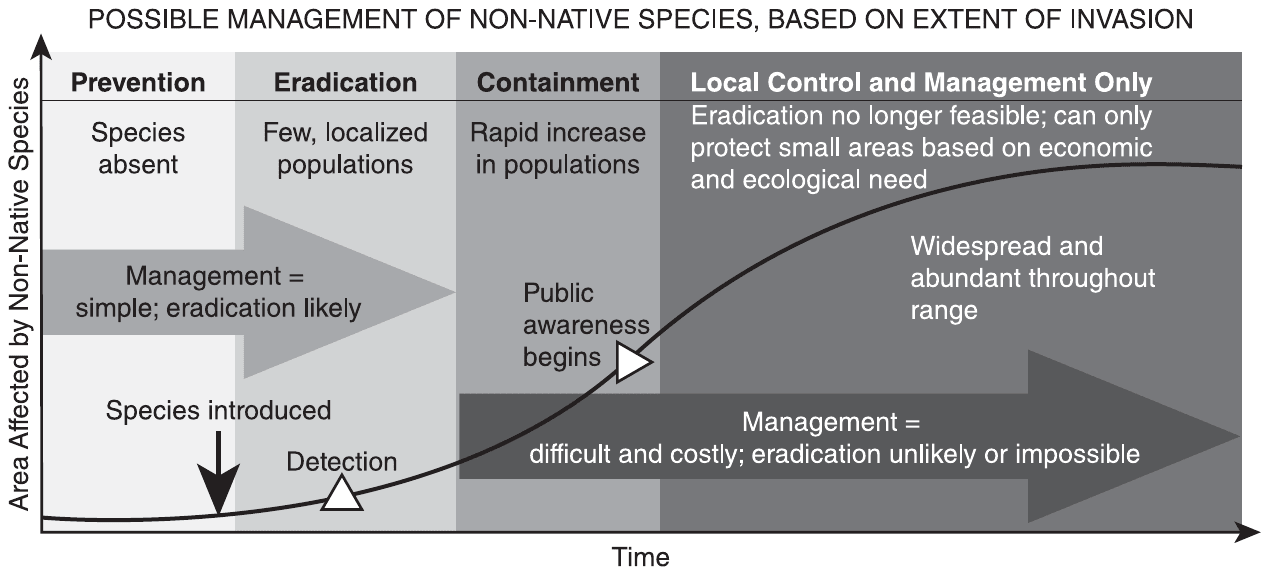
1stymie: hinder or interfere with
Question
Which sentence from the excerpt supports the conclusion that Elton’s “militaristic ‘invasion’ metaphor” (paragraph 1) has influenced scientific understanding of non-native species?
- A“Among [Olden’s] findings: a substantial number of them said they would immediately eradicate a hypothetical non-native forest plant, even if it were shown to have no effect on the forest.” (paragraph 5)
- B“Regardless of what we label them, conservationists will be reluctant to remove them from their new environs—to do so would stymie their chances of adapting to the warmer future we’re creating.” (paragraph 8)
- C“A project to rip out and poison the spartina—which grows in dense swaths that exclude many other shorebirds—saw clapper rail numbers go tumbling downward.” (paragraph 10)
- D“In some cases we can best serve biodiversity by leaving the non-natives alone or even—brace yourself, now—introducing them on purpose.” (paragraph 14)
Show the answer
Correct answer: A
The question asks which sentence from the excerpt supports the conclusion that Elton’s “militaristic ‘invasion’ metaphor” (paragraph 1) has influenced scientific understanding of non-native species.
A. CORRECT. This sentence shows that of the 2,000 ecologists Olden polled, many said they think it is right to “immediately eradicate” non-native plants even if they are demonstrably harmless in their new environment. The response of these ecologists supports that Elton’s metaphor discussed in paragraph 1 has influenced scientific understanding.
B. Incorrect. Rather than supporting the idea that the militaristic metaphor has influenced scientists, this sentence shows that conservationists, at any rate, are happy to let non-native species thrive wherever they can, given global warming.
C. Incorrect. While this sentence does refer to efforts to eradicate a non-native species, the main point of it is that these efforts ended up harming a native species (the clapper rail shorebird).
D. Incorrect. In contrast to supporting the idea that the militaristic invasion metaphor has influenced scientific understanding of non-native species, this sentence puts forth the bold idea of treating non-native species as something to be welcomed.
Question analysis
This evidence question asks which sentence from an opinion article about non-native species supports the conclusion that ecologist Charles Elton's war-like “invasion” metaphor has shaped how scientists think. Students must work out what attitude the metaphor implies and then judge which quotation shows that attitude at work in science.
- Grade level
- Grade 8 reading and task
- Compared with grade 7
- At grade 7 Finding evidence for a stated conclusion is grade 7 work. This conclusion is abstract, about a metaphor's influence on thinking, and the vocabulary, such as eradicate and environs, adds load, but the choices are fairly distinct.
- Estimated difficulty
- Moderate: several steps, or a close reading with one strong distractor.
- Thinking it demands
- Depth of knowledge 2, skills and concepts · mainly evaluate
- What makes it hard
- Reading between the lines moderate
- Hard words minor
- Evidence
- Answered from several paragraphs or stanzas
- Reading level
- Passage: about grade 11, 815 words; question and choices: about grade 16, 135 words.
- Corrected from the DOE handbook
- A wording slip in the explanation was corrected.
- Students, last 30 days
- Not enough answers yet to show (it takes 10).
Why it is hard, traps and wrong answers (shows the answer)
Why it is hard
The conclusion is abstract, that a figure of speech shaped how scientists think, so the student has to translate it into behavior: treating every non-native as an enemy to destroy. The spartina sentence describes exactly that kind of attack, which makes it tempting, but its point is the harm the attack did to a native bird. Two other sentences show conservationists and the author moving away from the invasion view, the opposite of what is asked.
Reading between the lines moderate Working it out
The right sentence never mentions Elton or war; eradicating a plant even when it is “shown to have no effect” must be recognized as the invasion mindset, which Olden calls “guilty even when proven innocent”. (Graesser, Singer & Trabasso, 1994; Kintsch, 1998)
Hard words minor Understanding the question
“Militaristic”, “eradicate”, “environs” and “stymie” all appear in the stem or the choices, and only “stymie” is footnoted. (Perfetti, 2007; Freedle & Kostin, 1993)
Strategy: Work out what attitude the invasion metaphor encourages toward non-native species, then test each sentence for evidence that scientists hold that attitude.
Traps
- Supports only part of the claim: In a question about evidence: a line that backs one half of the claim but not the other, or a related point rather than the claim itself.
The wrong answers, classified
B Supports only part of the claim (King et al., 2004; Thissen, Steinberg & Fitzpatrick, 1989)
Picks a sentence about labels and conservationists, but it says they would hesitate to remove species moving with the climate, the opposite of the war-like attitude in question.
C Supports only part of the claim (King et al., 2004; Thissen, Steinberg & Fitzpatrick, 1989)
Spots a war-like campaign, ripping out and poisoning spartina, but the sentence's point is that removal hurt the clapper rail, and it says nothing about how scientists think.
D Supports only part of the claim (King et al., 2004; Thissen, Steinberg & Fitzpatrick, 1989)
Chooses the author's case for leaving non-natives alone or even introducing them, which shows thinking turning against the invasion metaphor, not shaped by it.
What was corrected from the DOE handbook, and why
- Explanation: The handbook reads “many said they think it is right to “immediately eradicate” non-native species plants.” Paragraph 5 is about “a hypothetical non-native forest plant,” so the explanation now reads “non-native plants.”
Working it out, step by step
Unpack the conclusion
A metaphor describes one thing as if it were another. In paragraph 1, Elton called the spread of non-native species an “invasion,” as if they were an enemy army. Militaristic means having to do with war. So the conclusion says this war-like way of talking has shaped how scientists think about non-native species.
Picture that way of thinking
If you see a species as an invader, you treat it as an enemy. You want to get rid of it, whether or not it does any harm. So look for a sentence that shows scientists thinking this way.
Find the scientists’ answers
Paragraph 5 describes a poll of nearly 2,000 ecologists, scientists who study living things and where they live. Many said they would “immediately eradicate,” or wipe out, a non-native plant. They would do it “even if it were shown to have no effect on the forest.” The plant would do no harm, yet they would destroy it. Olden calls this “guilty even when proven innocent.”
Check each choice
- A fits: scientists would destroy a harmless plant just because it is non-native, which is the invasion way of thinking.
- B is wrong because conservationists being reluctant, or unwilling, to remove species is the opposite attitude.
- C is wrong because its point is that removing the grass hurt a native bird, not what scientists believe.
- D is wrong because the author argues for leaving non-natives alone, which goes against the invasion idea.
Watch out: C describes an attack on a plant, so it sounds war-like. But it tells what happened, not how scientists think.
Choose the answer
Only A shows scientists treating a non-native species as an enemy, even when it is harmless. So the answer is A.
Why this answer and not the closest wrong one
C comes closest, because ripping out and poisoning a plant looks like the war the metaphor describes. But the sentence reports that this harmed the clapper rail. It doesn’t show what scientists believe. A shows many ecologists ready to destroy even a harmless plant, which is the invasion way of thinking at work.
More questions like this
The original DOE question
The passage “Excerpt from “It’s Time to Stop Thinking That All Non-Native Species Are Evil”” as printed (pages 68–70)
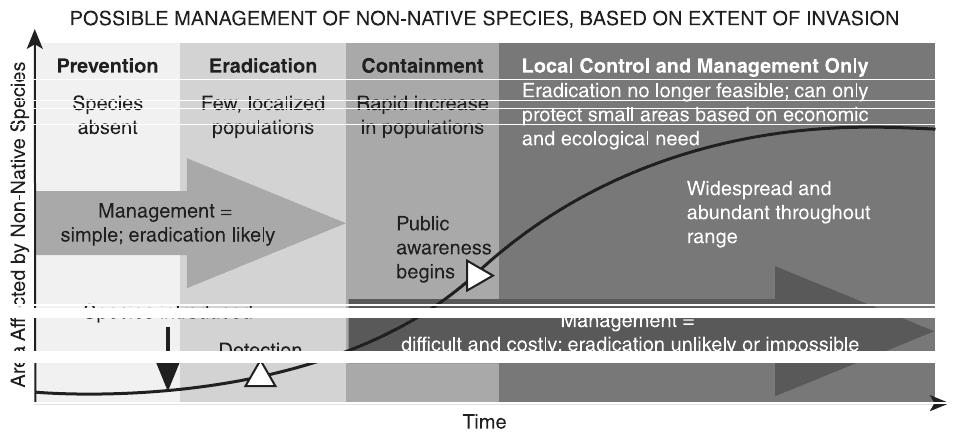
Question 50 of 120
2024 Test A English, question 52Uses the passage above: “Excerpt from “It’s Time to Stop Thinking That All Non-Native Species Are Evil””.
Question
Which detail provides the most relevant support for the claim that “climate change is making it harder even to decide who the invaders are” (paragraph 7)?
- Athe mention in paragraph 8 of non-native species that are forced to seek new habitats
- Bthe acknowledgment in paragraph 9 that non-native species include many domestic crops
- Cthe description in paragraph 11 of the interactions between native and non-native species
- Dthe account in paragraph 13 of an ecologist who changed his beliefs about non-native species
Show the answer
Correct answer: A
The question asks which detail provides the most relevant support for the claim that “climate change is making it harder even to decide who the invaders are” (paragraph 7).
A. CORRECT. The fact that many plants and animals have no choice but to seek out “climate conditions they can tolerate” (paragraph 8) makes it much harder to decide whether to call these species invaders.
B. Incorrect. The fact that many domestic crops are non-native species has nothing to do with climate change affecting our discernment of which species are invaders.
C. Incorrect. The description in paragraph 11 of native and non-native species interacting never suggests that climate change is a factor in these interactions and never suggests that climate change muddies our understanding of which species is native and which is non-native.
D. Incorrect. While the example of Mark Davis so thoroughly changing his beliefs about non-native species is a powerful one, the role that climate change might have played in this reversal is never discussed.
Question analysis
Here students choose the detail that gives the most relevant support to the claim that climate change is making it harder even to decide which species are invaders, in an article rethinking non-native species. Each choice names a paragraph, and the article gives several different reasons to question the label, so every detail must be checked against the whole claim.
- Grade level
- Grade 7 reading and task
- Compared with grade 7
- Below grade 7 Judging which detail supports a claim is grade 7 argument work, but here the choices name their paragraphs, the claim is short and specific, and only one key idea must be matched, so the task is lighter than typical.
- Estimated difficulty
- Straightforward: two steps or one careful reading.
- Thinking it demands
- Depth of knowledge 2, skills and concepts · mainly evaluate
- What makes it hard
- Evidence
- Answered from one paragraph or stanza
- Reading level
- Passage: about grade 11, 815 words; question and choices: about grade 11, 76 words.
- Students, last 30 days
- Not enough answers yet to show (it takes 10).
Why it is hard, traps and wrong answers (shows the answer)
Why it is hard
The claim has two parts, climate change as the cause and blurred labels as the effect, and every wrong detail muddies the word “invader” without any help from the climate. Crops, helpful partnerships and a converted invasion biologist all complicate the label, so a student who checks only the effect finds four plausible answers. Only paragraph 8 talks about a warming planet.
Every choice must be checked minor Choosing the answer
The choices describe paragraphs instead of quoting them, so each of paragraphs 8, 9, 11 and 13 must be reread for a link to climate. (Embretson & Wetzel, 1987)
The right answer is reworded minor Choosing the answer
The right choice says “forced to seek new habitats” where paragraph 8 says species are moving “toward the poles or up mountainsides in search of climate conditions they can tolerate”. (Freedle & Kostin, 1993; Kirsch & Mosenthal, 1990)
Strategy: Name the cause and the effect in the claim, then test each detail for both; a detail that fits only one part is not the most relevant support.
Traps
- Supports only part of the claim: In a question about evidence: a line that backs one half of the claim but not the other, or a related point rather than the claim itself.
The wrong answers, classified
B Supports only part of the claim (King et al., 2004; Thissen, Steinberg & Fitzpatrick, 1989)
Points to crops as non-natives people like, which complicates the label “invader”, but paragraph 9 never connects them to a changing climate.
C Supports only part of the claim (King et al., 2004; Thissen, Steinberg & Fitzpatrick, 1989)
Picks the helpful pairings of native and non-native species in paragraph 11, which blur good and bad but have nothing to do with a warming planet.
D Supports only part of the claim (King et al., 2004; Thissen, Steinberg & Fitzpatrick, 1989)
Chooses Mark Davis's turn away from invasion biology, a striking change of mind that nothing in paragraph 13 ties to climate change.
Working it out, step by step
Split the claim into two parts
This asks for the detail that best supports a claim. The claim has a cause and an effect. The cause is climate change. The effect is that it is harder to tell which species are invaders. The best support must connect both parts.
Find where climate comes up
Paragraph 8 comes right after the claim, and it talks about “a warming planet.” Plants and animals “are already moving toward the poles or up mountainsides in search of climate conditions they can tolerate.” To tolerate means to be able to live with. As places get hotter, many species move to cooler ones.
See why the labels get harder
When a species moves to a new place, it is not native there. But it didn’t really invade. Heat pushed it out of its old home. So scientists ask whether such species should be called invasive “in their new homes.” Climate change blurs the line between native and invader.
Check each choice
- A fits: species forced to move by the climate link the cause to the effect.
- B is wrong because crops are non-natives people like, but paragraph 9 never mentions climate.
- C is wrong because the helpful pairings in paragraph 11 have nothing to do with climate change.
- D is wrong because nothing ties Mark Davis’s change of mind to a warming planet.
Watch out: B, C and D all make the word invader less clear. But only A shows climate change doing it.
Choose the answer
Only A shows climate change making the word invader hard to apply. So the answer is A.
Why this answer and not the closest wrong one
B comes closest, since crops are non-natives we welcome, and that does complicate the word invader. But paragraph 9 says nothing about climate. A has both parts of the claim: a warming planet, and species that end up in new homes where the old labels don’t fit.
More questions like this
The original DOE question
Question 51 of 120
2024 Test A English, question 53Uses the passage above: “Excerpt from “It’s Time to Stop Thinking That All Non-Native Species Are Evil””.
Question
The author’s use of cause and effect in paragraphs 10–11 mainly emphasizes the idea that
- Asome non-native species have helped their environments while others have had harmful impacts.
- Battempts to remove non-native species have seldom produced desired results.
- Csome endangered native species have flourished because of the presence of non-native species.
- Dinteractions between endangered native species and non-native species must be carefully monitored.
Show the answer
Correct answer: C
The question asks what the author’s use of cause and effect in paragraphs 10–11 mainly emphasizes.
A. Incorrect. The examples of cause and effect discussed in paragraphs 10–11, such as the spartina grass helping the clapper rail and the Japanese white-eye bird pollinating Hawaiian flowers, are all instances in which non-native species have helped their new environments.
B. Incorrect. While paragraph 10 does mention that efforts to eradicate the non-native spartina grass hurt the native clapper rail shorebird, the main emphasis in both paragraphs 10–11 is on the fact that certain non-native species have helped native species.
C. CORRECT. Paragraphs 10–11 focus on several examples of non-native species that have helped endangered native species flourish: non-native spartina grass providing “important habitat for the endangered California clapper rail” (paragraph 10), non-native tamarisk shrubs providing nesting places for the endangered southwestern willow flycatcher (paragraph 11), and the non-native Japanese white-eye bird pollinating Hawaiian flowers (paragraph 11).
D. Incorrect. While paragraphs 10–11 describe several interactions between non-native and native species, they never discuss monitoring these interactions.
Question analysis
This text-structure question asks what the cause-and-effect examples in two paragraphs of an article about non-native species mainly emphasize. The paragraphs describe a shorebird, a flycatcher and Hawaiian flowers, and students must decide what the examples have in common rather than fixing on any one of them.
- Grade level
- Grade 8 reading and task
- Compared with grade 7
- Above grade 7 Analyzing what a cause-and-effect structure emphasizes is grade 7 work, but these examples involve unfamiliar species and endangered status, and more than one choice is partly supported by the paragraphs, which raises the demand above typical.
- Estimated difficulty
- Hard: combines ideas, needs a plan, and has more than one tempting wrong answer.
- Thinking it demands
- Depth of knowledge 3, strategic thinking · mainly analyze
- What makes it hard
- A very close wrong answer major
- Reading between the lines moderate
- An unfamiliar subject minor
- Evidence
- Answered from several paragraphs or stanzas
- Reading level
- Passage: about grade 11, 815 words; question and choices: about grade 11, 62 words.
- Students, last 30 days
- Not enough answers yet to show (it takes 10).
Why it is hard, traps and wrong answers (shows the answer)
Why it is hard
The paragraphs mention harm as well as help, so a balanced statement about both looks accurate and even fair-minded. What the cause-and-effect pairs stress, though, is endangered natives depending on non-natives, and the right answer captures that while overstating it, since a bird whose numbers held up only with spartina's help can hardly be said to have flourished. Students must prefer the statement of the main emphasis to one that is partly supported but off the point.
A very close wrong answer major Choosing the answer
The right choice and the help-and-harm choice both say non-natives have aided their surroundings; they part on harm, which the paragraphs do mention, spartina crowding out shorebirds and other non-natives killing Hawaii's pollinators, but only in passing. (Embretson & Wetzel, 1987; Gorin & Embretson, 2006; Ascalon et al., 2007)
Reading between the lines moderate Working it out
Paragraph 10 states its cause and effect backwards, removing spartina sent clapper rail numbers “tumbling downward”, and the student must turn that around into the grass's presence helping the bird. (Graesser, Singer & Trabasso, 1994; Kintsch, 1998)
An unfamiliar subject minor Understanding the question
Five unfamiliar species crowd two paragraphs, spartina grass, the California clapper rail, tamarisk shrubs, the southwestern willow flycatcher and the Japanese white-eye, and each one's role must be kept straight. (Recht & Leslie, 1988; Kintsch, 1998)
Strategy: List each cause-and-effect pair in paragraphs 10 and 11, the species involved and what happened to them, then pick the statement that holds for the examples taken together.
Traps
- Too narrow: A single detail offered as the central idea or a summary, or a summary that keeps minor details and leaves out an essential part.
- Too broad or too strong: A choice overstates, generalizes, or uses absolute words the text does not support.
- Outside knowledge: A choice is plausible in the real world but not supported by this text.
The wrong answers, classified
A Too narrow (King et al., 2004)
Accurately notes helpful and harmful non-natives, but the harm is mentioned only in passing, and it leaves out what every example stresses, endangered natives depending on non-natives.
B Too broad or too strong (King et al., 2004)
Generalizes from the single spartina project in paragraph 10 to removal attempts in general, a “seldom” claim that neither paragraph makes.
D Outside knowledge (King et al., 2004; Recht & Leslie, 1988)
Adds a sensible-sounding call for careful monitoring, the kind of advice scientists often give, but neither paragraph says anything about watching over these relationships.
Working it out, step by step
Know what the question asks
In a cause-and-effect pattern, one thing makes another happen. You need the main idea that the causes and effects in paragraphs 10 and 11 stress. Start by listing each pair.
List each cause and effect
- Paragraph 10: non-native spartina grass gives the endangered clapper rail a home, so when people ripped out the grass, clapper rail numbers went “tumbling downward.”
- Paragraph 11: the endangered willow flycatcher nests in non-native tamarisk shrubs.
- Paragraph 11: native Hawaiian flowers are now pollinated by a non-native bird, the Japanese white-eye.
Find the common thread
Endangered means at risk of dying out. Pollinated means a bird or bug carries pollen between flowers so they can make seeds. In every pair, a native species depends on a non-native one. The newcomer gives it a home, a place to nest or a pollinator. Two of the natives, the clapper rail and the flycatcher, are endangered. So the paragraphs stress that some endangered natives do better because non-natives are there.
Check each choice
- C fits: some endangered natives have “flourished,” or done well, because non-natives are present.
- A is wrong because harm comes up only in passing, while every example stresses a native getting help.
- B is wrong because one removal project is not enough to say removal “seldom” works.
- D is wrong because the paragraphs never mention monitoring, or watching over, these relationships.
Watch out: The paragraphs do mention harm. Spartina crowds out some other shorebirds, and other non-natives wiped out Hawaii’s native pollinators. So A sounds balanced, but it misses the main point.
Choose the answer
The causes and effects show struggling natives, two of them endangered, helped by non-natives. So the answer is C.
Why this answer and not the closest wrong one
A comes closest, because the paragraphs mention harm as well as help. But the harm is only a side note. Every cause and effect shows a native relying on a non-native, and two of those natives are endangered birds. C names that main point, even though “flourished” is a strong word for birds that are still endangered.
More questions like this
The original DOE question
Question 52 of 120
2024 Test A English, question 54Uses the passage above: “Excerpt from “It’s Time to Stop Thinking That All Non-Native Species Are Evil””.
Question
Which sentence from the excerpt supports the idea that some species are able to adjust to change?
- A“Native gardens have become increasingly popular, both as ways to celebrate the unique flora of each region and as tiny hot spots of diversity.” (paragraph 3)
- B“Many native (and beautiful) Hawaiian flowers are now pollinated by the Japanese white-eye bird—because the native pollinators have been driven extinct by other non-native species.” (paragraph 11)
- C“After all, nativeness is just one environmental value, and arguably not as important as preventing extinctions and preserving biodiversity.” (paragraph 14)
- D“The islands lost their own large tortoises, and the fruiting plants that formerly had their seeds moved around by these fruit-loving reptiles have been on the decline.” (paragraph 15)
Show the answer
Correct answer: B
The question asks which sentence from the excerpt supports the idea that some species are able to adjust to change.
A. Incorrect. This sentence discusses native gardens, featuring native species, which presumably have no need to adjust to change.
B. CORRECT. This sentence demonstrates that some species—in this case, Hawaiian flowers—have adapted well to change: the flowers thrive thanks to new pollinators.
C. Incorrect. This sentence focuses on the importance of “preventing extinctions and preserving biodiversity” but does not address the fact that being able to adjust to change is one thing that helps achieve those goals.
D. Incorrect. Far from demonstrating that some species can adjust to change, this sentence discusses species that were not adjusting to the loss of large tortoises and were therefore “on the decline.”
Question analysis
Using an article that argues not every non-native species is harmful, this evidence question asks students to pick the sentence showing that some species are able to adjust to change. Students must decide what adjusting to change would look like in nature, then find a quotation that actually shows a species doing it.
- NYS standards
- 7R1 textual evidence and inferences
- Grade level
- Grade 7 reading and task
- Compared with grade 7
- At grade 7 Selecting a sentence that supports an idea is typical grade 7 evidence work. The quotations are labeled, but the idea is stated generally and must be recognized inside a specific ecological example, a small inference that keeps the item at grade level.
- Estimated difficulty
- Moderate: several steps, or a close reading with one strong distractor.
- Thinking it demands
- Depth of knowledge 2, skills and concepts · mainly evaluate
- What makes it hard
- Reading between the lines moderate
- A very close wrong answer moderate
- Evidence
- Answered from one sentence or line
- Reading level
- Passage: about grade 11, 815 words; question and choices: about grade 14, 117 words.
- Students, last 30 days
- Not enough answers yet to show (it takes 10).
Why it is hard, traps and wrong answers (shows the answer)
Why it is hard
The idea is general and every choice is specific, so the student must recognize adjustment inside an ecological example. The Mauritius sentence is the trap: the paragraph it comes from ends with a new tortoise taking over, which is adjustment, but the quoted sentence stops at the decline. Judging only the words quoted, and asking whether a species carried on after a change, separates the two.
Reading between the lines moderate Working it out
The right sentence never says “adjust”; Hawaiian flowers now pollinated by a newcomer after their native pollinators died out must be recognized as species coping with a change. (Graesser, Singer & Trabasso, 1994; Kintsch, 1998)
A very close wrong answer moderate Choosing the answer
The Hawaiian sentence and the Mauritius sentence both describe plants losing the animals that served them; they part on the outcome, a new pollinator or a decline. (Embretson & Wetzel, 1987; Gorin & Embretson, 2006; Ascalon et al., 2007)
Strategy: For each quotation, ask whether a species faces a change and whether the sentence shows it carrying on successfully; judge only the words quoted.
Traps
- Supports only part of the claim: In a question about evidence: a line that backs one half of the claim but not the other, or a related point rather than the claim itself.
- True but not the answer: A choice says something accurate about the text that does not answer this question.
The wrong answers, classified
A True but not the answer (King et al., 2004; Embretson & Wetzel, 1987)
Picks the popularity of native gardens, which is about what people plant and celebrate, not about any species coping with a change in its world.
C True but not the answer (King et al., 2004; Embretson & Wetzel, 1987)
Chooses the author's ranking of nativeness below preventing extinctions, a statement of values that shows no species adapting to anything.
D Supports only part of the claim (King et al., 2004; Thissen, Steinberg & Fitzpatrick, 1989)
Remembers that a new tortoise later took over seed-spreading on Mauritius, but the quoted sentence shows only the change, plants declining after their tortoises vanished, not any adjustment.
Working it out, step by step
Know what the question asks
To adjust to change means to keep going when something important in your world changes. You need a sentence that shows a species facing a change and carrying on. Judge only the words in each quoted sentence.
Look for a change
Choice B says the native pollinators of some Hawaiian flowers “have been driven extinct.” Extinct means gone forever. Pollinators are animals that carry pollen between flowers so the plants can make seeds. Losing them is a huge change for the flowers.
Look for the adjustment
The same sentence says the flowers “are now pollinated by the Japanese white-eye bird.” A new bird does the job the old pollinators used to do. So the flowers carried on after the change. That is adjusting.
Check each choice
- B fits: the flowers lost their pollinators and gained a new one.
- A is wrong because native gardens are about what people like to plant, and no species adjusts to anything.
- C is wrong because it states the author’s values and shows no species at all.
- D is wrong because the plants “have been on the decline,” which means they are getting fewer, not adjusting.
Watch out: Later in paragraph 15, a new tortoise takes over some of the lost tortoises’ work. But the sentence in D stops at the decline.
Choose the answer
Only B shows a species carrying on after a big change. So the answer is B.
Why this answer and not the closest wrong one
D comes closest, because it also shows plants losing the animals that helped them. But D’s sentence ends with the plants in decline. B’s sentence goes further: a new bird now does the work, so the flowers carry on. That is a species adjusting to change.
More questions like this
The original DOE question
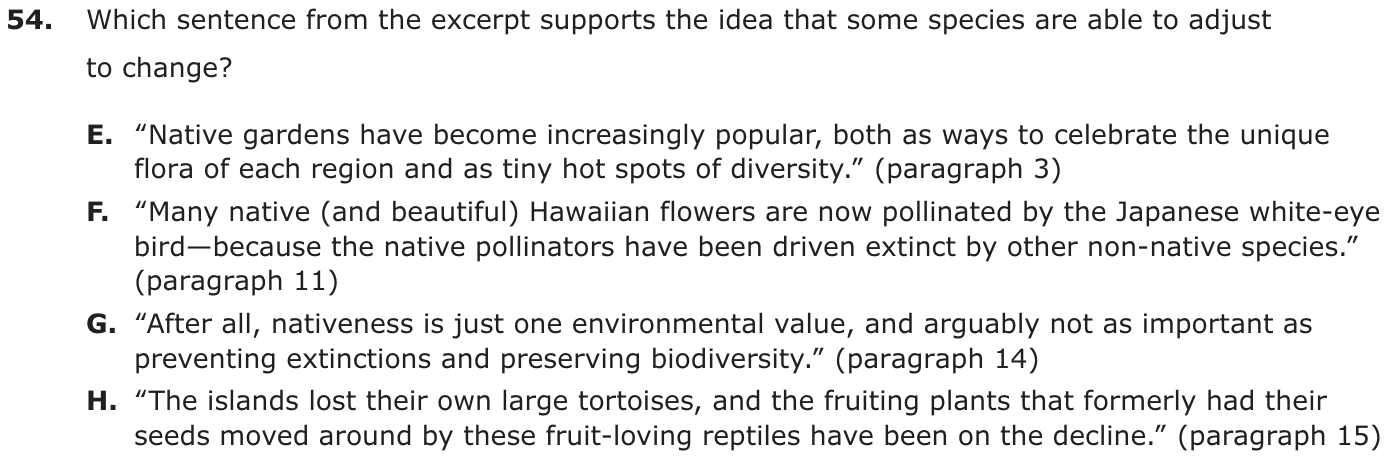
Question 53 of 120
2024 Test A English, question 55Uses the passage above: “Excerpt from “It’s Time to Stop Thinking That All Non-Native Species Are Evil””.
Question
The details in the section “A Good Thing, Not the Only Thing” convey a central idea of the excerpt by suggesting that
- Asome non-native species can replace native species that are unable to survive on their own.
- Bdecisions about whether to keep non-native species should be considered on an individual basis.
- Cthe scientists who study rapidly changing ecosystems agree that non-native species enhance biodiversity.
- Da natural habitat that is healthy should be able to support a blend of native and non-native species.
Show the answer
Correct answer: B
The question asks how the details in the section “A Good Thing, Not the Only Thing” convey a central idea of the excerpt.
A. Incorrect. While paragraph 15 does discuss introducing non-native Aldabra tortoises to replace native tortoises that no longer exist, the real point of this section is to show that non-native species can sometimes help support native species that still exist but are struggling. In this case, the Aldabra tortoises are now moving seeds around for the fruiting plants on the islands where the tortoises have been introduced.
B. CORRECT. This section discusses situations in which non-native species should be kept (as in the example of the Aldabra tortoises in paragraph 15) but also asserts that “most of the time . . . conserving species still means focusing on supporting them in their historical habitats, planting natives and removing non-natives” (paragraph 16). This section makes the point that the issue of non-natives needs to be considered on a case-by-case basis.
C. Incorrect. This section does not claim that non-native species always or even usually enhance biodiversity; rather, it states that “in some cases we can best serve biodiversity by leaving the non-natives alone or even—brace yourself, now—introducing them on purpose” (paragraph 14), later adding that “most of the time . . . conserving species still means focusing on supporting them in their historical habitats, planting natives and removing non-natives” (paragraph 16).
D. Incorrect. While the section happens to give a good example of a habitat that supports both native and non-native species (the islands of Mauritius), it never suggests that being able to do so is a defining characteristic of healthy habitats.
Question analysis
This central-idea question asks how the details in the final section of an article on non-native species, titled “A Good Thing, Not the Only Thing,” convey a central idea of the excerpt. Students must sum up the section as a whole, including its example of a tortoise brought to the islands of Mauritius, and match it to the article's larger argument.
- Grade level
- Grade 8 reading and task
- Compared with grade 7
- Above grade 7 Explaining how a section conveys a central idea is grade 7 work, but this section mixes an argument, an example and a closing paragraph, and the choices differ in how far they generalize from it, which demands more than typical.
- Estimated difficulty
- Hard: combines ideas, needs a plan, and has more than one tempting wrong answer.
- Thinking it demands
- Depth of knowledge 3, strategic thinking · mainly understand
- What makes it hard
- The right answer is reworded moderate
- Evidence in several places moderate
- Evidence
- Answered from several paragraphs or stanzas
- Reading level
- Passage: about grade 11, 815 words; question and choices: about grade 11, 82 words.
- Students, last 30 days
- Not enough answers yet to show (it takes 10).
Why it is hard, traps and wrong answers (shows the answer)
Why it is hard
The section's most memorable content is an example, the Aldabra tortoise doing the work of the islands' lost tortoises, and a choice built on it is the strongest pull. The central idea sits instead in the qualifiers at the start and end of the section: some cases favor non-natives, most still call for removing them. Students who summarize all three paragraphs in a sentence, including the last, arrive at the case-by-case reading.
The right answer is reworded moderate Choosing the answer
The right choice's “on an individual basis” appears nowhere in the section, while the wrong choices echo it: a non-native standing in for natives, “biodiversity”, natives alongside non-natives. (Freedle & Kostin, 1993; Kirsch & Mosenthal, 1990)
Evidence in several places moderate Working it out
The case-by-case idea comes only from joining paragraph 14's “In some cases” to paragraph 16's “Most of the time” and “where it is feasible and important to us”. (Kirsch & Mosenthal, 1990; Gorin & Embretson, 2006)
Strategy: Sum up the section's three paragraphs in one sentence of your own, including its example and its final paragraph, then compare that sentence with each choice.
Traps
- Too narrow: A single detail offered as the central idea or a summary, or a summary that keeps minor details and leaves out an essential part.
- Too broad or too strong: A choice overstates, generalizes, or uses absolute words the text does not support.
- Reads too much in: A reasonable-sounding conclusion that goes further than the text allows.
The wrong answers, classified
A Too narrow (King et al., 2004)
Builds on the Aldabra tortoise standing in for Mauritius's lost tortoises, a single example, and misses the closing point that most conservation still means removing non-natives.
C Too broad or too strong (King et al., 2004)
Turns “In some cases” into a consensus that non-natives enhance biodiversity, though the section limits the claim and the article shows ecologists divided over it.
D Reads too much in (Graesser, Singer & Trabasso, 1994)
Draws a rule about healthy habitats from the Mauritius example, though the section never defines a healthy habitat or says it should hold a mix of species.
Working it out, step by step
Know what the question asks
A section is a part of an article under its own heading. This one runs from paragraph 14 to paragraph 16. You need to sum up the whole section, including its last paragraph. Then match that summary to a central idea.
Read paragraph 14
It says that “in some cases” we help nature most “by leaving the non-natives alone.” We might even bring them in “on purpose.” The words “in some cases” are the key. They mean sometimes, not always.
Read the example and the ending
Paragraph 15 gives an example. A non-native tortoise was brought to Mauritius to spread the seeds of fruiting plants. Then paragraph 16 says that “most of the time,” saving species still means “planting natives and removing non-natives.” We should do that “where it is feasible and important to us.” Feasible means possible.
Put the section together
Sometimes it is best to keep a non-native species. Most of the time it is best to remove it. So each case has to be judged on its own. That is what “on an individual basis” means.
Check each choice
- B fits: deciding case by case matches both “in some cases” and “most of the time.”
- A is wrong because the tortoise is one example, and the section ends by saying removal is still the usual choice.
- C is wrong because the section never says scientists agree, and “in some cases” is far from always.
- D is wrong because the section never says what a healthy habitat should hold.
Watch out: A is built on the section’s most memorable detail. But the main idea comes from the words that limit the claim.
Choose the answer
The section says to keep non-natives in some cases and remove them in others. So the answer is B.
Why this answer and not the closest wrong one
A comes closest, because the Aldabra tortoise really does take over work the lost tortoises once did. But that is one case. The section ends by saying that most of the time we still remove non-natives. B covers both sides: some cases call for keeping them, and others call for removing them.
More questions like this
The original DOE question
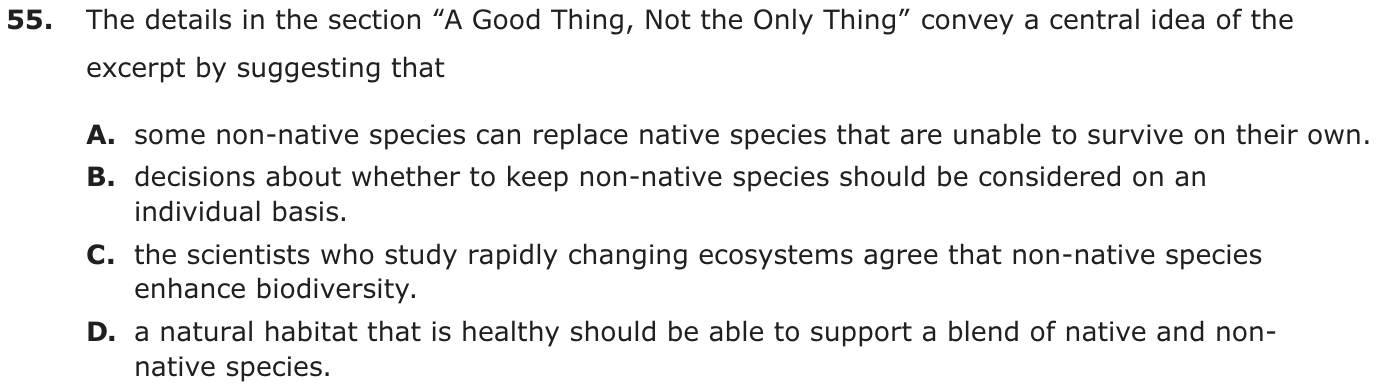
Question 54 of 120
2024 Test A English, question 56Uses the passage above: “Excerpt from “It’s Time to Stop Thinking That All Non-Native Species Are Evil””.
Question
Climate change has affected efforts to manage invasive species mainly by causing ecologists to
- Acall upon the public to be more tolerant of the presence of non-native species.
- Badmit that past attempts to eliminate non-native species have damaged the environment.
- Cfind ways of ensuring that native species are not harmed by the arrival of new species.
- Dacknowledge that it is not realistic for some species to remain in their native habitats.
Show the answer
Correct answer: D
This question asks how climate change has mainly affected efforts to manage invasive species.
A. Incorrect. While ecologists are now arguing for some non-native species to be left alone (paragraph 13), they are arguing specifically on behalf of “well-behaved” non-native species (paragraph 12), not non-native species in general.
B. Incorrect. While paragraph 10 describes how removing a non-native species negatively affected a native species, the excerpt never discusses the idea that attempts to eliminate non-native species might have damaged the environment.
C. Incorrect. While the excerpt refers to climate change causing plants and animals to move to more tolerable environments (paragraph 8), it does not specifically discuss ways to ensure that the arrival of these non-native species does not harm native species.
D. CORRECT. As paragraph 8 says, “plants and animals are already moving toward the poles” because of climate change, and ecologists recognize that those species need to do so to adapt “to the warmer future we’re creating.”
Question analysis
This question asks how climate change has mainly affected efforts to manage invasive species, according to an article arguing that not all non-native species are harmful. Students must locate the article's brief discussion of a warming planet and recognize its point when it is restated in different words.
- Grade level
- Grade 8 reading and task
- Compared with grade 7
- At grade 7 Tracing how one factor shapes an idea is grade 7 work. The relevant discussion is a single paragraph, but it is built from long questions rather than statements, and the choices restate it abstractly, so the item sits at a typical grade 7 level.
- Estimated difficulty
- Moderate: several steps, or a close reading with one strong distractor.
- Thinking it demands
- Depth of knowledge 2, skills and concepts · mainly understand
- What makes it hard
- The right answer is reworded moderate
- Complex sentences minor
- Reading between the lines minor
- Evidence
- Answered from several paragraphs or stanzas
- Reading level
- Passage: about grade 11, 815 words; question and choices: about grade 10, 71 words.
- Students, last 30 days
- Not enough answers yet to show (it takes 10).
Why it is hard, traps and wrong answers (shows the answer)
Why it is hard
Climate change is discussed in only one paragraph, and that paragraph mostly asks questions, so the student has to work out what the scientists concluded from what they wondered. The wrong choices borrow ideas from later in the article, leaving well-behaved exotics alone and the spartina project, or bring in a common conservation goal, and none of them is tied to a warming planet. Finding paragraph 8 first makes the rest straightforward.
The right answer is reworded moderate Choosing the answer
The right choice's “not realistic for some species to remain in their native habitats” shares no words with paragraph 8, which speaks of plants and animals “moving toward the poles or up mountainsides”. (Freedle & Kostin, 1993; Kirsch & Mosenthal, 1990)
Complex sentences minor Understanding the question
Paragraph 8 makes its point through questions, the first broken by “scientists at the symposium wondered”, so what ecologists accept has to be pulled out of what they ask. (Abedi & Lord, 2001; Freedle & Kostin, 1993; Messick, 1989)
Reading between the lines minor Working it out
The acknowledgment is implied: reluctance to remove species that would otherwise lose their chance of “adapting to the warmer future” shows that staying put is no longer an option. (Graesser, Singer & Trabasso, 1994; Kintsch, 1998)
Strategy: Find where the article actually discusses a warming planet and what the scientists there are wondering about, then match a choice to that discussion.
Traps
- Wrong part of the text: A choice is true of another paragraph, stanza or speaker than the one asked about.
- Too broad or too strong: A choice overstates, generalizes, or uses absolute words the text does not support.
- Outside knowledge: A choice is plausible in the real world but not supported by this text.
The wrong answers, classified
A Wrong part of the text (Kirsch & Mosenthal, 1990)
Borrows paragraph 13's plea to leave non-natives alone, which concerns well-behaved exotics and is made within the field, not to the public, and has no link to climate.
B Too broad or too strong (King et al., 2004)
Stretches one failed removal, the spartina project of paragraph 10, into ecologists admitting that past removals harmed the environment, and that example has nothing to do with climate.
C Outside knowledge (King et al., 2004; Recht & Leslie, 1988)
Assumes the rule the article questions, that newcomers threaten natives, so protecting natives seems the obvious response, but paragraph 8 talks of letting moving species adapt.
Working it out, step by step
Know what the question asks
This asks how climate change has changed the way scientists handle non-native species. First find the part of the article that talks about climate. Then see what the scientists there accept.
Find the climate paragraph
Paragraphs 7 and 8 are about climate change. Paragraph 8 says that on “a warming planet,” plants and animals “are already moving toward the poles or up mountainsides.” They are looking for “climate conditions they can tolerate,” which means weather they can survive.
See what the scientists accept
Paragraph 8 says conservationists “will be reluctant to remove them.” Reluctant means unwilling. Removing them “would stymie” their “chances of adapting to the warmer future.” The footnote says stymie means to hinder, or hold back. In other words, scientists accept that these species can’t stay where they were. To survive, they have to move.
Check each choice
- D fits: ecologists admit that some species can’t realistically stay in their native homes.
- A is wrong because the call to leave non-natives alone in paragraphs 12 and 13 is about “well-behaved” ones, not climate.
- B is wrong because the one failed removal in paragraph 10 has nothing to do with climate.
- C is wrong because paragraph 8 talks about letting moving species adapt, not shielding natives from newcomers.
Watch out: A sounds close because it is also about putting up with non-natives. But it comes from a part of the article that never mentions climate.
Choose the answer
Climate change has made ecologists accept that some species must leave their old homes. So the answer is D.
Why this answer and not the closest wrong one
A comes closest, because the article does argue for leaving some non-natives alone. But that argument is about helpful newcomers, and it never mentions climate. Paragraphs 7 and 8 are where climate change comes up. There, scientists accept that many species must leave their old homes to survive, which is D.
More questions like this
The original DOE question

Question 55 of 120
2024 Test A English, question 57Uses the passage above: “Excerpt from “It’s Time to Stop Thinking That All Non-Native Species Are Evil””.
Question
How does the chart provide additional support for a central idea of the excerpt?
- Aby implying that the public becomes aware of non-native species only after removal is impossible
- Bby showing that the complete removal of non-native species is usually not achievable after a certain period of time
- Cby demonstrating why non-native species can be destructive if they are not removed from an area immediately
- Dby explaining how some conservation groups have approached the removal of non-native species
Show the answer
Correct answer: B
The question asks how the chart provides additional support for a central idea of the excerpt.
A. Incorrect. The chart indicates that the public tends to become aware of non-native species once eradication is “unlikely or impossible,” not strictly impossible. Furthermore, this idea is not a central idea of the excerpt.
B. CORRECT. The chart strongly suggests that once “rapid increase in populations” of non-native species has occurred, eradication will be “unlikely or impossible.”
C. Incorrect. While the chart does show that non-native species can eventually be impossible to eradicate, it never addresses the issue of how the non-native species might be destructive to their new environments.
D. Incorrect. The chart shows how non-native species become harder and harder to remove as their population grows but does not explain how any conservation groups have approached their removal.
Question analysis
This question asks how a chart titled “Possible Management of Non-Native Species, Based on Extent of Invasion” supports a central idea of an article arguing that not all non-native species are harmful. Students must read the chart's stages, labels and curve, then decide which statement the chart actually shows and which also fits the article's argument.
- Grade level
- Grade 8 reading and task
- Compared with grade 7
- At grade 7 Grade 7 students connect graphics to a text, but this chart packs four stages, two arrows, a curve and several labels into one figure, and its pattern must be linked to an argument made in words, demanding but within upper grade 7.
- Estimated difficulty
- Moderate: several steps, or a close reading with one strong distractor.
- Thinking it demands
- Depth of knowledge 2, skills and concepts · mainly analyze
- What makes it hard
- Reading a figure, table or graph moderate
- A very close wrong answer moderate
- Combines ideas minor
- Evidence
- Answered from the whole text
- Reading level
- Passage: about grade 11, 815 words; question and choices: about grade 12, 78 words.
- Students, last 30 days
- Not enough answers yet to show (it takes 10).
Why it is hard, traps and wrong answers (shows the answer)
Why it is hard
The chart is easy to read in outline, simple management on the left and costly, likely failed eradication on the right, and the right choice restates that contrast. The pull comes from the “Public awareness begins” marker, placed at the border of the stage where eradication is no longer feasible, which makes a statement about public awareness look like a faithful reading. It is nearly faithful, but it describes one marker, not a central idea the article develops.
Reading a figure, table or graph moderate Understanding the question
The chart packs four shaded stages, two arrows, an S-shaped curve and three markers into one figure, and its message lies in the arrows: eradication “likely” early, “unlikely or impossible” later. (Lesh, Post & Behr, 1987; Kirsch & Mosenthal, 1990)
A very close wrong answer moderate Choosing the answer
The right choice and the public-awareness choice both read the late stages where removal fails; the awareness marker even sits on the border of “Eradication no longer feasible”, so only centrality separates them. (Embretson & Wetzel, 1987; Gorin & Embretson, 2006; Ascalon et al., 2007)
Combines ideas minor Working it out
The chart's pattern has to be matched to the article's argument that nativeness is one value among several and that removal makes sense only where “feasible and important to us”. (Embretson, 1998; Daniel & Embretson, 2010)
Strategy: Read the chart's title, axes and stage labels, say in one sentence what it shows happening over time, then ask which part of the article's argument that pattern supports.
Traps
- Too narrow: A single detail offered as the central idea or a summary, or a summary that keeps minor details and leaves out an essential part.
- Reads too much in: A reasonable-sounding conclusion that goes further than the text allows.
- Wrong part of the text: A choice is true of another paragraph, stanza or speaker than the one asked about.
The wrong answers, classified
A Too narrow (King et al., 2004)
Reads the “Public awareness begins” marker, which sits where eradication becomes unlikely or impossible, as the chart's point, though it is one label and public awareness is not a central idea.
C Reads too much in (Graesser, Singer & Trabasso, 1994)
Takes the rising curve of area affected as proof of damage, but the chart tracks spread and the difficulty of removal, never harm, and the article questions removing non-natives on reflex.
D Wrong part of the text (Kirsch & Mosenthal, 1990)
Credits the chart with the citizen groups of paragraph 3 and the spartina project of paragraph 10, but it shows general stages of possible management, not any group's actual approach.
Working it out, step by step
Know what the question asks
This asks how the chart supports a central idea, a main point of the article. First read the chart and say in your own words what it shows. Then link that to the article’s argument.
Read the chart from left to right
Time moves from left to right. The curve shows how much area a non-native species covers. Eradication means wiping a species out completely. Early on, the arrow says management is “simple” and eradication is “likely.” Then the species spreads fast. From there on, management is “difficult and costly,” and eradication is “unlikely or impossible.” In the last stage it is “no longer feasible,” or no longer possible.
Link the chart to the article
The article argues that we shouldn’t treat every non-native species the same way. Paragraph 16 says we should remove non-natives “in places where it is feasible and important to us.” The chart shows when removal is possible: mostly early, before the species spreads. After that, wiping it out usually can’t be done.
Check each choice
- B fits: complete removal is usually not possible after a certain time, which is the chart’s main message.
- A is wrong because the “Public awareness begins” marker is one small label, and the article never discusses when the public notices.
- C is wrong because the chart shows how far a species spreads, not how much damage it does.
- D is wrong because the chart shows general stages, not what any real group has done.
Watch out: A reads the marker correctly, since it does sit late, where removal is already hard. But it picks a detail, not the chart’s main point.
Choose the answer
The chart shows that removal works only early, which backs up the article’s argument. So the answer is B.
Why this answer and not the closest wrong one
A comes closest, since the chart does place “Public awareness begins” late, when removal is already hard. But that is one small marker, and the article never says when the public first notices a species. B states the chart’s main message, that removal works only early. That backs up the article’s point that removing non-natives isn’t always possible.
More questions like this
The original DOE question
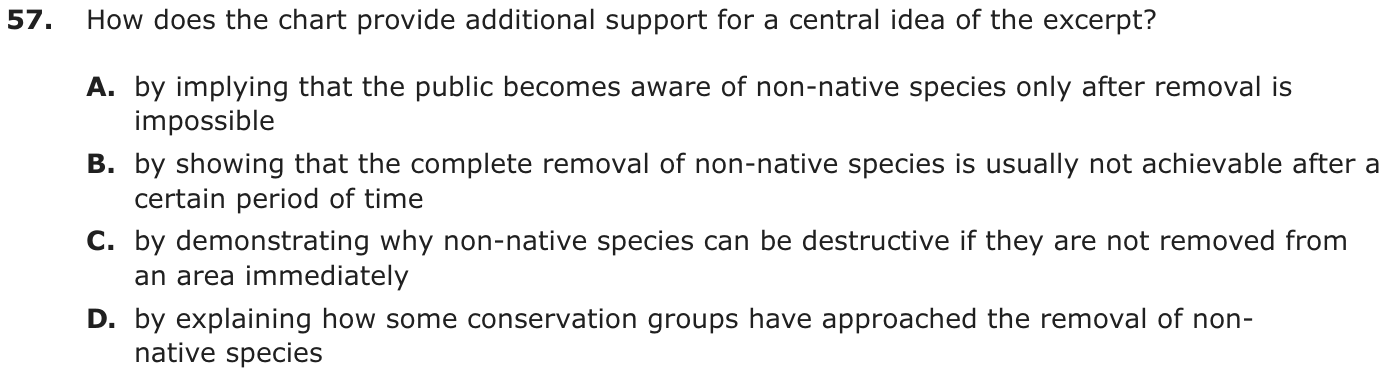
Question 56 of 120
2024 Test A Math, question 1Question
Simplify:
Grid-in question: work out the answer and enter it as a number.
Show the answer
Correct answer: -0.4
Subtracting a negative number is the same as adding a positive number. Rewrite the expression to simplify:
Question analysis
This grid-in asks students to simplify a short expression that mixes negative and positive decimals and ends by subtracting a negative number. It tests adding and subtracting rational numbers in order. The double negative, and keeping track of the sign of the final result, are where errors creep in.
- Grade level
- Grade 7 content, by NYS standard
- Compared with grade 7
- At grade 7 Adding and subtracting negative decimals is core grade 7 content, and this is a routine three-term version. It matches a typical classroom exercise; the only extra demand is gridding a signed decimal correctly.
- Estimated difficulty
- Straightforward: two steps or one careful reading.
- Thinking it demands
- Depth of knowledge 1, recall and reproduction · mainly apply
- What makes it hard
- Error-prone arithmetic moderate
- An answer in an unexpected form minor
- Solution
- 2 steps
- Reading level
- Question and choices: about grade 16+, 2 words.
- Students, last 30 days
- Not enough answers yet to show (it takes 10).
Why it is hard, traps and wrong answers (shows the answer)
Why it is hard
This is a three-term expression with small decimals, so the method is never in doubt; the points are lost on signs. The double negative at the end is the classic place to slip; the other is the result itself, which sits just below zero and is easy to grid without its minus sign. Grouping the positive terms first, 2.3 + 1.1, and comparing that sum with 3.8 settles both the size and the sign.
Error-prone arithmetic moderate Working it out
The last term, − (−1.1), has to turn into + 1.1, and the total then crosses zero, since 2.3 + 1.1 = 3.4 falls just short of the 3.8 below zero. (Brown & Burton, 1978; Junker & Sijtsma, 2001)
An answer in an unexpected form minor Choosing the answer
As a grid-in it shows no choices, so a double negative read as a single one, or a result gridded without its minus sign, gets no warning from the page. (Enright, Morley & Sheehan, 2002)
Strategy: Rewrite subtracting −1.1 as adding 1.1, combine the two positive decimals first, then compare their total with 3.8 to decide the sign and size.
Traps
- Negatives and direction: Arithmetic with negative numbers, the order of a subtraction, or direction on a number line. (Moving a term across the equals sign without changing its sign is a faulty procedure.)
The wrong answers, classified
-2.6 Negatives and direction (Brown & Burton, 1978)
Treats subtracting −1.1 as subtracting 1.1, so it works out −3.8 + 2.3 − 1.1 = −1.5 − 1.1 and moves further below zero.
0.4 Negatives and direction (Brown & Burton, 1978)
Rewrites the double negative correctly and finds the gap 3.8 − 3.4 = 0.4, but drops the minus sign that the larger negative term gives the result.
Worked solution, step by step
Formulas used
- Subtracting a negative number
- a is any number, and b is a positive number, so −b is negative. Taking away a negative number is the same as adding the positive number. Think of money: if someone takes away a debt of b dollars, you are b dollars better off.
- Adding a negative and a positive
- a and b are positive numbers, and a is the larger one. A negative and a positive partly cancel out. So find the difference of their sizes, a − b. The result keeps the sign of the number farther from zero, which here is the negative one.
Sort out the expression
You need to simplify . Simplify means work it out to one number. Two of the numbers are negative: −3.8 and −1.1. One is positive: 2.3. The tricky part is at the end. It says minus negative 1.1. The answer can be negative, so keep track of every sign.
Change minus a negative to plus
Taking away a negative is the same as adding a positive. Use the rule with b = 1.1.
Now only one negative number is left. Watch out: do not just subtract 1.1. That gives , which is wrong.
Add the two positive numbers
Group the positive numbers first. This makes the rest of the work short.
Now the problem is . One number is negative and one is positive.
Combine the negative and the positive
They partly cancel. Use the rule with a = 3.8 and b = 3.4.
The negative number, 3.8, is farther from zero than 3.4 is. So the result is negative. Watch out: keep the minus sign. Dropping it gives 0.4, which is wrong. So you would grid -0.4, with the minus sign in its own column.
Check your answer
Use a number line. Start at −3.8. Adding 2.3 moves you right, to −1.5. Subtracting −1.1 also moves you right, by 1.1, to −0.4. You end just to the left of zero. So a small negative answer makes sense.
More questions like this
The original DOE question
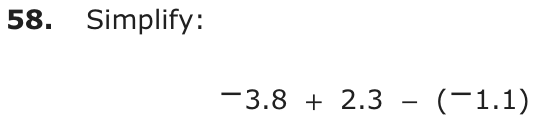
Question 57 of 120
2024 Test A Math, question 2Question
Angle M and angle R are supplementary. The measure of angle R is 5 times the measure of angle M. What is the measure of angle R, in degrees?
Grid-in question: work out the answer and enter it as a number.
Show the answer
Correct answer: 150
Angle M and angle R are supplementary, so the sum of the angles is 180°.
Let m equal the measure of angle M, and let r equal the measure of angle R.
The measure of angle R is 5 times the measure of angle M.
Therefore, the measure of angle R is 150°.
Question analysis
A geometry grid-in about two supplementary angles, where one angle is five times the size of the other. Students must recall what supplementary means, write an equation linking the two angles, and solve it. The question asks for the larger angle, so stopping at the smaller one is the usual slip.
- Grade level
- Grade 7 content, by NYS standard
- Compared with grade 7
- At grade 7 Grade 7 students regularly write and solve simple equations for unknown angles using supplementary and complementary facts. This is a two-step version of exactly that task, with whole numbers and no figure to read.
- Estimated difficulty
- Straightforward: two steps or one careful reading.
- Thinking it demands
- Depth of knowledge 2, skills and concepts · mainly apply
- What makes it hard
- Solution
- 3 steps
- Reading level
- Question and choices: about grade 5, 28 words.
- Students, last 30 days
- Not enough answers yet to show (it takes 10).
Why it is hard, traps and wrong answers (shows the answer)
Why it is hard
Once supplementary is read as a 180° total, the problem is a one-variable equation with whole numbers. Students lose the point in two ways: by stopping at the smaller angle, which the equation produces first, or by using 90° for the total. Checking that the gridded angle is the larger of the pair, and that the two angles add to 180°, catches both.
Something you must already know moderate Working it out
The stem never says what supplementary means; the 180° total has to be recalled, and a student who confuses it with complementary's 90° halves every angle. (Anderson & Krathwohl, 2001)
Turning words into math minor Understanding the question
The sentence "The measure of angle R is 5 times the measure of angle M" has to become R = 5M, so the 180° splits into six equal parts, not five. (Hegarty, Mayer & Monk, 1995; Koedinger & Nathan, 2004)
An answer in an unexpected form minor Choosing the answer
As a grid-in there is nothing to compare against, so gridding angle M's 30°, the first value the equation gives, looks just as finished as angle R. (Enright, Morley & Sheehan, 2002)
Strategy: Call angle M one part and angle R five parts; together the six parts make the supplementary total, so find one part and then multiply for angle R.
Traps
- Answers a different question: A choice is right for another quantity: the other unknown, the rest instead of the part, the part instead of the whole.
- Wrong formula: Uses a related but wrong formula: perimeter for area, diameter for radius, area for volume, or a misremembered one.
The wrong answers, classified
30 Answers a different question (King et al., 2004; Hegarty, Mayer & Monk, 1995)
Solves 6m = 180 correctly for angle M, 30°, and grids it instead of multiplying by 5 to get angle R, the angle the question asks for.
75 Wrong formula (King et al., 2004)
Uses 90° for supplementary, the complementary total, so 6m = 90 gives m = 15 and angle R = 75, half its real size.
36 Numbers taken from the question (Hegarty, Mayer & Monk, 1995)
Divides 180 by the 5 in the stem, combining the two numbers without an equation that gives angle M its own share of the 180°.
Worked solution, step by step
Formulas used
- Supplementary angles
- M and R are the sizes of two angles, in degrees. Supplementary means the two angles add up to 180 degrees. Put side by side, they make a straight line. Do not mix this up with complementary, which means a total of 90 degrees.
Sort out the question
Two angles, M and R, are supplementary. Angle R is 5 times as big as angle M. You need the measure of angle R, in degrees. Measure means its size. Notice that the question asks for R, not M.
Write the facts as equations
Supplementary angles add up to 180°.
The sentence “The measure of angle R is 5 times the measure of angle M” becomes this:
Watch out: supplementary means 180°, not 90°. Using 90° gives R = 75, which is wrong.
Find angle M
Put in place of R. Then the equation has only one unknown, M.
Think of 6 equal parts. M is 1 part and R is 5 parts. So angle M is 30°.
Find angle R
Angle R is 5 times angle M.
Angle R is 150°. Watch out: do not stop at M. Gridding 30 gives the wrong angle. So you would grid 150.
Check your answer
Add the two angles: . So they are supplementary. Also, , so R really is 5 times M. Both facts in the question check out.
More questions like this
The original DOE question
Question 58 of 120
2024 Test A Math, question 3Question
A juice mixture contains gallon of apple juice and gallon of cranberry juice. How many gallons of apple juice per gallon of cranberry juice does the mixture contain? (Express your answer as a decimal.)
Grid-in question: work out the answer and enter it as a number.
Show the answer
Correct answer: 2.5
Set up a proportion to solve:
Question analysis
This ratio grid-in describes a juice mixture with a fraction of a gallon of apple juice and a smaller fraction of a gallon of cranberry juice. Students find the unit rate, gallons of apple juice per gallon of cranberry juice, by dividing one fraction by the other and writing it as a decimal. Dividing in the wrong order is the main risk.
- Grade level
- Grade 7 content, by NYS standard
- Compared with grade 7
- At grade 7 Computing a unit rate from a ratio of two fractions is exactly the grade 7 standard, and this is a textbook example of it. The only added demands are dividing in the right order and answering as a decimal.
- Estimated difficulty
- Moderate: several steps, or a close reading with one strong distractor.
- Thinking it demands
- Depth of knowledge 2, skills and concepts · mainly apply
- What makes it hard
- Turning words into math moderate
- Error-prone arithmetic moderate
- An answer in an unexpected form minor
- Solution
- 2 steps
- Reading level
- Question and choices: about grade 8, 36 words.
- Students, last 30 days
- Not enough answers yet to show (it takes 10).
Why it is hard, traps and wrong answers (shows the answer)
Why it is hard
The method is one division of fractions, but the question tests whether the division runs the right way. The word per tells which juice goes on top, and a student who divides the smaller amount by the larger gets a tidy decimal for the reverse rate. A sense check helps: the mixture holds more apple juice than cranberry, so the rate must be greater than 1.
Turning words into math moderate Understanding the question
The phrase "gallons of apple juice per gallon of cranberry juice" fixes the order: apple's 3/16 goes on top and cranberry's 3/40 below, though the two fractions invite either order. (Hegarty, Mayer & Monk, 1995; Koedinger & Nathan, 2004)
Error-prone arithmetic moderate Working it out
Dividing 3/16 by 3/40 means multiplying by 40/3; the 3s cancel to leave 40/16, which still has to be reduced and written as a decimal. (Brown & Burton, 1978; Junker & Sijtsma, 2001)
An answer in an unexpected form minor Choosing the answer
The answer must be gridded as a decimal, and with no choices shown, the upside-down 0.4 gives no sign that it answers the reverse question. (Enright, Morley & Sheehan, 2002)
Strategy: Put the apple juice over the cranberry juice and divide the fractions by multiplying by the reciprocal; the matching 3s cancel, leaving a simple fraction to turn into a decimal.
Traps
- Wrong operation: Adds instead of multiplying, divides the wrong way round, turns a ratio or rate upside down, or undoes a step in the wrong direction (subtracts what should be added back).
The wrong answers, classified
0.4 Wrong operation (Hegarty, Mayer & Monk, 1995; King et al., 2004)
Divides cranberry by apple, 3/40 ÷ 3/16 = 16/40 = 0.4, giving gallons of cranberry per gallon of apple, the rate turned upside down.
0.014 Wrong operation (Hegarty, Mayer & Monk, 1995; King et al., 2004)
Multiplies the two amounts instead of dividing them, 3/16 × 3/40 = 9/640 ≈ 0.014, as if comparing the juices called for a product.
Worked solution, step by step
Formulas used
- Unit rate
- r is the rate: how much of one thing there is for each 1 of another. a is the amount of the first thing. b is the amount of the second thing, the one named after the word per. Dividing shares a out evenly over each 1 of b.
- Dividing by a fraction
- a/b and c/d are fractions, and b, c and d are not zero. To divide by a fraction, multiply by its reciprocal, the fraction flipped upside down. It works because flipping a fraction gives the number that undoes it.
Sort out the question
The mix has gallon of apple juice and gallon of cranberry juice. You need the “gallons of apple juice per gallon of cranberry juice”. Per means for each. So the question asks: for each 1 gallon of cranberry juice, how many gallons of apple juice are there? The answer must be a decimal.
Set up the division
To find an amount for each 1 gallon, divide. Apple juice goes first, because it comes before per. Cranberry juice comes second.
Watch out: do not flip the order. Cranberry divided by apple gives 0.4. That is gallons of cranberry juice for each gallon of apple juice, the reverse question.
Multiply by the reciprocal
To divide by , multiply by its reciprocal, .
The 3 on top and the 3 on the bottom cancel, since . Watch out: do not just multiply the two amounts. That gives , about 0.014, which is far too small.
Change the fraction to a decimal
Make simpler by dividing the top and bottom by 8. Then divide.
There are 2.5 gallons of apple juice for each gallon of cranberry juice. So you would grid 2.5.
Check your answer
Both fractions have 3 on top. The one with the smaller bottom, , is bigger. So there is more apple juice than cranberry juice, and the answer must be more than 1. That rules out 0.4. Also, and , which is .
More questions like this
The original DOE question
Question 59 of 120
2024 Test A Math, question 4Question
Mr. Chan’s lawn grows inches every 2 weeks. He mows his lawn every 2 weeks and cuts off the top inches of lawn. If Mr. Chan’s lawn was 4 inches tall at the beginning of the season, how many inches tall, in decimal form, is Mr. Chan’s lawn after 8 weeks?
Grid-in question: work out the answer and enter it as a number.
Show the answer
Correct answer: 5.5
The lawn grows inches every 2 weeks. Find the total number of inches it grows in 8 weeks.
The lawn was 4 inches tall at the beginning of the season.
Mr. Chan mows his lawn every 2 weeks and cuts off the top inches. Find the total number of inches that are cut off in 8 weeks.
The height after 8 weeks is the total number of inches grown minus the total number of inches cut off.
Question analysis
This multistep word problem follows Mr. Chan's lawn over 8 weeks: it grows a mixed number of inches every 2 weeks, and he mows a mixed number of inches off on the same schedule. Students combine the growth, the cuts and the starting height and give the final height as a decimal. Leaving out one of those three pieces is the usual error.
- Grade level
- Grade 7 content, by NYS standard
- Compared with grade 7
- At grade 7 Grade 7 students solve multi-step problems with mixed numbers and convert between fractions and decimals. This one strings four such steps together, including counting the 2-week periods, which is typical grade 7 work done carefully.
- Estimated difficulty
- Moderate: several steps, or a close reading with one strong distractor.
- Thinking it demands
- Depth of knowledge 2, skills and concepts · mainly apply
- What makes it hard
- Many steps moderate
- Error-prone arithmetic moderate
- Turning words into math minor
- An answer in an unexpected form minor
- Solution
- 4 steps
- Reading level
- Question and choices: about grade 3, 49 words.
- Corrected from the DOE handbook
- A misspelled name in the explanation was corrected.
- Students, last 30 days
- Not enough answers yet to show (it takes 10).
Why it is hard, traps and wrong answers (shows the answer)
Why it is hard
No single step is hard, but three parts must all reach the final height: the starting 4 inches, four rounds of growth and four rounds of mowing. Leaving out any one of them gives a clean decimal that can be gridded without a second thought. Working one 2-week period at a time, in which the lawn gains 3/8 inch net, keeps the bookkeeping short.
Many steps moderate Working it out
Four pieces have to be combined: count the four 2-week periods in 8 weeks, total the growth, total the mowing, and start from the lawn's first 4 inches. (Daniel & Embretson, 2010; Enright, Morley & Sheehan, 2002)
Error-prone arithmetic moderate Working it out
The amounts are mixed numbers with unlike denominators, 2 1/8 and 1 3/4, which must be multiplied by 4 or subtracted and then gridded as a decimal. (Brown & Burton, 1978; Junker & Sijtsma, 2001)
Turning words into math minor Understanding the question
The phrase "every 2 weeks" governs both the growing and the mowing, so 8 weeks means four rounds of each, not eight. (Hegarty, Mayer & Monk, 1995; Koedinger & Nathan, 2004)
An answer in an unexpected form minor Choosing the answer
As a grid-in it gives no choices, so a height that leaves out the starting 4 inches, or leaves out the mowing, looks as finished as the right one. (Enright, Morley & Sheehan, 2002)
Strategy: Find the net change for one 2-week period by subtracting the cut from the growth, multiply by the number of such periods in 8 weeks, and add the starting height.
Traps
- Stops one step early: A choice is a number from partway through the solution.
- Misreads the question: Misses or misreads a condition or a word in the question: "at least", "each", "remaining", "not".
The wrong answers, classified
1.5 Stops one step early (King et al., 2004; Gierl et al., 2017)
Finds the net gain of 3/8 inch per period and multiplies by the 4 periods, 1.5 inches, but stops before adding the lawn's starting height of 4 inches.
12.5 Stops one step early (King et al., 2004; Gierl et al., 2017)
Adds four periods of growth, 8.5 inches, to the starting 4 inches and stops there, never subtracting the 1 3/4 inches cut at each of the four mowings.
7 Misreads the question (Hegarty, Mayer & Monk, 1995)
Applies the net gain of 3/8 inch to each of the 8 weeks instead of each 2-week period, 8 × 3/8 = 3, then adds the starting 4.
What was corrected from the DOE handbook, and why
- Explanation: The handbook’s explanation says “Mr. Chen mows his lawn every 2 weeks.” The question calls him Mr. Chan throughout, so the site now reads “Mr. Chan.”
Worked solution, step by step
Formulas used
- Mixed number to decimal
- A mixed number has a whole part, a, and a fraction part, b over c. To write it as a decimal, divide b by c to get the fraction part as a decimal. Then add the whole part. For example, one and a half is 1 + 0.5 = 1.5.
- Repeated amount
- n is how many times something happens. a is the amount each time. Adding the same amount n times is the same as multiplying it by n.
Sort out the question
The lawn starts at 4 inches tall. Every 2 weeks it grows inches. Every 2 weeks Mr. Chan also cuts off inches. You need the height after 8 weeks, as a decimal. Three things matter: the start, the growing and the cutting.
Count the 2-week periods
Both the growing and the cutting happen every 2 weeks. So count how many 2-week periods fit in 8 weeks.
There are 4 periods. The lawn grows 4 times and is cut 4 times. Watch out: do not count 8 rounds, one for each week. That leads to the wrong answer 7.
Change the mixed numbers to decimals
The answer must be a decimal, so change both amounts now.
Each period, the lawn grows 2.125 inches and loses 1.75 inches.
Add up the growing
The lawn grows 2.125 inches, 4 times.
It grows 8.5 inches in all. Add the starting height of 4 inches.
Without mowing, the lawn would be 12.5 inches tall. Watch out: do not forget the starting 4 inches. Leaving them out leads to 1.5.
Add up the cutting
Mr. Chan cuts off 1.75 inches, 4 times.
He cuts off 7 inches in all.
Subtract the cutting
The lawn is 5.5 inches tall after 8 weeks. Watch out: 12.5 is not the answer. It leaves out the mowing. So you would grid 5.5.
Check your answer
Work one period at a time. Each period the lawn gains inch. In 4 periods that is inches. Add the starting 4 inches: . Same answer.
More questions like this
The original DOE question
Question 60 of 120
2024 Test A Math, question 5Question
RESULTS FROM SURVEY OF 110 FAMILIES
| Number of Children in the Family | Number of Families |
|---|---|
| 0 | 45 |
| 1 | 32 |
| 2 | 19 |
| 3 | 8 |
| 4 | 6 |
The table above shows the number of children in each of 110 families. What is the median number of children in these families?
Grid-in question: work out the answer and enter it as a number.
Show the answer
Correct answer: 1
Since 110 families were surveyed, the median will have 55 values less than or equal to it, and 55 values greater than or equal to it.
If the values in the table were listed in order, they would look like this:
The first row of the table indicates that 45 families had 0 children.
The second row of the table indicates that 32 families had 1 child.
So 77 families had either 0 children or 1 child, and 45 families had 0 children.
Since 55 is between 45 and 77, the median must be a value in the second row of the table.
So the median is 1.
Question analysis
This statistics grid-in gives a frequency table from a survey of 110 families, showing how many families have each number of children from none to four. Students find the median number of children per family. The table lists counts rather than the 110 data values themselves, so locating the middle value takes a running total of the families.
- Grade level
- Grade 6 content, by NYS standard
- Compared with grade 7
- Above grade 7 Grade 7 median problems usually list a dozen or so values. Here 110 values are hidden in a frequency table, so students must reason about positions with a running count, a less familiar and more error-prone task.
- Estimated difficulty
- Hard: combines ideas, needs a plan, and has more than one tempting wrong answer.
- Thinking it demands
- Depth of knowledge 2, skills and concepts · mainly apply
- What makes it hard
- Reading a figure, table or graph major
- No obvious method moderate
- An answer in an unexpected form minor
- Solution
- 3 steps
- Reading level
- Question and choices: about grade 7, 35 words.
- Students, last 30 days
- Not enough answers yet to show (it takes 10).
Why it is hard, traps and wrong answers (shows the answer)
Why it is hard
Students know a median as the middle of a list, but here the list is never written out. Treating the table's columns as the data gives quick, confident answers, 2 from the middle of the children column or 19 from the middle of the family counts, and neither can be checked against choices. The question rewards counting positions: 45 families have no children, so the 55th and 56th families both fall among the 32 with one child.
Reading a figure, table or graph major Understanding the question
The table hides 110 data values in five rows: the 0 to 4 column lists the possible values, and 45, 32, 19, 8 and 6 say how many families have each. (Lesh, Post & Behr, 1987; Kirsch & Mosenthal, 1990)
No obvious method moderate Working it out
The median of 110 values lies between the 55th and 56th; finding them takes a running count of families, 45 and then 77, a method seldom practiced with tables. (Schoenfeld, 1985)
An answer in an unexpected form minor Choosing the answer
As a grid-in there are no choices to compare, so a student who takes the middle row's 2 has nothing on the page to suggest it is wrong. (Enright, Morley & Sheehan, 2002)
Strategy: With 110 values the median sits between the 55th and 56th; add the family counts row by row until the running total passes 55, and read that row's number of children.
Traps
- Misunderstands the concept: A wrong belief about a concept: that percents can be added, that area grows like length, that averages can be averaged, that a bigger denominator means a bigger fraction.
- Answers a different question: A choice is right for another quantity: the other unknown, the rest instead of the part, the part instead of the whole.
The wrong answers, classified
2 Misunderstands the concept (Smith, diSessa & Roschelle, 1993; De Bock et al., 1998; Ni & Zhou, 2005)
Takes the middle entry of the children column, 0 to 4, ignoring that each number of children belongs to a different number of families.
19 Answers a different question (King et al., 2004; Hegarty, Mayer & Monk, 1995)
Finds the median of the Number of Families column, 6, 8, 19, 32 and 45, a middle family count rather than a number of children.
1.07 Answers a different question (King et al., 2004; Hegarty, Mayer & Monk, 1995)
Computes the mean instead, 118 children among 110 families, about 1.07, a different measure of center from the median asked for.
Worked solution, step by step
Formulas used
- Spot of the median
- The median is the middle value when all the values are put in order. n is how many values there are. This gives the spot of the middle value, with the same number of values before and after it. If it ends in a half, the median is halfway between the two values on either side.
Sort out the table
The table covers 110 families. The left column is a number of children. The right column says how many families have that many children. For example, 45 families have 0 children. You need the median number of children. The median is the middle value when all the values are in order.
Picture the values in order
Think of a list with one number for each family: how many children it has. The list has 45 zeros, then 32 ones, then 19 twos, then 8 threes, then 6 fours. It is already in order, from least to most.
There are 110 values. Watch out: the median is not the middle row, 2. Each row stands for a different number of families.
Find the middle spot
Use the median rule with n = 110.
The middle is halfway between the 55th and 56th values. So you need those two values in the list.
Count down the list
Keep a running total of families, row by row. The zeros fill spots 1 to 45. Now add the 32 families with 1 child.
So the ones fill spots 46 to 77. Spot 55 and spot 56 are both in that range. So both values are 1.
Give the median
The 55th and 56th values are both 1. Halfway between 1 and 1 is 1. So the median is 1 child. Watch out: the median is a number of children, not of families. Gridding 19, from the families column, is wrong. So is the mean, or average, which is about 1.07. So you would grid 1.
Check your answer
Half of 110 is 55. Families with 0 children: 45, which is less than half. So the median is not 0. Families with 0 or 1 child: 77, which is more than half. So the median is not more than 1. It must be 1.
More questions like this
The original DOE question
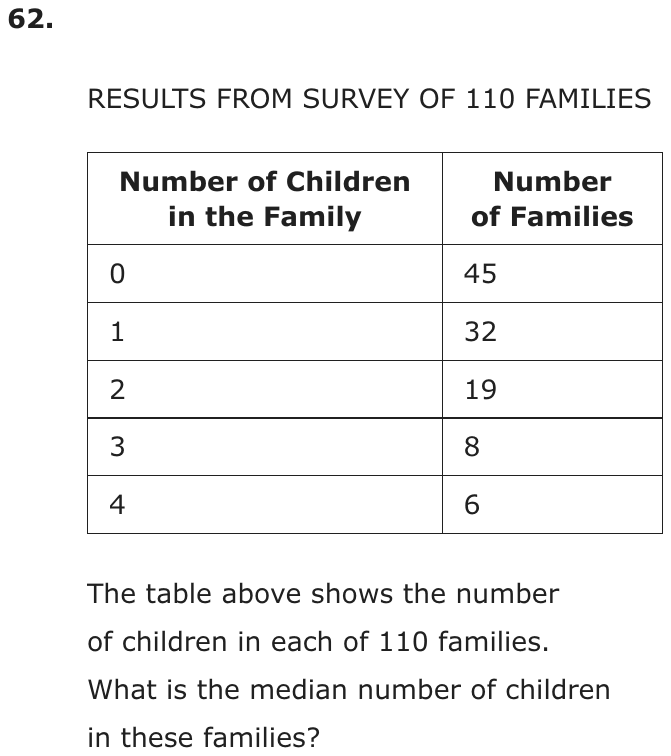
Question 61 of 120
2024 Test A Math, question 6Question
Mr. Jones has 550 goats, which is 10% more than Mr. King has. How many more goats does Mr. Jones have than Mr. King?
- A50
- B55
- C495
- D500
Show the answer
Correct answer: A
First, set up a proportion to determine x, the number of goats Mr. King has.
Then solve the proportion for x.
Finally, determine the difference between the number of goats Mr. Jones has, 550, and the number of goats Mr. King has, 500.
Mr. Jones has 50 more goats than Mr. King.
Question analysis
A percent word problem: Mr. Jones has 550 goats, which is 10% more than Mr. King has, and students find how many more goats Mr. Jones has. It asks students to work with a percent increase when only the larger amount is known. The tricky part is deciding which amount the 10% is taken of.
- Grade level
- Grade 7 content, by NYS standard
- Compared with grade 7
- Above grade 7 Grade 7 students usually find a percent increase from a known original amount. This runs the task backward: the increased amount is given, and the original must be recovered before the difference can be found, a step many do not expect.
- Estimated difficulty
- Hard: combines ideas, needs a plan, and has more than one tempting wrong answer.
- Thinking it demands
- Depth of knowledge 2, skills and concepts · mainly apply
- What makes it hard
- Turning words into math major
- A very close wrong answer moderate
- Solution
- 2 steps
- Reading level
- Question and choices: about grade 1, 22 words.
- Students, last 30 days
- Not enough answers yet to show (it takes 10).
Why it is hard, traps and wrong answers (shows the answer)
Why it is hard
The arithmetic is one division and one subtraction, so the question is really about the base of a percent. The sentence gives the bigger number and calls it 10% more, and the reflex is to take 10% of the number on the page. That shortcut lands on a listed choice five goats from the answer. Students who find King's herd first, 550 ÷ 1.1, still have to remember that the question wants the difference, not the herd.
Turning words into math major Understanding the question
The clause "which is 10% more than" makes King's unknown herd the base of the 10%, so 550 is 110% of his number rather than the amount the 10% is taken of. (Hegarty, Mayer & Monk, 1995; Koedinger & Nathan, 2004)
A very close wrong answer moderate Choosing the answer
The choices 50 and 55 are only 5 goats apart, and both are 10% of a herd; only taking the percent of King's 500 rather than of 550 separates them. (Embretson & Wetzel, 1987; Gorin & Embretson, 2006; Ascalon et al., 2007)
Strategy: Mr. Jones's 550 is 110% of Mr. King's number, so divide 550 by 1.10 to find Mr. King's goats, then subtract that from 550.
Traps
- Percent of the wrong amount: Finding the whole from a part, or a percent change measured from the wrong starting amount.
- Stops one step early: A choice is a number from partway through the solution.
The wrong answers, classified
B Percent of the wrong amount (Parker & Leinhardt, 1995)
Takes 10% of 550, measuring the increase from Jones's herd instead of from King's smaller herd, which is the amount the 10% is based on.
C Percent of the wrong amount (Parker & Leinhardt, 1995)
Takes 10% off 550 to get King's herd, 550 − 55 = 495, using the wrong base, then gives that herd instead of the difference.
D Stops one step early (King et al., 2004; Gierl et al., 2017)
Finds King's herd correctly, 550 ÷ 1.1 = 500, then stops there instead of subtracting it from 550 to get how many more.
Worked solution, step by step
Formulas used
- Percent increase
- The original is the amount you start from, the one the percent is taken of. p is the percent of increase. The new amount is all of the original, which is 100%, plus p% more. For 10% more, you multiply by 1.10.
Sort out the question
Mr. Jones has 550 goats. That is “10% more than Mr. King has”. You need how many more goats Mr. Jones has than Mr. King. That is the difference between the two herds, not the size of a herd.
Decide what the 10% is of
The words “10% more than Mr. King” mean the 10% is a part of Mr. King’s herd. So Mr. King’s herd is the original. Mr. Jones has all of Mr. King’s goats, 100%, plus 10% more. That is 110% of Mr. King’s herd. Watch out: do not take 10% of 550. That gives 55, choice B. It uses the wrong herd. Taking those 55 away from 550 gives 495, choice C, which is also wrong.
Find Mr. King’s herd
Call Mr. King’s number of goats K. Use the percent increase formula with p = 10. The new amount is 550.
Mr. King has 500 goats. Watch out: 500 is Mr. King’s herd, choice D. It is not the difference.
Find the difference
Mr. Jones has 50 more goats than Mr. King. So the answer is A, 50.
Check your answer
Check the 10%. 10% of 500 is , and , Mr. Jones’s herd. So 550 really is 10% more than 500. If King had 495, then 10% more would be about 545, not 550.
More questions like this
The original DOE question
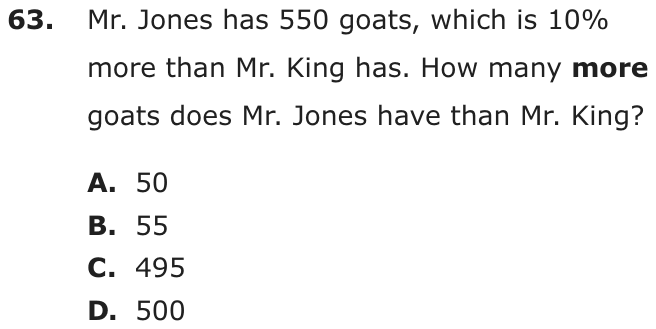
Question 62 of 120
2024 Test A Math, question 7Question
If and , what expression is represented by ?
- A
- B
- C
- D
Show the answer
Correct answer: C
Use properties of equations to determine the missing expression:
The missing expression is .
Question analysis
An algebra question with fractions: two fractions with x and 2x in their denominators are subtracted, and students find the numerator that makes the difference equal a fraction over 2x. It tests rewriting a fraction over a common denominator when the denominators contain a variable. Adjusting only part of a fraction is the common mistake.
- NYS standards
- Grade level
- Grade 7 content, by NYS standard
- Compared with grade 7
- At grade 7 Grade 7 students subtract fractions with unlike denominators and combine like terms, but rarely see a variable in a denominator. The steps are the same two as with numbers, so the demand is typical once the form is familiar.
- Estimated difficulty
- Straightforward: two steps or one careful reading.
- Thinking it demands
- Depth of knowledge 1, recall and reproduction · mainly apply
- What makes it hard
- Variables instead of numbers moderate
- Error-prone arithmetic minor
- Solution
- 2 steps
- Reading level
- Question and choices: about grade 13, 14 words.
- Students, last 30 days
- Not enough answers yet to show (it takes 10).
Why it is hard, traps and wrong answers (shows the answer)
Why it is hard
This is subtraction of fractions with unlike denominators, written with letters. The box over 2x shows the target denominator, which helps, but each wrong choice matches a familiar fraction error: subtracting the tops before matching the bottoms, or rewriting the first fraction and stopping. Students who rewrite 2y/x as 4y/2x and then subtract y from the new numerator finish in seconds.
Variables instead of numbers moderate Understanding the question
The denominators are x and 2x, so the common denominator is built with a letter, and there is no number to check unless students substitute values such as x = 1 and y = 2. (Koedinger & Nathan, 2004; Enright, Morley & Sheehan, 2002)
Error-prone arithmetic minor Working it out
Only the first fraction changes: 2y/x becomes 4y/2x with top and bottom both doubled, while y/2x already has the denominator the box sits over. (Brown & Burton, 1978; Junker & Sijtsma, 2001)
Strategy: Rewrite the first fraction over 2x by multiplying its top and bottom by 2, then subtract the numerators, which now share a denominator.
Traps
- A faulty procedure: A systematic but wrong procedure: adding fractions straight across, applying an exponent to each term of a sum, dropping a sign when moving a term.
- Stops one step early: A choice is a number from partway through the solution.
The wrong answers, classified
A A faulty procedure (Brown & Burton, 1978; Tatsuoka, 1983)
Subtracts the numerators straight away, 2y − y = y, and puts the result over 2x as if the two fractions already shared a denominator.
B A faulty procedure (Brown & Burton, 1978; Tatsuoka, 1983)
Subtracts the numerators over x, (2y − y)/x = y/x, then doubles top and bottom to reach the denominator 2x, giving 2y/2x.
D Stops one step early (King et al., 2004; Gierl et al., 2017)
Rewrites 2y/x as 4y/2x correctly to match the box's denominator, then stops before subtracting the y of the second fraction.
Worked solution, step by step
Formulas used
- Equivalent fractions
- a is the top of the fraction, b is the bottom, and k is any number except zero. Multiplying the top and bottom by the same number does not change the value. It is like multiplying by k over k, which is 1.
- Subtracting fractions with the same bottom
- a and b are the tops, and d is the shared bottom, called the denominator. When two fractions have the same bottom, their pieces are the same size. So subtract the tops and keep the bottom.
Sort out the question
The box, , stands for a missing expression. An expression is a math phrase made of numbers and letters, like 5y. You need what goes in the box to make the two sides equal. means x is not zero, so no fraction divides by zero.
Pick a shared bottom
You can only subtract fractions when their bottoms match. The bottoms here are x and 2x. The box sits over 2x, so use 2x for both. The second fraction, , already has it.
Rewrite the first fraction over 2x
To turn x into 2x, multiply by 2. Multiply the top by 2 as well, so the value stays the same.
Watch out: this is only the first fraction. Stopping here and choosing 4y gives choice D.
Subtract the tops
4y take away y is like 4 apples take away 1 apple. That leaves 3y. Watch out: do not subtract the tops, 2y − y, before the bottoms match. That gives y, choice A.
Match the box
The left side equals . The right side is . The bottoms are the same, so the tops must be equal. The box is 3y. So the answer is C, .
Check your answer
Try numbers. Let x = 1 and y = 2. The left side is . With 3y in the box, the right side is . Both sides are 3, so 3y works.
More questions like this
The original DOE question
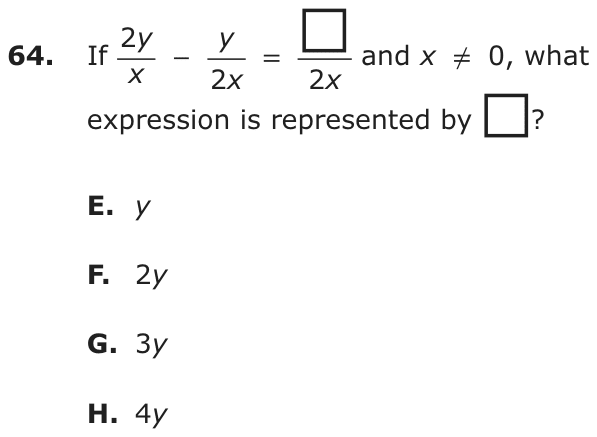
Question 63 of 120
2024 Test A Math, question 8Question
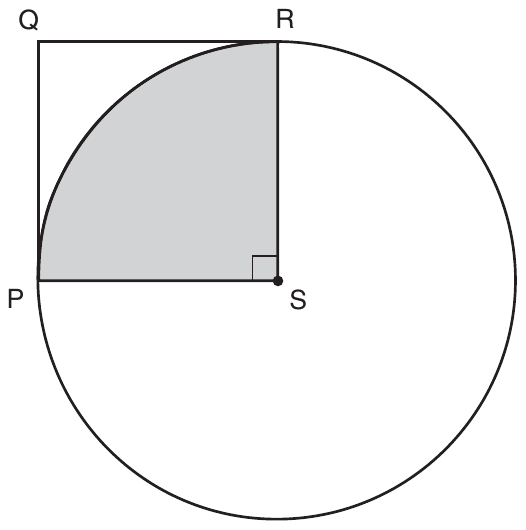
In the figure above, PQRS is a square. Point S is the center of the circle, and points P and R are on the circle. If the area of the square is 4 square centimeters, what is the area, in square centimeters, of the shaded quarter of the circle?
- A
- B
- C
- D
Show the answer
Correct answer: B
The area of square PQRS is 4 square centimeters. So
Sides PS and RS are each a radius of the circle. So the radius of the circle is 2 cm.
The shaded region is of the circle. The area of a circle is . So the area of the shaded region, in square centimeters, is
Question analysis
A geometry question with a figure: square PQRS has one corner at the center of a circle, and the quarter of the circle inside the square is shaded. Given the area of the square, students find the area of the shaded quarter circle. The key is connecting the square's side to the circle's radius.
- Grade level
- Grade 7 content, by NYS standard
- Compared with grade 7
- At grade 7 Circle area is grade 7 content, and this question adds only one linking step from the square's area to the radius. Typical grade 7 circle work gives the radius directly; here it takes one short extra inference.
- Estimated difficulty
- Straightforward: two steps or one careful reading.
- Thinking it demands
- Depth of knowledge 2, skills and concepts · mainly apply
- What makes it hard
- Reading a figure, table or graph moderate
- Something you must already know minor
- Combines ideas minor
- Solution
- 3 steps
- Reading level
- Question and choices: about grade 4, 52 words.
- Students, last 30 days
- Not enough answers yet to show (it takes 10).
Why it is hard, traps and wrong answers (shows the answer)
Why it is hard
The question chains three short facts: from the square's area to its side, from the side to the radius, and from the whole circle to a quarter of it. None is hard, but each wrong choice marks a broken link, most often the whole circle's area, which looks like a finished answer. Pointing to S as the center before computing anything settles the radius.
Reading a figure, table or graph moderate Understanding the question
The radius is never labeled: students must see that S is both a corner of the square and the circle's center, so sides PS and RS are radii. (Lesh, Post & Behr, 1987; Kirsch & Mosenthal, 1990)
Something you must already know minor Working it out
Neither the circle area formula, π times the radius squared, nor the step from a square's area to its side length is given. (Anderson & Krathwohl, 2001)
Combines ideas minor Working it out
Square and circle are linked in one chain: the area 4 gives a side of 2, the side is the radius, and the shaded part is a quarter of π × 2². (Embretson, 1998; Daniel & Embretson, 2010)
Strategy: Take the square root of the square's area to get its side, which is also the radius, then take one quarter of pi times the radius squared.
Traps
- Wrong formula: Uses a related but wrong formula: perimeter for area, diameter for radius, area for volume, or a misremembered one.
- Stops one step early: A choice is a number from partway through the solution.
- A formula you must know: Needs a formula the test does not give: area, circumference, volume, probability rules.
The wrong answers, classified
A Wrong formula (King et al., 2004)
Halves the square's side as if it were a diameter, so it uses a radius of 1, and one quarter of π × 1² gives π/4.
C Wrong formula (King et al., 2004)
Misremembers the circle's area as 2πr², blending it with the circumference 2πr, so one quarter of 2π × 2² gives 2π.
D Stops one step early (King et al., 2004; Gierl et al., 2017)
Finds the whole circle's area, π × 2² = 4π, and stops before taking the quarter that is shaded.
Worked solution, step by step
Formulas used
- Area of a square
- A is the area, the space inside. s is the length of one side, and s² means s × s. All four sides of a square are equal, so its area is side times side.
- Area of a circle
- A is the area of the whole circle. r is the radius: the distance from the center to the edge. π, called pi, is a number a little more than 3, about 3.14. Multiply π by r × r. This works for every circle.
Sort out the figure
PQRS is a square with an area of 4 sq cm. Point S is the center of the circle. Points P and R are on the circle. The shaded part is a quarter of the circle, inside the square. You need the shaded area, in square centimeters. The answer will have π in it.
Find the side of the square
Use the square formula. The area is 4, so find the number that times itself gives 4.
Each side is 2 cm long, because .
See that the side is the radius
Side SP goes from the center, S, to point P on the circle. So SP is a radius. So is side SR. The radius is 2 cm. Watch out: the side is a radius, not a diameter, the full width of the circle. Using a radius of 1 leads to , choice A.
Find the area of the whole circle
The whole circle has an area of 4π sq cm. Watch out: this is the whole circle. Stopping here gives choice D.
Take one quarter
The shaded part is one quarter of the circle, so take one quarter of 4π.
The shaded area is π sq cm. So the answer is B, .
Check your answer
π is about 3.14, so the shaded part is about 3.14 sq cm. The whole square is 4 sq cm. In the figure, the shaded part fills most of the square, but not all. So a bit less than 4 makes sense. The choice 4π is about 12.6, far too big.
More questions like this
The original DOE question
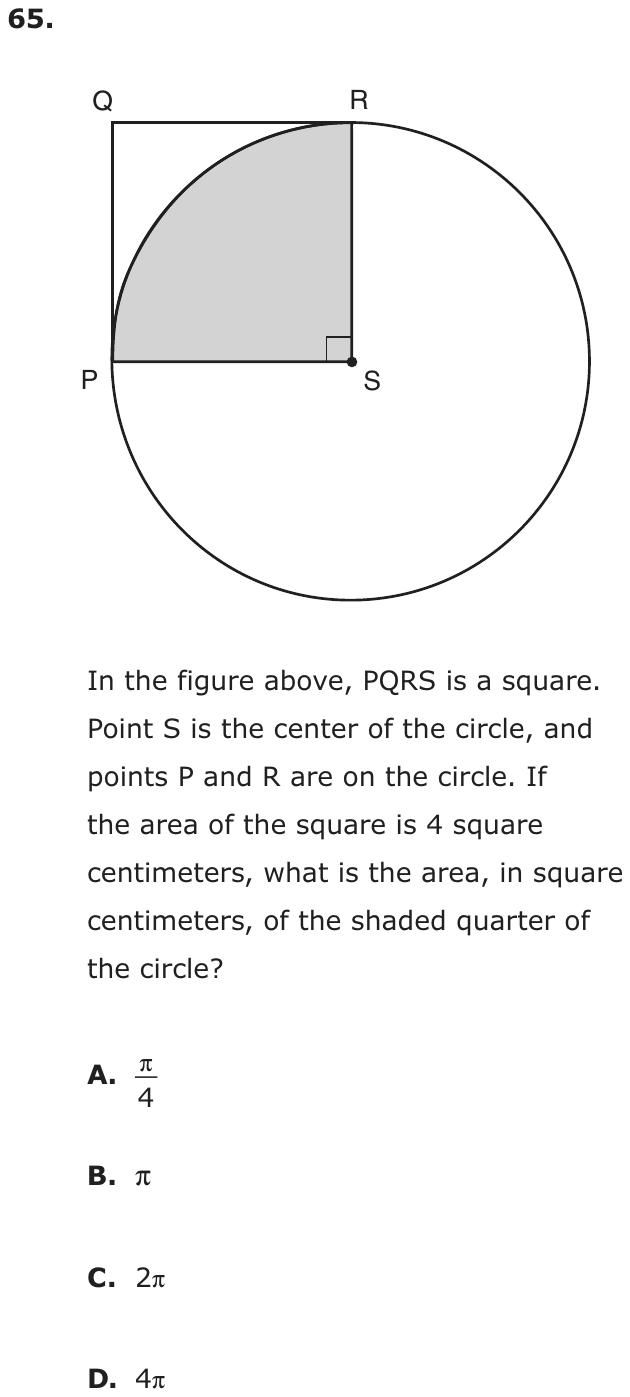
Question 64 of 120
2024 Test A Math, question 9Question
A list of consecutive integers begins with m and ends with n. If , how many integers are in the list?
- A2
- B33
- C66
- D67
Show the answer
Correct answer: D
Consider the case where .
The list of integers from 1 to 67 contains 67 numbers.
Question analysis
A number question about a list of consecutive integers that starts at m and ends at n, where n minus m is 66. Students decide how many integers the list contains. The tricky part is relating the difference between the two ends to the number of integers in the list.
- Grade level
- Grade 7 content, by NYS standard
- Compared with grade 7
- At grade 7 Consecutive integers and differences are familiar grade 7 ideas, and the arithmetic is trivial. What keeps this at grade 7 rather than below it is the counting trap, which needs a moment of careful reasoning.
- Estimated difficulty
- Moderate: several steps, or a close reading with one strong distractor.
- Thinking it demands
- Depth of knowledge 2, skills and concepts · mainly apply
- What makes it hard
- A very close wrong answer moderate
- Variables instead of numbers moderate
- Solution
- 2 steps
- Reading level
- Question and choices: about grade 7, 21 words.
- Students, last 30 days
- Not enough answers yet to show (it takes 10).
Why it is hard, traps and wrong answers (shows the answer)
Why it is hard
The arithmetic is trivial, so the question tests one idea: the number of integers from m to n is one more than their difference, because both ends belong to the list. The stem supplies 66 ready-made, and taking it as the count is the natural first reaction. A five-number list, 1 to 5, whose ends differ by 4, shows the extra one in seconds.
A very close wrong answer moderate Choosing the answer
The choices 66 and 67 differ by one, and 66 is the difference the stem hands over; only counting both ends of the list separates them. (Embretson & Wetzel, 1987; Gorin & Embretson, 2006; Ascalon et al., 2007)
Variables instead of numbers moderate Understanding the question
The list is given only by its ends, m and n, so the count has to be reasoned out in general, or checked on a small list such as 1 through 5. (Koedinger & Nathan, 2004; Enright, Morley & Sheehan, 2002)
Strategy: Try a small list you can count, such as 1 through 5, and compare its count with the difference between its first and last numbers.
Traps
- Counting the ends: Inclusive or exclusive ends, fence posts, consecutive numbers: an answer that is one too many or too few, or an endpoint drawn open where it belongs closed (or the reverse).
The wrong answers, classified
A Little reason to choose it (Haladyna & Downing, 1993; Rodriguez, 2005)
No common working counts only the two named ends, m and n, in a list said to hold consecutive integers, so 2 mostly draws guesses.
B Misunderstands the concept (Smith, diSessa & Roschelle, 1993; De Bock et al., 1998; Ni & Zhou, 2005)
Halves 66, as if consecutive integers went up by 2 like consecutive odd or even numbers, so the list held only every other integer.
C Counting the ends (Brown & Burton, 1978)
Takes the difference of the ends as the count, forgetting that a list from m to n includes both m and n.
Worked solution, step by step
Formulas used
- Counting consecutive integers
- m is the first number in the list and n is the last. n − m counts the steps from each number to the next. A list always has one more number than it has steps, so you add 1. This works for any list that goes up by 1.
Sort out the question
Integers are whole numbers and their negatives, like −2, 0 and 5. Consecutive integers come one after another, going up by 1, like 4, 5, 6. The list starts at m and ends at n. The difference is 66. You need how many integers are in the list.
Try a small list
Letters are hard to count, so try a list you can count: 1, 2, 3, 4, 5. Here m = 1 and n = 5.
But the list has 5 numbers, not 4. The difference counts the steps: 1 to 2, 2 to 3, 3 to 4 and 4 to 5. Both ends are in the list, so there is one more number than steps.
Use the counting rule
Watch out: 66 is the difference, not the count. Choosing 66, choice C, leaves out one end of the list. Also, consecutive integers go up by 1, not 2, so halving 66 to get 33 is wrong. So the answer is D, 67.
Check your answer
Try m = 1. Then . The list 1, 2, 3, and so on up to 67, plainly has 67 numbers. Any other start gives the same count, because the list just slides along.
More questions like this
The original DOE question
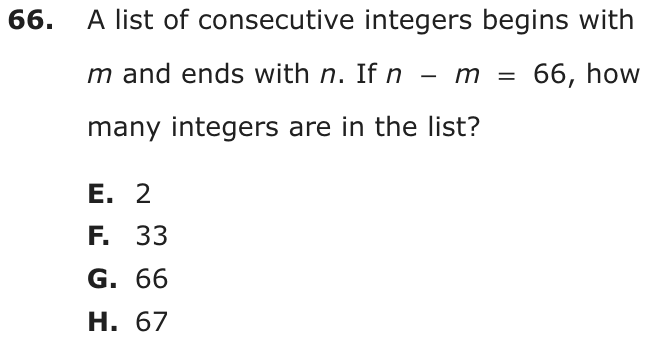
Question 65 of 120
2024 Test A Math, question 10Question
Simplify:
- A
- B
- C
- D
Show the answer
Correct answer: A
Divide the first 39 by 3.
Distribute 13 through .
In the numerator, the terms −39 and 39 cancel out.
Finally, divide the numerator and denominator by 13 to get x.
Question analysis
An algebra question that asks students to simplify a stacked fraction: 39 times (x − 3) over 3, plus 39, all divided by 13. It tests dividing, distributing and combining like terms in the right order. The nested fraction bars make it easy to divide only some of the terms or to distribute to only one.
- NYS standards
- Grade level
- Grade 7 content, by NYS standard
- Compared with grade 7
- At grade 7 Grade 7 students expand and simplify linear expressions such as 13(x − 3) + 39. This wraps that work inside two fraction bars, which adds reading load and chances to misstep but no new mathematics.
- Estimated difficulty
- Straightforward: two steps or one careful reading.
- Thinking it demands
- Depth of knowledge 1, recall and reproduction · mainly apply
- What makes it hard
- Error-prone arithmetic moderate
- Many steps minor
- Solution
- 3 steps
- Reading level
- Question and choices: about grade 16+, 6 words.
- Students, last 30 days
- Not enough answers yet to show (it takes 10).
Why it is hard, traps and wrong answers (shows the answer)
Why it is hard
The expression looks heavier than it is: every number is a multiple of 13, and the constants cancel to leave a single term. What makes it risky is scope, knowing which terms each fraction bar and each multiplier covers. Each wrong choice comes from stretching or shrinking that scope by one term, so working outward from the innermost parentheses, one line per step, is the safe way.
Error-prone arithmetic moderate Working it out
Two fraction bars are nested: 39 ÷ 3 applies only to the first term, the 13 must reach both x and −3, and only then does the whole numerator divide by 13. (Brown & Burton, 1978; Junker & Sijtsma, 2001)
Many steps minor Working it out
Four moves come in a fixed order, divide 39 by 3, distribute 13, cancel −39 with +39, divide by 13, and each is a chance to apply a step to the wrong terms. (Daniel & Embretson, 2010; Enright, Morley & Sheehan, 2002)
Strategy: Work from the inside out: divide 39 by 3, distribute through the parentheses, combine the constants in the numerator, and only then divide everything by 13.
Traps
- A faulty procedure: A systematic but wrong procedure: adding fractions straight across, applying an exponent to each term of a sum, dropping a sign when moving a term.
- Order of operations: Working left to right, or distributing a minus sign wrongly, gives a choice.
The wrong answers, classified
B Order of operations (Brown & Burton, 1978)
Reads the inner fraction bar as covering the added 39 too, so the numerator becomes 13(x − 3) + 13 = 13x − 26, and dividing by 13 gives x − 2.
C Order of operations (Brown & Burton, 1978)
Divides only the last 39 by 13, leaving 13(x − 3) + 3 = 13x − 36, as if the outer fraction bar covered a single term.
D A faulty procedure (Brown & Burton, 1978; Tatsuoka, 1983)
Distributes the 13 to x but not to −3, so the numerator becomes 13x − 3 + 39 = 13x + 36, and dividing by 13 leaves a fraction.
Worked solution, step by step
Formulas used
- Distributive property
- a is the number outside the parentheses. b and c are the terms inside. Multiply a by each term inside, and keep the minus sign between them. It works because a groups of (b − c) are a groups of b, take away a groups of c.
Sort out the expression
You need to simplify the big fraction, which means write it in its shortest form. It has a small fraction inside its top. The top is , and the bottom is 13. Work from the inside out, one step at a time.
Divide the first 39 by 3
The small fraction bar is only under . So divide just that 39 by 3.
Now the top is . Watch out: the small bar does not reach the added 39. Dividing that 39 by 3 as well leads to , choice B.
Multiply out the parentheses
Watch out: multiply the 3 by 13 too, not just the x. Leaving −3 as it is leads to choice D.
Combine the plain numbers on top
−39 and 39 add up to 0, so they cancel. The top is now just 13x, which means 13 times x.
Divide by the bottom
Now divide the whole top by 13. Dividing by 13 undoes times 13.
Watch out: the long bar is under the whole top. Dividing only the last 39 by 13 gives , choice C. So the answer is A, .
Check your answer
Try x = 5. Then and . Next, and . Last, . You get back 5, the same as x. So x is right.
More questions like this
The original DOE question
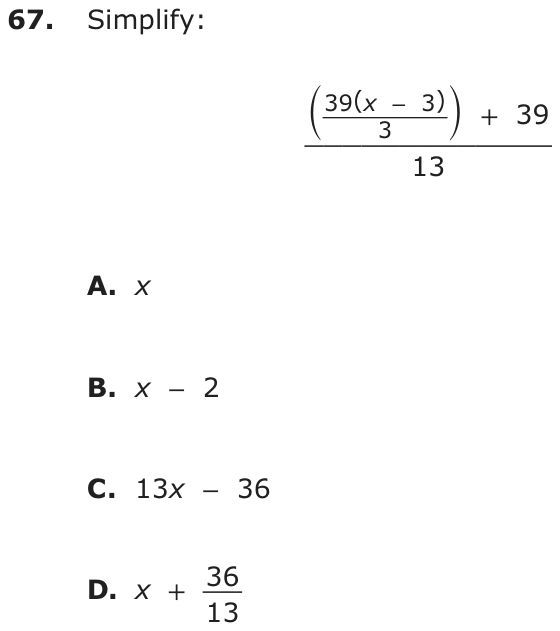
Question 66 of 120
2024 Test A Math, question 11Question
Jar 1 and Jar 2 each contain cup of water. If of the water in Jar 1 is poured into Jar 2, how much water is now in Jar 2?
- A cup
- B cup
- C cup
- D cup
Show the answer
Correct answer: C
Jar 1 starts with cup of water. If of its water is poured into Jar 2, then the amount of water added to Jar 2 is cup.
Jar 2 starts with cup of water. If cup of water is added to it, then the amount of water now in Jar 2 is cup.
Question analysis
A fraction word problem about two jars that each hold half a cup of water; a quarter of the water in the first jar is poured into the second. Students find how much water the second jar now holds. Reading exactly what the quarter is a quarter of is the detail that matters.
- NYS standards
- 7.NS.3 four operations with rational numbers
- Grade level
- Grade 7 content, by NYS standard
- Compared with grade 7
- Below grade 7 Multiplying and adding positive fractions is review by grade 7, and the problem takes two short steps. It is easier than typical grade 7 work with negative numbers or longer rational-number problems, apart from careful reading.
- Estimated difficulty
- Straightforward: two steps or one careful reading.
- Thinking it demands
- Depth of knowledge 2, skills and concepts · mainly apply
- What makes it hard
- Turning words into math moderate
- Error-prone arithmetic minor
- Solution
- 2 steps
- Reading level
- Question and choices: about grade 4, 35 words.
- Students, last 30 days
- Not enough answers yet to show (it takes 10).
Why it is hard, traps and wrong answers (shows the answer)
Why it is hard
The numbers are friendly halves, quarters and eighths, and the work is two steps. The question turns on one phrase: the quarter is a fraction of Jar 1's water, not a measured quarter cup, and reading it the second way gives a choice that looks right. Students who also remember that Jar 2 already held water finish correctly.
Turning words into math moderate Understanding the question
The phrase "1/4 of the water in Jar 1" means a quarter of Jar 1's half cup, an eighth of a cup, not a quarter cup; the word of calls for multiplying. (Hegarty, Mayer & Monk, 1995; Koedinger & Nathan, 2004)
Error-prone arithmetic minor Working it out
Adding the 1/8 cup to Jar 2's 1/2 cup needs the common denominator 8, so 1/2 becomes 4/8 before the sum. (Brown & Burton, 1978; Junker & Sijtsma, 2001)
Strategy: Find the amount poured by taking one quarter of Jar 1's half cup, then add that amount to the half cup already in Jar 2.
Traps
- Stops one step early: A choice is a number from partway through the solution.
- Misreads the question: Misses or misreads a condition or a word in the question: "at least", "each", "remaining", "not".
The wrong answers, classified
A Stops one step early (King et al., 2004; Gierl et al., 2017)
Finds the amount poured, 1/4 of 1/2 cup = 1/8 cup, and stops there instead of adding it to the half cup already in Jar 2.
B Numbers taken from the question (Hegarty, Mayer & Monk, 1995)
Picks the fraction 1/4 straight from the question, as if the share poured were the amount of water now in Jar 2.
D Misreads the question (Hegarty, Mayer & Monk, 1995)
Reads 1/4 of the water as 1/4 cup and adds it to Jar 2's half cup, 1/2 + 1/4 = 3/4.
Worked solution, step by step
Formulas used
- Fraction of an amount
- N is the whole amount, and a over b is the part of it you want. In math, the word of means multiply. For example, half of 10 is one half times 10, which is 5.
- Multiplying fractions
- a and c are the tops, and b and d are the bottoms. Multiply the tops together and the bottoms together. Taking a part of a part makes the pieces smaller, so the bottom gets bigger.
- Adding fractions with the same bottom
- a and b are the tops, and d is the shared bottom, called the denominator. If the bottoms match, add the tops and keep the bottom. If they do not match, rewrite one fraction first.
Sort out the question
Each jar starts with cup of water. You pour “ of the water in Jar 1” into Jar 2. You need how much water is in Jar 2 after that, in cups.
Find how much water is poured
Jar 1 has cup. You pour of it. Of means multiply.
You pour cup. Watch out: a quarter of the water is not a quarter cup. It is a quarter of a half cup. Adding cup gives cup, choice D.
Make the bottoms match
Now add the poured water to the cup already in Jar 2. The bottoms are 2 and 8, so rewrite the half with 8 on the bottom. Multiply its top and bottom by 4.
Add the water in Jar 2
Jar 2 now holds cup. Watch out: cup is only the water poured in. Stopping there gives choice A. So the answer is C, cup.
Check your answer
Jar 2 started with a half cup and got a little more. So it should hold just over a half cup, and is. Also, the water in both jars still adds up to 1 cup: Jar 1 has cup left, and .
More questions like this
The original DOE question
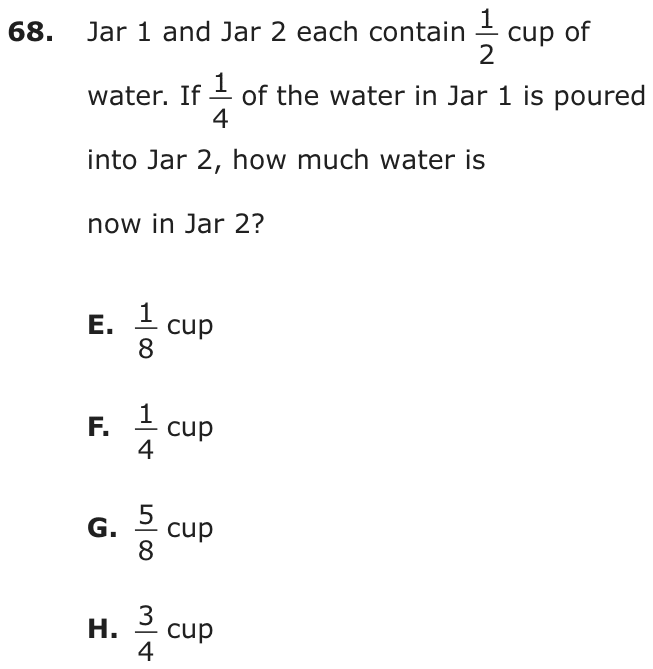
Question 67 of 120
2024 Test A Math, question 12Question
If n is a whole number, and 0.01 is between and , what is the value of n?
- A0
- B1
- C2
- D99
Show the answer
Correct answer: D
, which is between and .
Therefore, and .
Question analysis
A number sense question: 0.01 lies between 1 over n and 1 over n + 2, where n is a whole number, and students find n. It tests comparing a decimal with unit fractions and knowing how a fraction changes as its denominator grows. The unusual form, with n in two denominators, is what slows students down.
- Grade level
- Grade 6 content, by NYS standard
- Compared with grade 7
- At grade 7 Grade 7 students compare fractions and decimals routinely, but not with an unknown in the denominators. The comparison is simple once 0.01 is written as a fraction; the unfamiliar setup is the main demand.
- Estimated difficulty
- Straightforward: two steps or one careful reading.
- Thinking it demands
- Depth of knowledge 2, skills and concepts · mainly apply
- What makes it hard
- Variables instead of numbers moderate
- Something you must already know minor
- Solution
- 2 steps
- Reading level
- Question and choices: about grade 9, 18 words.
- Students, last 30 days
- Not enough answers yet to show (it takes 10).
Why it is hard, traps and wrong answers (shows the answer)
Why it is hard
The setup looks unfamiliar, with n in two denominators, but one rewrite makes it routine: 0.01 is 1/100, so the two denominators must sit on either side of 100. The three small choices fail a quick check, since every fraction from 1/1 to 1/4 is far above 0.01, and 0 cannot be a denominator at all. Students who test the choices instead of rewriting the decimal spend a little longer but reach the same place.
Variables instead of numbers moderate Understanding the question
The unknown sits in two denominators, n and n + 2, so students must reason about which unit fractions lie on either side of 0.01 rather than solve an equation. (Koedinger & Nathan, 2004; Enright, Morley & Sheehan, 2002)
Something you must already know minor Working it out
Two facts are assumed: 0.01 equals 1/100, and a unit fraction shrinks as its denominator grows, so 1/99 is just above 0.01 and 1/101 just below. (Anderson & Krathwohl, 2001)
Strategy: Rewrite 0.01 as a unit fraction, recall that a larger denominator gives a smaller fraction, and test each choice in both 1/n and 1/(n + 2).
Traps
- Misunderstands the concept: A wrong belief about a concept: that percents can be added, that area grows like length, that averages can be averaged, that a bigger denominator means a bigger fraction.
- Numbers taken from the question: Combines the numbers in the question without a model of the situation, or is simply a number that appears in the question.
The wrong answers, classified
A Misunderstands the concept (Smith, diSessa & Roschelle, 1993; De Bock et al., 1998; Ni & Zhou, 2005)
Treats 1/0 as 0, so 0.01 seems to lie between 0 and 1/2; but division by zero is undefined, so n cannot be 0.
B Numbers taken from the question (Hegarty, Mayer & Monk, 1995)
Takes the 1 from 0.01 or from 1/n as the value of n, without checking that 0.01 is far below both 1 and 1/3.
C Numbers taken from the question (Hegarty, Mayer & Monk, 1995)
Takes the 2 from n + 2, or the two decimal places of 0.01, without testing 1/2 and 1/4, which are both far above 0.01.
Worked solution, step by step
Formulas used
- Comparing unit fractions
- A unit fraction has 1 on top, like one fifth. a and b are positive whole numbers on the bottom. A bigger bottom cuts the whole into more pieces, so each piece is smaller. So the fraction with the bigger bottom is the smaller number.
Sort out the question
n is a whole number: 0, 1, 2, 3 and so on. The number 0.01 is between and . Between means one fraction is bigger than 0.01 and the other is smaller. You need the value of n.
Write 0.01 as a fraction
0.01 means one hundredth.
Now all three numbers are fractions with 1 on top. That makes them easy to compare.
Find fractions on each side
With 1 on top, a bigger bottom makes a smaller fraction.
So is a little more than , and is a little less.
The bottoms 99 and 101 are 2 apart, just like n and n + 2.
Match the fractions to n
The smaller bottom is n, and the larger bottom is n + 2.
Both fit. Watch out: small choices do not work. For n = 1, the fractions are 1 and . Both are far bigger than 0.01. For n = 0, is not a number, because you can’t divide by zero. So the answer is D, 99.
Check your answer
Write the fractions as decimals. , a bit more than 0.01. , a bit less. The sign ≈ means about. So 0.01 sits right between them.
More questions like this
The original DOE question
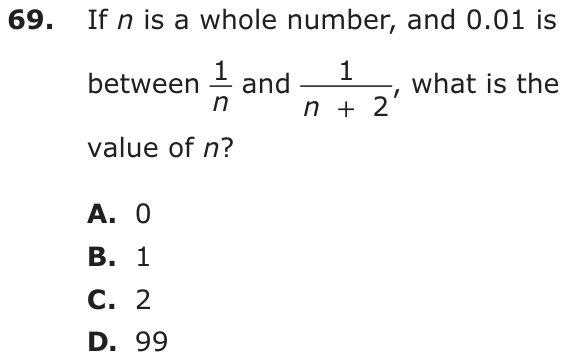
Question 68 of 120
2024 Test A Math, question 13Question
When asked a certain question in a poll, 72% of the people polled answered yes. If 56 people did not answer yes to that question, what is the total number of people who were polled?
- A78
- B128
- C144
- D200
Show the answer
Correct answer: D
72% of the people polled answered yes, so 28% of the people did not answer yes.
Therefore, 56 people is 28% of the total, x.
Question analysis
A percent word problem about a poll: 72% of the people answered yes, and 56 people did not. Students find the total number of people polled. They must first match the 56 people with the right percent and then find the whole from a part, which is where the main slip happens.
- Grade level
- Grade 7 content, by NYS standard
- Compared with grade 7
- At grade 7 Finding a whole from a part and a percent is grade 6 and 7 work. This adds one short step, finding the complementary percent first, which makes it a standard grade 7 multistep percent problem.
- Estimated difficulty
- Moderate: several steps, or a close reading with one strong distractor.
- Thinking it demands
- Depth of knowledge 2, skills and concepts · mainly apply
- What makes it hard
- Turning words into math moderate
- Error-prone arithmetic minor
- Solution
- 2 steps
- Reading level
- Question and choices: about grade 6, 33 words.
- Students, last 30 days
- Not enough answers yet to show (it takes 10).
Why it is hard, traps and wrong answers (shows the answer)
Why it is hard
The only percent printed is 72 and the only count is 56, so the first instinct is to pair them, even though the bold not says they describe different groups. Once 56 is matched with the 28% who did not say yes, a single division finds the total. The listed wrong answers come from that mismatch, from adding the two numbers, and from stopping at the yes count.
Turning words into math moderate Understanding the question
The 56 people are the ones who did not answer yes, so they match 100% − 72% = 28%, not the 72% printed in the sentence before them. (Hegarty, Mayer & Monk, 1995; Koedinger & Nathan, 2004)
Error-prone arithmetic minor Working it out
Finding the total means 56 ÷ 0.28, a division by a decimal; scaling 28% up to 100% at 2 people per percent avoids it. (Brown & Burton, 1978; Junker & Sijtsma, 2001)
Strategy: Subtract 72% from 100% to find the percent who did not answer yes, then find the total that makes 56 equal to that percent.
Traps
- Misreads the question: Misses or misreads a condition or a word in the question: "at least", "each", "remaining", "not".
- Answers a different question: A choice is right for another quantity: the other unknown, the rest instead of the part, the part instead of the whole.
- Misunderstands the concept: A wrong belief about a concept: that percents can be added, that area grows like length, that averages can be averaged, that a bigger denominator means a bigger fraction.
The wrong answers, classified
A Misreads the question (Hegarty, Mayer & Monk, 1995)
Overlooks the bold not and pairs the 56 people with the 72% who said yes: 56 ÷ 0.72 ≈ 77.8, rounded to 78.
B Misunderstands the concept (Smith, diSessa & Roschelle, 1993; De Bock et al., 1998; Ni & Zhou, 2005)
Reads the 72% as a fixed 72 people and adds the 56 who did not say yes, 72 + 56 = 128, instead of treating 72% as a share of the unknown total.
C Answers a different question (King et al., 2004; Hegarty, Mayer & Monk, 1995)
Gets 2 people per percent from 56 ÷ 28 but multiplies by 72 instead of 100, finding the 144 who answered yes rather than everyone polled.
Worked solution, step by step
Formulas used
- Percent of a whole
- The whole is the total amount, here everyone polled. p is the percent. The part is the amount that p percent stands for. Percent means out of 100, so p% is p hundredths of the whole.
Sort out the question
In a poll, 72% of the people answered yes. 56 people did not answer yes. You need the total number of people polled. Notice the bold word not. The 56 people are the ones who did not say yes.
Find the percent who did not say yes
Everyone polled makes 100%. Take away the 72% who said yes.
So 28% did not answer yes. That is the group of 56 people. Watch out: do not match the 56 people with 72%. That leads to about 78, choice A.
Set up the percent equation
Call the total number of people T. The 56 people are 28% of T.
Solve for the total
First find how many people make 1%. Divide 56 people by 28.
So each 1% is 2 people. All 100% is 100 times that.
Watch out: do not multiply 2 by 72. That gives 144, the people who said yes, choice C. So the answer is D, 200.
Check your answer
Find 28% of 200: . That matches the people who did not say yes. Also, 72% of 200 is 144 people who said yes, and , everyone.
More questions like this
The original DOE question
Question 69 of 120
2024 Test A Math, question 14Question
A museum has a room in the shape of a rectangle. The area of the floor is 960 square feet. In a scale drawing of the museum, 1 inch = 20 feet. If the length of the room is 2 inches in the scale drawing, what is the width of this room in the scale drawing?
- A in.
- B in.
- C24 in.
- D40 in.
Show the answer
Correct answer: A
The scale is 1 inch = 20 feet, and the length in the scale drawing is 2 inches, so the actual length is 40 feet.
The actual width is 24 feet.
Let x equal the width of the scale drawing, in inches.
Question analysis
A scale drawing problem: a museum room has a floor area of 960 square feet, the drawing's scale is 1 inch to 20 feet, and the room is 2 inches long in the drawing. Students find the room's width in the drawing. They must move between drawing inches and real feet, and back again, without mixing them.
- Grade level
- Grade 7 content, by NYS standard
- Compared with grade 7
- At grade 7 Scale drawings are grade 7 content, and grade 7 tasks usually convert one length. This one converts to real size, uses the area to find a second side, and converts back: three steps with a units trap.
- Estimated difficulty
- Moderate: several steps, or a close reading with one strong distractor.
- Thinking it demands
- Depth of knowledge 2, skills and concepts · mainly apply
- What makes it hard
- Combines ideas moderate
- Much to keep track of minor
- Solution
- 3 steps
- Reading level
- Question and choices: about grade 2, 57 words.
- Students, last 30 days
- Not enough answers yet to show (it takes 10).
Why it is hard, traps and wrong answers (shows the answer)
Why it is hard
Scale questions usually convert one length; this one needs a round trip, from the drawing to the real room and back. The real width of 24 feet appears partway through and is a choice, so students who lose track of units stop there. The last conversion, 24/20, then has to be written as a mixed number, and its fraction part is where a hurried student slips.
Combines ideas moderate Working it out
The 960 square feet is a real-world area, so the scale cannot be applied to it directly; the length must go to feet, the width come from the area, and then return to inches. (Embretson, 1998; Daniel & Embretson, 2010)
Much to keep track of minor Working it out
Four lengths in two units are in play, 2 inches, 40 feet, 24 feet and the width on the drawing, and each must stay labeled with its unit. (Sweller, 1988; Carpenter, Just & Shell, 1990)
Strategy: Convert the 2-inch length to real feet, divide the area by it to get the real width, then use the scale to change that width back to inches.
Traps
- Units or scale: The answer is wanted in other units, or a rate or scale must be converted first.
- Answers a different question: A choice is right for another quantity: the other unknown, the rest instead of the part, the part instead of the whole.
The wrong answers, classified
B An arithmetic slip (Junker & Sijtsma, 2001)
Gets the real width of 24 feet and divides by 20 correctly, but writes the remainder 4/20 as 1/4 instead of 1/5.
C Units or scale (King et al., 2004)
Finds the room's real width, 960 ÷ 40 = 24 feet, and gives it as the drawing's width without converting back at 1 inch per 20 feet.
D Answers a different question (King et al., 2004; Hegarty, Mayer & Monk, 1995)
Converts the 2-inch length to the real 40 feet and gives that number, answering for the length instead of the width and in the wrong units.
Worked solution, step by step
Formulas used
- Area of a rectangle
- A is the area, the space the floor covers. l is the length and w is the width. The floor is like rows of 1-foot squares, with w rows and l squares in each row. So you multiply.
- Using the scale
- The scale says 1 inch on the drawing stands for 20 feet in the real room. The drawing length is in inches, and the real length is in feet. To go back from feet to inches, divide by 20.
Sort out the question
The real room is a rectangle with a floor area of 960 square feet. On the drawing, 1 inch stands for 20 feet. The room is 2 inches long on the drawing. You need its width on the drawing, in inches. The area is in real feet, so you must switch between the drawing and the room.
Find the real length
The real room is 40 feet long. Watch out: 40 is the real length, not the width on the drawing. Choosing 40 in., choice D, is wrong.
Find the real width
Use the area of the rectangle. You know the area and the length.
The real room is 24 feet wide. Watch out: this width is in real feet. Choosing 24 in., choice C, skips changing it back to the drawing.
Change the width to the drawing
Every 20 feet is 1 inch on the drawing. So undo the scale: divide the real width by 20.
To simplify , divide the top and bottom by 4. Watch out: it is , not , so choice B is wrong. So the answer is A, in.
Check your answer
Go the other way. On the drawing, the room is 2 inches by inches. In real feet that is 40 by 24, since . And square feet, the real area.
More questions like this
The original DOE question
Question 70 of 120
2024 Test A Math, question 15Question
A program on a computer randomly generates a sequence of whole numbers from 1 to 9, inclusive. If the computer generates a sequence of 300 numbers, what is the best prediction of the number of odd numbers in the sequence?
- A120
- B133
- C150
- D167
Show the answer
Correct answer: D
There are five odd numbers in the range 1 through 9: 1, 3, 5, 7, and 9.
So the proportion of odd numbers in the range 1 through 9 is .
The expected number of odd values in the sequence from the computer program is
So the best prediction for the number of odd numbers in the sequence is 167.
Question analysis
A probability question: a computer randomly generates 300 whole numbers from 1 to 9, and students predict how many will be odd. It asks students to find the probability of an odd number and use it to predict a count. Counting carefully which of the nine numbers are odd, and rounding the prediction sensibly, are the points to watch.
- Grade level
- Grade 6 content, by NYS standard
- Compared with grade 7
- At grade 7 Using a probability to predict how often an event happens is grade 6 and 7 work. This takes two short steps plus a rounding decision, about the demand of a typical grade 7 probability task.
- Estimated difficulty
- Straightforward: two steps or one careful reading.
- Thinking it demands
- Depth of knowledge 2, skills and concepts · mainly apply
- What makes it hard
- Solution
- 3 steps
- Reading level
- Question and choices: about grade 11, 37 words.
- Students, last 30 days
- Not enough answers yet to show (it takes 10).
Why it is hard, traps and wrong answers (shows the answer)
Why it is hard
The method is short, a probability times 300, so the question is decided by the probability. Odd and even feel like an even split, and half of 300 is a listed choice, but the numbers 1 to 9 hold five odd and four even. Listing the nine numbers before computing removes the trap, and the result, about 167, then needs only rounding.
Turning words into math minor Understanding the question
The phrase "whole numbers from 1 to 9, inclusive" means nine equally likely values, five of them odd, so the chance of odd is 5/9, not the one half that odd and even suggest. (Hegarty, Mayer & Monk, 1995; Koedinger & Nathan, 2004)
Something you must already know minor Working it out
The stem never says that an expected count is the probability times the number of trials, here 5/9 of the 300 numbers generated. (Anderson & Krathwohl, 2001)
Error-prone arithmetic minor Working it out
The product 300 × 5/9 is 166.67, not a whole number, so the prediction has to be rounded to the nearest whole number. (Brown & Burton, 1978; Junker & Sijtsma, 2001)
Strategy: Count the odd numbers from 1 to 9, write the probability as that count over 9, and multiply by 300, rounding to the nearest whole number.
Traps
- Misunderstands the concept: A wrong belief about a concept: that percents can be added, that area grows like length, that averages can be averaged, that a bigger denominator means a bigger fraction.
- Answers a different question: A choice is right for another quantity: the other unknown, the rest instead of the part, the part instead of the whole.
The wrong answers, classified
A Little reason to choose it (Haladyna & Downing, 1993; Rodriguez, 2005)
No count of the nine numbers gives 120, which is 40% of 300; reaching it takes two errors at once, so it mostly attracts guesses.
B Answers a different question (King et al., 2004; Hegarty, Mayer & Monk, 1995)
Counts the four even numbers instead of the five odd ones and predicts 4/9 of 300, about 133.
C Misunderstands the concept (Smith, diSessa & Roschelle, 1993; De Bock et al., 1998; Ni & Zhou, 2005)
Assumes odd and even numbers are equally likely and takes half of 300, ignoring that 1 to 9 holds one more odd number than even.
Worked solution, step by step
Formulas used
- Probability
- P is the probability, the chance that something happens. Possible results are all the results that are equally likely. Wanted results are the ones you are looking for. The chance is the fraction of the results that you want.
- Expected count
- E is the expected count, your best guess of how many times something will happen. P is its probability, and n is the number of tries. If something happens 5 times out of 9, it should happen about 5 ninths of the time in many tries.
Sort out the question
The computer picks whole numbers from 1 to 9. Inclusive means 1 and 9 count too. Randomly means each number has the same chance. It picks 300 numbers. You need the best guess of how many of them are odd.
Count the odd numbers
An odd number does not split evenly by 2. From 1 to 9, the odd numbers are 1, 3, 5, 7 and 9. That is 5 of the 9 numbers. The even ones, 2, 4, 6 and 8, are only 4. Watch out: odd and even are not equally likely here, since there is one more odd number. Taking half of 300 gives 150, choice C.
Find the chance of odd
Each number the computer picks has a 5 in 9 chance of being odd. Watch out: do not use the 4 even numbers. That gives about 133, choice B.
Multiply by the 300 numbers
The sign ≈ means about. You can’t have part of a number, so round to the nearest whole number. 166.7 is closer to 167 than to 166. So the answer is D, 167.
Check your answer
The odd numbers are a bit more than half of the nine. So the answer should be a bit more than half of 300, which is 150. Only 167 is a bit more than 150. Also, 167 odd plus about 133 even makes 300.
More questions like this
The original DOE question
Question 71 of 120
2024 Test A Math, question 16Question
A truck rental company charges a one-time fee of $40 plus $1 per mile driven. Dalia rented a truck and used a coupon for 20% off the total rental cost. After the coupon was applied, she spent a total of $60. How many miles did she drive?
- A8
- B20
- C32
- D35
Show the answer
Correct answer: D
Let m equal the miles driven during Dalia’s rental. The total cost, c, can be expressed as an equation.
Dalia spent a total of $60, which included a 20% off coupon. Find the cost before the coupon by dividing the final cost ($60) by the percentage paid (80%):
Use $75 as the total cost to find m.
Dalia drove 35 miles.
Question analysis
A multistep word problem about a truck rental that costs a $40 fee plus $1 per mile, with a 20% off coupon applied to the total. Given that Dalia paid $60 after the coupon, students find how many miles she drove. Undoing the discount correctly before removing the fixed fee is the hard part.
- Grade level
- Grade 7 content, by NYS standard
- Compared with grade 7
- Above grade 7 Grade 7 students solve two-step equations and work with discounts, usually separately. This combines them and makes students undo a 20% discount starting from the price paid, a reversal many grade 7 students have not practised.
- Estimated difficulty
- Hard: combines ideas, needs a plan, and has more than one tempting wrong answer.
- Thinking it demands
- Depth of knowledge 2, skills and concepts · mainly apply
- What makes it hard
- Turning words into math moderate
- Combines ideas moderate
- A very close wrong answer moderate
- Solution
- 3 steps
- Reading level
- Question and choices: about grade 5, 43 words.
- Students, last 30 days
- Not enough answers yet to show (it takes 10).
Why it is hard, traps and wrong answers (shows the answer)
Why it is hard
Two ordinary skills, undoing a discount and solving a two-step equation, are stacked, and the first runs in reverse. The natural way to undo 20% off is to add 20% back, which gives $72 instead of $75 and a choice three miles from the answer. Students who check by applying the coupon to the full cost of 40 + 35 = 75 dollars see at once that 80% of it is 60.
Turning words into math moderate Understanding the question
The sentence "After the coupon was applied, she spent a total of $60" makes 60 the price after 20% off, so it is 80% of the full cost, 40 + m. (Hegarty, Mayer & Monk, 1995; Koedinger & Nathan, 2004)
Combines ideas moderate Working it out
A percent discount has to be undone before the fee-plus-mileage equation can be solved: 60 ÷ 0.8 = 75, then 75 − 40 = 35 miles. (Embretson, 1998; Daniel & Embretson, 2010)
A very close wrong answer moderate Choosing the answer
The choices 32 and 35 are three miles apart, too close to tell apart by estimate; only dividing 60 by 0.8, rather than adding 20% of 60, separates them. (Embretson & Wetzel, 1987; Gorin & Embretson, 2006; Ascalon et al., 2007)
Strategy: Since $60 is 80% of the full cost, divide 60 by 0.80 to find the cost before the coupon, then subtract the $40 fee to get the miles.
Traps
- Percent of the wrong amount: Finding the whole from a part, or a percent change measured from the wrong starting amount.
- Misreads the question: Misses or misreads a condition or a word in the question: "at least", "each", "remaining", "not".
The wrong answers, classified
A Wrong operation (Hegarty, Mayer & Monk, 1995; King et al., 2004)
Takes 20% off the $60 again, 60 × 0.8 = 48, instead of undoing the discount, then subtracts the $40 fee to get 8 miles.
B Misreads the question (Hegarty, Mayer & Monk, 1995)
Ignores the coupon and treats the $60 as the full cost, so it subtracts the $40 fee and gets 20 miles.
C Percent of the wrong amount (Parker & Leinhardt, 1995)
Undoes the coupon by adding 20% of $60 to get $72, though the 20% was taken of the larger pre-coupon cost, then subtracts the $40 fee.
Worked solution, step by step
Formulas used
- Rental cost
- c is the full cost in dollars, before any coupon. 40 is the one-time fee, paid once no matter how far you drive. m is the number of miles, and each mile costs 1 dollar.
- Price after a discount
- The full cost is the price before the discount. p is the percent taken off. You pay what is left: 100% minus p%. For 20% off you pay 80%, so you multiply by 0.80.
Sort out the question
The truck costs a $40 fee, plus $1 for each mile. Dalia’s coupon took 20% off the total. After the coupon, she paid $60. You need how many miles she drove. The $60 is the price after the discount, not the full cost.
Write what she paid
20% off means she paid what was left of the full cost.
As a decimal, 80% is 0.80.
Undo the discount
To undo times 0.80, divide by 0.80. Move the decimal point one place in both numbers to make it easier.
The full cost was $75. Watch out: the 20% was taken off the full cost, not off $60. Adding 20% of $60 gives $72 and leads to 32 miles, choice C. Taking 20% off $60 again leads to 8 miles, choice A.
Find the miles
She drove 35 miles. Watch out: do not skip the coupon. Using $60 as the full cost gives 20 miles, choice B. So the answer is D, 35.
Check your answer
Go forward. 35 miles cost $35. Add the $40 fee to get $75. The coupon takes off 20% of $75, which is dollars. Then . That is exactly what she paid.
More questions like this
The original DOE question
Question 72 of 120
2024 Test A Math, question 17Question
The probability of drawing a red candy at random from a bag of 25 candies is . After 5 red candies are removed from the bag, what is the probability of randomly drawing a red candy from the bag?
- A0
- B
- C
- D
Show the answer
Correct answer: D
Start with a proportion to determine the total number of red candies in the bag:
There are currently 10 red candies out of 25 candies in the bag. After 5 red candies are removed, there would be 5 red candies left in the bag and 20 total candies.
The probability of randomly drawing a red candy would then be .
Question analysis
A probability question about a bag of 25 candies in which the chance of drawing red is 2/5; then 5 red candies are taken out. Students find the new probability of drawing a red candy. They must work out how many red candies there were, then rebuild the fraction from the counts left in the bag.
- Grade level
- Grade 6 content, by NYS standard
- Compared with grade 7
- At grade 7 Simple probability as a fraction of outcomes is grade 6 and 7 content. This adds a step back from the probability to a count and an update after removal, which is typical grade 7 multi-step work.
- Estimated difficulty
- Moderate: several steps, or a close reading with one strong distractor.
- Thinking it demands
- Depth of knowledge 2, skills and concepts · mainly apply
- What makes it hard
- Turning words into math moderate
- Many steps minor
- Solution
- 3 steps
- Reading level
- Question and choices: about grade 7, 40 words.
- Students, last 30 days
- Not enough answers yet to show (it takes 10).
Why it is hard, traps and wrong answers (shows the answer)
Why it is hard
The question gives a probability, not a count, so the first job is to rebuild the bag: 10 red candies among 25. Removing candies changes two numbers at once, and the strongest wrong choice comes from updating the red count while leaving the total at 25. A student who writes both new counts before forming the fraction avoids it.
Turning words into math moderate Understanding the question
The probability 2/5 has to be turned into a count, 10 red of 25, and "after 5 red candies are removed" lowers both the red count and the bag's total. (Hegarty, Mayer & Monk, 1995; Koedinger & Nathan, 2004)
Many steps minor Working it out
Three steps follow in order: 2/5 of 25 = 10, then 5 red among 20 candies left, then 5/20 reduced to lowest terms. (Daniel & Embretson, 2010; Enright, Morley & Sheehan, 2002)
Strategy: Use 2/5 of 25 to find the number of red candies, subtract 5 from both the red count and the total, and write the new fraction in lowest terms.
Traps
- Misreads the question: Misses or misreads a condition or a word in the question: "at least", "each", "remaining", "not".
The wrong answers, classified
A An arithmetic slip (Junker & Sijtsma, 2001)
Takes 2/5 of 25 as 25 ÷ 5 = 5, forgetting to multiply by 2, so removing 5 red candies seems to leave none.
B Little reason to choose it (Haladyna & Downing, 1993; Rodriguez, 2005)
No working gives 1/10, which would need 2 red candies among the 20 left; it mostly draws students who are guessing.
C Misreads the question (Hegarty, Mayer & Monk, 1995)
Subtracts the 5 removed candies from the 10 red ones but keeps 25 as the total, finding 5/25 = 1/5, though the bag now holds 20.
Worked solution, step by step
Formulas used
- Probability
- P is the probability, the chance of drawing a red candy. Red candies is how many red ones are in the bag. All candies is how many candies are in the bag in all. Each candy is equally likely, so the chance is the fraction of the bag that is red.
Sort out the question
The bag has 25 candies. The chance of drawing red is . Then 5 red candies are taken out. You need the new chance of drawing red. Taking out candies changes both the red count and the total.
Find the number of red candies
A chance of means 2 out of every 5 candies are red. Call the red count r.
There are 10 red candies. Watch out: do not stop at . You must also multiply by 2. Thinking there are 5 red candies leads to 0, choice A.
Take out the 5 red candies
Now 5 of the 20 candies are red. Watch out: the total goes down too. Keeping 25 gives , choice C.
Find the new probability
To simplify, divide the top and bottom by 5. So the answer is D, .
Check your answer
At first, is 40% of the bag. Taking out only red candies should lower the chance. is 25%, which is lower but not zero. That makes sense, because 5 red candies are still in the bag.
More questions like this
The original DOE question
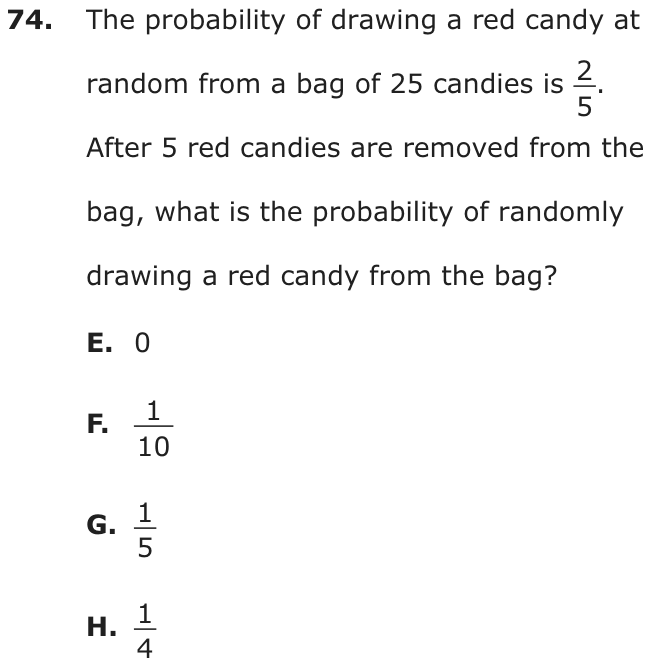
Question 73 of 120
2024 Test A Math, question 18Question
Each number in a sequence is formed by doubling the previous number and then adding 1. If the 9th number in the sequence is 63, what is the 10th number minus the 7th number?
- A96
- B111
- C112
- D127
Show the answer
Correct answer: C
First, write an equation based on the rule described in the item. Let x be the previous number in the sequence and y be the number in the sequence. The ninth number in the sequence is 63.
Determine the 10th number in the sequence, y, by making and solving:
Determine the 8th number in the sequence, x, by making and solving:
Subtract one from both sides of the equation.
Determine the 7th number in the sequence, x, by making and solving:
Subtract the 7th number in the sequence from the 10th number:
The difference is 112.
Question analysis
A sequence question: each number is found by doubling the one before it and adding 1, and the 9th number is 63. Students find the 10th number minus the 7th. That means running the rule forward once and backward twice, while keeping track of which position each number holds.
- Grade level
- Grade 7 content, by NYS standard
- Compared with grade 7
- Above grade 7 Grade 7 students solve two-step equations but rarely have to run a rule backward through a sequence. This mixes forward and backward steps with position counting, so it asks for more planning than a typical grade 7 task.
- Estimated difficulty
- Hard: combines ideas, needs a plan, and has more than one tempting wrong answer.
- Thinking it demands
- Depth of knowledge 2, skills and concepts · mainly apply
- What makes it hard
- No obvious method moderate
- Many steps moderate
- Much to keep track of minor
- Solution
- 4 steps
- Reading level
- Question and choices: about grade 7, 32 words.
- Corrected from the DOE handbook
- A misplaced parenthesis in the explanation’s working was corrected.
- Students, last 30 days
- Not enough answers yet to show (it takes 10).
Why it is hard, traps and wrong answers (shows the answer)
Why it is hard
Applying the rule forward is routine; running it backward is not, and the question needs both. Students must also count positions carefully, since the 9th number is given and the 7th is two steps back, not one. Each listed wrong answer stops or slips at a different stage, so writing the four numbers in a row, 15, 31, 63 and 127, before subtracting is the reliable way.
No obvious method moderate Working it out
The rule is stated only forward, double and add 1, but the 7th and 8th numbers come before the given 9th, so the rule must be undone: subtract 1, then halve. (Schoenfeld, 1985)
Many steps moderate Working it out
One forward step reaches the 10th number, 127, two backward steps reach the 8th and 7th, 31 and 15, and a final subtraction finishes. (Daniel & Embretson, 2010; Enright, Morley & Sheehan, 2002)
Much to keep track of minor Working it out
Four positions and their values, 7th to 10th, have to be kept straight, and the 8th number is easy to mistake for the 7th. (Sweller, 1988; Carpenter, Just & Shell, 1990)
Strategy: Apply the rule to 63 to get the 10th number; to go back a position, subtract 1 and halve, doing it twice to reach the 7th; then subtract.
Traps
- Counting the ends: Inclusive or exclusive ends, fence posts, consecutive numbers: an answer that is one too many or too few, or an endpoint drawn open where it belongs closed (or the reverse).
- Stops one step early: A choice is a number from partway through the solution.
The wrong answers, classified
A Counting the ends (Brown & Burton, 1978)
Steps back only once from the 9th number and subtracts the 8th, 127 − 31 = 96, one position short of the 7th.
B Misreads the question (Hegarty, Mayer & Monk, 1995)
Doubles 63 to 126 but forgets to add 1 on that step, then subtracts the correct 7th number: 126 − 15 = 111.
D Stops one step early (King et al., 2004; Gierl et al., 2017)
Finds the 10th number, 2 × 63 + 1 = 127, and stops without subtracting the 7th number from it.
What was corrected from the DOE handbook, and why
- Explanation: Finding the 7th number, the handbook writes “2x + (1 − 1 = 31 − 1)”, with the closing parenthesis after the whole equation, so the line reads as an equation inside an expression (and 1 − 1 = 31 − 1 is false). The site now reads 2x + (1 − 1) = 31 − 1, the same step the handbook writes correctly for the 8th number (2x + (1 − 1) = 63 − 1). It leads to 2x = 30 and x = 15 as before.
Worked solution, step by step
Formulas used
- The sequence rule
- A sequence is a list of numbers that follows a rule. x is a number in the list, and y is the next number. To get the next number, double x and then add 1.
- Going back one number
- y is a number in the list, and x is the one just before it. To go back, undo the rule in reverse order. The rule doubles and then adds 1. So first subtract 1, then divide by 2.
Sort out the question
Each number is “formed by doubling the previous number and then adding 1”. Previous means the one just before. The 9th number is 63. You need the 10th number minus the 7th number. So you go forward one number and back two numbers.
Find the 10th number
Use the rule with x = 63.
The 10th number is 127. Watch out: remember to add 1. Doubling only gives 126 and leads to 111, choice B.
Plan how to go back
The 7th number comes before the 9th, so you must undo the rule. The rule doubled, then added 1. Undo the last step first: subtract 1. Then undo the doubling: divide by 2.
Find the 8th number
The 8th number is 31. Watch out: 31 is the 8th number, not the 7th. Using it gives , choice A.
Find the 7th number
Step back once more, from the 8th number. Use the same rule with y = 31.
The 7th number is 15.
Subtract the 7th from the 10th
Watch out: 127 alone is choice D. You still have to subtract the 7th number. So the answer is C, 112.
Check your answer
Go forward from 15 using the rule. , then , then . You land on 63 as the 9th number, so the list is right. And .
More questions like this
The original DOE question
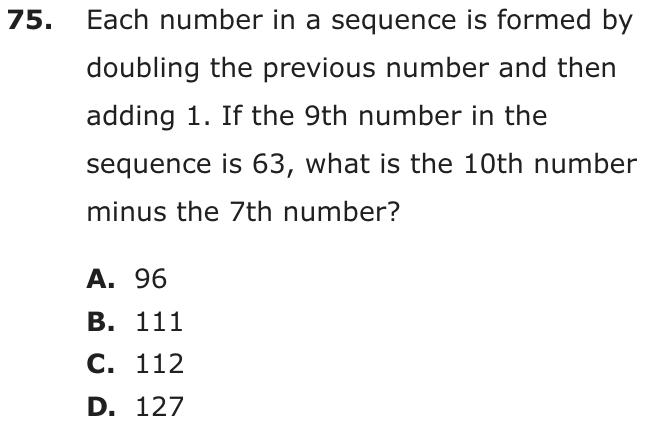
Question 74 of 120
2024 Test A Math, question 19Question
8.9, 8.2, 8.5, 9.0, 8.4, 8.6, 8.8
At a skating championship, there are seven judges who each award a score for each skater’s performance. The highest and lowest scores given to each skater are discarded, and the mean of the remaining scores is then calculated and reported as the skater’s final score. What is the final score for the skater who received the scores shown above from the judges?
- A8.60
- B8.62
- C8.64
- D8.70
Show the answer
Correct answer: C
The highest and lowest scores are discarded: 8.2 and 9.0.
To find the mean, add the remaining scores and then divide that sum by the total number of remaining scores.
Question analysis
A statistics question about a skating championship with seven judges: the highest and lowest of a skater's seven scores are dropped, and the rest are averaged. Students apply that rule to the listed scores, decimals close together. Following the dropping rule exactly and adding the decimals carefully both matter, since the choices are very close.
- Grade level
- Grade 6 content, by NYS standard
- Compared with grade 7
- Below grade 7 Finding a mean is grade 6 content, and this adds only a rule about which scores to drop. Grade 7 statistics usually compares whole data sets, so this is easier, though the close choices demand exact decimal arithmetic.
- Estimated difficulty
- Straightforward: two steps or one careful reading.
- Thinking it demands
- Depth of knowledge 2, skills and concepts · mainly apply
- What makes it hard
- A very close wrong answer moderate
- Error-prone arithmetic minor
- Turning words into math minor
- Solution
- 3 steps
- Reading level
- Question and choices: about grade 9, 62 words.
- Students, last 30 days
- Not enough answers yet to show (it takes 10).
Why it is hard, traps and wrong answers (shows the answer)
Why it is hard
The arithmetic is short, but the choices are spaced so closely that a small slip or a skipped rule lands on a neighbor. Averaging all seven scores, or picking the middle score, gives values within a few hundredths of the answer. The question rewards following the stated rule exactly and adding the five remaining scores with care.
A very close wrong answer moderate Choosing the answer
The choices 8.60, 8.62 and 8.64 lie within 0.04 of one another, so no estimate separates them; only the exact sum of the five kept scores, 43.2, does. (Embretson & Wetzel, 1987; Gorin & Embretson, 2006; Ascalon et al., 2007)
Error-prone arithmetic minor Working it out
Five one-decimal scores must be added and divided by 5; subtracting 8 from each first leaves 0.9, 0.5, 0.4, 0.6 and 0.8, which are easier to add. (Brown & Burton, 1978; Junker & Sijtsma, 2001)
Turning words into math minor Understanding the question
The scoring rule takes two sentences to state: discard the single highest and the single lowest score, then average the five that remain. (Hegarty, Mayer & Monk, 1995; Koedinger & Nathan, 2004)
Strategy: Cross out the single highest and the single lowest score, add the five that remain, and divide that sum by 5.
Traps
- Misreads the question: Misses or misreads a condition or a word in the question: "at least", "each", "remaining", "not".
- Answers a different question: A choice is right for another quantity: the other unknown, the rest instead of the part, the part instead of the whole.
The wrong answers, classified
A Answers a different question (King et al., 2004; Hegarty, Mayer & Monk, 1995)
Gives the median, the middle score 8.6, instead of the mean of the five scores left after the highest and lowest are dropped.
B Misreads the question (Hegarty, Mayer & Monk, 1995)
Averages all seven scores without discarding any, 60.4 ÷ 7 = 8.628…, and takes 8.62, the nearest choice to that mean.
D Misreads the question (Hegarty, Mayer & Monk, 1995)
Drops only the lowest score, 8.2, and averages the other six, (60.4 − 8.2) ÷ 6 = 8.7, keeping the top score of 9.0.
Worked solution, step by step
Formulas used
- Mean, or average
- The mean is the average. The sum is what you get when you add all the scores. Divide it by how many scores you added. It shares the total out evenly, as if every score were the same.
Sort out the rule
Seven judges gave the seven scores shown. The rule has two parts. First, throw out the highest score and the lowest score. Then find the mean of the scores that are left. The mean is the average. That is the final score you need.
Cross out the highest and lowest
The highest score is 9.0. The lowest is 8.2. Cross both out. Five scores are left: 8.9, 8.5, 8.4, 8.6 and 8.8. Watch out: drop both. Dropping only 8.2 gives 8.70, choice D. Keeping all seven gives about 8.63, which is closest to 8.62, choice B.
Add the five scores
A shortcut: each score is 8 plus a bit. The bits are 0.9, 0.5, 0.4, 0.6 and 0.8, and they add to 3.2. Five 8s make 40, and .
Divide by the number of scores
Watch out: do not just take the middle score, 8.6. That is the median, choice A. The question asks for the mean. So the answer is C, 8.64.
Check your answer
Multiply back: , the sum. Also, the mean should sit between the lowest kept score, 8.4, and the highest kept score, 8.9. 8.64 does.
More questions like this
The original DOE question
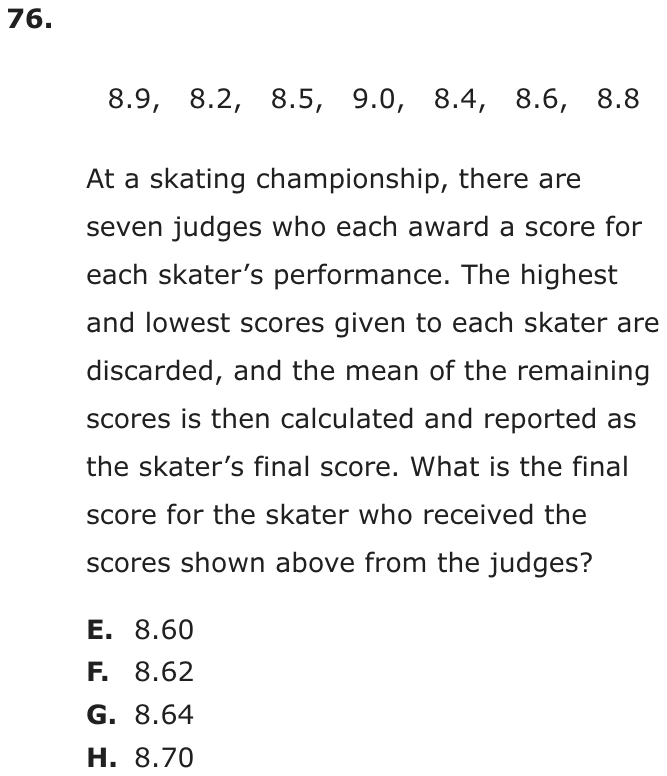
Question 75 of 120
2024 Test A Math, question 20Question
A piece of wood that is feet long is cut into 2 pieces of different lengths. The shorter piece has a length of x feet. Which inequality expresses all possible values of x?
- A
- B
- C
- D
Show the answer
Correct answer: A
The original piece of wood is feet long.
The shorter piece is x feet long, and it must be less than half the length of the original piece of wood.
Since half of is , it follows that .
The shorter piece of wood cannot be 0 feet long, so it follows that .
This gives the compound inequality .
Question analysis
An inequality question: a piece of wood 4½ feet long is cut into two pieces of different lengths, and the shorter piece is x feet long. Students choose the inequality that gives every possible value of x. They must turn each condition in the words into a boundary and decide whether each end of the range is included.
- Grade level
- Grade 7 content, by NYS standard
- Compared with grade 7
- Above grade 7 Grade 7 students solve and graph simple inequalities. Writing a compound inequality from a description, where the words decide whether each end is strict, is less familiar and calls for careful reading of every condition.
- Estimated difficulty
- Moderate: several steps, or a close reading with one strong distractor.
- Thinking it demands
- Depth of knowledge 2, skills and concepts · mainly analyze
- What makes it hard
- Turning words into math moderate
- A very close wrong answer moderate
- Variables instead of numbers minor
- Solution
- 2 steps
- Reading level
- Question and choices: about grade 5, 37 words.
- Students, last 30 days
- Not enough answers yet to show (it takes 10).
Why it is hard, traps and wrong answers (shows the answer)
Why it is hard
Halving 4 1/2 feet is the only computation; the rest is deciding whether each end of the range can actually happen. A shorter piece of 2 1/4 feet would make the two pieces equal, and a piece of 0 feet is no piece at all, so both ends are excluded. Students who find the right bounds but never test the ends are drawn to the version with the inclusive symbols.
Turning words into math moderate Understanding the question
Two phrases set the two ends: "cut into 2 pieces" means x is more than 0, and "of different lengths" with "the shorter piece" means x is less than half of 4 1/2. (Hegarty, Mayer & Monk, 1995; Koedinger & Nathan, 2004)
A very close wrong answer moderate Choosing the answer
The inequalities 0 < x < 2 1/4 and 0 ≤ x ≤ 2 1/4 share both bounds and differ only in their symbols; only checking whether each end can happen separates them. (Embretson & Wetzel, 1987; Gorin & Embretson, 2006; Ascalon et al., 2007)
Variables instead of numbers minor Understanding the question
The question asks for every possible length of the shorter piece, a range rather than one length, so students must picture the cut moving along the board. (Koedinger & Nathan, 2004; Enright, Morley & Sheehan, 2002)
Strategy: Picture cutting the board in different places, find the largest and smallest values the shorter piece could take, and check whether each boundary value is actually possible.
Traps
- Counting the ends: Inclusive or exclusive ends, fence posts, consecutive numbers: an answer that is one too many or too few, or an endpoint drawn open where it belongs closed (or the reverse).
- Misreads the question: Misses or misreads a condition or a word in the question: "at least", "each", "remaining", "not".
- Answers a different question: A choice is right for another quantity: the other unknown, the rest instead of the part, the part instead of the whole.
The wrong answers, classified
B Counting the ends (Brown & Burton, 1978)
Finds the right bounds but includes both ends, allowing a piece of 0 feet or two equal halves, though the stem says 2 pieces of different lengths.
C Misreads the question (Hegarty, Mayer & Monk, 1995)
Ignores that x is the shorter piece and allows any length up to the whole 4 1/2-foot board.
D Answers a different question (King et al., 2004; Hegarty, Mayer & Monk, 1995)
Describes the longer piece, whose length lies between half the board and the whole board, instead of the shorter piece the stem calls x.
Worked solution, step by step
Formulas used
- Two pieces make the whole board
- x is the length of the shorter piece, and L is the length of the longer piece, both in feet. Together they make the whole board. Since x is smaller than L, x must be less than half of the board.
- Inequality signs
- a < b says a is less than b. a ≤ b says a is less than or equal to b, so a can also equal b. A chain like 0 < x < 5 means x is more than 0 and less than 5.
Sort out the question
A board is feet long. It is cut into 2 pieces of different lengths. The shorter piece is x feet long. You need an inequality for every possible value of x. An inequality uses signs like <, less than, to show a range of numbers.
Find the top end for x
If you cut exactly in the middle, each piece is half the board.
But the pieces have different lengths, so the cut is not in the middle. The shorter piece must be less than half.
Find the bottom end for x
The shorter piece can be very small, like 0.1 foot. But it can’t be 0 feet. Then nothing would be cut off, and there would not be 2 pieces.
Put the two ends together
This says x is more than 0 and less than . Watch out: choice B uses ≤, which allows x = 0 or . Neither can happen. Choice C lets x be more than half, so it would not be the shorter piece. Choice D describes the longer piece. So the answer is A, .
Check your answer
Test values. Cut off 1 foot: the pieces are 1 foot and feet. The shorter one is 1, and 1 is between 0 and . If x were 3, the other piece would be feet, so x would not be the shorter one. Choice A leaves 3 out, as it should.
More questions like this
The original DOE question
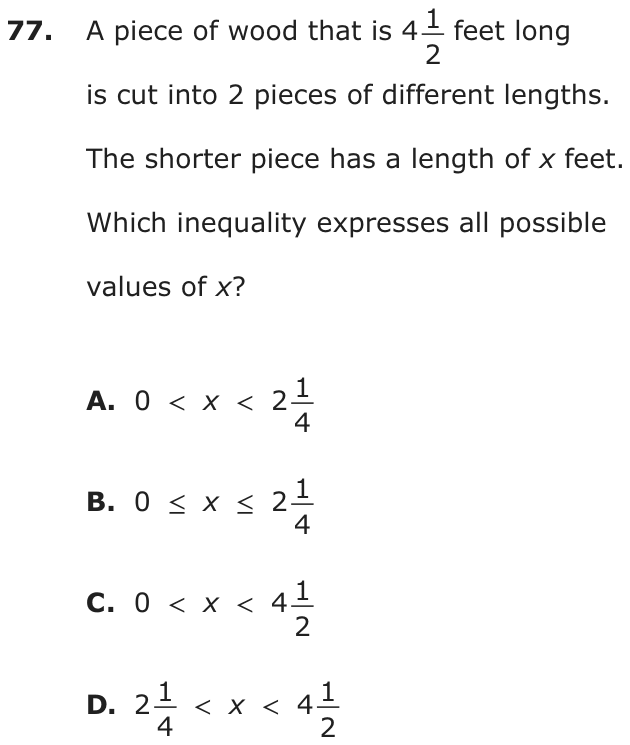
Question 76 of 120
2024 Test A Math, question 21Question
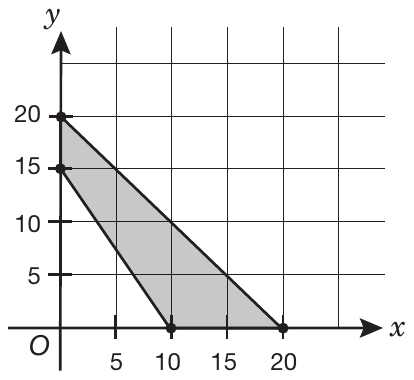
What is the area, in square units, of the shaded region shown in the figure above?
- A75
- B125
- C150
- D200
Show the answer
Correct answer: B
The area of the shaded region, in square units, is the area of the triangle created by the shaded and unshaded regions minus the area of the triangle created by the unshaded region.
The area of the triangle created by the shaded and unshaded regions is 200 square units.
The area of the triangle created by the unshaded region is 75 square units.
Subtract to find the area of the shaded region.
Question analysis
A coordinate geometry question: two line segments cross a grid, one from (0, 20) to (20, 0) and one from (0, 15) to (10, 0), and the region between them is shaded. Students find the shaded area. The shape is not a standard figure, so they need to see it as one triangle with another removed.
- Grade level
- Grade 6 content, by NYS standard
- Compared with grade 7
- At grade 7 Area of triangles is grade 6 content; finding a composite area by subtraction is the kind of task grade 7 students meet regularly. Points on the axes make every length easy to read.
- Estimated difficulty
- Straightforward: two steps or one careful reading.
- Thinking it demands
- Depth of knowledge 2, skills and concepts · mainly apply
- What makes it hard
- Reading a figure, table or graph moderate
- No obvious method minor
- Something you must already know minor
- Solution
- 3 steps
- Reading level
- Question and choices: about grade 6, 16 words.
- Students, last 30 days
- Not enough answers yet to show (it takes 10).
Why it is hard, traps and wrong answers (shows the answer)
Why it is hard
The shaded shape has no name, so the question is about seeing it as a difference of two right triangles whose legs lie on the axes. Once that is seen, both areas are one-line calculations. The wrong choices come from stopping after either triangle or from pairing a base from one segment with a height from the other.
Reading a figure, table or graph moderate Understanding the question
All four lengths come from where the two segments meet the axes, at 20 and 15 on the y-axis and at 10 and 20 on the x-axis, read against grid lines 5 units apart. (Lesh, Post & Behr, 1987; Kirsch & Mosenthal, 1990)
No obvious method minor Working it out
The shaded region is a four-sided shape with no formula of its own; it has to be seen as the large triangle with the small one removed. (Schoenfeld, 1985)
Something you must already know minor Working it out
The area of a triangle, one half of base times height, is assumed and not given. (Anderson & Krathwohl, 2001)
Strategy: Find the area of the large right triangle under the outer segment and subtract the area of the smaller triangle under the inner segment, reading the legs from the axes.
Traps
- Stops one step early: A choice is a number from partway through the solution.
- Answers a different question: A choice is right for another quantity: the other unknown, the rest instead of the part, the part instead of the whole.
- Misreads the figure: Reads a value, label or tick spacing in a figure, table or graph wrongly.
The wrong answers, classified
A Answers a different question (King et al., 2004; Hegarty, Mayer & Monk, 1995)
Finds the area of the small unshaded triangle, 1/2 × 10 × 15 = 75, and gives that region instead of the shaded one.
C Misreads the figure (Lesh, Post & Behr, 1987; Kirsch & Mosenthal, 1990)
Pairs the outer segment's x-intercept, 20, with the inner segment's y-intercept, 15, as if they bounded one triangle: 1/2 × 20 × 15 = 150.
D Stops one step early (King et al., 2004; Gierl et al., 2017)
Finds the area of the large triangle, 1/2 × 20 × 20 = 200, and stops before subtracting the unshaded triangle inside it.
Worked solution, step by step
Formulas used
- Area of a triangle
- A is the area. b is the base, the side the triangle sits on. h is the height: the straight-up distance from the base to the top corner, at a right angle to the base. You take half because a triangle is half of a rectangle with the same base and height.
Sort out the figure
The grid lines are 5 units apart. Two slanted segments run from the y-axis down to the x-axis. The outer one goes from 20 on the y-axis to 20 on the x-axis. The inner one goes from 15 on the y-axis to 10 on the x-axis. The shaded region is the strip between them. You need its area, in square units.
See the shape as two triangles
The shaded region has four sides, and it has no simple formula. But look at the big triangle under the outer segment, with its corner at O. It is the shaded strip plus the small white triangle. So the shaded area is the big triangle minus the small one.
Find the area of the big triangle
The big triangle has a right angle at O. Its base runs along the x-axis from 0 to 20, so it is 20 units. Its height runs up the y-axis from 0 to 20, so it is 20 units.
Watch out: this is the whole big triangle. Stopping here gives 200, choice D.
Find the area of the small triangle
The small triangle also has its right angle at O. Its base is 10 units, from 0 to 10 on the x-axis. Its height is 15 units, from 0 to 15 on the y-axis.
Watch out: 75 is the white triangle, choice A, not the shaded part. Also, pair the base and height of the same triangle. Mixing 20 and 15 gives 150, choice C.
Subtract to find the shaded area
Take the small white triangle away from the big triangle.
The shaded area is 125 square units. So the answer is B, 125.
Check your answer
In the figure, the shaded strip looks bigger than the white triangle. So the shaded area should be more than half of the big triangle, which is . 125 is more than 100. And , the whole big triangle.
More questions like this
The original DOE question
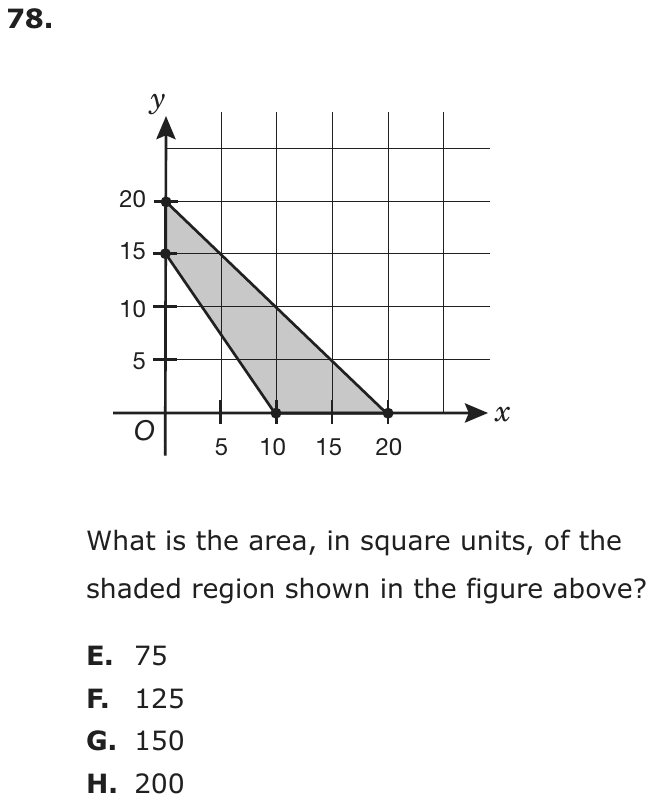
Question 77 of 120
2024 Test A Math, question 22Question
Yesterday in Centerville, the highest Fahrenheit temperature, F, was 86°, and the lowest was 68°. What was the difference between these temperatures, in degrees Celsius, C?
- A10.0° C
- B15.0° C
- C20.0° C
- D32.4° C
Show the answer
Correct answer: A
The highest temperature was 86° F.
Subtract 32 from both sides of the equation:
Multiply both sides of the equation by :
The lowest temperature was 68° F.
The difference, in degrees Celsius, is 30 minus 20.
Question analysis
A formula question: given F = 9/5 C + 32 and a day's high and low of 86 and 68 degrees Fahrenheit, students find the difference between the two temperatures in degrees Celsius. It tests solving a two-step equation with a fraction coefficient. Answering with the difference, in the right scale, is what to watch.
- Grade level
- Grade 7 content, by NYS standard
- Compared with grade 7
- At grade 7 Solving equations of the form px + q = r with fraction coefficients is grade 7 work. Doing it twice and comparing the results is a typical multistep grade 7 task, with extra care over which scale the answer is in.
- Estimated difficulty
- Moderate: several steps, or a close reading with one strong distractor.
- Thinking it demands
- Depth of knowledge 2, skills and concepts · mainly apply
- What makes it hard
- Many steps moderate
- Error-prone arithmetic minor
- Solution
- 4 steps
- Reading level
- Question and choices: about grade 7, 29 words.
- Corrected from the DOE handbook
- A stray term in the explanation’s working was removed.
- Students, last 30 days
- Not enough answers yet to show (it takes 10).
Why it is hard, traps and wrong answers (shows the answer)
Why it is hard
The formula is written to give Fahrenheit from Celsius, and the question runs it the other way, twice. Plugging 86 and 68 straight into the right-hand side is the tempting misuse, and it produces a listed choice. A shortcut avoids most of the work: the 18-degree Fahrenheit gap times 5/9 is the Celsius gap, because the 32 cancels when two readings are subtracted.
Many steps moderate Working it out
Each Fahrenheit reading needs its own two-step solve, subtracting 32 and multiplying by 5/9, and then the two Celsius values must be subtracted. (Daniel & Embretson, 2010; Enright, Morley & Sheehan, 2002)
Error-prone arithmetic minor Working it out
Multiplying 54 and 36 by 5/9 is easy only if the division by 9 comes first; multiplying by 5 first leaves 270/9 and 180/9 to reduce. (Brown & Burton, 1978; Junker & Sijtsma, 2001)
Strategy: Solve the formula for C at 86° and at 68° by subtracting 32 and multiplying by 5/9, then subtract; or convert the 18-degree gap directly with 5/9.
Traps
- Wrong operation: Adds instead of multiplying, divides the wrong way round, turns a ratio or rate upside down, or undoes a step in the wrong direction (subtracts what should be added back).
- Answers a different question: A choice is right for another quantity: the other unknown, the rest instead of the part, the part instead of the whole.
The wrong answers, classified
B Little reason to choose it (Haladyna & Downing, 1993; Rodriguez, 2005)
No conversion route gives 15; the gap is 18 × 5/9 by any method, so 15 needs a slip such as 54 ÷ 9 = 7, and it mostly draws guesses.
C Answers a different question (King et al., 2004; Hegarty, Mayer & Monk, 1995)
Converts the low reading, 68°F, to 20°C and gives that temperature instead of the difference between the two readings.
D Wrong operation (Hegarty, Mayer & Monk, 1995; King et al., 2004)
Converts in the wrong direction, multiplying the 18-degree gap by 9/5 instead of 5/9, the same as putting 86 and 68 in for C.
What was corrected from the DOE handbook, and why
- Explanation: After “Subtract 32 from both sides of the equation,” the handbook writes “86 − 32 = (9/5)C = 32”. The extra “= 32” would mean (9/5)C = 32, which is false: 86 − 32 = 54, and the next line is 54 = (9/5)C. The site now reads 86 − 32 = (9/5)C, as the handbook writes the same step for 68°.
Worked solution, step by step
Formulas used
- Changing Celsius to Fahrenheit
- F is a temperature in degrees Fahrenheit. C is the same temperature in degrees Celsius. Multiply the Celsius number by 9 fifths, then add 32. To go the other way, undo each step: subtract 32, then multiply by 5 ninths.
Sort out the question
Fahrenheit and Celsius are two ways to measure temperature. The formula changes Celsius, C, into Fahrenheit, F. Yesterday’s high was 86° F and the low was 68° F. You need the difference between them in degrees Celsius. So change each one to Celsius, then subtract.
Undo the + 32 for the high
Put 86 in for F. Then subtract 32 from both sides. That keeps the equation balanced.
Solve for the high in Celsius
To undo times , multiply both sides by . That is its reciprocal, the fraction flipped upside down.
Dividing 54 by 9 first gives 6, which keeps the numbers small. The high was 30° C.
Change the low to Celsius
Do the same with 68.
The low was 20° C. Watch out: 20° C is the low, not the difference. That is choice C.
Subtract to find the difference
The difference is 10 degrees Celsius. Watch out: do not multiply the 18-degree Fahrenheit gap by . That goes the wrong way and gives 32.4, choice D. So the answer is A, 10.0° C.
Check your answer
A shortcut: the gap in Fahrenheit is degrees. The + 32 moves both temperatures the same, so it does not change the gap. Multiply the gap by : . Same answer.
More questions like this
The original DOE question
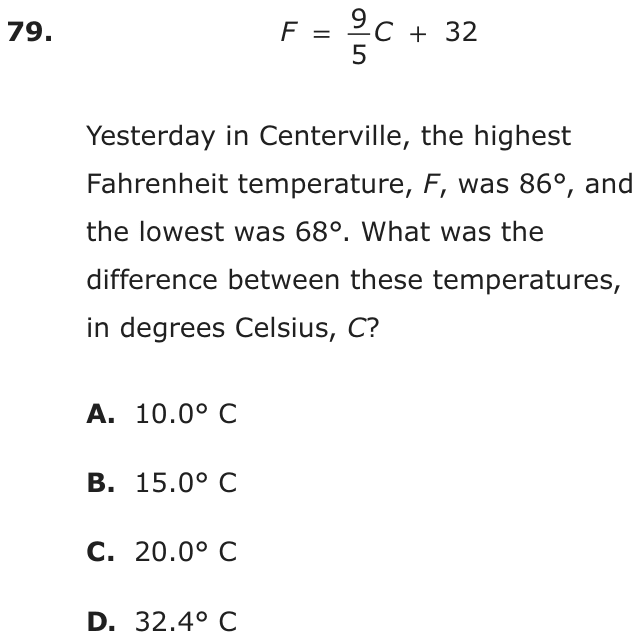
Question 78 of 120
2024 Test A Math, question 23Question
Let x be an odd number. In terms of x, what is the sum of the two even numbers closest to x?
- A
- B
- C
- D
Show the answer
Correct answer: B
If x is odd, then the two even numbers closest to x are and . Find the sum of these two expressions:
Question analysis
An algebra question about odd and even numbers: x is odd, and students write the sum of the two even numbers closest to x in terms of x. It tests representing neighboring integers with expressions and adding them. Deciding exactly which even numbers are closest to an odd number is where errors start.
- NYS standards
- Grade level
- Grade 7 content, by NYS standard
- Compared with grade 7
- At grade 7 Grade 7 students write and combine linear expressions; here the expressions describe neighboring integers, a familiar idea from consecutive-integer problems. Two short steps and a quick number check put it at typical grade 7 demand.
- Estimated difficulty
- Straightforward: two steps or one careful reading.
- Thinking it demands
- Depth of knowledge 2, skills and concepts · mainly apply
- What makes it hard
- Variables instead of numbers moderate
- Turning words into math minor
- Solution
- 2 steps
- Reading level
- Question and choices: about grade 3, 26 words.
- Students, last 30 days
- Not enough answers yet to show (it takes 10).
Why it is hard, traps and wrong answers (shows the answer)
Why it is hard
The algebra is a single addition, so the work is in naming the right two numbers. An odd x sits between two even numbers, one step away on each side, and the minus one and plus one cancel. Wrong choices come from picking both neighbors below x, from treating x as even, or from giving the middle of the pair; a test value catches each of them.
Variables instead of numbers moderate Understanding the question
Here x stands for any odd number, so the two even neighbors must be written as x − 1 and x + 1; trying x = 7, with neighbors 6 and 8, makes it concrete. (Koedinger & Nathan, 2004; Enright, Morley & Sheehan, 2002)
Turning words into math minor Understanding the question
The phrase "the two even numbers closest to x" means one just below and one just above x, not two in a row on the same side. (Hegarty, Mayer & Monk, 1995; Koedinger & Nathan, 2004)
Strategy: Substitute a real odd number such as 7 for x, find its two closest even numbers and their sum, then see which expression gives that sum.
Traps
- Misreads the question: Misses or misreads a condition or a word in the question: "at least", "each", "remaining", "not".
- Answers a different question: A choice is right for another quantity: the other unknown, the rest instead of the part, the part instead of the whole.
The wrong answers, classified
A Answers a different question (King et al., 2004; Hegarty, Mayer & Monk, 1995)
Finds the number midway between the two even neighbors, x itself, which is their mean rather than their sum.
C Misreads the question (Hegarty, Mayer & Monk, 1995)
Treats x as if it were even and adds it to the even number below it, x + (x − 2), ignoring that x is odd.
D Misreads the question (Hegarty, Mayer & Monk, 1995)
Takes the two even numbers just below x, x − 1 and x − 3, instead of the closest one on each side.
Worked solution, step by step
Formulas used
- Neighbors of a number
- x is any whole number. The number just below it is x − 1, and the number just above it is x + 1. Whole numbers take turns being odd and even. So if x is odd, both of its neighbors are even.
- Combining like terms
- Like terms have the same letter, such as x and 2x. To add them, add the numbers in front. x by itself means 1x, so x + x is 2x, which is two x’s.
Sort out the question
x is an odd number. You need the sum of the two even numbers closest to x. Sum means the result of adding. In terms of x means write the answer using the letter x.
Try a real number first
Pick an odd number, like 7. The even numbers closest to 7 are 6 and 8, one on each side.
Notice that 14 is .
Write the neighbors with x
Odd and even numbers take turns. So both numbers right next to an odd x are even.
For x = 7, these are 6 and 8. Watch out: take one even number below x and one above. Using two even numbers below x, and , gives , choice D.
Add the two neighbors
The −1 and the +1 cancel, and . Watch out: x is the number in the middle, not the sum, so choice A is wrong. So the answer is B, .
Check your answer
Try another odd number, 11. Its even neighbors are 10 and 12, and . The answer 2x gives . They match.
More questions like this
The original DOE question
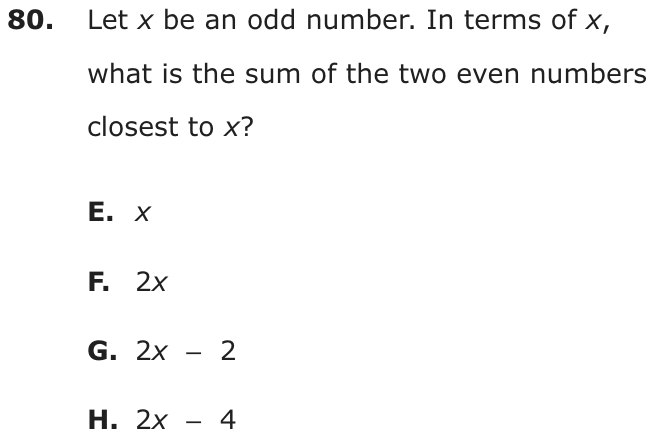
Question 79 of 120
2024 Test A Math, question 24Question
In 1991, the total public debt of the United States was about $3,600,000,000,000. In that year, there were about 250,000,000 people in the United States. Which amount is the best estimate of the public debt per person for that year?
- A$1,440
- B$14,400
- C$144,000
- D$14,400,000,000
Show the answer
Correct answer: B
The question asks for the amount of the public debt per person, so divide the total public debt by the number of people.
The amount of the public debt per person was about $14,400.
Question analysis
An estimation question with very large numbers: the 1991 United States public debt of about 3.6 trillion dollars and a population of about 250 million. Students find the debt per person. The choices differ by powers of ten, so cancelling zeros and keeping track of place value is the whole challenge.
- Grade level
- Grade 6 content, by NYS standard
- Compared with grade 7
- Below grade 7 Dividing large whole numbers and using place value are grade 5 and 6 skills. Grade 7 work goes further with rational numbers; this asks only for one careful division, with counting zeros as the main risk.
- Estimated difficulty
- Straightforward: two steps or one careful reading.
- Thinking it demands
- Depth of knowledge 2, skills and concepts · mainly apply
- What makes it hard
- Error-prone arithmetic moderate
- A very close wrong answer minor
- Solution
- 2 steps
- Reading level
- Question and choices: about grade 5, 37 words.
- Corrected from the DOE handbook
- A misprinted number in the explanation was corrected.
- Students, last 30 days
- Not enough answers yet to show (it takes 10).
Why it is hard, traps and wrong answers (shows the answer)
Why it is hard
The division itself is easy once the zeros are handled, and the question is built to punish miscounting them. Three choices carry the same digits, 144, at different sizes, so a student who loses or gains one zero still finds a match. A quick estimate in powers of ten, 3.6 trillion over a quarter of a billion, confirms that the answer is in the tens of thousands.
Error-prone arithmetic moderate Working it out
The debt has 13 digits and the population 9; cancelling seven zeros from each leaves 360,000 ÷ 25, and losing or adding one zero shifts the answer tenfold. (Brown & Burton, 1978; Junker & Sijtsma, 2001)
A very close wrong answer minor Choosing the answer
Three choices share the digits 144 and differ only by powers of ten, so getting the digits right does not settle it; only exact place value does. (Embretson & Wetzel, 1987; Gorin & Embretson, 2006; Ascalon et al., 2007)
Strategy: Cancel the same number of zeros from the debt and the population, then divide the smaller numbers that remain; check the size by estimating with powers of ten.
Traps
- An arithmetic slip: The right method with a plausible arithmetic error: a digit, a place value or a times-table fact.
- A faulty procedure: A systematic but wrong procedure: adding fractions straight across, applying an exponent to each term of a sum, dropping a sign when moving a term.
The wrong answers, classified
A An arithmetic slip (Junker & Sijtsma, 2001)
Cancels one zero too many while dividing and ends with $1,440, a per-person amount ten times too small.
C An arithmetic slip (Junker & Sijtsma, 2001)
Cancels one zero too few from the debt and ends with $144,000, a per-person amount ten times too large.
D A faulty procedure (Brown & Burton, 1978; Tatsuoka, 1983)
Divides the debt by 250 alone, dropping the six zeros that follow 250 in the population without removing any from the debt.
What was corrected from the DOE handbook, and why
- Explanation: The handbook’s first division writes the debt as “3,6000,000,000,000”, with an extra zero. The question gives $3,600,000,000,000, and the handbook’s next line (where the zeros are cancelled) uses 3,600,000,000,000, so the site now reads 3,600,000,000,000 ÷ 250,000,000. The answer, $14,400, is unchanged.
Worked solution, step by step
Formulas used
- Amount per person
- The total is the whole amount, here the debt in dollars. Dividing by the number of people shares it out equally. The result is how much goes with each one person.
- Canceling zeros
- a and b are any numbers, and b is not zero. Dividing the top and bottom of a fraction by 10 does not change its value. So you can cross off a zero at the end of the top and one at the end of the bottom, as a pair.
Sort out the question
The debt was about $3,600,000,000,000, which is 3.6 trillion dollars. There were about 250,000,000 people, which is 250 million. You need the debt per person. Per person means the amount for each one person.
Set up the division
Share the debt equally by dividing it by the number of people. The debt goes on top, and the people go on the bottom.
Cancel zeros in pairs
Count the zeros at the end of each number. The debt ends in 11 zeros. The population ends in 7. Cross off 7 zeros from each. Each pair you cross off divides the top and bottom by 10.
Watch out: cross off the same number from each. One too many from the debt gives $1,440, choice A. One too few gives $144,000, choice C.
Divide what is left
Dividing by 25 is the same as dividing by 100 and then multiplying by 4. That is because 4 groups of 25 make 100.
The debt was about $14,400 per person. Watch out: choice D divides by 250 only and forgets the zeros after it. So the answer is B, $14,400.
Check your answer
Multiply back. First, . Then put back the 7 zeros you crossed off: 3,600,000,000,000. That is the debt, so $14,400 is right.
More questions like this
The original DOE question
Question 80 of 120
2024 Test A Math, question 25Question
In the figure above, N is the midpoint of . Which segment has length centimeters?
- A
- B
- C
- D
Show the answer
Correct answer: A
These facts are given:
- N is the midpoint of .
- has a length of x centimeters.
- has a length of y centimeters.
Use the first two facts to determine that has a length of centimeters. So can be represented by , which is .
Question analysis
A geometry and algebra question with a labeled figure: points M, N, P and Q lie on a line, MN is x cm, MP is y cm, and N is the midpoint of MQ. Students find which segment has length 2x − y. They must turn the midpoint fact into an expression and read a difference of lengths on the figure.
- NYS standards
- Grade level
- Grade 7 content, by NYS standard
- Compared with grade 7
- Above grade 7 Grade 7 students evaluate and rewrite expressions but rarely read one as a length on a figure. Combining the midpoint idea from geometry with a difference of expressions, and no numbers, makes this more abstract than typical grade 7 work.
- Estimated difficulty
- Moderate: several steps, or a close reading with one strong distractor.
- Thinking it demands
- Depth of knowledge 2, skills and concepts · mainly analyze
- What makes it hard
- Variables instead of numbers moderate
- Reading a figure, table or graph moderate
- Solution
- 2 steps
- Reading level
- Question and choices: about grade 9, 20 words.
- Students, last 30 days
- Not enough answers yet to show (it takes 10).
Why it is hard, traps and wrong answers (shows the answer)
Why it is hard
The question reverses the usual task: instead of finding a length, students match an expression to a segment. The midpoint fact turns into MQ = 2x, and taking away the y of MP leaves the piece from P to Q. The wrong choices reward stopping at 2x, reading only the labeled arrows, or matching the letter y; picking x = 5 and y = 7 lets students check with numbers.
Variables instead of numbers moderate Understanding the question
Every length is a letter: MN is x, MP is y, and the target is the expression 2x − y, so the matching segment cannot be found by measuring. (Koedinger & Nathan, 2004; Enright, Morley & Sheehan, 2002)
Reading a figure, table or graph moderate Understanding the question
The figure marks only MN and MP with arrows; the length of MQ comes from the stem's midpoint fact, not from the drawing, and has to be written as 2x. (Lesh, Post & Behr, 1987; Kirsch & Mosenthal, 1990)
Strategy: Use the midpoint to write the length of the whole segment in terms of x, or pick sample values for x and y, then see which segment's length matches 2x − y.
Traps
- Stops one step early: A choice is a number from partway through the solution.
- Misreads the question: Misses or misreads a condition or a word in the question: "at least", "each", "remaining", "not".
The wrong answers, classified
B Misreads the question (Hegarty, Mayer & Monk, 1995)
Leaves out the midpoint fact, so the only difference it can read from the arrows is NP = y − x, which it takes for 2x − y.
C Stops one step early (King et al., 2004; Gierl et al., 2017)
Uses the midpoint to find that MQ is 2x centimeters and picks that segment, stopping before subtracting the y of MP.
D Numbers taken from the question (Hegarty, Mayer & Monk, 1995)
Sees y in the expression and picks MP, the segment labeled y, without working out the rest of 2x − y.
Worked solution, step by step
Formulas used
- Midpoint
- N is the midpoint of segment MQ, the point exactly in the middle. MN is the half from M to N, and MQ is the whole segment. The whole is two equal halves, so it is 2 times MN.
- Adding segments
- When points lie in order on a line, the short segments add up to the long one. MP runs from M to P, and PQ runs from P to Q. Put end to end, they make MQ.
Sort out the figure
Points M, N, P and Q lie in that order on a line. Segment MN is x cm long, and segment MP is y cm long. N is the midpoint of , the point exactly halfway from M to Q. You need the segment that is cm long.
Find the length of MQ
MN is half of MQ, so MQ is twice as long.
MQ is 2x cm long. Watch out: 2x is only part of the expression. Stopping here gives MQ, choice C.
Take MP away from MQ
Subtracting y from 2x means taking MP away from MQ. MP covers the part from M to P. What is left of MQ is the piece from P to Q.
So PQ is cm long. Watch out: do not pick MP just because y appears. MP is y, choice D. NP is , choice B. So the answer is A, .
Check your answer
Try numbers. Say x = 5, so MN = 5 and MQ = 10. Say y = 7, so MP = 7. Then PQ is . And . They match. NP would be , which does not.
More questions like this
The original DOE question
Question 81 of 120
2024 Test A Math, question 26Question
What is the area of the parallelogram shown above?
- A750 sq ft
- B600 sq ft
- C500 sq ft
- D300 sq ft
Show the answer
Correct answer: B
To find the area of a parallelogram, multiply the length of a side by the altitude for that side.
One property of parallelograms is that opposite sides are the same length.
So the bottom side of the parallelogram is 30 feet long and has an altitude of 20 feet.
Therefore, the area of the parallelogram, in square feet, is .
Question analysis
A geometry question with a figure: a parallelogram is labeled with a 30-foot top side, a 25-foot slanted side and a 20-foot height drawn at a right angle. Students find its area. The figure gives one length that is not needed, so students must pick the base and height that belong together.
- NYS standards
- 6.G.1 area of polygons
- Grade level
- Grade 6 content, by NYS standard
- Compared with grade 7
- Below grade 7 Area of a parallelogram is grade 6 content, and this is a one-step use of the formula. It is easier than typical grade 7 area work, which involves composite figures, circles or scale drawings.
- Estimated difficulty
- Routine: one familiar step, little to misread.
- Thinking it demands
- Depth of knowledge 1, recall and reproduction · mainly apply
- What makes it hard
- Solution
- 1 step
- Reading level
- Question and choices: about grade 2, 17 words.
- Students, last 30 days
- Not enough answers yet to show (it takes 10).
Why it is hard, traps and wrong answers (shows the answer)
Why it is hard
This is a one-step formula question with whole numbers, made slightly harder by one length too many. A student who multiplies the two side lengths, as for a rectangle, or brings in a triangle's one half, finds a listed choice. Matching the base to the height marked with a right angle is all it takes.
Reading a figure, table or graph minor Understanding the question
The figure labels three lengths, but only the 30-foot side and the 20-foot height drawn at a right angle to it belong together; the slanted 25-foot side is extra. (Lesh, Post & Behr, 1987; Kirsch & Mosenthal, 1990)
Something you must already know minor Working it out
The parallelogram area formula, base times height, is not given, and its height must be the perpendicular distance, not the slanted side. (Anderson & Krathwohl, 2001)
Strategy: Use base times height, where the height is the perpendicular distance between the two parallel sides chosen as bases.
Traps
- Wrong formula: Uses a related but wrong formula: perimeter for area, diameter for radius, area for volume, or a misremembered one.
- Information you don't need: The question gives numbers or facts that play no part in the answer.
The wrong answers, classified
A Wrong formula (King et al., 2004)
Multiplies the two side lengths, 30 × 25 = 750, as if a parallelogram's area were side times side like a rectangle's.
C Misreads the figure (Lesh, Post & Behr, 1987; Kirsch & Mosenthal, 1990)
Pairs the 20-foot height with the slanted 25-foot side, 25 × 20 = 500, though the height is drawn at a right angle to the 30-foot sides.
D Wrong formula (King et al., 2004)
Uses the triangle formula, 1/2 × 30 × 20 = 300, halving the base times the height.
Worked solution, step by step
Formulas used
- Area of a parallelogram
- A is the area. b is the base, one of the two parallel sides. h is the height: the straight distance between the two parallel sides, at a right angle to the base. It works because you can cut a triangle off one end, move it to the other end and make a rectangle.
Sort out the figure
A parallelogram is a four-sided shape whose opposite sides are parallel. Parallel means they never meet. The figure shows three lengths. The top side is 30 ft. The slanted left side is 25 ft. The arrow from top to bottom is 20 ft, and the small square shows a right angle. You need the area, in square feet.
Choose the base and height
The height must make a right angle with the base. The 20 ft arrow meets the bottom side at a right angle. Opposite sides of a parallelogram are equal, so the bottom side is 30 ft too. So the base is 30 ft and the height is 20 ft. Watch out: the slanted 25 ft side is not needed. Using gives choice C.
Find the area
The area is 600 sq ft. Watch out: do not multiply the two sides, . That is choice A. Do not take half either, which is for triangles and gives 300, choice D. So the answer is B, 600 sq ft.
Check your answer
Picture cutting the triangle off the left end and sliding it to the right end. The shape becomes a rectangle 30 ft long and 20 ft tall, with an area of 600 sq ft. 750 is too big, because the shape is only 20 ft tall, not 25 ft.
More questions like this
The original DOE question
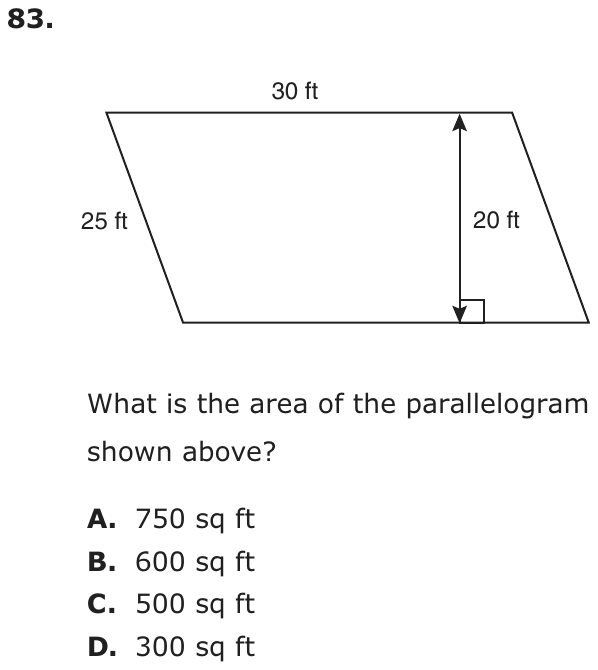
Question 82 of 120
2024 Test A Math, question 27Question
On Wednesday, a baker produced 100 more loaves of bread than were produced on Tuesday. On Thursday, the baker produced 50 fewer loaves than were produced on Tuesday. If the total number of loaves produced on all three days was 230, how many loaves were produced on Wednesday?
- A60
- B80
- C120
- D160
Show the answer
Correct answer: D
Let t represent the number of loaves of bread produced on Tuesday.
First, determine the number of loaves of bread produced on Tuesday, t, using the number of loaves produced on Wednesday, , the number produced on Thursday, , and the total number produced on these three days, 230:
Next, determine the number of loaves of bread produced on Wednesday, , when :
The number of loaves of bread produced on Wednesday is 160.
Question analysis
A word problem about a baker's bread over three days: Wednesday's output is 100 loaves more than Tuesday's, Thursday's is 50 fewer than Tuesday's, and the total is 230. Students find the number of loaves made on Wednesday. Writing every day in terms of Tuesday, and answering for the right day, are the keys.
- Grade level
- Grade 7 content, by NYS standard
- Compared with grade 7
- At grade 7 Writing and solving an equation of the form px + q = r from a word problem is a core grade 7 standard. This is a typical three-step version, with one negative adjustment and an extra step after solving.
- Estimated difficulty
- Straightforward: two steps or one careful reading.
- Thinking it demands
- Depth of knowledge 2, skills and concepts · mainly apply
- What makes it hard
- Turning words into math moderate
- Much to keep track of minor
- Solution
- 3 steps
- Reading level
- Question and choices: about grade 7, 45 words.
- Corrected from the DOE handbook
- A misplaced parenthesis in the explanation’s working was corrected.
- Students, last 30 days
- Not enough answers yet to show (it takes 10).
Why it is hard, traps and wrong answers (shows the answer)
Why it is hard
Writing all three days in terms of Tuesday turns the story into 3t + 50 = 230, a routine equation. The trap comes after it is solved: the value found is Tuesday's, and it is a listed choice. Students who label t as Tuesday from the start, and reread the question before choosing, add the 100 loaves and are done.
Turning words into math moderate Understanding the question
Both comparisons are made with Tuesday, 100 more loaves on Wednesday and 50 fewer on Thursday, so the three days become t, t + 100 and t − 50. (Hegarty, Mayer & Monk, 1995; Koedinger & Nathan, 2004)
Much to keep track of minor Working it out
The equation's unknown is Tuesday's count, while the question asks for Wednesday's, so one more step remains after the equation is solved. (Sweller, 1988; Carpenter, Just & Shell, 1990)
Strategy: Let t be Tuesday's loaves, write Wednesday and Thursday in terms of t, set the sum equal to 230, solve for t, and add 100.
Traps
- Answers a different question: A choice is right for another quantity: the other unknown, the rest instead of the part, the part instead of the whole.
- Numbers taken from the question: Combines the numbers in the question without a model of the situation, or is simply a number that appears in the question.
The wrong answers, classified
A Answers a different question (King et al., 2004; Hegarty, Mayer & Monk, 1995)
Solves 3t + 50 = 230 for Tuesday's loaves, t = 60, and gives that instead of Wednesday's t + 100.
B Numbers taken from the question (Hegarty, Mayer & Monk, 1995)
Subtracts both 100 and 50 from the total, 230 − 100 − 50 = 80, combining the numbers without writing each day in terms of Tuesday.
C Misreads the question (Hegarty, Mayer & Monk, 1995)
Finds Tuesday's 60, then gets Wednesday by subtraction, 230 − 60 − 50, taking Thursday as 50 loaves instead of 60 − 50 = 10.
What was corrected from the DOE handbook, and why
- Explanation: The handbook writes “3t + (50 − 50 = 230 − 50)”, with the closing parenthesis after the whole equation, so the line reads as an equation inside an expression (and 50 − 50 = 230 − 50 is false). The site now reads 3t + (50 − 50) = 230 − 50: subtract 50 from both sides, giving 3t = 180 as before.
Worked solution, step by step
Formulas used
- Keeping an equation balanced
- a and b are the two sides of an equation, and c is any number. An equation is like a balanced scale. If you subtract the same thing from both sides, it stays balanced. The same is true if you divide both sides by the same number that is not zero.
Sort out the question
The baker made bread on Tuesday, Wednesday and Thursday. Wednesday had 100 more loaves than Tuesday. Thursday had 50 fewer loaves than Tuesday. All three days add up to 230 loaves. You need the number of loaves made on Wednesday.
Write each day using Tuesday
Both other days are compared with Tuesday. So call Tuesday’s loaves t.
Day Loaves Tuesday Wednesday Thursday 100 more means add 100. 50 fewer means subtract 50.
Write the equation and combine
Group the t’s together and the plain numbers together. Three t’s make 3t, and .
Watch out: do not just subtract 100 and 50 from 230. That gives 80, choice B, and skips writing each day with t.
Solve for Tuesday
Subtract 50 from both sides. Then divide both sides by 3.
Tuesday had 60 loaves. Watch out: 60 is Tuesday, choice A. The question asks about Wednesday.
Find Wednesday’s loaves
Wednesday had 100 more loaves than Tuesday, so add 100 to t.
Wednesday had 160 loaves. So the answer is D, 160.
Check your answer
Find all three days. Tuesday is 60, Wednesday is 160, and Thursday is . Add them: . That is the total in the question, so 160 is right.
More questions like this
The original DOE question
Question 83 of 120
2024 Test A Math, question 28Question
QUIZ SCORES IN
MRS. ARCH’S CLASS
| Quiz Score | Number of Students |
|---|---|
| 60 | 9 |
| 70 | 7 |
| 80 | 4 |
| 90 | 5 |
| 100 | 3 |
In the table above, what is the mean quiz score?
- A60
- B70
- C75
- D80
Show the answer
Correct answer: C
First, find the total number of students who took the quiz.
Multiply each quiz score by the number of students who received that score. Add those products together to find the total number of points scored.
To find the mean quiz score, divide the total number of points by the number of students who took the quiz.
Question analysis
A frequency table question: the table lists five quiz scores from 60 to 100 and how many students in Mrs. Arch's class earned each. Students find the mean quiz score for the whole class. Each score has to count once for every student who earned it, and the class size has to be added up from the table.
- Grade level
- Grade 6 content, by NYS standard
- Compared with grade 7
- At grade 7 A mean from a frequency table is grade 6 content in a three-step form that grade 7 students meet regularly. Five rows of products make it slightly longer than a typical exercise, but the arithmetic is friendly.
- Estimated difficulty
- Moderate: several steps, or a close reading with one strong distractor.
- Thinking it demands
- Depth of knowledge 2, skills and concepts · mainly apply
- What makes it hard
- Reading a figure, table or graph moderate
- Many steps minor
- Error-prone arithmetic minor
- Solution
- 3 steps
- Reading level
- Question and choices: about grade 2, 19 words.
- Students, last 30 days
- Not enough answers yet to show (it takes 10).
Why it is hard, traps and wrong answers (shows the answer)
Why it is hard
The table invites a shortcut: average the five scores in the first column and get a round number that is a choice. That ignores the fact that more students earned the low scores than the high ones, which pulls the true mean down. Weighting each score by its count is a five-row calculation with friendly numbers, and the other choices catch students who confuse the mean with the most common or the middle score.
Reading a figure, table or graph moderate Understanding the question
Each row of the table stands for several students, 9 with 60, 7 with 70 and so on, so a score counts once per student and the class size, 28, must be added up. (Lesh, Post & Behr, 1987; Kirsch & Mosenthal, 1990)
Many steps minor Working it out
Five products, 540, 490, 320, 450 and 300, must be found and added to 2,100 before dividing by the 28 students. (Daniel & Embretson, 2010; Enright, Morley & Sheehan, 2002)
Error-prone arithmetic minor Working it out
The last step, 2,100 ÷ 28, is not a familiar fact; noticing that 28 × 75 = 2,100, or testing the choices, keeps it quick. (Brown & Burton, 1978; Junker & Sijtsma, 2001)
Strategy: Multiply each score by its number of students, add the products for the total points, add the student counts, and divide the points by the students.
Traps
- Misunderstands the concept: A wrong belief about a concept: that percents can be added, that area grows like length, that averages can be averaged, that a bigger denominator means a bigger fraction.
- Answers a different question: A choice is right for another quantity: the other unknown, the rest instead of the part, the part instead of the whole.
The wrong answers, classified
A Answers a different question (King et al., 2004; Hegarty, Mayer & Monk, 1995)
Picks the score that the most students earned, 60, the mode of the class, instead of computing the mean.
B Answers a different question (King et al., 2004; Hegarty, Mayer & Monk, 1995)
Finds the median instead: in the ordered list of 28 scores, the 14th and 15th are both 70.
D Misunderstands the concept (Smith, diSessa & Roschelle, 1993; De Bock et al., 1998; Ni & Zhou, 2005)
Averages the five listed scores, (60 + 70 + 80 + 90 + 100) ÷ 5 = 80, without weighting each by its number of students.
Worked solution, step by step
Formulas used
- Mean from a table
- The mean is the average score. Total points is every student’s score added up. Each score in the table counts once for every student who got it. Number of students is how many took the quiz.
Sort out the table
The left column lists quiz scores. The right column says how many students got each score. For example, 9 students scored 60. You need the mean quiz score, which is the average.
Count the students
28 students took the quiz. So there are 28 scores in all, not just 5.
Find the total points
Each score counts once for each student who got it. So multiply each score by its number of students.
Score Students Points 60 9 70 7 80 4 90 5 100 3 The class scored 2,100 points in all.
Divide to find the mean
To divide, try . That leaves , and . So the mean is . Watch out: do not just average the five scores in the table. That gives 80, choice D. Also, 70 is the median and 60 is the most common score, choices B and A. So the answer is C, 75.
Check your answer
More students scored low, 60 or 70, than high. So the mean should be below 80, the middle of the listed scores. 75 is below 80. Also, , the total points.
More questions like this
The original DOE question
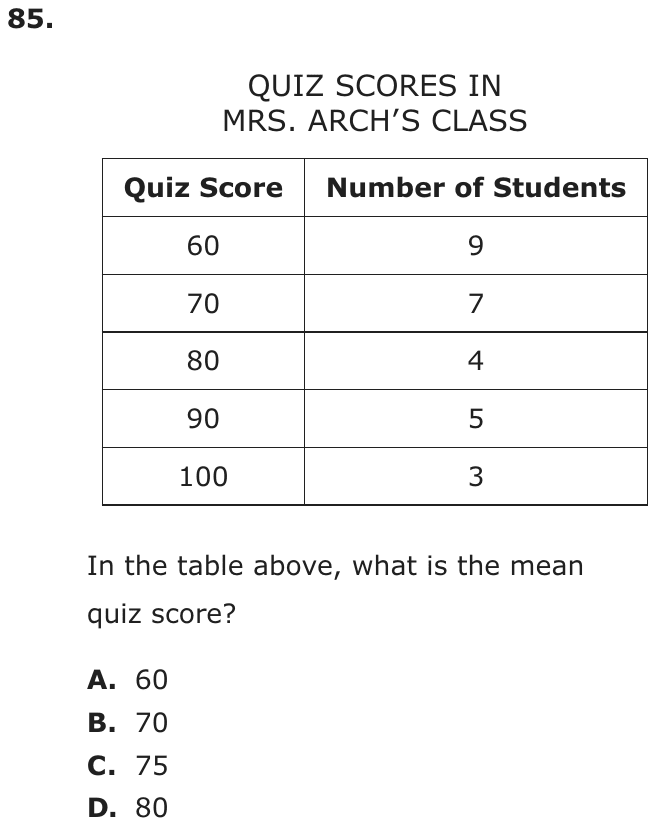
Question 84 of 120
2024 Test A Math, question 29Question
Which graph represents the solution to the inequality ?
- A

- B

- C

- D

Show the answer
Correct answer: A
Use the properties of equations to solve the inequality for x.
Subtract 4 from both sides of the inequality.
The graph of will have a point at −1 and will include all values that are greater than, or to the right of, −1. The greater than or equal sign is used, which indicates that the solution includes −1. So the point at −1 will be solid. Option A is the correct answer.
Question analysis
This inequality question asks which number line graph shows the solution set of x + 4 ≥ 3. Students solve a one-step inequality by undoing the addition, then match the result to a graph. All four graphs use a solid dot and an arrow pointing right, so the whole question rests on where the shaded ray begins.
- Grade level
- Grade 7 content, by NYS standard
- Compared with grade 7
- Below grade 7 Grade 7 inequality work is usually two-step, such as 3x − 5 ≥ 10, and asks students to choose an open or closed dot and a direction. This one needs a single subtraction, and all four graphs share a closed dot and a rightward arrow.
- Estimated difficulty
- Routine: one familiar step, little to misread.
- Thinking it demands
- Depth of knowledge 1, recall and reproduction · mainly apply
- What makes it hard
- Solution
- 2 steps
- Reading level
- Question and choices: about grade 13, 9 words.
- Students, last 30 days
- Not enough answers yet to show (it takes 10).
Why it is hard, traps and wrong answers (shows the answer)
Why it is hard
Solving takes a single subtraction, and the graphs differ only in where the solid dot sits, so the question comes down to 3 − 4. Students who lose the negative sign land on the graph that starts at 1, while those who never isolate x pick a graph that starts at a number printed in the inequality. Testing 0, which satisfies 0 + 4 ≥ 3, shows that the shading must include 0.
Reading a figure, table or graph minor Understanding the question
All four graphs share a closed dot and a rightward arrow, so the only thing to read is where the dot sits, against tick labels printed with raised minus signs. (Lesh, Post & Behr, 1987; Kirsch & Mosenthal, 1990)
Error-prone arithmetic minor Working it out
Undoing the + 4 means computing 3 − 4, the one step that crosses zero; a dropped minus sign moves the dot from −1 to 1. (Brown & Burton, 1978; Junker & Sijtsma, 2001)
Strategy: Subtract 4 from both sides to get x alone, then find the graph whose solid dot sits at that number; test one shaded value in the original inequality to confirm.
Traps
- Negatives and direction: Arithmetic with negative numbers, the order of a subtraction, or direction on a number line. (Moving a term across the equals sign without changing its sign is a faulty procedure.)
- Numbers taken from the question: Combines the numbers in the question without a model of the situation, or is simply a number that appears in the question.
The wrong answers, classified
B Negatives and direction (Brown & Burton, 1978)
Computes 4 − 3 instead of 3 − 4, or drops the minus sign of −1, and starts the shaded ray at positive 1.
C Numbers taken from the question (Hegarty, Mayer & Monk, 1995)
Starts the ray at 3, the number on the right side of the inequality, as if x ≥ 3, without subtracting the 4.
D Numbers taken from the question (Hegarty, Mayer & Monk, 1995)
Starts the ray at 4, the number added to x, reading it off the inequality instead of solving for x.
Worked solution, step by step
Formulas used
- Keeping an inequality balanced
- a and b are the two sides of an inequality, and c is any number. The sign ≥ stands for greater than or equal to. Taking the same number away from both sides keeps the comparison true, like taking the same weight off both pans of a scale. Use it to get x by itself.
Sort out the question
An inequality is a math sentence that compares two amounts. The sign means is greater than or equal to. So says that x plus 4 is 3 or more.
You need the graph that shows every number x that makes this true. All four graphs have a solid dot and an arrow to the right. Only the place where the dot sits is different.
Get x by itself
Right now 4 is added to x. To undo adding 4, subtract 4 from both sides.
So x is −1 or any number greater than −1. Watch out: 3 − 4 is −1, not 1. Dropping the minus sign puts the dot at 1, choice B. Putting the dot at 3 or 4 means you read a number off the inequality without solving. That leads to C or D.
Match the solution to a graph
On a number line, greater numbers are to the right. So the shading starts at −1 and goes right. The arrow shows that it keeps going.
The dot is solid, or filled in, because of the or equal to part. A solid dot means −1 itself is a solution, a number that makes the inequality true.
Graph A has a solid dot at −1 and is shaded to the right. So the answer is A, the graph with a solid dot at −1.
Check your answer
Test a number from the shaded part, such as 0. , and 4 is more than 3. Now test the dot: , and 3 is equal to 3, so −1 works. A number left of the dot, −2, gives . That is less than 3, so −2 should not be shaded, and it isn’t.
More questions like this
The original DOE question
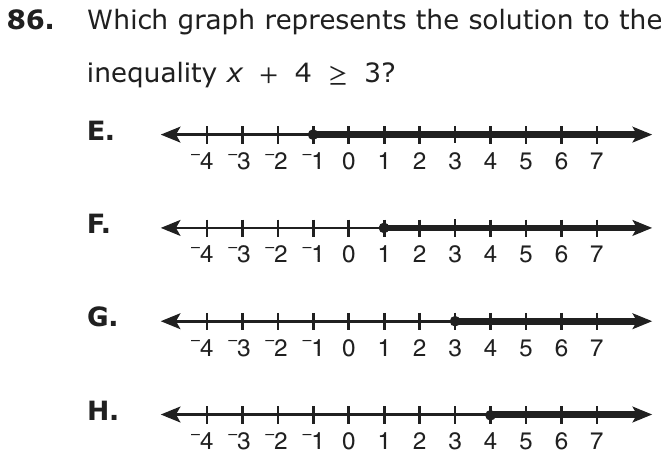
Question 85 of 120
2024 Test A Math, question 30Question
The reciprocal of is added to the reciprocal of 3. What is the reciprocal of this sum?
- A
- B
- C
- D
Show the answer
Correct answer: A
The reciprocal of is added to the reciprocal of 3.
The reciprocal of this sum is .
Question analysis
This fractions question asks for the reciprocal of a sum: the reciprocal of one fourth is added to the reciprocal of 3, and students must flip the total. It tests knowing what a reciprocal is and adding a whole number to a fraction. Keeping the three flips in the right order, without skipping one, is what makes it tricky.
- NYS standards
- 6.NS.1 dividing fractions by fractions
- Grade level
- Grade 6 content, by NYS standard
- Compared with grade 7
- At grade 7 Grade 7 students use reciprocals when dividing fractions, usually one at a time. This item chains three reciprocals around one addition, with positive numbers only, so the demand is following the wording in order rather than new content.
- Estimated difficulty
- Straightforward: two steps or one careful reading.
- Thinking it demands
- Depth of knowledge 2, skills and concepts · mainly apply
- What makes it hard
- Turning words into math moderate
- Error-prone arithmetic minor
- Solution
- 3 steps
- Reading level
- Question and choices: about grade 8, 21 words.
- Students, last 30 days
- Not enough answers yet to show (it takes 10).
Why it is hard, traps and wrong answers (shows the answer)
Why it is hard
Each step is easy, so the question is about order: flip each number, add, then flip the total. The common failures are flipping at the wrong moment, term by term instead of the whole sum, and adding a whole number to a fraction straight across. Writing the full expression 1 ÷ (4 + 1/3) before doing any arithmetic keeps the three reciprocals in their places.
Turning words into math moderate Understanding the question
The two sentences hold three reciprocals and a sum, which must become 1 ÷ (4 + 1/3) before any arithmetic; "this sum" means flipping the total, not each part. (Hegarty, Mayer & Monk, 1995; Koedinger & Nathan, 2004)
Error-prone arithmetic minor Working it out
Adding 4 and 1/3 means writing 4 as 12/3 to get 13/3, a whole number plus a fraction, where adding tops and bottoms gives 5/4 instead. (Brown & Burton, 1978; Junker & Sijtsma, 2001)
Strategy: Work in the order of the words: flip each number to get its reciprocal, add the two using a common denominator, and then flip that sum.
Traps
- A faulty procedure: A systematic but wrong procedure: adding fractions straight across, applying an exponent to each term of a sum, dropping a sign when moving a term.
- Wrong operation: Adds instead of multiplying, divides the wrong way round, turns a ratio or rate upside down, or undoes a step in the wrong direction (subtracts what should be added back).
The wrong answers, classified
B Wrong operation (Hegarty, Mayer & Monk, 1995; King et al., 2004)
Multiplies the two reciprocals instead of adding them, 4 × 1/3 = 4/3, then flips that product to 3/4.
C A faulty procedure (Brown & Burton, 1978; Tatsuoka, 1983)
Adds 4/1 and 1/3 straight across, numerators and denominators, getting 5/4, then flips it to 4/5.
D A faulty procedure (Brown & Burton, 1978; Tatsuoka, 1983)
Flips each term of 4 + 1/3 instead of the whole sum, as if the reciprocal of a sum were the sum of reciprocals: 1/4 + 3 = 13/4.
Worked solution, step by step
Formulas used
- Reciprocal
- a is the top of a fraction and b is the bottom. The reciprocal is the fraction flipped upside down. A whole number such as 3 is the fraction 3 over 1, so its reciprocal is 1 over 3. A number times its reciprocal always makes 1.
- Adding fractions with the same bottom
- c is the shared bottom number, called the denominator. a and b are the tops, called numerators. When the pieces are the same size, you just add how many pieces you have. The size of the pieces, c, stays the same.
Sort out the wording
The question has three reciprocals in it. A reciprocal is a fraction flipped upside down. Do the jobs in the order of the words:
- Flip .
- Flip 3.
- Add the two results to get the sum.
- Flip that sum.
The last flip gives the answer.
Flip each number
Flip to get , which is 4. The number 3 is the same as , so its reciprocal is .
Add the two reciprocals
You need . To add, both numbers need the same bottom. So write 4 in thirds. One whole is 3 thirds, so 4 wholes are 12 thirds.
The sum is . Watch out: don’t add the tops and the bottoms straight across. That gives , which flips to , choice C.
Flip the sum
Watch out: flip the whole sum, not each part. Flipping 4 and one at a time takes you back to , choice D.So the answer is A, .
Check your answer
A number times its reciprocal is 1. Test it: . Also estimate. The sum is a bit more than 4, so its reciprocal should be a bit less than . is about 0.23, just under 0.25.
More questions like this
The original DOE question
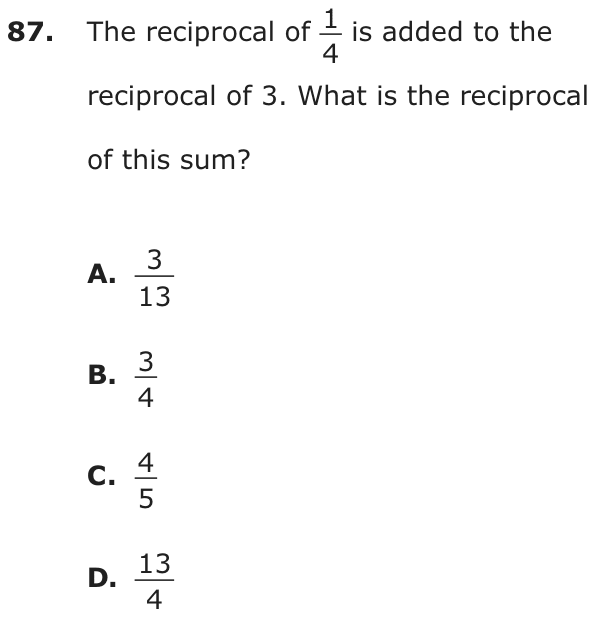
Question 86 of 120
2024 Test A Math, question 31Question
Nura made a square poster with a side length of 13 inches. Latrice made a square poster with a side length of 15 inches. What is the difference, in square inches, between the area of Latrice’s poster and the area of Nura’s poster?
- A56
- B8
- C4
- D2
Show the answer
Correct answer: A
Nura’s poster is square, so all the side lengths are 13 inches. The area, in square inches, is
Latrice’s poster is square, so all the side lengths are 15 inches.
Subtract to determine the difference between the areas.
The difference, in square inches, is 56.
Question analysis
This area word problem compares two square posters, one 13 inches on a side and one 15 inches on a side, and asks for the difference between their areas in square inches. Students square each side length and subtract. Working with the difference in the sides, or with perimeters, instead of the areas is the easy mistake.
- Grade level
- Grade 6 content, by NYS standard
- Compared with grade 7
- Below grade 7 Area of a square is elementary content, and squaring 13 and 15 is grade 6 exponent work. Typical grade 7 area problems involve circles, composite shapes or scale drawings; this one has two familiar areas and a subtraction.
- Estimated difficulty
- Straightforward: two steps or one careful reading.
- Thinking it demands
- Depth of knowledge 2, skills and concepts · mainly apply
- What makes it hard
- Solution
- 3 steps
- Reading level
- Question and choices: about grade 5, 41 words.
- Students, last 30 days
- Not enough answers yet to show (it takes 10).
Why it is hard, traps and wrong answers (shows the answer)
Why it is hard
The method is short, but the question invites a shortcut: the sides differ by 2, so it feels as if the areas should differ by 2 squared. Two choices reward working with the side lengths and one rewards perimeters. Squaring each side before subtracting avoids all three, and a sketch of the 13-inch square inside the 15-inch one shows the gap is an L-shaped strip, far more than 4 square inches.
Something you must already know minor Working it out
The area of a square, side times side, is not given; students must square 13 and 15 themselves rather than work with the side lengths. (Anderson & Krathwohl, 2001)
Error-prone arithmetic minor Working it out
Squaring 13 and 15 by hand gives 169 and 225, and the subtraction 225 − 169 needs a borrow, where an arithmetic slip creeps in. (Brown & Burton, 1978; Junker & Sijtsma, 2001)
Strategy: Find each poster's area by squaring its side length, then subtract the smaller area from the larger; work with the areas, not the side lengths.
Traps
- Wrong formula: Uses a related but wrong formula: perimeter for area, diameter for radius, area for volume, or a misremembered one.
- A faulty procedure: A systematic but wrong procedure: adding fractions straight across, applying an exponent to each term of a sum, dropping a sign when moving a term.
- Answers a different question: A choice is right for another quantity: the other unknown, the rest instead of the part, the part instead of the whole.
The wrong answers, classified
B Wrong formula (King et al., 2004)
Compares perimeters instead of areas, 4 × 15 − 4 × 13 = 60 − 52 = 8, a difference in inches, not square inches.
C A faulty procedure (Brown & Burton, 1978; Tatsuoka, 1983)
Subtracts the sides first and squares the difference, (15 − 13)² = 4, as if 15² − 13² equaled (15 − 13)².
D Answers a different question (King et al., 2004; Hegarty, Mayer & Monk, 1995)
Gives the difference in side lengths, 15 − 13 = 2, a length rather than a difference in area.
Worked solution, step by step
Formulas used
- Area of a square
- A is the area, the flat space inside the shape. s is the length of one side. All four sides of a square are equal, so the area is side times side. The small 2 means squared, or times itself. Area is measured in square units, here square inches.
Write down what you know
Nura’s poster is a square with sides of 13 inches. Latrice’s poster is a square with sides of 15 inches. You need the difference between their areas, in square inches. The difference is how much bigger one area is than the other. So find each area, then subtract.
Find the area of Nura’s poster
Use the area formula with the side of 13 inches.
Nura’s poster has an area of 169 square inches.
Find the area of Latrice’s poster
Use the same formula with the side of 15 inches.
Latrice’s poster has an area of 225 square inches.
Subtract the two areas
Take the smaller area away from the larger one.
The difference is 56 square inches.
Watch out: don’t subtract the sides first and then square. , choice C, is not the same as . The side difference, 2 inches, is choice D, a length. Comparing perimeters, the distance around, gives 8, choice B.So the answer is A, 56 square inches.
Check your answer
Picture Nura’s poster laid in a corner of Latrice’s. The extra part is an L-shaped strip 2 inches wide. One arm is 15 by 2 and the other is 13 by 2. , so the strip is 56 square inches. That matches.
More questions like this
The original DOE question
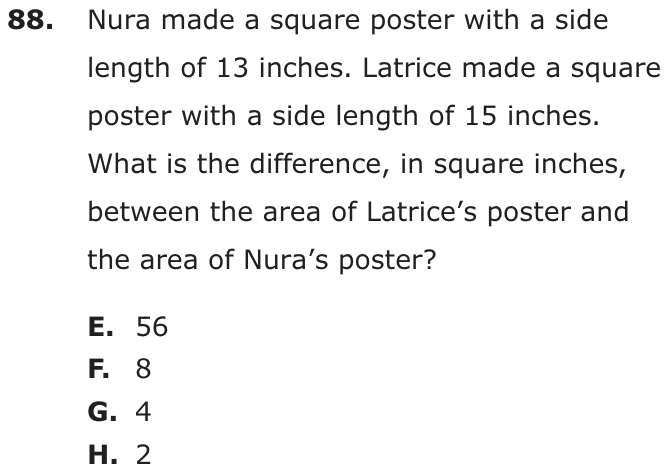
Question 87 of 120
2024 Test A Math, question 32Question
INGREDIENTS FOR 4 SERVINGS OF OATMEAL
| Ingredient | Cups |
|---|---|
| Oats | |
| Water |
The table shows the cups of ingredients used to make 4 servings of oatmeal. What is the unit rate for cups of oats per cup of water?
- A
- B
- C
- D
Show the answer
Correct answer: B
The unit rate for cups of oats per cup of water can be found by dividing the number of cups of oats by the number of cups of water:
The denominator can be rewritten as .
The quotient can be rewritten as:
Therefore, the unit rate for cups of oats per cup of water is .
Question analysis
This unit rate question uses a recipe table for 4 servings of oatmeal, with 2/3 cup of oats and 3 1/4 cups of water, and asks for cups of oats per cup of water. Students divide one fraction by another, including a mixed number. Deciding which quantity goes on top, and whether the number of servings matters, is the tricky part.
- Grade level
- Grade 7 content, by NYS standard
- Compared with grade 7
- At grade 7 Unit rates from fractions, such as 1/2 mile in 1/4 hour, are exactly grade 7 work. This one adds a mixed number, a fraction divided by a fraction, and a table titled for 4 servings, so students must decide which numbers the rate uses.
- Estimated difficulty
- Moderate: several steps, or a close reading with one strong distractor.
- Thinking it demands
- Depth of knowledge 2, skills and concepts · mainly apply
- What makes it hard
- Error-prone arithmetic moderate
- Turning words into math moderate
- Reading a figure, table or graph minor
- Solution
- 3 steps
- Reading level
- Question and choices: about grade 6, 40 words.
- Students, last 30 days
- Not enough answers yet to show (it takes 10).
Why it is hard, traps and wrong answers (shows the answer)
Why it is hard
The question rewards reading the rate's wording exactly and then carrying out a fraction division without slips. The 4 servings in the title is the hook: dividing by 4 gives a per-serving amount that sounds like a unit rate and is listed. Students who write oats over water as one fraction, convert the mixed number and multiply by the reciprocal finish in a few lines.
Error-prone arithmetic moderate Working it out
The rate is a fraction over a mixed number, 2/3 ÷ 3 1/4, so 3 1/4 must become 13/4 and the division a multiplication by 4/13. (Brown & Burton, 1978; Junker & Sijtsma, 2001)
Turning words into math moderate Understanding the question
In "cups of oats per cup of water" the quantity before "per" goes on top; reading the phrase loosely puts water over oats or brings in servings. (Hegarty, Mayer & Monk, 1995; Koedinger & Nathan, 2004)
Reading a figure, table or graph minor Understanding the question
The table's title, "for 4 servings", supplies the only other number on the page, and it plays no part in a rate of oats to water. (Lesh, Post & Behr, 1987; Kirsch & Mosenthal, 1990)
Strategy: Write the rate as cups of oats over cups of water, change the mixed number to an improper fraction, and divide by multiplying by its reciprocal.
Traps
- Information you don't need: The question gives numbers or facts that play no part in the answer.
- Answers a different question: A choice is right for another quantity: the other unknown, the rest instead of the part, the part instead of the whole.
- Wrong operation: Adds instead of multiplying, divides the wrong way round, turns a ratio or rate upside down, or undoes a step in the wrong direction (subtracts what should be added back).
The wrong answers, classified
A Answers a different question (King et al., 2004; Hegarty, Mayer & Monk, 1995)
Divides the 2/3 cup of oats by the 4 servings, 2/3 ÷ 4 = 1/6, giving oats per serving instead of oats per cup of water.
C Answers a different question (King et al., 2004; Hegarty, Mayer & Monk, 1995)
Divides the 3 1/4 cups of water by the 4 servings, 13/4 ÷ 4 = 13/16, leaving the oats out altogether.
D Wrong operation (Hegarty, Mayer & Monk, 1995; King et al., 2004)
Turns the rate upside down, water over oats, and also drops the 3 of 2/3, dividing 13/4 by 2 to get 13/8.
Worked solution, step by step
Formulas used
- Unit rate
- A unit rate tells how much of the first amount goes with 1 of the second amount. The word per means for each. The amount named before per goes on top, and the amount after it goes on the bottom.
- Mixed number to fraction
- a is the whole number part, b is the top of the fraction, and c is the bottom. Each whole holds c pieces, so a wholes hold a times c pieces. Then add the b extra pieces.
- Dividing by a fraction
- a over b is the number you divide. c over d is the number you divide by. To divide by a fraction, multiply by its reciprocal, the fraction flipped upside down. This works because dividing by a number undoes multiplying by it.
Sort out the question
The table shows cup of oats and cups of water. You need the unit rate for “cups of oats per cup of water.” That is how many cups of oats go with 1 cup of water.
Watch out: the 4 servings play no part here. Dividing the oats by 4 servings gives cup for each serving, choice A.Set up the rate
Oats comes before per, so oats goes on top. Water goes on the bottom.
Watch out: water over oats flips the rate. That gives a number bigger than 1, like choice D.Change the mixed number
A mixed number is a whole number plus a fraction. Change to a fraction so you can divide.
So 3 and one quarter cups is 13 quarters of a cup.
Divide by multiplying
To divide by , multiply by its reciprocal, .
No whole number bigger than 1 divides both 8 and 39, so the fraction can’t be made simpler. The rate is cup of oats per cup of water.
So the answer is B, .
Check your answer
There is much more water than oats. So the oats for 1 cup of water should be small, and is about 0.2. Also multiply back: . That is the cups of oats in the table.
More questions like this
The original DOE question
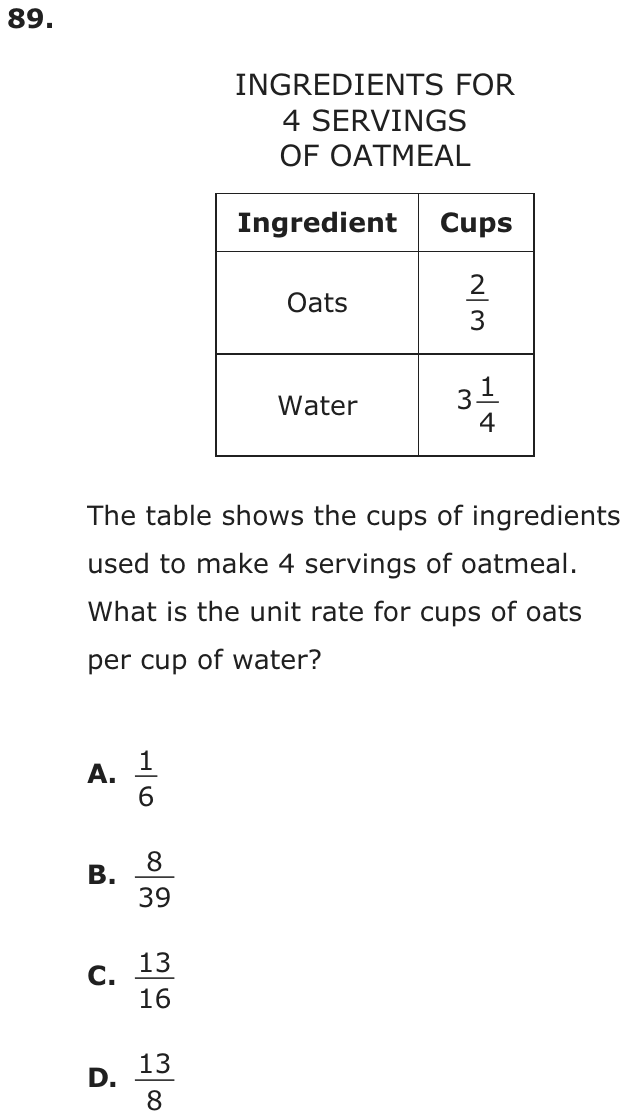
Question 88 of 120
2024 Test A Math, question 33Question
If , what is the value of x?
- A
- B
- C
- D
Show the answer
Correct answer: D
Rewrite with equivalent fractions that have like denominators.
Multiply both sides of the equation by 10.
Question analysis
This equation has fractions on both sides: the coefficient of x is 3/5 minus 1/2, and the right side is 1/4 plus 2/3. Students simplify each side using common denominators, then solve for x. Each step is routine, but four fraction operations in a row leave many places to slip, especially when undoing the coefficient.
- Grade level
- Grade 7 content, by NYS standard
- Compared with grade 7
- At grade 7 Grade 7 students solve equations such as (2/3)x = 4/5 with fractional coefficients. Here both sides must first be simplified over unlike denominators, so four fraction operations come before x is found: on level, but long.
- Estimated difficulty
- Moderate: several steps, or a close reading with one strong distractor.
- Thinking it demands
- Depth of knowledge 1, recall and reproduction · mainly apply
- What makes it hard
- Error-prone arithmetic moderate
- Many steps moderate
- Solution
- 4 steps
- Reading level
- Question and choices: about grade 8, 12 words.
- Corrected from the DOE handbook
- A minus sign printed in place of an equals sign in the explanation was corrected.
- Students, last 30 days
- Not enough answers yet to show (it takes 10).
Why it is hard, traps and wrong answers (shows the answer)
Why it is hard
Nothing here is new, but the question strings together four fraction operations, and the last one runs against habit. Having found that one tenth of x is 11/12, students must multiply by 10; multiplying by 1/10 instead gives a tiny listed value. The size of the answer is a useful check: if a tenth of x is almost 1, then x must be almost 10.
Error-prone arithmetic moderate Working it out
Both sides need common denominators, tenths on the left and twelfths on the right, and the coefficient comes out as 1/10, a fraction to divide by. (Brown & Burton, 1978; Junker & Sijtsma, 2001)
Many steps moderate Working it out
Four operations come before x appears: 3/5 − 1/2, then 1/4 + 2/3, then 11/12 divided by 1/10, then reducing 110/12 to 55/6. (Daniel & Embretson, 2010; Enright, Morley & Sheehan, 2002)
Strategy: Simplify the parentheses on the left and the sum on the right over common denominators, then undo the coefficient by multiplying both sides by its reciprocal.
Traps
- Wrong operation: Adds instead of multiplying, divides the wrong way round, turns a ratio or rate upside down, or undoes a step in the wrong direction (subtracts what should be added back).
- A faulty procedure: A systematic but wrong procedure: adding fractions straight across, applying an exponent to each term of a sum, dropping a sign when moving a term.
The wrong answers, classified
A Wrong operation (Hegarty, Mayer & Monk, 1995; King et al., 2004)
Simplifies both sides correctly but multiplies 11/12 by 1/10 instead of dividing by it, getting 11/120.
B A faulty procedure (Brown & Burton, 1978; Tatsuoka, 1983)
Combines each pair straight across, 3/5 − 1/2 as 2/3 and 1/4 + 2/3 as 3/7, then multiplies them: 2/3 × 3/7 = 2/7.
C Wrong operation (Hegarty, Mayer & Monk, 1995; King et al., 2004)
Adds 3/5 and 1/2 instead of subtracting, so the coefficient is 11/10 and x = 11/12 ÷ 11/10 = 5/6.
What was corrected from the DOE handbook, and why
- Explanation: The handbook writes “(1/10)x − 11/12”, an expression, where the working needs the equation (1/10)x = 11/12: the line before is (6/10 − 5/10)x = 3/12 + 8/12, and the next step multiplies both sides of the equation by 10. The site now reads (1/10)x = 11/12, which gives x = 110/12 = 55/6.
Worked solution, step by step
Formulas used
- Equivalent fractions
- a is the top of a fraction and b is the bottom. n is any number except 0. Multiplying the top and bottom by the same number gives an equal fraction, cut into smaller pieces. Use it to give two fractions the same bottom before you add or subtract.
- Keeping an equation balanced
- a and b are the two sides of an equation, and n is any number. An equation is like a balanced scale. If you multiply both sides by the same number, it stays balanced. Use it to undo a number that multiplies x.
Sort out the equation
An equation says two things are equal. On the left, the subtraction in the parentheses multiplies x. On the right is a sum. You need the value of x. First make each side as simple as you can. Then get x by itself.
Simplify the left side
To subtract, the fractions need the same bottom. Both 5 and 2 go into 10, so use tenths.
Watch out: this is a minus sign. Adding instead gives , and that leads to , choice C.Simplify the right side
Both 4 and 3 go into 12, so use twelfths.
Now the equation is much simpler:
Get x by itself
x is multiplied by . To undo that, multiply both sides by 10. That is the reciprocal of , the fraction flipped upside down.
Watch out: multiplying by does not undo anything. It gives , choice A.Simplify the fraction
Both 110 and 12 are even, so divide the top and the bottom by 2.
So the answer is D, .
Check your answer
Put back in for x. . That matches the right side. Also estimate. A tenth of x is almost 1, so x should be almost 10. is about 9.2.
More questions like this
The original DOE question
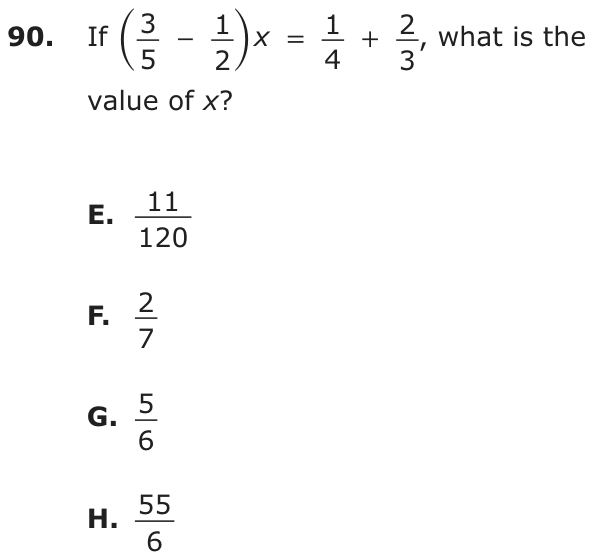
Question 89 of 120
2024 Test A Math, question 34Question
In a certain state, the sales tax rate increased from 7.0% to 7.5%. What was the increase in the sales tax on a $200 item?
- A$1
- B$10
- C$14
- D$15
Show the answer
Correct answer: A
The increase in sales tax percentage is
0.5% of $200 is
Question analysis
This percent word problem says a state's sales tax rate rose from 7.0% to 7.5% and asks how much more tax is charged on a $200 item. Students find the change in the rate and apply it to the price, or compute both taxes and compare. Converting a fraction of a percent to a decimal is where errors creep in.
- Grade level
- Grade 7 content, by NYS standard
- Compared with grade 7
- At grade 7 Sales tax is a standard grade 7 percent topic, usually finding the tax or the total on one price. This one compares two tax rates whose difference is a fraction of a percent, where placing the decimal point is the main hazard.
- Estimated difficulty
- Straightforward: two steps or one careful reading.
- Thinking it demands
- Depth of knowledge 2, skills and concepts · mainly apply
- What makes it hard
- Error-prone arithmetic moderate
- Turning words into math minor
- Solution
- 2 steps
- Reading level
- Question and choices: about grade 4, 22 words.
- Corrected from the DOE handbook
- A dash printed in place of a minus sign in the explanation was corrected.
- Students, last 30 days
- Not enough answers yet to show (it takes 10).
Why it is hard, traps and wrong answers (shows the answer)
Why it is hard
The arithmetic is tiny once 0.5% is written correctly, so the question turns on the decimal point. A percent below 1 is unfamiliar, and moving the point one place instead of two gives a choice ten times too large. Students can sidestep it by finding both taxes, $14 and $15, and subtracting, though either tax on its own is also a listed choice.
Error-prone arithmetic moderate Working it out
The change in rate is half of one percent, and writing 0.5% as a decimal moves the point two places, to 0.005; one place gives 0.05 and a tenfold error. (Brown & Burton, 1978; Junker & Sijtsma, 2001)
Turning words into math minor Understanding the question
The question asks for "the increase in the sales tax", a difference in dollars, while the stem's first sentence is about the two rates themselves. (Hegarty, Mayer & Monk, 1995; Koedinger & Nathan, 2004)
Strategy: Subtract the old rate from the new rate, then take that percent of $200, writing it as a decimal carefully; or find both taxes and subtract.
Traps
- Answers a different question: A choice is right for another quantity: the other unknown, the rest instead of the part, the part instead of the whole.
- An arithmetic slip: The right method with a plausible arithmetic error: a digit, a place value or a times-table fact.
The wrong answers, classified
B An arithmetic slip (Junker & Sijtsma, 2001)
Writes 0.5% as 0.05 instead of 0.005, so 0.05 × 200 = 10, a decimal-place slip that makes the increase ten times too large.
C Answers a different question (King et al., 2004; Hegarty, Mayer & Monk, 1995)
Finds the tax at the old rate, 7% of $200 = $14, and gives that instead of how much the tax went up.
D Stops one step early (King et al., 2004; Gierl et al., 2017)
Finds the tax at the new rate, 7.5% of $200 = $15, and stops before subtracting the $14 charged at the old rate.
What was corrected from the DOE handbook, and why
- Explanation: The handbook writes the subtraction with an em dash, “7.5% — 7.0% = 0.5%”. The site uses a minus sign: 7.5% − 7.0% = 0.5%. Nothing else changes; 0.5% of $200 is $1.
Worked solution, step by step
Formulas used
- Percent of a number
- p is the percent. Percent means out of 100, so p percent is p over 100. The whole is the amount you take the percent of, here the $200 price. The part is the result. To write a percent as a decimal, move the decimal point two places left.
Sort out the question
Sales tax is extra money added to a price. The tax rate went from 7.0% to 7.5%. The item costs $200. You need “the increase in the sales tax” in dollars. That is how much more tax you pay now.
Watch out: the tax at the old rate is $14, choice C. The tax at the new rate is $15, choice D. Neither one is the increase.Find how much the rate went up
Subtract the old rate from the new rate.
The rate went up 0.5%. That is half of one percent.
Find 0.5% of $200
The extra tax is 0.5% of the price. Use the percent formula with p = 0.5 and the whole = 200.
The tax goes up by $1. Watch out: 0.5% is 0.005, not 0.05. Moving the point only one place gives $10, choice B.
So the answer is A, $1.
Check your answer
Find both taxes and subtract. Old tax: , so $14. New tax: , so $15. The difference is , or $1. Both ways give the same answer.
More questions like this
The original DOE question
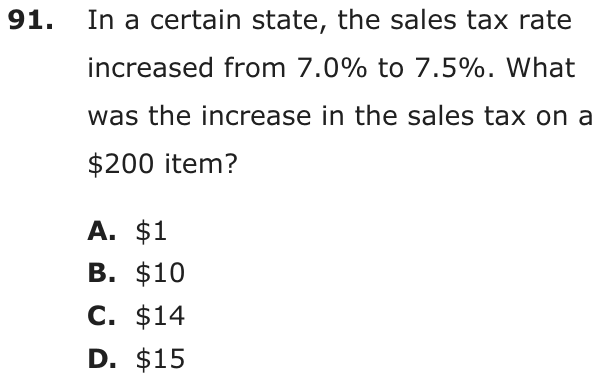
Question 90 of 120
2024 Test A Math, question 35Question
Evaluate:
- A−30
- B−18
- C18
- D44
Show the answer
Correct answer: B
Simplify negatives inside the first absolute value brackets.
Simplify the first absolute value.
Calculate the absolute values.
Perform the final subtraction.
Question analysis
This integer question asks students to evaluate an expression with two absolute values: the first holds four positive and negative numbers, and the second is the absolute value of 24. It tests subtracting negative numbers and understanding absolute value. Subtracting a negative number and handling each pair of bars separately are where most slips happen.
- Grade level
- Grade 7 content, by NYS standard
- Compared with grade 7
- At grade 7 Grade 7 students add and subtract integers and know absolute value as distance from zero. This expression puts four signed terms inside one pair of bars and subtracts a second absolute value, a typical but sign-heavy grade 7 exercise.
- Estimated difficulty
- Moderate: several steps, or a close reading with one strong distractor.
- Thinking it demands
- Depth of knowledge 1, recall and reproduction · mainly apply
- What makes it hard
- Error-prone arithmetic moderate
- A very close wrong answer moderate
- Many steps minor
- Solution
- 4 steps
- Reading level
- Question and choices: about grade 16+, 2 words.
- Students, last 30 days
- Not enough answers yet to show (it takes 10).
Why it is hard, traps and wrong answers (shows the answer)
Why it is hard
Every step is routine, but the question stacks sign decisions, and one slip anywhere produces a clean wrong number. The last step is the subtle one: each pair of bars gives a positive number, but 6 minus 24 is still negative. Students who believe bars guarantee a positive result flip that subtraction, and the choices offer the flipped number beside the right one.
Error-prone arithmetic moderate Working it out
The first bars hold four signed terms, and two must be rewritten, + (−17) as − 17 and − (−31) as + 31, before they combine to −6. (Brown & Burton, 1978; Junker & Sijtsma, 2001)
A very close wrong answer moderate Choosing the answer
The answer, −18, and the choice 18 differ only in sign, so estimating cannot separate them; only doing the last step as 6 − 24 does. (Embretson & Wetzel, 1987; Gorin & Embretson, 2006; Ascalon et al., 2007)
Many steps minor Working it out
Each pair of bars is simplified inside and made positive before the outer subtraction, so three separate jobs must be done in the right order. (Daniel & Embretson, 2010; Enright, Morley & Sheehan, 2002)
Strategy: Rewrite each subtraction of a negative as addition, combine the four numbers inside the first bars, take both absolute values, and only then do the final subtraction.
Traps
- Negatives and direction: Arithmetic with negative numbers, the order of a subtraction, or direction on a number line. (Moving a term across the equals sign without changing its sign is a faulty procedure.)
- Misunderstands the concept: A wrong belief about a concept: that percents can be added, that area grows like length, that averages can be averaged, that a bigger denominator means a bigger fraction.
The wrong answers, classified
A A faulty procedure (Brown & Burton, 1978; Tatsuoka, 1983)
Simplifies the inside to −6 but treats the bars like parentheses, keeping −6, so −6 − 24 = −30.
C Misunderstands the concept (Smith, diSessa & Roschelle, 1993; De Bock et al., 1998; Ni & Zhou, 2005)
Assumes an expression made of absolute values cannot be negative, so subtracts 6 from 24 instead of 24 from 6.
D Negatives and direction (Brown & Burton, 1978)
Reads − (−31) as − 31, so the inside becomes −8 − 12 − 17 − 31 = −68, and 68 − 24 = 44.
Worked solution, step by step
Formulas used
- Adding and subtracting negatives
- a is any number, and b is a positive number, so −b is negative. Adding a negative moves you left on the number line, just like subtracting. Subtracting a negative is like taking away a debt, so you end up with more. It is the same as adding.
- Absolute value
- The bars around a number mean absolute value. a is any number. Its absolute value is how far a is from 0 on the number line. A distance is never negative, so the absolute value of −6 is 6.
Sort out the expression
The expression has two absolute values. The bars mean the distance from 0, so what comes out of them is never negative. Work in this order. First simplify inside the first bars. Then take both absolute values. Last, do the subtraction between them.
Rewrite the signs inside
Two signs inside the first bars are tricky. Adding −17 is the same as subtracting 17. Subtracting −31 is the same as adding 31.
Watch out: minus negative 31 is plus 31. Treating it as minus 31 makes the inside −68. That leads to 44, choice D.Combine the four numbers
Go from left to right, one number at a time.
The inside of the first bars is −6.
Take the absolute values
Now the expression is . Watch out: the bars turn −6 into 6. Keeping −6 gives , choice A.
Do the last subtraction
You take 24 away from 6. Taking a bigger number from a smaller one gives a negative answer. Watch out: absolute values are never negative, but this answer can be. Doing instead gives 18, choice C.
So the answer is B, −18.
Check your answer
Check the inside a new way. The positive part is 31. The negative parts add to . Since , the inside is right. Then, on a number line, start at 6 and move 24 to the left. Six steps reach 0, and 18 more land on −18.
More questions like this
The original DOE question
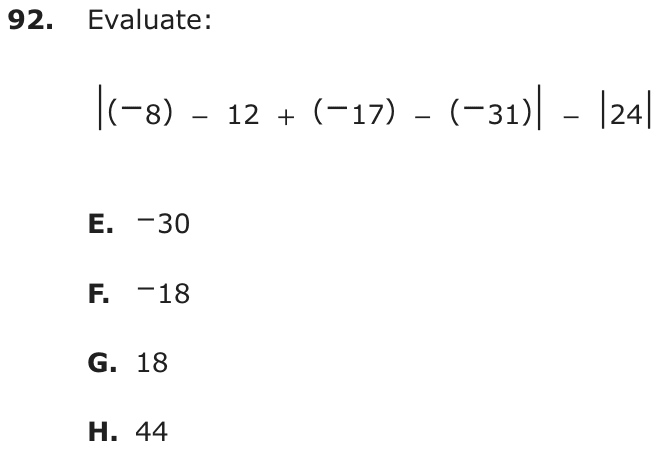
Question 91 of 120
2024 Test A Math, question 36Question
CELL PHONE SALES BY COLOR
| Color | Percentage of Cell Phones Sold |
|---|---|
| White | |
| Black | 30 |
| Blue | |
| Red | |
| Total | 100 |
The table above shows cell phone sales by color. What percentage of the cell phones sold were blue?
- A18%
- B20%
- C22%
- D28%
Show the answer
Correct answer: B
First, use the information given in the table and properties of equations to determine the value of k:
Then, determine the percentage of cell phones sold that were blue by finding the value of the expression (given in the table), when :
The percentage of cell phones sold that were blue is 20%.
Question analysis
A table of cell phone sales by color gives each color's percentage as an expression in k, such as 8k for white and 30 − 2k for blue, with a total of 100. Students write and solve an equation for k, then find the percentage for blue. Combining terms with a negative coefficient, and remembering that k itself is not the answer, both need care.
- Grade level
- Grade 7 content, by NYS standard
- Compared with grade 7
- At grade 7 Grade 7 students solve two-step equations that are written out for them. Here the equation must be built from a table whose percentages total 100, with like terms to combine, and the value found must then be substituted back.
- Estimated difficulty
- Moderate: several steps, or a close reading with one strong distractor.
- Thinking it demands
- Depth of knowledge 2, skills and concepts · mainly apply
- What makes it hard
- Many steps moderate
- Reading a figure, table or graph minor
- Error-prone arithmetic minor
- Solution
- 4 steps
- Reading level
- Question and choices: about grade 4, 36 words.
- Students, last 30 days
- Not enough answers yet to show (it takes 10).
Why it is hard, traps and wrong answers (shows the answer)
Why it is hard
The question hides an equation in a table, and the key insight is that the four percentages must add to 100. After that the algebra is routine, and no listed choice rewards stopping early, since neither k nor any other color's percentage appears. The wrong choices sit near the answer or use the blue expression with k ignored, so students who cannot set up the equation are left guessing.
Many steps moderate Working it out
The answer needs a chain: add the four expressions, set the sum to 100, collect 8k − 2k + k into 7k, solve for k, then substitute into 30 − 2k. (Daniel & Embretson, 2010; Enright, Morley & Sheehan, 2002)
Reading a figure, table or graph minor Understanding the question
No equation is printed; the table's Total row of 100 is what turns the four percentages written in k into one equation to solve. (Lesh, Post & Behr, 1987; Kirsch & Mosenthal, 1990)
Error-prone arithmetic minor Working it out
Collecting like terms includes the negative coefficient in the blue row, −2k, and the constants 30, 30 and 5 have to be gathered too. (Brown & Burton, 1978; Junker & Sijtsma, 2001)
Strategy: Add the four color expressions and set the sum equal to 100, combine like terms to solve for k, then substitute k into the blue row's expression.
Traps
- Numbers taken from the question: Combines the numbers in the question without a model of the situation, or is simply a number that appears in the question.
The wrong answers, classified
A Little reason to choose it (Haladyna & Downing, 1993; Rodriguez, 2005)
No common slip gives k = 6 from 7k + 65 = 100, the value 18% would need; it sits 2 points below the answer and mostly draws guesses.
C Little reason to choose it (Haladyna & Downing, 1993; Rodriguez, 2005)
No usual error in collecting terms or solving yields k = 4, which 22% requires, so this near neighbor of the answer mostly attracts guessers.
D Numbers taken from the question (Hegarty, Mayer & Monk, 1995)
Never solves for k and reads the blue entry 30 − 2k as 30 − 2, as if k were 1, giving 28.
Worked solution, step by step
Formulas used
- Combining like terms
- k is the unknown number. a and b are the numbers in front of k, called coefficients. Terms with the same letter are called like terms. You can add their coefficients, because a groups of k plus b groups of k make a + b groups of k.
- Keeping an equation balanced
- a and b are the two sides of an equation, and c is any number (not 0 when you divide). An equation is like a balanced scale. Doing the same thing to both sides keeps it balanced. Use it to undo each step and get k alone.
Sort out the table
The table gives the percent of phones sold in each color. Some entries use k, a letter that stands for an unknown number. 8k means 8 times k. You need the percent that were blue, . To find it, you first need k.
Write an equation for the total
Every phone sold is one of the four colors. So the four percents add up to the total, 100, as the last row of the table shows.
Combine like terms
Terms with k in them are called like terms, so they can be combined. Group the k terms together and the plain numbers together. A k on its own means 1k.
So the equation becomes . Watch out: the blue row takes away 2k. Keep its minus sign, or the k terms will be wrong.
Solve for k
Undo the adding first, then the multiplying.
So k is 5. But k is not the answer. You still need the blue row.
Find the blue percent
Put 5 in for k in the blue row.
So 20% of the phones sold were blue. Watch out: 2k means 2 times k, not 2. Reading as gives 28%, choice D.
So the answer is B, 20%.
Check your answer
Put k = 5 into every row. White: . Black: 30. Blue: 20. Red: . Now add them: . The total matches the table, so k = 5 is right.
More questions like this
The original DOE question
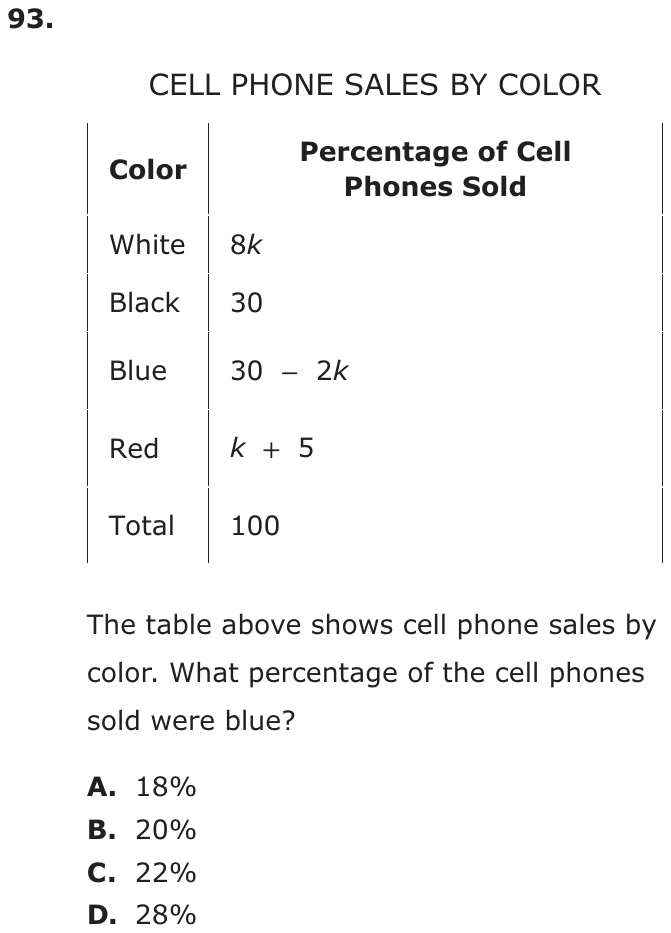
Question 92 of 120
2024 Test A Math, question 37Question
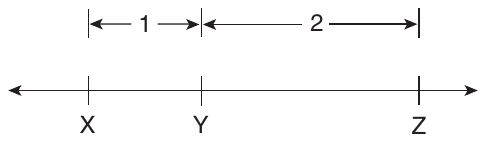
On the number line above, the distance between X and Y is 1 unit, and the distance between Y and Z is 2 units. What is the distance, in units, between Y and the midpoint of X and Z?
- A
- B1
- C
- D3
Show the answer
Correct answer: A
First, find the distance between X and Z by adding the distance between X and Y to the distance between Y and Z.
Since the distance between X and Z is 3, the midpoint between X and Z is units from X.
The midpoint between X and Z is units from X, and the distance between X and Y is 1. The distance between Y and the midpoint of X and Z is .
Question analysis
This number line question shows points X, Y and Z, with 1 unit from X to Y and 2 units from Y to Z, and asks how far Y is from the midpoint of X and Z. Students find the length of XZ, locate its midpoint, and compare it with Y. Each step produces a tempting number, so stopping early is the usual mistake.
- Grade level
- Grade 7 content, by NYS standard
- Compared with grade 7
- Below grade 7 Grade 7 number line problems usually involve negative numbers and fractions as coordinates. This one has no coordinates, only two whole-number distances, and needs three short steps: a total length, a midpoint and a difference.
- Estimated difficulty
- Straightforward: two steps or one careful reading.
- Thinking it demands
- Depth of knowledge 2, skills and concepts · mainly apply
- What makes it hard
- Reading a figure, table or graph minor
- Many steps minor
- Solution
- 3 steps
- Reading level
- Question and choices: about grade 5, 39 words.
- Corrected from the DOE handbook
- An imprecise statement about the midpoint in the explanation was corrected.
- Students, last 30 days
- Not enough answers yet to show (it takes 10).
Why it is hard, traps and wrong answers (shows the answer)
Why it is hard
The arithmetic is light, but every intermediate result is waiting among the choices, so the risk is stopping before the last subtraction. Students also have to keep two midpoints apart: the one asked about lies between X and Z, not halfway along the 2-unit stretch from Y. Marking X at 0 and the midpoint at 1.5 on the drawing makes the half-unit gap visible.
Reading a figure, table or graph minor Understanding the question
The number line has no coordinates, only dimension arrows labeled 1 and 2, so students must assign positions themselves, such as X at 0, Y at 1 and Z at 3. (Lesh, Post & Behr, 1987; Kirsch & Mosenthal, 1990)
Many steps minor Working it out
Three short results come in sequence, the length XZ, the midpoint's distance from X, then its distance from Y, and each is also a listed choice. (Daniel & Embretson, 2010; Enright, Morley & Sheehan, 2002)
Strategy: Place X at 0 so that Y and Z get positions from the given distances, find the midpoint of X and Z as half their distance, then compare it with Y's position.
Traps
- Stops one step early: A choice is a number from partway through the solution.
- Answers a different question: A choice is right for another quantity: the other unknown, the rest instead of the part, the part instead of the whole.
The wrong answers, classified
B Answers a different question (King et al., 2004; Hegarty, Mayer & Monk, 1995)
Halves the 2-unit segment from Y to Z, the midpoint of the wrong pair of points, which is 1 unit from Y; it also matches the labeled XY.
C Stops one step early (King et al., 2004; Gierl et al., 2017)
Finds that the midpoint is 1 1/2 units from X and stops before subtracting the 1 unit between X and Y.
D Answers a different question (King et al., 2004; Hegarty, Mayer & Monk, 1995)
Adds the two labeled distances, 1 + 2 = 3, and gives the whole length XZ rather than any distance to the midpoint.
What was corrected from the DOE handbook, and why
- Explanation: The handbook says “the midpoint between X and Z is 1½” (twice). A midpoint is a point, and this number line has no numbers on it, so the 1½ is the midpoint’s distance from X (half of XZ = 3). Both sentences now say the midpoint is “1½ units from X.” The rest is unchanged: Y is 1 unit from X, so the distance between Y and the midpoint is 1½ − 1 = ½.
Worked solution, step by step
Formulas used
- Adding lengths on a line
- X, Y and Z are points on one line, with Y between X and Z. XY and YZ are the lengths of the two short pieces. XZ is the length of the whole. The two pieces join end to end to make the whole.
- Midpoint of a segment
- A segment is the straight piece of a line between two points, its ends. The midpoint is the point exactly halfway between the ends. It splits the segment into two equal halves. So it is half the length away from each end.
Sort out the picture
The points go X, then Y, then Z, from left to right. X to Y is 1 unit, and Y to Z is 2 units. You need the midpoint of X and Z, the point halfway between them. Then you need how far Y is from that midpoint. The line has no numbers, so measure everything from X.
Find the length from X to Z
X to Z is 3 units. Watch out: 3 is the whole length, choice D. It is not a distance to the midpoint.
Place the midpoint
The midpoint of X and Z is half of 3 units from X.
So the midpoint is units to the right of X. Watch out: this is its distance from X, not from Y. Stopping here gives choice C.
Measure from Y to the midpoint
Y is 1 unit to the right of X. The midpoint is units to the right of X. Subtract to find the gap between them.
Watch out: use the midpoint of X and Z, not of Y and Z. Halving the 2 units from Y to Z gives 1, choice B.So the answer is A, unit.
Check your answer
Give each point a number, with X at 0. Then Y is at 1 and Z is at 3. Halfway between 0 and 3 is . From Y at 1 to is . This fits the picture too: Y sits a little left of the middle of XZ.
More questions like this
The original DOE question
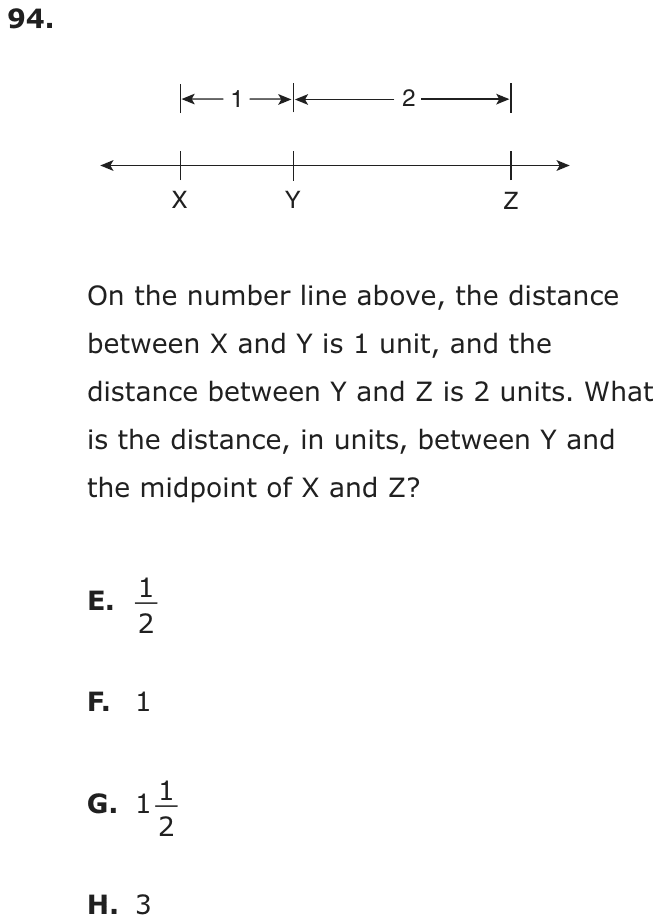
Question 93 of 120
2024 Test A Math, question 38Question
By what percent did the price of a cup of coffee increase if its price was increased from $1.25 to $1.35?
- A7%
- B8%
- C10%
- D12%
Show the answer
Correct answer: B
Subtract to determine the amount of the increase.
Divide the increase by the original price.
Multiply the quotient by 100 to express the decimal answer as a percent.
Question analysis
This percent increase question gives the price of a cup of coffee before and after a raise, from $1.25 to $1.35, and asks by what percent the price went up. Students find the change in price and compare it with a price. Deciding which price to compare the change with is the tricky part.
- Grade level
- Grade 7 content, by NYS standard
- Compared with grade 7
- At grade 7 Percent increase is grade 7 content, and this is a standard case with two prices. What makes it harder than routine is deciding which price the change is measured against and dividing small decimals accurately.
- Estimated difficulty
- Moderate: several steps, or a close reading with one strong distractor.
- Thinking it demands
- Depth of knowledge 2, skills and concepts · mainly apply
- What makes it hard
- A very close wrong answer moderate
- Error-prone arithmetic moderate
- Solution
- 3 steps
- Reading level
- Question and choices: about grade 6, 19 words.
- Students, last 30 days
- Not enough answers yet to show (it takes 10).
Why it is hard, traps and wrong answers (shows the answer)
Why it is hard
Most students see that the price rose by 10 cents; the question is what to compare that with. Percent change is measured from the original amount, and dividing by the new price gives a number close enough to the answer that rounding hides the mistake. Reading the 10 cents directly as 10 percent is the other quick trap, since 10 cents is only 10 percent of a dollar.
A very close wrong answer moderate Choosing the answer
Dividing the 10-cent rise by either price gives a single-digit percent, 8% from $1.25 and about 7.4% from $1.35, so only the choice of base separates the two listed answers. (Embretson & Wetzel, 1987; Gorin & Embretson, 2006; Ascalon et al., 2007)
Error-prone arithmetic moderate Working it out
Without a calculator, 0.10 ÷ 1.25 is a division by a decimal; rewriting it in cents as 10/125, which simplifies to 8/100, is the clean way through. (Brown & Burton, 1978; Junker & Sijtsma, 2001)
Strategy: Subtract to get the increase, then divide it by the price before the raise and multiply by 100; working in cents keeps the decimals out of the way.
Traps
- Percent of the wrong amount: Finding the whole from a part, or a percent change measured from the wrong starting amount.
- Misunderstands the concept: A wrong belief about a concept: that percents can be added, that area grows like length, that averages can be averaged, that a bigger denominator means a bigger fraction.
- Wrong operation: Adds instead of multiplying, divides the wrong way round, turns a ratio or rate upside down, or undoes a step in the wrong direction (subtracts what should be added back).
The wrong answers, classified
A Percent of the wrong amount (Parker & Leinhardt, 1995)
Divides the 10-cent increase by the new price, $1.35, measuring from the wrong amount; 0.10 ÷ 1.35 is about 7.4%, so 7%.
C Misunderstands the concept (Smith, diSessa & Roschelle, 1993; De Bock et al., 1998; Ni & Zhou, 2005)
Reads the 10-cent increase as 10 percent, as if every percent change were a percent of one dollar rather than of the $1.25 price.
D Wrong operation (Hegarty, Mayer & Monk, 1995; King et al., 2004)
Divides the wrong way round, $1.25 ÷ $0.10 = 12.5, and takes the nearest choice, 12%.
Worked solution, step by step
Formulas used
- Percent increase
- New is the price after the change, and original is the price before it. The top is the amount of the increase. Dividing by the original compares the increase with where you started. Multiplying by 100 turns that decimal into a percent.
Sort out the question
The coffee cost $1.25 before. That is the original price. Now it costs $1.35, the new price. You need the percent increase. That compares how much the price went up with the original price.
Find the amount of the increase
The price went up $0.10, or 10 cents. Watch out: 10 cents is not 10%. It would be 10% only if the price started at $1.00. That mistake gives choice C.
Divide by the original price
Dividing by a decimal is easier in cents: 10 cents out of 125 cents. Divide the top and bottom by 5. Then multiply both by 4 to get hundredths.
Change to a percent
The price went up 8%. Watch out: divide by the original price, $1.25, not the new one. Dividing by $1.35 gives about 7.4%, which rounds to choice A.
So the answer is B, 8%.
Check your answer
Work forward from the answer. 8% of $1.25 is , or 10 cents. Then . That is the new price, so 8% is right.
More questions like this
The original DOE question
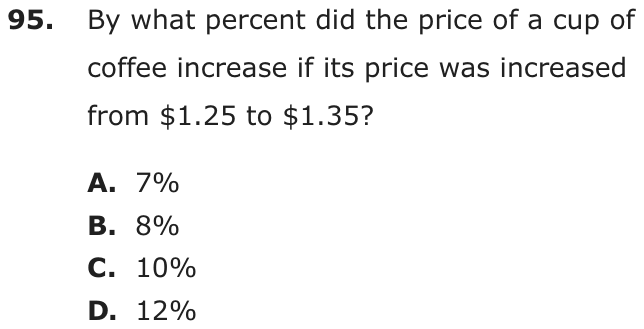
Question 94 of 120
2024 Test A Math, question 39Question
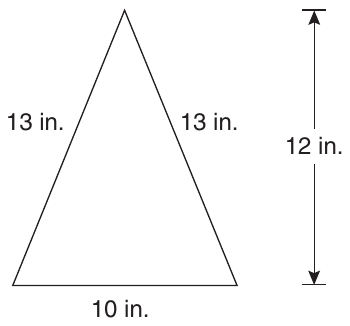
Raquel is cutting out pieces of cardboard to make a pyramid. She will use a square piece for the base and identical triangular pieces for the sides. The figure above shows the dimensions of the triangle for each side. What will be the total surface area, in square inches, of the pyramid, including the square base?
- A280
- B295
- C340
- D360
Show the answer
Correct answer: C
Surface area is found by calculating the area of each side, including the base, and adding them all together.
The base of the pyramid measures 10 inches on each side, so the area of the base is
Each triangular face has a base of 10 inches and a height of 12 inches, so the area of each face is
There are 4 triangular faces (because the square base has 4 edges, each of which will have a triangular face). So the total surface area of the pyramid is the sum of the areas of 4 triangles and 1 square.
So the total surface area is 340 square inches.
Question analysis
This surface area word problem shows one triangular face, with sides of 13 inches, a base of 10 inches and a height of 12 inches, that Raquel will use to build a cardboard pyramid with a square base. Students find the total area of the base and all the triangular sides. Picturing the solid and choosing the right measurements from the figure are the tricky parts.
- Grade level
- Grade 7 content, by NYS standard
- Compared with grade 7
- Above grade 7 Grade 7 students find the surface area of a pyramid from a drawn net or solid. Here only one triangular face is shown, so students must picture the whole pyramid, count its faces, and choose which labeled length belongs in the area formula.
- Estimated difficulty
- Hard: combines ideas, needs a plan, and has more than one tempting wrong answer.
- Thinking it demands
- Depth of knowledge 2, skills and concepts · mainly apply
- What makes it hard
- Reading a figure, table or graph moderate
- Combines ideas moderate
- Something you must already know minor
- Solution
- 4 steps
- Reading level
- Question and choices: about grade 6, 56 words.
- Corrected from the DOE handbook
- A wrong unit in the explanation was corrected.
- Students, last 30 days
- Not enough answers yet to show (it takes 10).
Why it is hard, traps and wrong answers (shows the answer)
Why it is hard
Students have to build the pyramid in their heads from one flat triangle, then choose the right measurement from three labels. The 13-inch sides look like the natural height, and using them gives a listed total; picturing a pyramid with three sloping faces gives another. Sketching the square base with a triangle on each edge, and marking 12 as the height, settles both the face count and the formula.
Reading a figure, table or graph moderate Understanding the question
The figure gives one triangle with three length labels, 13, 13 and 10, and puts its height, 12, on a separate arrow beside it, where it is easy to overlook. (Lesh, Post & Behr, 1987; Kirsch & Mosenthal, 1990)
Combines ideas moderate Working it out
The solid is never drawn: students must see that the square's side equals the triangle's 10-inch base, count four triangles, and add triangle and square areas. (Embretson, 1998; Daniel & Embretson, 2010)
Something you must already know minor Working it out
A triangle's area uses its perpendicular height, not a slanted side, and a pyramid on a square base has four triangular faces; neither fact is given. (Anderson & Krathwohl, 2001)
Strategy: Sketch the pyramid: a square base whose side is the triangle's base, and one triangular face on each side of the square. Find each area with the matching formula, then add them all.
Traps
- Misreads the figure: Reads a value, label or tick spacing in a figure, table or graph wrongly.
- Information you don't need: The question gives numbers or facts that play no part in the answer.
- Misunderstands the concept: A wrong belief about a concept: that percents can be added, that area grows like length, that averages can be averaged, that a bigger denominator means a bigger fraction.
The wrong answers, classified
A Misunderstands the concept (Smith, diSessa & Roschelle, 1993; De Bock et al., 1998; Ni & Zhou, 2005)
Counts only three triangular faces, as if the pyramid had a triangular base, so 3 × 60 + 100 = 280.
B Misunderstands the concept (Smith, diSessa & Roschelle, 1993; De Bock et al., 1998; Ni & Zhou, 2005)
Counts three faces and also uses the 13-inch side as each triangle's height: 3 × 65 + 100 = 295.
D Misreads the figure (Lesh, Post & Behr, 1987; Kirsch & Mosenthal, 1990)
Takes the 13-inch slanted side as each triangle's height instead of the 12-inch arrow beside it, so 4 × 65 + 100 = 360.
What was corrected from the DOE handbook, and why
- Explanation: The handbook ends “So the total surface area is 340 square feet.” The triangle’s dimensions are in inches and the question asks for square inches, so the site now reads “340 square inches.”
Worked solution, step by step
Formulas used
- Area of a triangle
- A is the area. b is the base, the side the triangle sits on. h is the height: the straight-up distance from the base to the top corner, at a right angle to the base. You take half because a triangle is half of a rectangle with the same base and height.
- Area of a square
- A is the area and s is the length of one side. All four sides of a square are equal, so the area is side times side.
- Surface area
- A face is one flat side of a solid shape. The surface area is the total area of the outside. Picture unfolding the solid into flat pieces. Then add up the area of every piece.
Sort out the question
Raquel’s pyramid has a square base. Each side is a triangle like the one in the figure. The triangle’s base is 10 in. Its two slanted sides are 13 in. Its height, the arrow beside it, is 12 in. You need the total surface area, including the square base, in square inches.
Picture the pyramid
Surface area is the total area of all the flat sides, called faces. Each triangle stands on one edge of the square. So each edge of the square is 10 inches, the same as the triangle’s base. A square has 4 edges, so the pyramid has 4 triangles.
Here that is 4 triangles plus 1 square. Watch out: counting only 3 triangles gives 280, choice A.
Find the area of one triangle
Each triangle is 60 square inches. Watch out: the height is 12 in., the straight-up arrow. It is not 13 in., the slanted side. Using 13 gives 65 for each triangle and 360 in all, choice D.
Find the area of the base
The base is a square with sides of 10 inches, the same as each triangle’s base.
The square base is 100 square inches.
Add all five faces
The four triangles and the square together cover 340 square inches.
So the answer is C, 340 square inches.
Check your answer
Each triangle is half of a 10 by 12 rectangle, which has an area of 120. So two triangles make 120, and four make 240. Add the base: . The units fit too: inches times inches gives square inches.
More questions like this
The original DOE question
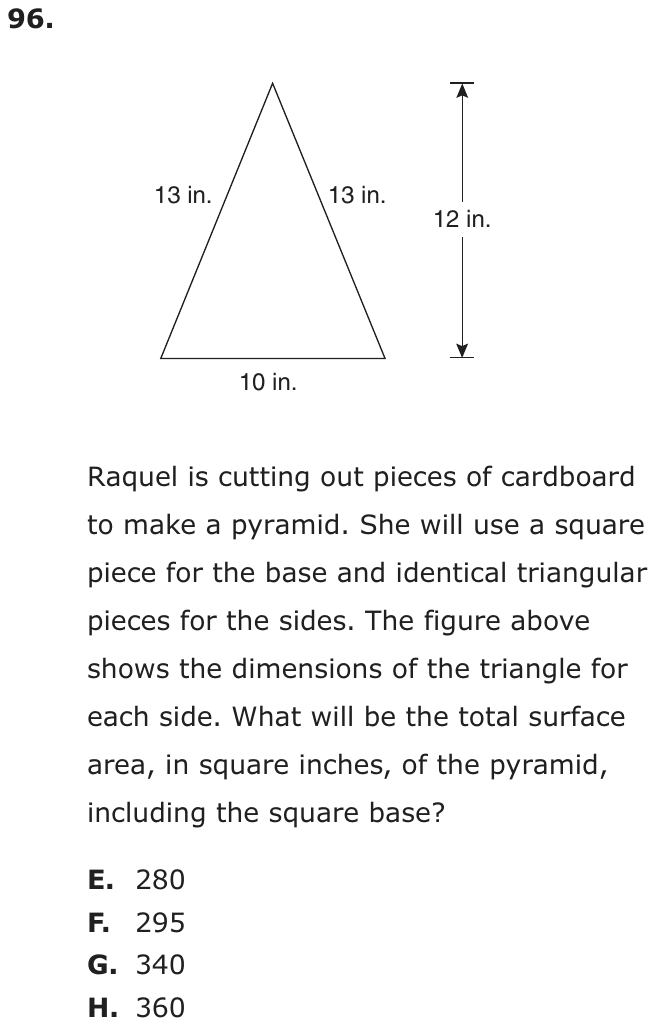
Question 95 of 120
2024 Test A Math, question 40Question
The price of a sandwich was raised from $6.25 to $6.75. What was the percent increase in the price?
- A5%
- B8%
- C7%
- D50%
Show the answer
Correct answer: B
Use the percent increase expression to find the answer:
Question analysis
A sandwich's price went up from $6.25 to $6.75, and this percent change question asks for the percent increase in the price. Students divide the 50-cent increase by one of the prices and write the result as a percent. Picking which price is the base, and doing the decimal division accurately, decide whether the answer comes out right.
- Grade level
- Grade 7 content, by NYS standard
- Compared with grade 7
- At grade 7 Finding a percent increase is a core grade 7 skill, and this is the plain version with no context beyond two prices. Its demand lies in measuring the change against the correct price and dividing by $6.25 without a calculator.
- Estimated difficulty
- Moderate: several steps, or a close reading with one strong distractor.
- Thinking it demands
- Depth of knowledge 2, skills and concepts · mainly apply
- What makes it hard
- A very close wrong answer moderate
- Error-prone arithmetic moderate
- Solution
- 3 steps
- Reading level
- Question and choices: about grade 2, 17 words.
- Students, last 30 days
- Not enough answers yet to show (it takes 10).
Why it is hard, traps and wrong answers (shows the answer)
Why it is hard
The 50-cent rise is easy to find; the percent depends on what it is compared with. Dividing by the new price, $6.75, gives a value that rounds to a listed choice one point below the answer, and reading 50 cents as 50 percent gives another. The choices are printed out of order, 8% before 7%, so students should read each one rather than scan the list.
A very close wrong answer moderate Choosing the answer
Measured against $6.75 the 50-cent rise is about 7.4%, and against $6.25 it is 8%; both are listed side by side, so only the right base separates them. (Embretson & Wetzel, 1987; Gorin & Embretson, 2006; Ascalon et al., 2007)
Error-prone arithmetic moderate Working it out
The division 0.50 ÷ 6.25 is easiest as 50/625, which reduces to 2/25 and then to 8/100; a three-digit decimal divisor invites a slip. (Brown & Burton, 1978; Junker & Sijtsma, 2001)
Strategy: Put the 50-cent change over the original price, 0.50 over 6.25, then scale the fraction to hundredths or divide to read off the percent.
Traps
- Percent of the wrong amount: Finding the whole from a part, or a percent change measured from the wrong starting amount.
- Misunderstands the concept: A wrong belief about a concept: that percents can be added, that area grows like length, that averages can be averaged, that a bigger denominator means a bigger fraction.
The wrong answers, classified
A Little reason to choose it (Haladyna & Downing, 1993; Rodriguez, 2005)
No common working gives 5%: dividing the 50-cent rise by either price does not come near it, so it mostly draws guesses.
C Percent of the wrong amount (Parker & Leinhardt, 1995)
Divides the 50-cent increase by the new price, $6.75, instead of the original, which gives about 7.4%, so 7%.
D Misunderstands the concept (Smith, diSessa & Roschelle, 1993; De Bock et al., 1998; Ni & Zhou, 2005)
Reads the 50-cent increase as 50 percent, treating cents as a percent of one dollar rather than of the $6.25 price.
Worked solution, step by step
Formulas used
- Percent increase
- New is the price after the change, and original is the price before it. The top is the amount of the increase. Dividing by the original compares the increase with where you started. Multiplying by 100 turns that decimal into a percent.
Sort out the question
The sandwich cost $6.25 before. That is the original price. Now it costs $6.75, the new price. You need the percent increase. That compares the increase with the original price. Note that the choices are not in order: C, 7%, comes after B, 8%.
Find the amount of the increase
The price went up $0.50, or 50 cents. Watch out: 50 cents is not 50%. It would be 50% only if the price started at $1.00. That mistake gives choice D.
Divide by the original price
In cents, this is 50 out of 625. Divide the top and bottom by 25. Then multiply both by 4 to get hundredths.
Change to a percent
The price went up 8%. Watch out: divide by the original price, $6.25, not the new one. Dividing by $6.75 gives about 7.4%, which is choice C.
So the answer is B, 8%.
Check your answer
Work forward from the answer. 8% of $6.25 is , or 50 cents. Then . That is the new price, so 8% is right.
More questions like this
The original DOE question
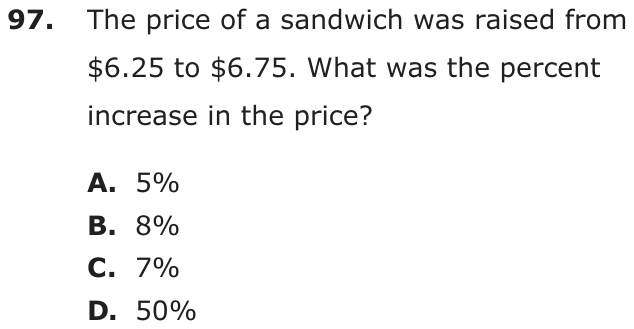
Question 96 of 120
2024 Test A Math, question 41Question
Terrell played 5 computer games and earned a mean score of 8 points per game. If his mean score for the first 4 games was 7 points per game, how many points was his score in the fifth game?
- A9
- B11
- C12
- D14
Show the answer
Correct answer: C
If the mean number of points for the first four games is 7, the total number of points earned in those games is 28.
If the mean number of points for all five games is 8, the total number of points earned is 40.
To find the number of points in the fifth game, find the difference between 40 and 28.
Question analysis
This mean, or average, word problem says Terrell averaged 8 points over 5 computer games and 7 points over the first 4, and asks for his score in the fifth game. Students turn each average into a total and compare the totals. Combining the two averages directly, without going through totals, is the tempting shortcut that fails.
- Grade level
- Grade 6 content, by NYS standard
- Compared with grade 7
- At grade 7 Computing a mean is grade 6 content. Working backward from two means to the totals they stand for, then to one missing score, is a common grade 7 test task, and it comes with a tempting shortcut.
- Estimated difficulty
- Moderate: several steps, or a close reading with one strong distractor.
- Thinking it demands
- Depth of knowledge 2, skills and concepts · mainly apply
- What makes it hard
- Turning words into math moderate
- Something you must already know minor
- Solution
- 3 steps
- Reading level
- Question and choices: about grade 4, 35 words.
- Students, last 30 days
- Not enough answers yet to show (it takes 10).
Why it is hard, traps and wrong answers (shows the answer)
Why it is hard
The question rewards turning both means into totals, 40 points for five games and 28 for four, after which one subtraction finishes it. Averaging 7 with the unknown score is a quick shortcut that gives a listed choice, but it weighs four games as one. Checking that 28 plus the answer, divided by 5, gives 8 catches that error and the near miss next to the answer.
Turning words into math moderate Understanding the question
Each mean has to become a total before the fifth game can be found: "a mean score of 8 points per game" over 5 games means 40 points in all. (Hegarty, Mayer & Monk, 1995; Koedinger & Nathan, 2004)
Something you must already know minor Working it out
Students must know that a total is the mean times the number of games, and that means over different numbers of games cannot simply be averaged. (Anderson & Krathwohl, 2001)
Strategy: Turn each mean into a total by multiplying by its number of games, then subtract the four-game total from the five-game total.
Traps
- Misunderstands the concept: A wrong belief about a concept: that percents can be added, that area grows like length, that averages can be averaged, that a bigger denominator means a bigger fraction.
The wrong answers, classified
A Misunderstands the concept (Smith, diSessa & Roschelle, 1993; De Bock et al., 1998; Ni & Zhou, 2005)
Averages the four-game mean with the fifth score, (7 + x) ÷ 2 = 8, so x = 9, as if the first four games counted once.
B Counting the ends (Brown & Burton, 1978)
Sees the fifth game must lift the mean 1 point above 7 but spreads that over only 4 games, 7 + 4 = 11, instead of all 5.
D Little reason to choose it (Haladyna & Downing, 1993; Rodriguez, 2005)
No common working gives 14, which is twice the four-game mean and matches no total or difference, so it mostly draws guesses.
Worked solution, step by step
Formulas used
- Total from a mean
- The mean, or average, is what each game would score if the total were shared out equally. So the total is the mean times the number of games. Use it to turn each mean back into a total. Totals can be subtracted, but means over different numbers of games can’t.
Sort out the question
Terrell played 5 games. His mean score for all 5 was 8 points per game. His mean for the first 4 games was 7 points per game. The mean, or average, is the total split equally among the games. You need his score in game 5.
Find the total for all 5 games
Turn the mean for all 5 games into a total. Multiply the mean by the number of games.
He scored 40 points in all 5 games together.
Find the total for the first 4 games
Use the same formula with the mean of 7 and 4 games.
He scored 28 points in the first 4 games.
Subtract to find game 5
The 40 points include the first 4 games and game 5. Take away the first 4 games to leave game 5.
He scored 12 points in game 5. Watch out: don’t average 7 and the fifth score as if they were two games. That gives 9, choice A. The 7 stands for 4 games, not 1. Watch out: adding 4 to 7 gives 11, choice B. Each of the first 4 games was 1 point below 8. So game 5 needs 8 plus 4 more points.
So the answer is C, 12 points.
Check your answer
Try scores of 7, 7, 7, 7 and 12. They add up to , and . That is the mean for all 5 games, so 12 is right.
More questions like this
The original DOE question
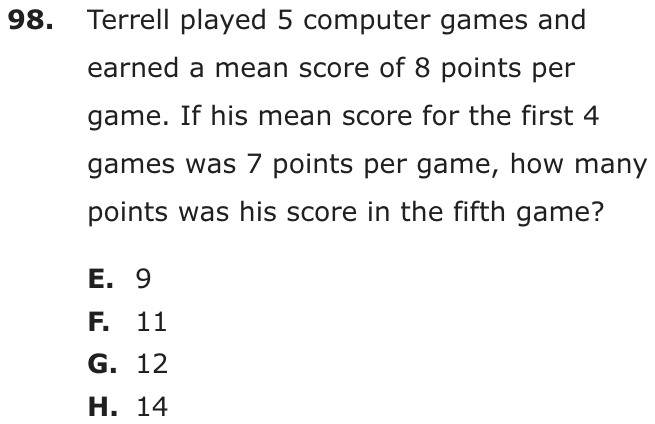
Question 97 of 120
2024 Test A Math, question 42Question
Lian bought enough oranges to fill 4 bags. Each bag contains 8 oranges. The total cost was $11.52. At that rate, how much would Lian pay for 42 oranges?
- A$17.28
- B$15.12
- C$15.02
- D$12.52
Show the answer
Correct answer: B
First, find the amount, in dollars, that Lian paid for each orange. There are 4 bags with 8 oranges each.
Divide the total cost by the total number of oranges to get the cost per orange:
Multiply to find the cost of 42 oranges:
Question analysis
This rate word problem says Lian paid $11.52 for 4 bags of 8 oranges each and asks how much 42 oranges would cost at the same rate. Students find the price of one orange and multiply. Since 42 oranges is not a whole number of bags, working by the bag instead of by the orange invites mistakes.
- Grade level
- Grade 6 content, by NYS standard
- Compared with grade 7
- Below grade 7 Finding a unit price and scaling it up is grade 6 rate work. The decimals are multi-digit, but the plan is routine, with less to manage than grade 7 problems built on percents or negative numbers.
- Estimated difficulty
- Straightforward: two steps or one careful reading.
- Thinking it demands
- Depth of knowledge 2, skills and concepts · mainly apply
- What makes it hard
- Error-prone arithmetic moderate
- A very close wrong answer minor
- Solution
- 3 steps
- Reading level
- Question and choices: about grade 2, 25 words.
- Students, last 30 days
- Not enough answers yet to show (it takes 10).
Why it is hard, traps and wrong answers (shows the answer)
Why it is hard
The plan is familiar, total oranges, price per orange, then the new cost, so the work lies in the decimals. Because 42 oranges is five bags and two oranges, students who price by the bag either round up to six bags or must handle the leftover. Estimating, since 42 is about a third more than 32, gives roughly $15 and rules out the far choices but not the near one.
Error-prone arithmetic moderate Working it out
Two decimal operations are done by hand: 11.52 ÷ 32 = 0.36 for one orange, then 0.36 × 42 = 15.12, where a dropped carry is easy. (Brown & Burton, 1978; Junker & Sijtsma, 2001)
A very close wrong answer minor Choosing the answer
The choices $15.12 and $15.02 differ by 10 cents, so a rough estimate of about $15 cannot choose between them; only the exact product can. (Embretson & Wetzel, 1987; Gorin & Embretson, 2006; Ascalon et al., 2007)
Strategy: Multiply to find how many oranges were bought, divide the total cost by that number to get the price of one orange, then multiply by 42.
Traps
- Misreads the question: Misses or misreads a condition or a word in the question: "at least", "each", "remaining", "not".
- An arithmetic slip: The right method with a plausible arithmetic error: a digit, a place value or a times-table fact.
The wrong answers, classified
A Misreads the question (Hegarty, Mayer & Monk, 1995)
Prices whole bags, rounding 42 oranges up to 6 bags of 8, and pays 6 × $2.88 = $17.28, missing that "at that rate" means per orange.
C An arithmetic slip (Junker & Sijtsma, 2001)
Uses the right method but slips one digit in multiplying 0.36 by 42, a tens-place error that lands 10 cents short of the total.
D Little reason to choose it (Haladyna & Downing, 1993; Rodriguez, 2005)
No common working gives $12.52, exactly one dollar more than $11.52; no price per orange or per bag leads there, so it mostly draws guesses.
Worked solution, step by step
Formulas used
- Unit price
- The unit price is what one item costs. Divide the total cost by how many items you got. It works because the total is shared equally among the items.
- Cost
- The unit price is the cost of one item, here one orange. Multiply it by how many items you buy to get the total cost. This works when every item costs the same.
Sort out the question
Lian bought 4 bags with 8 oranges in each bag. She paid $11.52 in all. You need the cost of 42 oranges. “At that rate” means each orange costs the same as before. So find the price of one orange first.
Count the oranges
Each of the 4 bags holds 8 oranges, so multiply to find how many she bought.
Lian bought 32 oranges for $11.52.
Find the price of one orange
This is easier in cents: . So one orange costs $0.36, or 36 cents.
Find the cost of 42 oranges
Break 42 into 40 and 2 to make it easier.
The 42 oranges cost $15.12.
Avoid the traps and answer
Watch out: $15.02, choice C, is only 10 cents away. Multiply and add with care. Watch out: Lian pays for each orange, not for full bags. Buying 6 whole bags would cost $17.28, choice A.So the answer is B, $15.12.
Check your answer
42 oranges is 10 more than 32. Those 10 oranges cost $3.60, since . Then . Same answer, so $15.12 is right.
More questions like this
The original DOE question
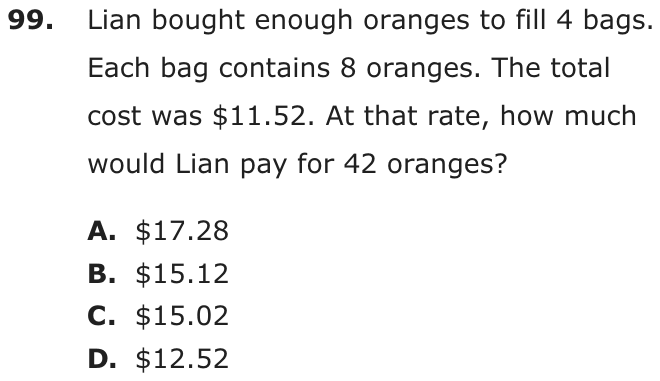
Question 98 of 120
2024 Test A Math, question 43Question
- A0.005
- B0.648
- C20
- D200
Show the answer
Correct answer: D
Question analysis
This decimal division question asks for 3.6 divided by 0.018, with no context. Students rewrite the division so the divisor is a whole number and then divide. Because the divisor has three decimal places, moving the decimal point the right number of places in both numbers is where students go wrong.
- NYS standards
- 6.NS.3 multi-digit decimal operations
- Grade level
- Grade 6 content, by NYS standard
- Compared with grade 7
- Below grade 7 Dividing multi-digit decimals is a grade 6 fluency standard, and this is a single division with no context. It is easier than typical grade 7 work, though shifting three decimal places invites a place-value slip.
- Estimated difficulty
- Straightforward: two steps or one careful reading.
- Thinking it demands
- Depth of knowledge 1, recall and reproduction · mainly apply
- What makes it hard
- Error-prone arithmetic moderate
- Solution
- 2 steps
- Reading level
- Question and choices: about grade 16+, 1 words.
- Students, last 30 days
- Not enough answers yet to show (it takes 10).
Why it is hard, traps and wrong answers (shows the answer)
Why it is hard
This is a single division, and the only real hazard is the decimal point. Shifting it three places in the divisor but only two in the dividend gives a listed answer ten times too small. An estimate settles it: 0.018 is about 0.02, and 3.6 ÷ 0.02 = 180, so the answer must be in the hundreds.
Error-prone arithmetic moderate Working it out
The divisor 0.018 has three decimal places, so both numbers must be multiplied by 1,000, turning 3.6 into 3,600, not 360, before dividing by 18. (Brown & Burton, 1978; Junker & Sijtsma, 2001)
Strategy: Multiply both numbers by 1,000 so the divisor becomes a whole number, then divide; estimate first by asking roughly how many 0.02s fit into 3.6.
Traps
- An arithmetic slip: The right method with a plausible arithmetic error: a digit, a place value or a times-table fact.
- Wrong operation: Adds instead of multiplying, divides the wrong way round, turns a ratio or rate upside down, or undoes a step in the wrong direction (subtracts what should be added back).
The wrong answers, classified
A Wrong operation (Hegarty, Mayer & Monk, 1995; King et al., 2004)
Divides the wrong way round, 0.018 ÷ 3.6 = 0.005, putting the smaller number on top as if division always shrinks.
B Wrong operation (Hegarty, Mayer & Monk, 1995; King et al., 2004)
Multiplies instead of dividing, 36 × 18 = 648, and misplaces the decimal point too, since 3.6 × 0.018 is really 0.0648.
C An arithmetic slip (Junker & Sijtsma, 2001)
Moves the decimal point two places instead of three, dividing 360 by 18 to get 20, a result ten times too small.
Worked solution, step by step
Formulas used
- Scaling a division
- a is the number being divided, and b is the number you divide by. n is any number except 0. Multiplying both numbers by the same n keeps the answer the same, just like an equal fraction. Use it to turn a decimal you divide by into a whole number.
Sort out the problem
You need . The number you divide by, 0.018, has three decimal places. That means three digits after the decimal point. Dividing by a decimal is hard, so first turn 0.018 into a whole number.
Multiply both numbers by 1,000
Multiplying by 1,000 moves the decimal point 3 places to the right. Do it to both numbers, so the answer does not change.
Watch out: 3.6 has only one decimal place, so fill in zeros: 3.6 becomes 3,600. Moving its point only two places gives , choice C.Divide the whole numbers
This works because , so . Watch out: divide 3.6 by 0.018, not the other way around. Dividing 0.018 by 3.6 gives 0.005, choice A.
So the answer is D, 200.
Check your answer
Multiply back: . Also estimate. 0.018 is close to 0.02, and . The answer should be near that, and 200 is. Dividing by a number less than 1 gives a bigger answer, so 200 makes sense.
More questions like this
The original DOE question
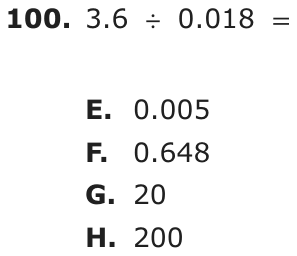
Question 99 of 120
2024 Test A Math, question 44Question
A tank with a 500-gallon capacity currently contains 75 gallons of water. Additional water is poured into this tank at a rate of 5 gallons per minute. After 45 minutes of adding water, what percentage of the tank’s total capacity will be filled? (Assume that there is no loss of water from the tank.)
- A45%
- B55%
- C60%
- D70%
Show the answer
Correct answer: C
If 5 gallons of water is added to the tank per minute for 45 minutes, then gallons is added to the tank.
The tank started with 75 gallons of water in it. After the 45 minutes, it contains gallons, assuming no loss of water.
The tank has a capacity of 500 gallons, and .
Rewrite decimal 0.6 as a percentage:
Question analysis
A 500-gallon tank holds 75 gallons, and water flows in at 5 gallons per minute for 45 minutes. This rate and percent word problem asks what percentage of the tank's capacity will then be filled. Students find the water added, the new amount in the tank and its percent of 500, keeping track of every quantity of water.
- Grade level
- Grade 7 content, by NYS standard
- Compared with grade 7
- At grade 7 Grade 7 students solve multistep rate and percent problems. This one combines a pouring rate, a starting amount and a percent of capacity in three short steps with friendly numbers, which matches typical grade 7 work.
- Estimated difficulty
- Straightforward: two steps or one careful reading.
- Thinking it demands
- Depth of knowledge 2, skills and concepts · mainly apply
- What makes it hard
- Much to keep track of minor
- Many steps minor
- Solution
- 3 steps
- Reading level
- Question and choices: about grade 8, 51 words.
- Students, last 30 days
- Not enough answers yet to show (it takes 10).
Why it is hard, traps and wrong answers (shows the answer)
Why it is hard
The numbers are friendly, so the question tests whether students track every quantity of water. Forgetting the 75 gallons that were there from the start is the costly slip, because the share of the tank that was poured in is itself a listed choice. A quick check, that 300 gallons is more than half of 500 but well under three quarters, confirms the answer.
Much to keep track of minor Working it out
The 75 gallons already in the tank, given in the first sentence, must be held aside through the rate calculation and added back before dividing. (Sweller, 1988; Carpenter, Just & Shell, 1990)
Many steps minor Working it out
The chain runs from 5 gallons a minute for 45 minutes to 225 gallons, then to 300 gallons in the tank, then to 300 out of 500 as a percent. (Daniel & Embretson, 2010; Enright, Morley & Sheehan, 2002)
Strategy: Multiply the rate by the time to get the water added, account for the water already in the tank, and divide the total by the 500-gallon capacity.
Traps
- Stops one step early: A choice is a number from partway through the solution.
- Answers a different question: A choice is right for another quantity: the other unknown, the rest instead of the part, the part instead of the whole.
The wrong answers, classified
A Stops one step early (King et al., 2004; Gierl et al., 2017)
Finds that the 225 gallons poured in fill 45% of the tank and stops before adding the 15% filled by the 75 gallons already there.
B Answers a different question (King et al., 2004; Hegarty, Mayer & Monk, 1995)
Leaves out the starting 75 gallons and gives the share still empty after pouring, (500 − 225) ÷ 500 = 55%, instead of the share filled.
D Little reason to choose it (Haladyna & Downing, 1993; Rodriguez, 2005)
No common working gives 70%, which would need 350 gallons, as if water flowed for 55 minutes; it mostly draws guesses.
Worked solution, step by step
Formulas used
- Amount from a rate
- The rate is how much water goes in each minute, here 5 gallons. The time is how many minutes it runs. Multiply them to get the amount added. It works because the same amount goes in every minute.
- Percent of a whole
- The part is the amount you have, and the whole is the full amount. Dividing gives what fraction of the whole you have. Multiplying by 100 turns it into a percent, which means out of 100.
Sort out the question
The tank holds at most 500 gallons. That is its capacity. It already has 75 gallons in it. Water is added at 5 gallons per minute for 45 minutes. You need the percent of the tank that will be full.
Find the water added
The same amount of water goes in every minute, so multiply the rate by the time.
So 225 gallons are poured in during the 45 minutes.
Find the total water in the tank
Add the water that was already there.
The tank holds 300 gallons after 45 minutes. Watch out: don’t forget the first 75 gallons. The 225 gallons alone fill 45% of the tank, choice A.
Find the percent full
The tank is 60% full. Watch out: find the part that is full, not the part that is empty. Choice B, 55%, is the empty part if you also forget the first 75 gallons.
So the answer is C, 60%.
Check your answer
10% of 500 gallons is 50 gallons. The tank has 300 gallons, which is 6 groups of 50. So it is 60% full. Also, 300 gallons is less than 500, so the tank never overflows.
More questions like this
The original DOE question
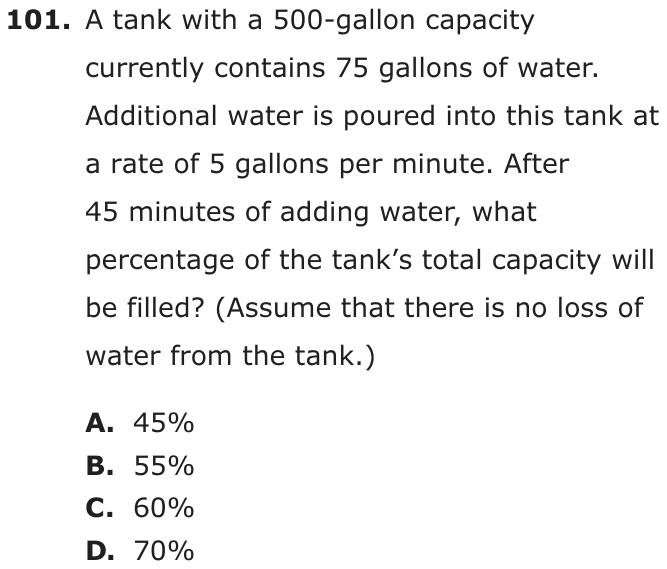
Question 100 of 120
2024 Test A Math, question 45Question
Misha wants to use ribbon to make 2 straps for a backpack. The ribbon costs $5.00 a yard. If each strap requires yards of ribbon, how much will Misha pay for the ribbon (not including tax)?
- A$4.00
- B$6.25
- C$11.25
- D$12.50
Show the answer
Correct answer: D
Each strap requires yards of ribbon, and ribbon costs $5.00 a yard.
, so the ribbon for each strap costs $6.25.
Misha wants to make 2 straps.
, so the cost of the ribbon for 2 straps is $12.50.
Question analysis
Misha needs ribbon for 2 backpack straps, each using 1 1/4 yards, and ribbon costs $5.00 a yard. This cost word problem asks how much she will pay for the ribbon before tax. Students multiply a mixed number by a price per yard and by the number of straps; it is short, but both the mixed number and the two straps need care.
- Grade level
- Grade 6 content, by NYS standard
- Compared with grade 7
- Below grade 7 Multiplying a mixed number by a whole number and finding a total cost are grade 5 and 6 skills. With two short steps and friendly numbers, this is easier than typical grade 7 problems with percents or negatives.
- Estimated difficulty
- Routine: one familiar step, little to misread.
- Thinking it demands
- Depth of knowledge 2, skills and concepts · mainly apply
- What makes it hard
- Error-prone arithmetic minor
- Much to keep track of minor
- Solution
- 2 steps
- Reading level
- Question and choices: about grade 5, 35 words.
- Students, last 30 days
- Not enough answers yet to show (it takes 10).
Why it is hard, traps and wrong answers (shows the answer)
Why it is hard
The question is short and the numbers are friendly; points are lost by stopping at one strap or by mishandling the mixed number. Pricing a single strap gives a listed choice, as does doubling only the whole-number part of 1 1/4. Finding the total ribbon first, 2 1/2 yards, before multiplying by the price keeps both errors away.
Error-prone arithmetic minor Working it out
The length per strap is a mixed number, 1 1/4 yards, so the arithmetic is easiest as 2 × 1.25 = 2.5 yards, then 2.5 × $5.00. (Brown & Burton, 1978; Junker & Sijtsma, 2001)
Much to keep track of minor Working it out
The number of straps comes in the first sentence and the length of each in the last, so the 2 has to be carried through to the cost. (Sweller, 1988; Carpenter, Just & Shell, 1990)
Strategy: Find the total ribbon first by doubling the length for one strap, then multiply the yards by $5.00; writing 1 1/4 as 1.25 keeps the arithmetic simple.
Traps
- Stops one step early: A choice is a number from partway through the solution.
- A faulty procedure: A systematic but wrong procedure: adding fractions straight across, applying an exponent to each term of a sum, dropping a sign when moving a term.
- Wrong operation: Adds instead of multiplying, divides the wrong way round, turns a ratio or rate upside down, or undoes a step in the wrong direction (subtracts what should be added back).
The wrong answers, classified
A Wrong operation (Hegarty, Mayer & Monk, 1995; King et al., 2004)
Divides the price by the length, $5.00 ÷ 1.25 = 4, instead of multiplying yards by dollars per yard.
B Stops one step early (King et al., 2004; Gierl et al., 2017)
Prices the ribbon for one strap, 1 1/4 × $5.00 = $6.25, and forgets that Misha is making 2 straps.
C A faulty procedure (Brown & Burton, 1978; Tatsuoka, 1983)
Doubles only the whole-number part of 1 1/4, getting 2 1/4 yards instead of 2 1/2, and pays 2.25 × $5.00 = $11.25.
Worked solution, step by step
Formulas used
- Cost
- Price per unit is the cost of one unit, here $5.00 for one yard. Number of units is how many you buy, here yards of ribbon. Multiply them to get the total before tax.
Sort out the question
Misha makes 2 straps. Each strap needs yards of ribbon. A yard is a length of 3 feet. Ribbon costs $5.00 a yard. You need the total cost for both straps, with no tax.
Find the total ribbon
First change the mixed number to a decimal. One quarter is 0.25, so is 1.25. Then double it for 2 straps.
Misha needs 2.5 yards of ribbon. Watch out: double the whole mixed number, the 1 and the quarter. Doubling only the 1 gives yards and $11.25, choice C.
Find the cost
The ribbon costs $12.50. Watch out: this is for both straps. One strap’s ribbon costs $6.25, choice B. Don’t stop there.
So the answer is D, $12.50.
Check your answer
Estimate. Each strap needs a bit more than 1 yard, so both need a bit more than 2 yards. Two yards cost $10, so the answer should be a bit more than $10. $12.50 fits. Also, 2 yards cost $10 and the extra half yard costs $2.50, which makes $12.50.
More questions like this
The original DOE question
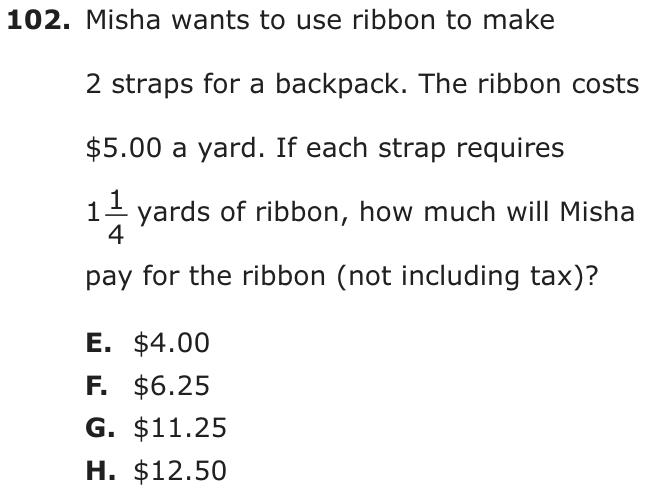
Question 101 of 120
2024 Test A Math, question 46Question
A graph shows the proportional relationship between the number of test questions a student gets correct, x, and the student’s test score, y. The ordered pair is on the graph. What does the y-coordinate of the ordered pair represent in this relationship?
- AThe test will last hours.
- BEach test question is worth points.
- CAn average student can answer 5 questions in 4 minutes.
- DA student who answers 5 questions correctly will earn 4 points.
Show the answer
Correct answer: B
The graph represents a proportional relationship, which means the y-intercept of the graph is (0, 0).
This means that the point represents the unit rate for this situation.
In this situation, x represents the number of questions answered correctly, and y represents the number of points received.
Therefore, for each question answered correctly, the student receives , or , points.
Question analysis
A proportional relationship links the number of test questions a student gets right, x, to the test score, y, and the point (1, 5/4) lies on its graph. Students decide what the y-coordinate of that point means in the situation. The choices reuse the numbers 5, 4 and 1 1/4 in different ways, so the meaning of each coordinate must be kept straight.
- Grade level
- Grade 7 content, by NYS standard
- Compared with grade 7
- At grade 7 Explaining what a point on the graph of a proportional relationship means is named in the grade 7 standards. This item is a direct case, with the graph described in words rather than drawn and only one point to interpret.
- Estimated difficulty
- Straightforward: two steps or one careful reading.
- Thinking it demands
- Depth of knowledge 2, skills and concepts · mainly understand
- What makes it hard
- Solution
- 2 steps
- Reading level
- Question and choices: about grade 7, 73 words.
- Students, last 30 days
- Not enough answers yet to show (it takes 10).
Why it is hard, traps and wrong answers (shows the answer)
Why it is hard
The question checks one idea: when x is 1, the y-coordinate is the score for one correct answer, the unit rate. The pitfall is reading 5/4 as two separate numbers, 5 and 4, and attaching them to questions and points the wrong way round. Ruling out the choices about hours and minutes is quick, since the relationship never mentions time.
Variables instead of numbers minor Understanding the question
No graph is drawn: the relationship and the point (1, 5/4) exist only in words, so students must say for themselves that x counts correct answers and y counts points. (Koedinger & Nathan, 2004; Enright, Morley & Sheehan, 2002)
An answer in an unexpected form minor Choosing the answer
The point gives 5/4, but two choices write it as 1 1/4 and two split it into 5 and 4, so the right reading must be recognized in another form. (Enright, Morley & Sheehan, 2002)
Strategy: Say in words what x and y stand for, then read the ordered pair as a sentence: when x has the first value, y has the second.
Traps
- Wrong operation: Adds instead of multiplying, divides the wrong way round, turns a ratio or rate upside down, or undoes a step in the wrong direction (subtracts what should be added back).
- Numbers taken from the question: Combines the numbers in the question without a model of the situation, or is simply a number that appears in the question.
The wrong answers, classified
A Numbers taken from the question (Hegarty, Mayer & Monk, 1995)
Attaches 1 1/4 to hours of testing, matching the number while ignoring that y measures the test score, not time.
C Numbers taken from the question (Hegarty, Mayer & Monk, 1995)
Reads 5/4 as 5 questions in 4 minutes, using the numbers 5 and 4 with units that the relationship never measures.
D Wrong operation (Hegarty, Mayer & Monk, 1995; King et al., 2004)
Reads 5/4 as 5 correct answers for 4 points, turning the rate upside down; the point means 1 correct answer earns 5/4 points.
Worked solution, step by step
Formulas used
- Proportional relationship
- x and y are two amounts that change together, here right answers and the test score. k is the constant of proportionality: how much y goes with 1 of x. In a proportional relationship, y is always the same number times x. So when x is 1, y equals k.
Sort out the question
x is the number of questions a student gets right. y is the student’s test score, in points. An ordered pair such as lists x first and y second. The y-coordinate is the second number, . You need what that number means.
Read the point as a sentence
In the point, x is 1 and y is . Put those into words: a student who gets 1 question right scores points.
Use the proportional rule
The relationship is proportional. So the score is always the same number times the questions right.
So k is . Every right answer adds the same points. That makes the points for each question.
Write it as a mixed number
A mixed number is a whole number plus a fraction. Four quarters make 1 whole, so five quarters are 1 whole and 1 quarter.
Each question right is worth points.
Match the choices
Choice B says each question is worth points. That matches. Watch out: choice D splits into 5 and 4. But 5 right answers earn points, not 4. Choices A and C talk about time, which this relationship does not measure.
So the answer is B, each test question is worth points.
Check your answer
Try another point. A student with 4 right answers scores points. That fits B, since four questions at points each make 5 points. It does not fit D, which says 5 questions earn 4 points.
More questions like this
The original DOE question
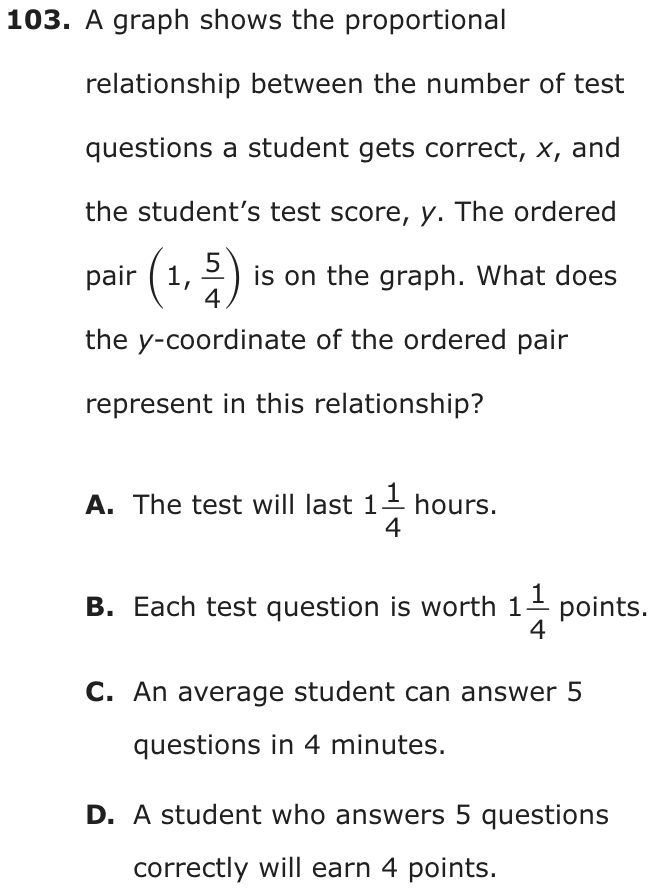
Question 102 of 120
2024 Test A Math, question 47Question
In a survey of 200 adults in the town of Waskegon, 45 reported reading the online version of the Waskegon Bulletin the previous day. If 25,000 adults live in Waskegon, which number is the best estimate of the number of adults who read the online version of the Waskegon Bulletin the previous day?
- A5,600
- B9,000
- C11,300
- D24,800
Show the answer
Correct answer: A
In the survey, 45 out of 200 adults reported reading the online version of the Waskegon Bulletin, and there are 25,000 adults living in Waskegon. Set up a proportion to find the number of adults who read the online version.
Rounded to the nearest 100, this number is 5,600.
Question analysis
In a survey of 200 adults in Waskegon, 45 said they read the online Waskegon Bulletin the day before, and the town has 25,000 adults. This sampling question asks for the best estimate of how many adults in town read it. Students scale the sample's rate up to the population with a proportion and round.
- Grade level
- Grade 6 content, by NYS standard
- Compared with grade 7
- At grade 7 Using a sample to estimate a count for a whole population is typical grade 7 statistics and ratio work. This version takes one proportion with large numbers and a rounding step, about the usual grade 7 demand.
- Estimated difficulty
- Straightforward: two steps or one careful reading.
- Thinking it demands
- Depth of knowledge 2, skills and concepts · mainly apply
- What makes it hard
- Turning words into math minor
- Error-prone arithmetic minor
- Solution
- 3 steps
- Reading level
- Question and choices: about grade 13, 50 words.
- Students, last 30 days
- Not enough answers yet to show (it takes 10).
Why it is hard, traps and wrong answers (shows the answer)
Why it is hard
The idea is a single proportion, and the choices are far apart, so a reasonable estimate is enough. The main trap is treating 45 out of 200 as 45 percent, which doubles the estimate; the other wrong choices combine the survey numbers without a proportion. Noting that 45 is a bit under a quarter of 200, so the town figure must be a bit under a quarter of 25,000, confirms the choice.
Turning words into math minor Understanding the question
The survey's 45 out of 200 is a rate to scale up to the town's 25,000 adults, a fraction of the sample rather than a percent. (Hegarty, Mayer & Monk, 1995; Koedinger & Nathan, 2004)
Error-prone arithmetic minor Working it out
The scale factor 25,000 ÷ 200 = 125 and the product 45 × 125 = 5,625 involve large numbers, and the result must then be rounded to the nearest hundred. (Brown & Burton, 1978; Junker & Sijtsma, 2001)
Strategy: Set the survey's fraction, 45 out of 200, equal to the unknown number out of 25,000, then scale up: 25,000 is 125 times 200.
Traps
- Numbers taken from the question: Combines the numbers in the question without a model of the situation, or is simply a number that appears in the question.
- Misunderstands the concept: A wrong belief about a concept: that percents can be added, that area grows like length, that averages can be averaged, that a bigger denominator means a bigger fraction.
The wrong answers, classified
B Numbers taken from the question (Hegarty, Mayer & Monk, 1995)
Multiplies the two survey numbers, 45 × 200 = 9,000, combining numbers from the question without setting up a proportion.
C Misunderstands the concept (Smith, diSessa & Roschelle, 1993; De Bock et al., 1998; Ni & Zhou, 2005)
Treats 45 out of 200 as 45 percent, as if 100 adults were surveyed: 0.45 × 25,000 = 11,250, about 11,300.
D Numbers taken from the question (Hegarty, Mayer & Monk, 1995)
Subtracts the 200 surveyed adults from the 25,000 in town, giving the number of adults who were not surveyed.
Worked solution, step by step
Formulas used
- Proportion
- A proportion says two ratios are equal. A ratio compares two numbers by dividing. Here a out of b in the survey matches c out of d in the whole town. Use it when a small group stands for a bigger group.
Sort out the question
A survey asked 200 adults, and 45 of them read the online paper. The town has 25,000 adults. You need a good estimate of how many adults in the whole town read it. Assume the town is like the survey. Then the same fraction of adults read it.
Set up a proportion
A proportion says two fractions are equal. Let x be the number of readers in the town. The fraction of readers is the same in both groups.
Watch out: multiplying 45 by 200 gives 9,000, choice B. That mixes the numbers without a plan.Find the scale factor
The scale factor is how many times bigger the town is than the survey group.
The town is 125 times as big. So multiply the top, 45, by 125 too.
Scale up the readers
Break 125 into 100 and 25.
About 5,625 adults read it. Watch out: 45 out of 200 is not 45%. A percent is out of 100. Using 45% gives about 11,300, choice C.
Round to the nearest hundred
The choices are rounded, since this is an estimate. 5,625 is between 5,600 and 5,700. Its last two digits, 25, are less than 50, so round down to 5,600.
So the answer is A, 5,600.
Check your answer
45 out of 200 is a bit less than 50 out of 200, which is one fourth. One fourth of 25,000 is 6,250. So the answer should be a bit less than 6,250. 5,600 fits, and the other choices are all much bigger.
More questions like this
The original DOE question
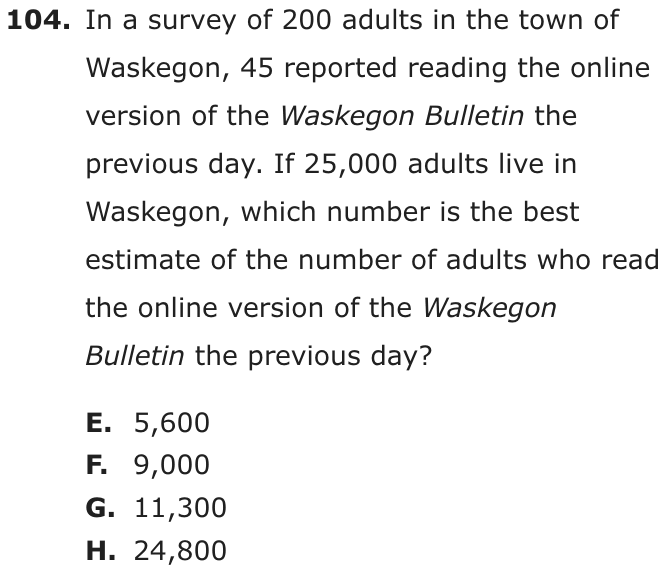
Question 103 of 120
2024 Test A Math, question 48Question
A hiker plans on hiking 17 miles in 3 days. Which equation describes the relationship between the number of days hiked, x, and the number of miles traveled, y?
- A
- B
- C
- D
Show the answer
Correct answer: C
There is a proportional relationship between the number of miles traveled, y, and the number of days hiked, x.
So the equation describes the relationship.
Question analysis
A hiker plans to cover 17 miles in 3 days, and this proportional relationship question asks for the equation linking days hiked, x, to miles traveled, y. Students find the constant rate and write it as an equation of the form y = kx. Putting the right quantity on top of the rate is the main decision.
- Grade level
- Grade 7 content, by NYS standard
- Compared with grade 7
- At grade 7 Writing an equation y = kx for a proportional relationship is a core grade 7 skill, and this is the textbook form. The only extra demand is keeping the rate's direction straight: miles per day or days per mile.
- Estimated difficulty
- Straightforward: two steps or one careful reading.
- Thinking it demands
- Depth of knowledge 2, skills and concepts · mainly apply
- What makes it hard
- A very close wrong answer moderate
- Turning words into math minor
- Solution
- 2 steps
- Reading level
- Question and choices: about grade 7, 31 words.
- Students, last 30 days
- Not enough answers yet to show (it takes 10).
Why it is hard, traps and wrong answers (shows the answer)
Why it is hard
Writing y = kx is routine, so the question rests on putting the right number on top of the rate. Two choices use one number from the stem with no division at all, and one inverts the rate. Substituting x = 3 into each equation is the fastest check, since only one of them gives y = 17.
A very close wrong answer moderate Choosing the answer
The coefficients 17/3 and 3/17 use the same two numbers, one the other inverted, so only checking that 3 days gives 17 miles separates the two equations. (Embretson & Wetzel, 1987; Gorin & Embretson, 2006; Ascalon et al., 2007)
Turning words into math minor Understanding the question
With x as days and y as miles, "17 miles in 3 days" becomes miles per day, 17 ÷ 3, the number that multiplies x. (Hegarty, Mayer & Monk, 1995; Koedinger & Nathan, 2004)
Strategy: Find the constant of proportionality as miles per day, since y is miles and x is days, then write y equals that constant times x; check with x = 3.
Traps
- Wrong operation: Adds instead of multiplying, divides the wrong way round, turns a ratio or rate upside down, or undoes a step in the wrong direction (subtracts what should be added back).
- Numbers taken from the question: Combines the numbers in the question without a model of the situation, or is simply a number that appears in the question.
The wrong answers, classified
A Wrong operation (Hegarty, Mayer & Monk, 1995; King et al., 2004)
Divides days by miles, 3/17, the number of days per mile, turning the rate upside down.
B Numbers taken from the question (Hegarty, Mayer & Monk, 1995)
Uses the 3 days as the rate, writing y = 3x, a number from the question with no division.
D Numbers taken from the question (Hegarty, Mayer & Monk, 1995)
Uses the 17 total miles as if they were covered in one day, writing y = 17x without dividing by the 3 days.
Worked solution, step by step
Formulas used
- Constant of proportionality
- x and y are two amounts that change together. k is the constant of proportionality: how much y goes with 1 of x. In a proportional relationship, y divided by x gives the same k every time.
- Proportional relationship
- kx means k times x. In a proportional relationship, y is always k times x. Here x is the number of days and y is the miles. k is the miles for each day. Use it to write the equation once you know k.
Sort out the question
The hiker plans 17 miles in 3 days. x is the number of days, and y is the number of miles. You need an equation that links them. Assume the hiker goes the same distance each day. Then y is always the same number times x.
Find the miles for each day
That number is the constant of proportionality, k. It is miles divided by days.
That is miles each day. Watch out: miles go on top, because y is miles. is days per mile, upside down. That is choice A.
Write the equation
Watch out: 17 is the miles for all 3 days, not for 1 day. So , choice D, is too fast. And , choice B, uses the days as the rate.So the answer is C, .
Check your answer
Put in x = 3, for 3 days: . That is 17 miles, which matches the plan. Try choice A the same way: . That is less than 1 mile, far too short.
More questions like this
The original DOE question
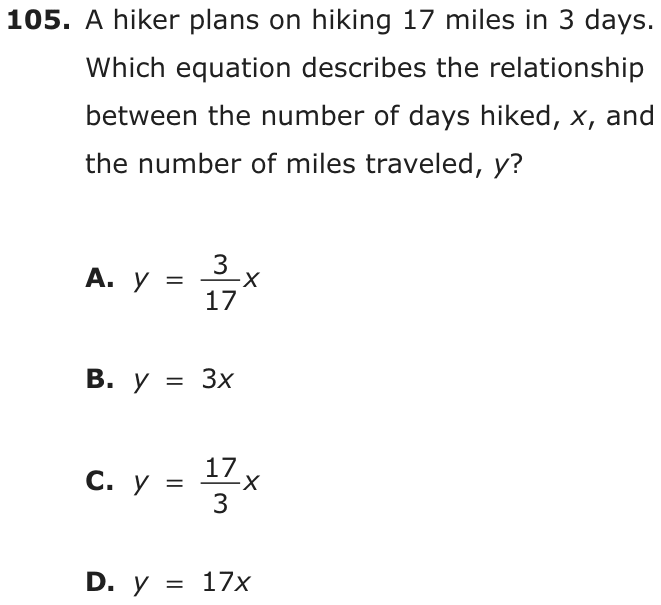
Question 104 of 120
2024 Test A Math, question 49Question
Carolyn walked 3 miles from her house to the library and then miles farther to the grocery store. Returning home by the same route, she walked miles before stopping at a friend’s house. How many miles did Carolyn have left to walk home?
- A
- B
- C
- D
Show the answer
Correct answer: A
The distance from Carolyn’s house to the grocery store is miles.
Carolyn walked miles back, so she still had miles left to walk home.
So Carolyn had miles left to walk home.
Question analysis
Carolyn walks 3 miles from home to the library and 2 1/2 miles more to the grocery store, then heads back the same way and stops at a friend's house after 1 2/3 miles. This fractions word problem asks how far she still has to walk home. Students add and subtract mixed numbers, and the subtraction needs regrouping across unlike denominators.
- Grade level
- Grade 7 content, by NYS standard
- Compared with grade 7
- At grade 7 Grade 7 students solve multi-step word problems with mixed numbers. This one has only positive numbers, but it needs a clear picture of the route and a subtraction that requires regrouping across unlike denominators.
- Estimated difficulty
- Moderate: several steps, or a close reading with one strong distractor.
- Thinking it demands
- Depth of knowledge 2, skills and concepts · mainly apply
- What makes it hard
- Error-prone arithmetic moderate
- A very close wrong answer moderate
- Turning words into math minor
- Solution
- 3 steps
- Reading level
- Question and choices: about grade 6, 48 words.
- Students, last 30 days
- Not enough answers yet to show (it takes 10).
Why it is hard, traps and wrong answers (shows the answer)
Why it is hard
The story needs a quick sketch, but the real test is one mixed-number subtraction in which the second fraction is larger than the first. Many students subtract the fractions the easy way round, which gives a choice close to the right one. Converting both numbers to sixths, 33/6 − 10/6, sidesteps the regrouping, and adding the result to 1 2/3 to get back 5 1/2 is a quick check.
Error-prone arithmetic moderate Working it out
The subtraction 5 1/2 − 1 2/3 needs sixths, 5 3/6 − 1 4/6, and the fraction on top is the smaller one, so a whole must be regrouped. (Brown & Burton, 1978; Junker & Sijtsma, 2001)
A very close wrong answer moderate Choosing the answer
Subtracting the fraction parts the wrong way round gives 4 1/6, only 1/3 away from the answer, so a rough estimate cannot tell the two apart. (Embretson & Wetzel, 1987; Gorin & Embretson, 2006; Ascalon et al., 2007)
Turning words into math minor Understanding the question
The route has to be pictured: the walk back starts at the grocery store, 5 1/2 miles from home, not at the library. (Hegarty, Mayer & Monk, 1995; Koedinger & Nathan, 2004)
Strategy: Sketch the route as a line from home to the library to the store, find the total distance out, then subtract the distance already walked back, using sixths.
Traps
- A faulty procedure: A systematic but wrong procedure: adding fractions straight across, applying an exponent to each term of a sum, dropping a sign when moving a term.
- Answers a different question: A choice is right for another quantity: the other unknown, the rest instead of the part, the part instead of the whole.
The wrong answers, classified
B A faulty procedure (Brown & Burton, 1978; Tatsuoka, 1983)
Subtracts the whole numbers, 5 − 1 = 4, then the fractions the easy way round, 2/3 − 1/2 = 1/6, giving 4 1/6.
C Answers a different question (King et al., 2004; Hegarty, Mayer & Monk, 1995)
On the store-to-library stretch, uses the 1 2/3 miles already walked instead of the 5/6 mile left, then adds the 3 miles home.
D Answers a different question (King et al., 2004; Hegarty, Mayer & Monk, 1995)
Adds all three distances, 3 + 2 1/2 + 1 2/3 = 7 1/6, which is how far she has walked so far, not how far is left.
Worked solution, step by step
Formulas used
- Mixed number to fraction
- a is the whole number part, b is the top of the fraction, and c is the bottom. Each whole holds c pieces, so a wholes hold a times c pieces. Then add the b extra pieces.
- Equivalent fractions
- a is the top of a fraction and b is the bottom. n is any number except 0. Multiplying the top and bottom by the same number gives an equal fraction, cut into smaller pieces. Use it to give two fractions the same bottom before you add or subtract.
- Subtracting fractions with the same bottom
- c is the shared bottom number. a and b are the tops. When the pieces are the same size, you just take away how many pieces you have. The size of the pieces, c, stays the same.
Picture the route
Draw a line: home, then the library, then the store. Home to the library is 3 miles. The library to the store is miles more. Carolyn walks back the same way. After miles she stops at a friend’s house. You need the miles still left to get home.
Find the distance from home to the store
The store is miles from home. She starts back from the store, so this is the full trip home. Watch out: adding all three distances gives , choice D. That is how far she has walked, not how far is left.
Change to improper fractions
The miles left are . An improper fraction has a top bigger than its bottom. Change each mixed number to one.
Use sixths for both
To subtract, the fractions need the same bottom. 2 and 3 both go into 6, so change both to sixths.
Subtract and simplify
23 sixths is 3 wholes (18 sixths) and 5 sixths more. So . Watch out: is less than . Subtracting the fraction parts the wrong way round gives , choice B.
So the answer is A, miles.
Check your answer
Add back: . That is the full distance from the store to home. Also estimate: 5.5 minus about 1.7 is about 3.8, and is about 3.83.
More questions like this
The original DOE question
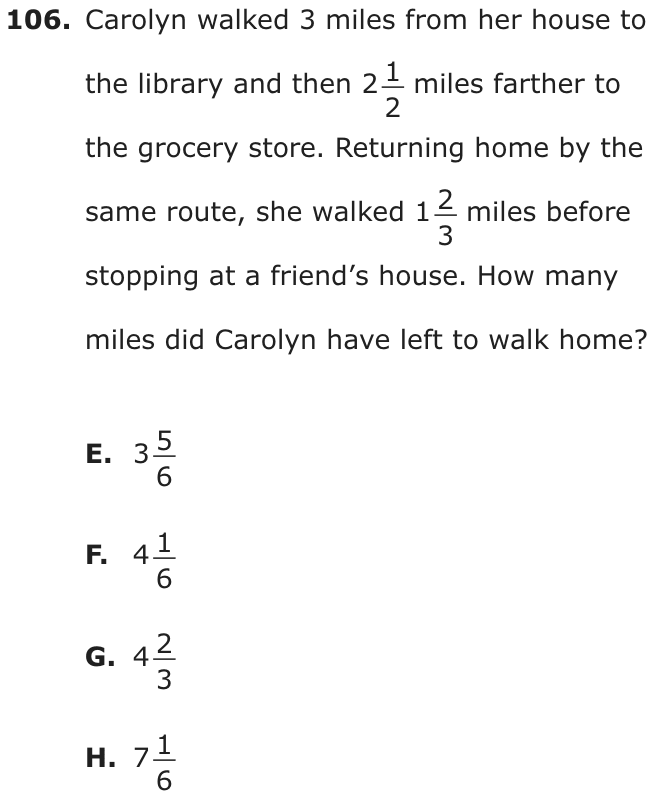
Question 105 of 120
2024 Test A Math, question 50Question
A child grows inches in of a year. What would be his yearly growth rate in inches per year?
- A
- B
- C
- D
Show the answer
Correct answer: C
Set up a proportion to solve.
Question analysis
A child grows 1 1/4 inches in one third of a year, and this unit rate question asks for his growth rate in inches per year. Students divide a mixed number by a fraction, or scale the growth up to a whole year. Choosing between multiplying and dividing, and handling the whole mixed number, are where the wrong rates come from.
- Grade level
- Grade 7 content, by NYS standard
- Compared with grade 7
- At grade 7 Computing a unit rate from a ratio of fractions is the grade 7 standard itself, and this is a typical example: one mixed number over one unit fraction, in two short steps with no extra information.
- Estimated difficulty
- Straightforward: two steps or one careful reading.
- Thinking it demands
- Depth of knowledge 2, skills and concepts · mainly apply
- What makes it hard
- Error-prone arithmetic minor
- A very close wrong answer minor
- Solution
- 2 steps
- Reading level
- Question and choices: about grade 4, 25 words.
- Students, last 30 days
- Not enough answers yet to show (it takes 10).
Why it is hard, traps and wrong answers (shows the answer)
Why it is hard
The idea is simple: three thirds make a year, so the yearly growth is three times the growth in a third. Errors come from the mixed number, where students triple the 1 and leave the 1/4 alone, and from multiplying by 1/3 instead of dividing, which shrinks the rate. A sense check helps, since a yearly rate must be larger than the 1 1/4 inches grown in a third of a year.
Error-prone arithmetic minor Working it out
Dividing 1 1/4 by 1/3 means multiplying by 3, and the mixed number must be multiplied whole, as 5/4 × 3 = 15/4, not just its 1. (Brown & Burton, 1978; Junker & Sijtsma, 2001)
A very close wrong answer minor Choosing the answer
Multiplying only the whole part gives 3 1/4, which differs from the answer only in the fraction's numerator, so a rough size check cannot rule it out. (Embretson & Wetzel, 1987; Gorin & Embretson, 2006; Ascalon et al., 2007)
Strategy: Divide the growth by the time, writing 1 1/4 as 5/4 and dividing by 1/3 as multiplying by 3; or ask how much he grows in three such periods.
Traps
- Wrong operation: Adds instead of multiplying, divides the wrong way round, turns a ratio or rate upside down, or undoes a step in the wrong direction (subtracts what should be added back).
- A faulty procedure: A systematic but wrong procedure: adding fractions straight across, applying an exponent to each term of a sum, dropping a sign when moving a term.
The wrong answers, classified
A Wrong operation (Hegarty, Mayer & Monk, 1995; King et al., 2004)
Multiplies 5/4 by 1/3 instead of dividing by it, getting 5/12, a yearly rate smaller than the growth in a third of a year.
B A faulty procedure (Brown & Burton, 1978; Tatsuoka, 1983)
Triples only the whole-number part of 1 1/4, writing 3 × 1 1/4 as 3 1/4 and leaving the 1/4 unchanged.
D Wrong operation (Hegarty, Mayer & Monk, 1995; King et al., 2004)
Adds 3 to 1 1/4 instead of multiplying it by 3, getting 4 1/4.
Worked solution, step by step
Formulas used
- Rate
- The amount is how much something changed, here inches grown. The time is how long it took, here part of a year. Dividing tells how much it changes in 1 unit of time, here 1 whole year.
- Mixed number to fraction
- a is the whole number part, b is the top of the fraction, and c is the bottom. Each whole holds c pieces, so a wholes hold a times c pieces. Then add the b extra pieces.
- Dividing by a fraction
- a over b is the number you divide. c over d is the number you divide by. To divide by a fraction, multiply by its reciprocal, the fraction flipped upside down. This works because dividing by a number undoes multiplying by it.
Sort out the question
The child grows inches in of a year. You need his growth rate in inches per year. That is how much he would grow in 1 whole year at the same speed. A year has 3 thirds, so the answer should be bigger than .
Set up the rate
Divide the growth by the time to get the inches for 1 whole year.
Change the mixed number to a fraction first.
Divide by multiplying
To divide by a fraction, multiply by its reciprocal, the fraction flipped upside down. The reciprocal of is 3.
Watch out: multiplying by instead gives , choice A. That is less than he grew in a third of a year.Change back to a mixed number
15 quarters is 3 wholes (12 quarters) and 3 quarters more.
He grows inches per year. Watch out: triple all of , not just the 1. Tripling only the whole number gives , choice B.
So the answer is C, .
Check your answer
Think of the year as 3 thirds. He grows inches in each third. Add them: . The wholes make 3, and the quarters make . That is inches, the same answer.
More questions like this
The original DOE question
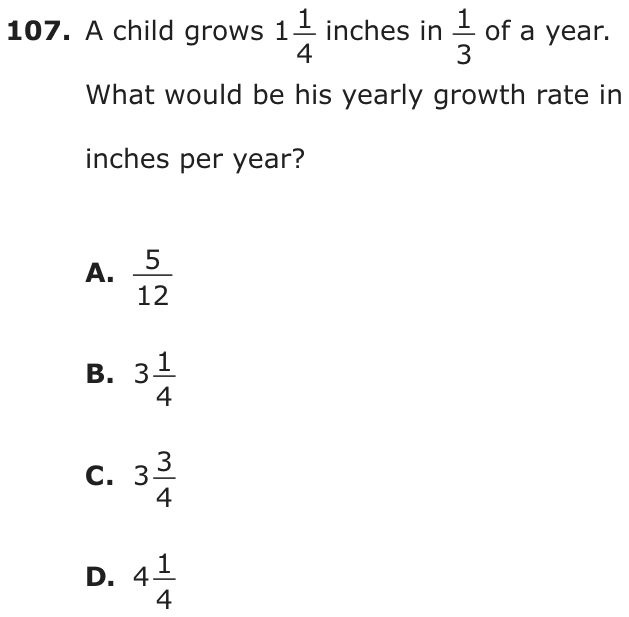
Question 106 of 120
2024 Test A Math, question 51Question
- A−0.33
- B−0.27
- C0
- D0.33
Show the answer
Correct answer: B
Question analysis
This decimal question asks for the value of 3 times 0.01 minus 3 times 0.1. Students multiply each decimal by 3 and subtract, keeping the order of the subtraction as written. The two decimals look alike, so place value and the sign of the result both need care.
- Grade level
- Grade 7 content, by NYS standard
- Compared with grade 7
- At grade 7 Grade 7 students subtract rational numbers and get negative results. This short computation adds place-value care, since 0.01 and 0.1 look alike, but it is a routine two-step grade 7 exercise.
- Estimated difficulty
- Straightforward: two steps or one careful reading.
- Thinking it demands
- Depth of knowledge 1, recall and reproduction · mainly apply
- What makes it hard
- Error-prone arithmetic moderate
- A very close wrong answer minor
- Solution
- 2 steps
- Reading level
- Question and choices: about grade 16+, 1 words.
- Students, last 30 days
- Not enough answers yet to show (it takes 10).
Why it is hard, traps and wrong answers (shows the answer)
Why it is hard
Two quick multiplications leave 0.03 − 0.3, a subtraction whose result is negative. The usual errors are adding the two products, with or without a minus sign, and treating 0.01 and 0.1 as the same number. Rewriting the subtraction as −(0.3 − 0.03) keeps the place values lined up and makes the sign plain.
Error-prone arithmetic moderate Working it out
The products 0.03 and 0.3 have their digits in different places, and taking the larger from the smaller crosses zero, so both alignment and sign need care. (Brown & Burton, 1978; Junker & Sijtsma, 2001)
A very close wrong answer minor Choosing the answer
The choice −0.33 has the right sign and is only 0.06 from the answer, so a sense that the result is a little below zero cannot separate them. (Embretson & Wetzel, 1987; Gorin & Embretson, 2006; Ascalon et al., 2007)
Strategy: Multiply each decimal by 3, then subtract with the place values lined up; or factor out the 3 and compute 3 times (0.01 − 0.1).
Traps
- Negatives and direction: Arithmetic with negative numbers, the order of a subtraction, or direction on a number line. (Moving a term across the equals sign without changing its sign is a faulty procedure.)
- Wrong operation: Adds instead of multiplying, divides the wrong way round, turns a ratio or rate upside down, or undoes a step in the wrong direction (subtracts what should be added back).
The wrong answers, classified
A Negatives and direction (Brown & Burton, 1978)
Sees the result must be negative but adds the sizes, −(0.03 + 0.3) = −0.33, instead of subtracting 0.03 from 0.3.
C Misunderstands the concept (Smith, diSessa & Roschelle, 1993; De Bock et al., 1998; Ni & Zhou, 2005)
Treats 0.01 and 0.1 as equal, since each shows a single 1 after the point, so the two products cancel to 0.
D Wrong operation (Hegarty, Mayer & Monk, 1995; King et al., 2004)
Adds the products, 0.03 + 0.3 = 0.33, instead of subtracting the second from the first.
Worked solution, step by step
Formulas used
- Subtracting a bigger number
- a and b are numbers, and b is the bigger one. When you take a bigger number away from a smaller one, the answer is negative. Its size is the gap between them, b minus a. So subtract the other way, then put a minus sign in front.
Sort out the problem
3(0.01) means 3 times 0.01. A number right next to parentheses means multiply. Then subtract 3 times 0.1. Note that 0.01 is one hundredth, and 0.1 is one tenth. They are not equal. Watch out: treating them as equal makes the two parts cancel to 0, choice C.
Multiply each part
So the problem is . Write 0.3 as 0.30 so both have two decimal places. Now you can see that 0.30 is bigger than 0.03.
Subtract the bigger number
You take a bigger number from a smaller one, so the answer is negative.
Watch out: find the gap between the numbers. Don’t add them. Adding gives 0.33, choice D, or −0.33, choice A.So the answer is B, −0.27.
Check your answer
Pull out the 3 first: . Same answer. Also think of a number line. Start at 0.03, just right of 0. Move 0.30 to the left. You land a little left of 0, at −0.27.
More questions like this
The original DOE question
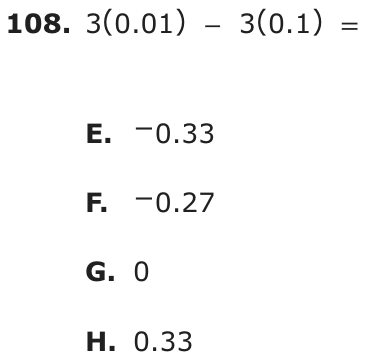
Question 107 of 120
2024 Test A Math, question 52Question
What is the value of ?
- A
- B
- C
- D
Show the answer
Correct answer: B
Rewrite the mixed numbers so that they all have equivalent denominators.
Subtracting a negative is the same as adding.
Group the whole numbers together and the fractions together.
Question analysis
This signed-number question asks for the value of 10 1/2 plus negative 5 1/3 minus negative 2 3/4. It tests adding and subtracting negative mixed numbers with unlike denominators. Turning each sign combination into a plain addition or subtraction, and then working in twelfths, is where students most often go wrong.
- Grade level
- Grade 7 content, by NYS standard
- Compared with grade 7
- At grade 7 Adding and subtracting negative mixed numbers is central grade 7 work. This three-term expression is typical in length, but it needs a common denominator of 12 and two different sign rules: adding a negative and subtracting one.
- Estimated difficulty
- Moderate: several steps, or a close reading with one strong distractor.
- Thinking it demands
- Depth of knowledge 1, recall and reproduction · mainly apply
- What makes it hard
- Error-prone arithmetic moderate
- Many steps minor
- Solution
- 4 steps
- Reading level
- Question and choices: about grade 10, 10 words.
- Students, last 30 days
- Not enough answers yet to show (it takes 10).
Why it is hard, traps and wrong answers (shows the answer)
Why it is hard
The expression is short, but it packs both sign rules for negative numbers into one line, and each misapplication has its own choice. Subtracting a negative is the rule most often broken, and the result is a reasonable-looking mixed number. Estimating with decimals, 10.5 − 5.3 + 2.8 is about 8, separates the answer from every wrong choice.
Error-prone arithmetic moderate Working it out
Two different sign rules meet: adding −5 1/3 means subtracting 5 1/3, while subtracting −2 3/4 means adding 2 3/4, and mixing them up gives a listed value. (Brown & Burton, 1978; Junker & Sijtsma, 2001)
Many steps minor Working it out
After the signs, halves, thirds and quarters become twelfths, and the wholes, 10 − 5 + 2, are combined apart from the fractions, 6/12 − 4/12 + 9/12. (Daniel & Embretson, 2010; Enright, Morley & Sheehan, 2002)
Strategy: Rewrite adding a negative as subtraction and subtracting a negative as addition, convert the fractions to twelfths, then combine the whole numbers and the fractions separately.
Traps
- Negatives and direction: Arithmetic with negative numbers, the order of a subtraction, or direction on a number line. (Moving a term across the equals sign without changing its sign is a faulty procedure.)
The wrong answers, classified
A Negatives and direction (Brown & Burton, 1978)
Handles the added negative but treats subtracting −2 3/4 as subtracting 2 3/4, so 5 1/6 − 2 3/4 = 2 5/12.
C Negatives and direction (Brown & Burton, 1978)
Drops the negative signs inside the parentheses and keeps the operations, 10 1/2 + 5 1/3 − 2 3/4 = 13 1/12.
D Negatives and direction (Brown & Burton, 1978)
Ignores every sign and adds all three mixed numbers, 10 1/2 + 5 1/3 + 2 3/4 = 18 7/12.
Worked solution, step by step
Formulas used
- Adding and subtracting negatives
- a is any number, and b is a positive number, so −b is negative. Adding a negative moves you left on the number line, just like subtracting. Subtracting a negative is like taking away a debt, so you end up with more. It is the same as adding.
- Equivalent fractions
- a is the top of a fraction and b is the bottom. n is any number except 0. Multiplying the top and bottom by the same number gives an equal fraction, cut into smaller pieces. Use it to give two fractions the same bottom before you add or subtract.
Sort out the expression
You need . There are three mixed numbers, and two of them are negative. A mixed number is a whole number plus a fraction. Plan: fix the signs, give the fractions the same bottom, then work with the whole numbers and the fractions one group at a time.
Fix the signs
Adding means subtracting . Subtracting means adding .
Watch out: subtracting a negative is adding. Subtracting instead gives , choice A. Dropping the minus signs gives C or D.Use twelfths for the fractions
The bottoms are 2, 3 and 4. All three go into 12, so change each fraction to twelfths.
Now the problem is .
Combine whole numbers, then fractions
Work with the whole numbers and the fractions one group at a time. Keep each sign.
The fraction part is less than 1, so just put them together: .
So the answer is B, .
Check your answer
Estimate with decimals. is about 7.92. And is also about 7.92, since is almost 1. They match.
More questions like this
The original DOE question
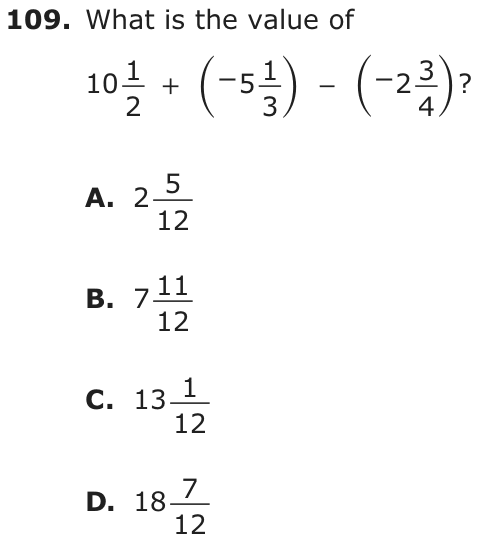
Question 108 of 120
2024 Test A Math, question 53Question
Carlos has $350 in a savings account that earns 5% simple interest each year. How much will he have in the account after 1 year, if there is no money withdrawn?
- A$17.50
- B$175.00
- C$367.50
- D$525.00
Show the answer
Correct answer: C
Find 5% of 350.
Question analysis
Carlos has $350 in a savings account earning 5% simple interest a year, and this interest question asks how much will be in the account after 1 year with no withdrawals. Students find 5 percent of the balance and use it. Reading whether the question wants the interest or the account's new balance matters most.
- Grade level
- Grade 7 content, by NYS standard
- Compared with grade 7
- Below grade 7 Simple interest is a grade 7 percent topic, but one year of interest is just 5 percent of the balance added on. Typical grade 7 problems run for several years or ask for the rate, so this is lighter.
- Estimated difficulty
- Routine: one familiar step, little to misread.
- Thinking it demands
- Depth of knowledge 2, skills and concepts · mainly apply
- What makes it hard
- Solution
- 2 steps
- Reading level
- Question and choices: about grade 6, 28 words.
- Students, last 30 days
- Not enough answers yet to show (it takes 10).
Why it is hard, traps and wrong answers (shows the answer)
Why it is hard
This is a one-year interest question with friendly numbers, so most students who know what interest is will finish it. The two ways to lose the point are stopping at the interest, which is listed, and writing 5% as 0.5, which gives a listed interest and a listed balance of its own. A sensible balance is only a little more than $350, which rules out every wrong choice.
Something you must already know minor Working it out
Simple interest for one year is the rate times the balance, 5% of $350, added to what is already there; the stem does not spell this out. (Anderson & Krathwohl, 2001)
Error-prone arithmetic minor Working it out
Writing 5% as 0.05, not 0.5, is the one place-value decision, and 0.05 × 350 = 17.5 must then be read as $17.50. (Brown & Burton, 1978; Junker & Sijtsma, 2001)
Strategy: Find 5 percent of $350 by multiplying by 0.05, then decide whether the question wants the interest alone or the amount in the account.
Traps
- Stops one step early: A choice is a number from partway through the solution.
- An arithmetic slip: The right method with a plausible arithmetic error: a digit, a place value or a times-table fact.
The wrong answers, classified
A Stops one step early (King et al., 2004; Gierl et al., 2017)
Finds the interest, 0.05 × $350 = $17.50, and stops without adding it to the $350 already in the account.
B An arithmetic slip (Junker & Sijtsma, 2001)
Writes 5% as 0.5 instead of 0.05, a decimal slip that makes the interest $175.00, and then also stops at the interest.
D An arithmetic slip (Junker & Sijtsma, 2001)
Writes 5% as 0.5, so the interest comes out as $175.00, and adds it to the $350 to reach $525.00.
Worked solution, step by step
Formulas used
- Simple interest
- I is the interest, the extra money the bank pays you. P is the principal, the money you put in. r is the yearly rate as a decimal. t is the time in years. Simple means you earn interest only on the money you started with.
Sort out the question
Carlos starts with $350. The account earns 5% simple interest each year. Interest is extra money the bank adds to your account. You need the total in the account after 1 year. That is the $350 plus the interest.
Change the percent to a decimal
Percent means out of 100, so 5% is 5 out of 100.
Watch out: 5% is 0.05, not 0.5. Using 0.5 makes the interest $175, which leads to B or D.Find the interest
Put in P = 350, r = 0.05 and t = 1 year.
The interest for one year is $17.50. That is the money added to the account.
Add the interest to the savings
After 1 year, Carlos has $367.50. Watch out: $17.50 is only the interest, choice A. The question asks how much is in the account.
So the answer is C, $367.50.
Check your answer
10% of $350 is $35. 5% is half of that, $17.50, so the interest is right. The total should be a little more than $350, since 5% is small. $367.50 fits. $525.00 would mean the account grew by half.
More questions like this
The original DOE question
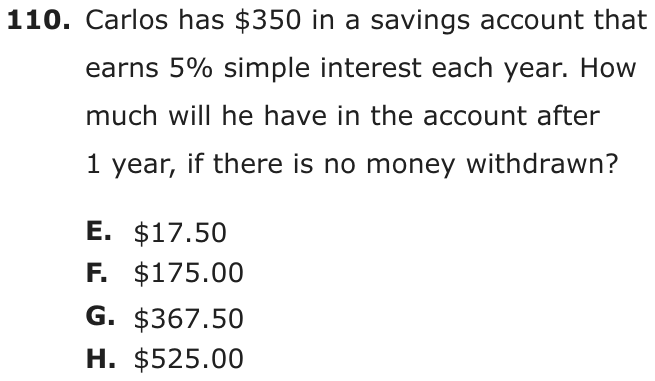
Question 109 of 120
2024 Test A Math, question 54Question
The probability of an event occurring is 0.05. What is the chance that the event will occur?
- Alikely
- Bunlikely
- Cimpossible
- Dneither likely nor unlikely
Show the answer
Correct answer: B
The probability of the event is 0.05, which equals 5%, which is less than 50%.
Option A:
An event that is likely has a probability over 50%.
Option B:
An event that is unlikely has a probability less than 50% but greater than 0%.
Option C:
An event that is impossible has a 0% probability.
Option D:
An event that is neither likely nor unlikely has a 50% probability.
Question analysis
This probability question gives an event a probability of 0.05 and asks how likely the event is to occur, described in words. Students place the decimal on the scale from 0, impossible, to 1, certain. Reading the place value of the decimal correctly is the only real hurdle.
- NYS standards
- 6.SP.6 probability from 0 to 1
- Grade level
- Grade 6 content, by NYS standard
- Compared with grade 7
- Below grade 7 Describing in words how likely an event is from its probability between 0 and 1 is a grade 6 standard. This is one quick judgment with no computation, well below grade 7 probability work with compound events.
- Estimated difficulty
- Routine: one familiar step, little to misread.
- Thinking it demands
- Depth of knowledge 1, recall and reproduction · mainly understand
- What makes it hard
- Solution
- 1 step
- Reading level
- Question and choices: about grade 10, 23 words.
- Students, last 30 days
- Not enough answers yet to show (it takes 10).
Why it is hard, traps and wrong answers (shows the answer)
Why it is hard
One judgment answers the question: 0.05 is a small probability, but it is not zero. The two tempting errors are treating a small chance as no chance at all and misreading 0.05 as 0.5, an even chance. Writing the probability as 5% or as 1 in 20 makes its size plain.
Something you must already know minor Working it out
The probability scale, 0 for impossible, 1/2 for an even chance and 1 for certain, is assumed, and 0.05 has to be placed near its low end. (Anderson & Krathwohl, 2001)
Strategy: Picture the probability scale from 0 to 1, with 0 for impossible, 1/2 for an even chance and 1 for certain, and see where 0.05 falls.
Traps
- Misunderstands the concept: A wrong belief about a concept: that percents can be added, that area grows like length, that averages can be averaged, that a bigger denominator means a bigger fraction.
- An arithmetic slip: The right method with a plausible arithmetic error: a digit, a place value or a times-table fact.
The wrong answers, classified
A Little reason to choose it (Haladyna & Downing, 1993; Rodriguez, 2005)
No common reading makes 0.05 likely, which would need a probability above one half, so it mostly draws guesses.
C Misunderstands the concept (Smith, diSessa & Roschelle, 1993; De Bock et al., 1998; Ni & Zhou, 2005)
Treats a probability close to 0 as exactly 0, as if an event with a 1 in 20 chance could never happen.
D An arithmetic slip (Junker & Sijtsma, 2001)
Reads 0.05 as 0.5, a place-value slip, which would mean an even chance of happening or not.
Worked solution, step by step
Formulas used
- Probability scale
- P is the probability of an event, a number that tells how likely it is to happen. It is always from 0 to 1. 0 means impossible, and 1 means certain. One half, or 0.5, means an even chance. The closer P is to 0, the less likely the event.
Sort out the question
Probability is a number that tells how likely an event is. An event is something that might happen. Here the probability is 0.05. You need the word that best describes that chance.
Change 0.05 to a percent
So 0.05 is 5 out of 100, or 5%. That is the same as 1 chance in 20. Watch out: 0.05 is not 0.5. A probability of 0.5 would be an even chance, choice D.
Place it on the scale
Probability Chance 0 impossible more than 0, less than 0.5 unlikely 0.5 neither likely nor unlikely more than 0.5, less than 1 likely 1 certain 0.05 is more than 0 but much less than 0.5. So the event is unlikely.
Rule out the other choices
Watch out: a small chance is still a chance. 0.05 is more than 0, so the event can happen. It is not impossible, choice C. Likely, choice A, would need more than 0.5.So the answer is B, unlikely.
Check your answer
Picture 20 tries. With a 5% chance, the event would happen about once, since 5% of 20 is 1. It would not happen about 19 times. That is rare but possible, so unlikely fits.
More questions like this
The original DOE question
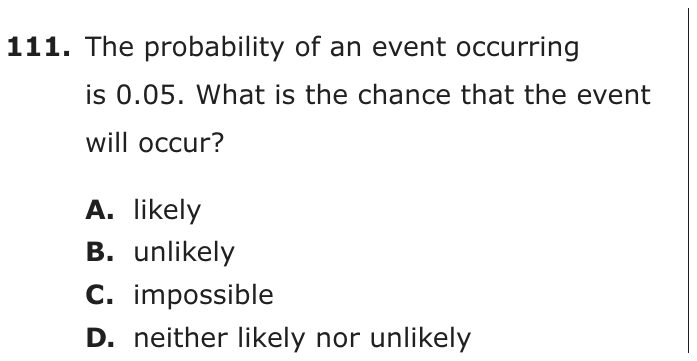
Question 110 of 120
2024 Test A Math, question 55Question
The table below shows the number of cups of red paint and blue paint used to make a purple paint mixture.
PURPLE PAINT
| Cups of Red Paint | Cups of Blue Paint |
|---|---|
| 1 | 1.5 |
| 4 | 6 |
| 11 | y |
Based on the relationship between the number of cups of red paint and the number of cups of blue paint, what is the value of y?
- A10.5
- B13
- C16.5
- D24
Show the answer
Correct answer: C
Divide the number of cups of blue paint by the number of cups of red paint to find the constant of proportionality.
Multiply to find the value of y.
Question analysis
A table gives cups of red and blue paint for a purple mixture: 1 and 1.5, 4 and 6, and 11 and an unknown y. This ratio table question asks for y based on the relationship between the two colors. The tricky part is noticing whether the relationship works by multiplying or by adding.
- Grade level
- Grade 7 content, by NYS standard
- Compared with grade 7
- Below grade 7 Finding a constant of proportionality from a table is grade 7 work, but here one row already pairs 1 cup of red with its cups of blue, so a single multiplication finishes it, lighter than typical grade 7 tasks.
- Estimated difficulty
- Routine: one familiar step, little to misread.
- Thinking it demands
- Depth of knowledge 2, skills and concepts · mainly apply
- What makes it hard
- Solution
- 2 steps
- Reading level
- Question and choices: about grade 4, 57 words.
- Students, last 30 days
- Not enough answers yet to show (it takes 10).
Why it is hard, traps and wrong answers (shows the answer)
Why it is hard
The relationship is multiplicative, 1.5 cups of blue for every cup of red, and one multiplication finishes the question. The trap is additive thinking: red grows by 7 cups from the second row to the third, and adding the same 7 to the blue column gives a listed answer. Testing a rule on every row exposes the additive one, since blue is 0.5 more than red in the first row but 2 more in the second.
Reading a figure, table or graph minor Understanding the question
The table's first row, 1 cup of red to 1.5 cups of blue, hands over the constant of proportionality; the other two rows only confirm it. (Lesh, Post & Behr, 1987; Kirsch & Mosenthal, 1990)
Strategy: Use the row with 1 cup of red paint to read the cups of blue per cup of red, multiply that rate by 11, and check the rate against the row with 4 cups.
Traps
- Misunderstands the concept: A wrong belief about a concept: that percents can be added, that area grows like length, that averages can be averaged, that a bigger denominator means a bigger fraction.
- Stops one step early: A choice is a number from partway through the solution.
The wrong answers, classified
A Stops one step early (King et al., 2004; Gierl et al., 2017)
Scales only the jump from 4 to 11 cups of red, 7 × 1.5 = 10.5, and forgets to add the 6 cups of blue already there.
B Misunderstands the concept (Smith, diSessa & Roschelle, 1993; De Bock et al., 1998; Ni & Zhou, 2005)
Thinks additively: red goes up 7 cups from 4 to 11, so adds the same 7 to the 6 cups of blue, getting 13.
D Numbers taken from the question (Hegarty, Mayer & Monk, 1995)
Multiplies the two numbers in the second row, 4 × 6 = 24, without finding how the two columns are related.
Worked solution, step by step
Formulas used
- Constant of proportionality
- x and y are two amounts that change together. k is the constant of proportionality: how much y goes with 1 of x. In a proportional relationship, y divided by x gives the same k every time.
- Proportional relationship
- x is the cups of red paint, and y is the cups of blue paint. k is the cups of blue for each cup of red. In a proportional relationship, y is always k times x. Use it to find y for any amount of red.
Sort out the table
The table shows cups of red and blue paint for the same purple. 1 cup of red goes with 1.5 cups of blue. 4 cups of red go with 6 cups of blue. You need y, the cups of blue for 11 cups of red. The same color means the paints mix at the same rate in every row.
Find the blue for each cup of red
Both rows give 1.5. So there are always 1.5 cups of blue for each cup of red. This number is the constant of proportionality.
Use the rate for 11 cups
Think of it as 11 cups plus half of 11 cups: . So y is 16.5 cups of blue.
Avoid the traps and answer
Watch out: red goes up 7 cups from 4 to 11. Adding the same 7 cups to the 6 cups of blue gives 13, choice B. Paint mixes by multiplying, not by adding. Watch out: , choice A, is only the extra blue for the 7 extra cups of red.So the answer is C, 16.5.
Check your answer
Divide to check: . That matches the other rows. Also, every row has more blue than red, so y must be more than 11. That rules out 10.5.
More questions like this
The original DOE question
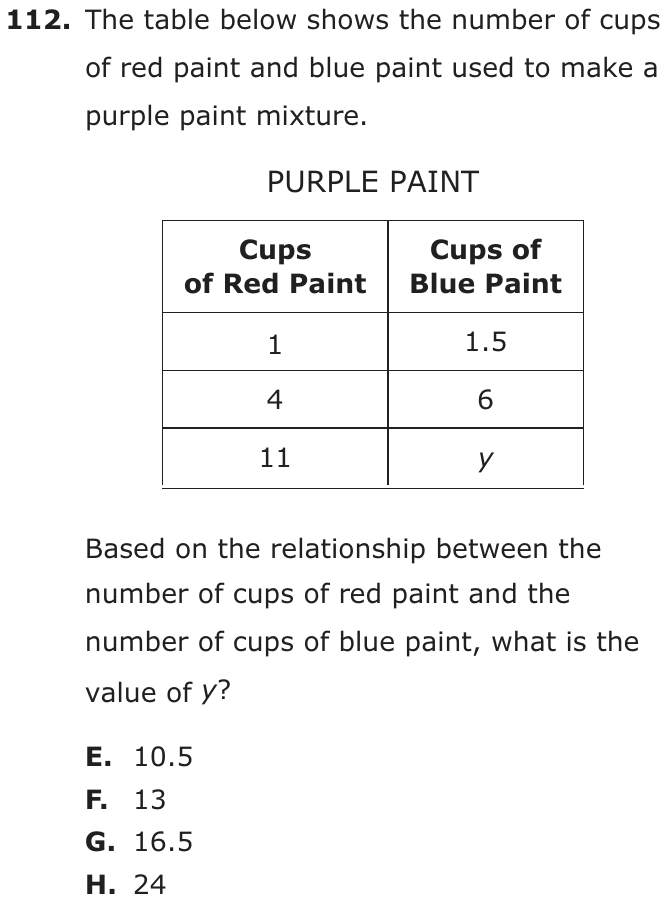
Question 111 of 120
2024 Test A Math, question 56Question

On the number line above, what is the distance, in units, between the midpoint of and the midpoint of ?
- A3
- B4
- C5
- D6
Show the answer
Correct answer: C
To find the midpoint of a segment, subtract the value on the left from the value on the right and then divide by 2. Then add the result to the value on the left of the segment.
Find the midpoint of :
Find the midpoint of :
The distance between −1 and 4 on the number line is 5 units.
Question analysis
A number line marks points P, Q and R at labeled integer positions, with P to the left of zero. This midpoint and distance question asks how far apart the midpoints of segments PQ and QR are. Students locate both midpoints and then measure the distance between them, which takes care with negative positions.
- Grade level
- Grade 7 content, by NYS standard
- Compared with grade 7
- At grade 7 Grade 7 students measure distances on a number line as the difference of two positions, including across zero. Here two midpoints must be located first, but all three points sit on labeled integers, which keeps it at grade 7 level.
- Estimated difficulty
- Straightforward: two steps or one careful reading.
- Thinking it demands
- Depth of knowledge 2, skills and concepts · mainly apply
- What makes it hard
- Error-prone arithmetic minor
- Many steps minor
- Solution
- 3 steps
- Reading level
- Question and choices: about grade 11, 21 words.
- Corrected from the DOE handbook
- A reversed instruction in the explanation was corrected.
- Students, last 30 days
- Not enough answers yet to show (it takes 10).
Why it is hard, traps and wrong answers (shows the answer)
Why it is hard
The points sit on labeled integers, so the midpoints can be found by counting, and the question is mostly about finishing carefully. Dropping the negative in 4 − (−1), stopping at the second midpoint, and counting tick marks instead of spaces each give a listed choice. Marking −1 and 4 on the figure and counting the unit spaces between them confirms the distance.
Error-prone arithmetic minor Working it out
P sits at −3, so the midpoint of PQ is (−3 + 1) ÷ 2 = −1, and the final distance, 4 − (−1), subtracts a negative number. (Brown & Burton, 1978; Junker & Sijtsma, 2001)
Many steps minor Working it out
Three results come in sequence, the midpoint of PQ, the midpoint of QR, then the gap between them, and the second of them, 4, is itself a listed choice. (Daniel & Embretson, 2010; Enright, Morley & Sheehan, 2002)
Strategy: Read the positions of P, Q and R, average each pair of endpoints to place the two midpoints, then subtract the left midpoint from the right one.
Traps
- Negatives and direction: Arithmetic with negative numbers, the order of a subtraction, or direction on a number line. (Moving a term across the equals sign without changing its sign is a faulty procedure.)
- Stops one step early: A choice is a number from partway through the solution.
- Counting the ends: Inclusive or exclusive ends, fence posts, consecutive numbers: an answer that is one too many or too few, or an endpoint drawn open where it belongs closed (or the reverse).
The wrong answers, classified
A Negatives and direction (Brown & Burton, 1978)
Finds the midpoints −1 and 4 but computes the gap as 4 − 1 = 3, dropping the negative sign instead of finding 4 − (−1).
B Stops one step early (King et al., 2004; Gierl et al., 2017)
Finds the midpoint of QR at 4 and gives its position as the answer, stopping before measuring from the other midpoint at −1.
D Counting the ends (Brown & Burton, 1978)
Counts the six tick marks from −1 to 4 inclusive rather than the five unit spaces between them.
What was corrected from the DOE handbook, and why
- Explanation: The handbook’s rule says to “subtract the value on the right from the value on the left and then divide by 2,” but its own working does the opposite: 1 − (−3) = 4 for PQ and 7 − 1 = 6 for QR, the right value minus the left. Following the rule as printed gives (−3 − 1) ÷ 2 = −2 and (1 − 7) ÷ 2 = −3, which would put the midpoints at −5 and −2, outside the segments, and lead to a distance of 3, a wrong choice. The site now says “subtract the value on the left from the value on the right.” The midpoints, −1 and 4, and the distance between them, 5 units, are unchanged.
Worked solution, step by step
Formulas used
- Midpoint on a number line
- The left end and right end are the numbers at the two ends of a segment. Right end minus left end is the segment’s length. The midpoint is halfway, so it is half the length to the right of the left end.
- Distance on a number line
- On a number line, numbers grow as you move right. The distance between two points is the larger number minus the smaller one. That is the right point minus the left point, so a distance is never negative.
Read the number line
P is at −3, Q is at 1 and R is at 7. A bar over two letters, such as , means the segment between them. A segment is the straight piece of line between two points. You need the midpoint of each segment, the point exactly halfway between its ends. Then you need the distance between those two midpoints.
Find the midpoint of PQ
The left end is −3 and the right end is 1.
So the midpoint of PQ is at −1. Note that is , which is 4.
Find the midpoint of QR
The left end is 1 and the right end is 7.
So the midpoint of QR is at 4. Watch out: 4 is where a midpoint is, not the answer. Stopping here gives choice B.
Measure between the midpoints
Watch out: keep the minus sign on −1. Using gives choice A. Also count the spaces, not the tick marks. From −1 to 4 there are 5 spaces but 6 marks, and 6 is choice D.So the answer is C, 5 units.
Check your answer
Each midpoint should sit in the middle of its segment. −1 is 2 units from both −3 and 1. 4 is 3 units from both 1 and 7. There is also a shortcut. The gap between the midpoints is half of PR: .
More questions like this
The original DOE question
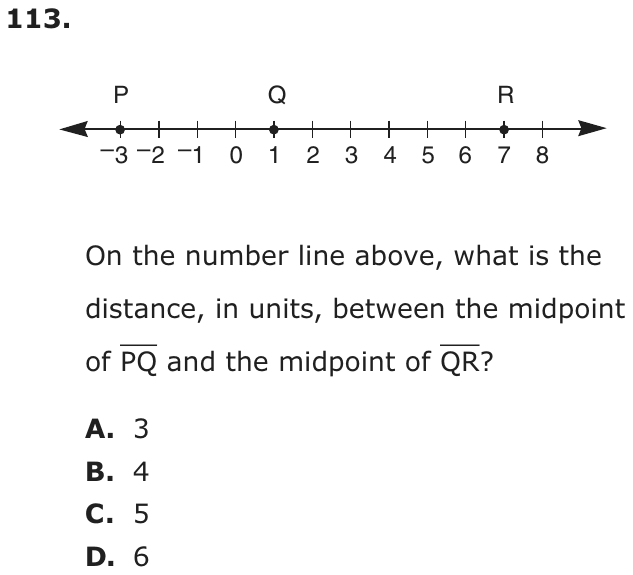
Question 112 of 120
2024 Test A Math, question 57Question
An ice cream shop sells 16 cups of ice cream for $48 and 4 cups for $12. There is a proportional relationship between the number of cups of ice cream and the cost. What is the constant of proportionality for this relationship?
- A3 cups per dollar
- B3 dollars per cup
- C4 cups per dollar
- D4 dollars per cup
Show the answer
Correct answer: B
There is a proportional relationship between the cost and the number of cups of ice cream.
Divide the cost by the number of cups of ice cream to find the constant of proportionality.
The constant is the cost per cup, 3 dollars.
Question analysis
An ice cream shop sells 16 cups for $48 and 4 cups for $12, and the cost is proportional to the number of cups. This proportional relationship question asks for the constant of proportionality, with its units. The choices pair two numbers with two kinds of units, so the units of the rate matter as much as the number.
- Grade level
- Grade 7 content, by NYS standard
- Compared with grade 7
- Below grade 7 Grade 7 students find constants of proportionality in tables, graphs and equations. Here one division gives the number, as in grade 6 unit pricing, and the real demand is attaching the right units to it.
- Estimated difficulty
- Straightforward: two steps or one careful reading.
- Thinking it demands
- Depth of knowledge 2, skills and concepts · mainly apply
- What makes it hard
- A very close wrong answer moderate
- Something you must already know minor
- Solution
- 2 steps
- Reading level
- Question and choices: about grade 4, 50 words.
- Students, last 30 days
- Not enough answers yet to show (it takes 10).
Why it is hard, traps and wrong answers (shows the answer)
Why it is hard
One division gives the number, so the question is really about units. The cost depends on the number of cups, and dividing $48 by 16 cups gives the dollars for each cup; reversing the label describes a shop where one dollar buys three cups. The second offer, 4 cups for $12, is a built-in check that the rate stays the same.
A very close wrong answer moderate Choosing the answer
Two choices carry the number 3, "3 cups per dollar" and "3 dollars per cup", so finding 48 ÷ 16 is not enough; the units decide. (Embretson & Wetzel, 1987; Gorin & Embretson, 2006; Ascalon et al., 2007)
Something you must already know minor Working it out
Students must know that dividing dollars by cups gives dollars per cup: a quotient's units read as the top quantity per the bottom one. (Anderson & Krathwohl, 2001)
Strategy: Divide one quantity by the other for one offer, check that the other offer gives the same quotient, and label it with the numerator's units per the denominator's units.
Traps
- Wrong operation: Adds instead of multiplying, divides the wrong way round, turns a ratio or rate upside down, or undoes a step in the wrong direction (subtracts what should be added back).
- Numbers taken from the question: Combines the numbers in the question without a model of the situation, or is simply a number that appears in the question.
The wrong answers, classified
A Wrong operation (Hegarty, Mayer & Monk, 1995; King et al., 2004)
Gets 3 from 48 ÷ 16 but labels it cups per dollar, turning the rate upside down; at these prices a dollar buys only 1/3 of a cup.
C Numbers taken from the question (Hegarty, Mayer & Monk, 1995)
Divides the two cup amounts, 16 ÷ 4 = 4, and attaches cups per dollar, a ratio of like quantities given made-up units.
D Numbers taken from the question (Hegarty, Mayer & Monk, 1995)
Divides the two costs, $48 ÷ $12 = 4, or the two cup counts, and calls the result dollars per cup.
Worked solution, step by step
Formulas used
- Constant of proportionality
- In a proportional relationship, y is always the same number, k, times x. Here x is the number of cups and y is the cost in dollars. So k is y divided by x. Its units are the top’s units per the bottom’s units: dollars per cup.
Sort out the question
16 cups cost $48, and 4 cups cost $12. The cost is proportional to the cups. That means the cost is always the same number times the number of cups. That number is the constant of proportionality. You need it with the right units.
Divide cost by cups
For each offer, divide the cost in dollars by the number of cups.
Both offers give 3. So the constant is 3.
Name the units
Dollars are on top and cups are on the bottom. So the units are dollars per cup. 3 dollars per cup means each cup costs $3. Watch out: two choices use 3. Choice A, 3 cups per dollar, flips the rate. Then 16 cups would cost only about $5, not $48.
Avoid the traps and answer
Watch out: dividing two costs, , or two cup counts, , gives 4. That compares like amounts, so it is not a cost for each cup. It leads to choice C or D.So the answer is B, 3 dollars per cup.
Check your answer
Multiply back. At 3 dollars per cup, 16 cups cost , which is $48. And 4 cups cost , which is $12. Both match the shop’s prices.
More questions like this
The original DOE question
Question 113 of 120
2024 Test B English, question 1Question
What is the best way to combine these sentences to clarify the relationship between ideas?
(1) The International Space Station has been inhabited by crew members since 2000.
(2) Tourists will soon be allowed to pay for visits to the space station.
(3) Because the cost is $52–$58 million round trip, few people will be able to take advantage of the opportunity to have a vacation in outer space.
- AThe International Space Station has been inhabited by crew members since 2000, but tourists will soon be allowed to pay for visits to the space station, which cost $52–$58 million round trip, so few people will be able to take advantage of the opportunity to have a vacation in outer space.
- BThe International Space Station has been inhabited by crew members since 2000 and will soon allow tourists to pay for visits, but because the cost is $52–$58 million round trip, few people will be able to take advantage of the opportunity to have a vacation in outer space.
- CThe International Space Station has been inhabited by crew members since 2000, but tourists will soon be allowed to pay for visits to the space station, though the cost is $52–$58 million round trip, so few people will be able to take advantage of the opportunity to have a vacation in outer space.
- DThe International Space Station has been inhabited by crew members since 2000, and tourists will soon be allowed to pay for visits to the space station because the cost is $52–$58 million round trip, therefore few people will be able to take advantage of the opportunity to have a vacation in outer space.
Show the answer
Correct answer: B
The question asks for the best way to combine the sentences.
A. Incorrect. Although the option combines the sentences in a way that accurately reflects the meaning of each individual sentence, the combined sentence is a string of clauses that do not effectively cohere. Because it is poorly structured, the combined sentence does not clarify the relationship of ideas as effectively as the correct response does. The sentence incorrectly uses “but tourists,” and “which cost” modifies “the space station” but does not modify the trip. Compared with the correct response, the combined sentence in this option is also imprecise and unnecessarily wordy.
B. CORRECT. The option uses a complex sentence to present ideas clearly and precisely, and it shows the relationship between the ideas in the original sentences. In the first part of the sentence, the conjunction “and” correctly joins the first and second sentences by indicating a relationship, rather than a contrast, between the two. In the second part of the sentence, the conjunction “but” adds additional emphasis to the fact that while tourists will be allowed to visit the space station, the cost of the trip will likely prohibit most people from visiting.
C. Incorrect. Although the option combines the sentences in a way that accurately reflects the meaning of each individual sentence, the combined sentence is a string of clauses that do not effectively cohere. Because it is so poorly structured, the combined sentence does not clarify the relationship of ideas as effectively as the correct response does. Compared with the correct response, the combined sentence in this option is also imprecise and unnecessarily wordy.
D. Incorrect. The combination of the sentences contains an illogical relationship between ideas with the statement that tourists will be allowed to pay for visits to the space station because the cost is $52–$58 million round trip. The connection between the idea that “tourists will soon be allowed to pay for visits” and the subsequent “therefore few people will be able to take advantage of the opportunity” is also illogical.
Question analysis
This sentence-combining question gives three sentences about the International Space Station, its crew and the high price of a tourist trip, and asks for the best way to join them into one. Every version keeps the same facts, so students must judge which connecting words show how the ideas relate while the sentences stay long and nearly identical.
- Grade level
- Grade 8 reading and task
- Compared with grade 7
- Above grade 7 Grade 7 students practice joining two short sentences with a fitting conjunction. Here three sentences become one long sentence in four nearly identical versions, so students must weigh every connecting word and clause rather than spot one error.
- Estimated difficulty
- Hard: combines ideas, needs a plan, and has more than one tempting wrong answer.
- Thinking it demands
- Depth of knowledge 2, skills and concepts · mainly evaluate
- What makes it hard
- How sentences fit together major
- Complex sentences moderate
- Every choice must be checked moderate
- Evidence
- Answered from one sentence or line
- Reading level
- Question and choices: about grade 15, 261 words.
- Students, last 30 days
- Not enough answers yet to show (it takes 10).
Why it is hard, traps and wrong answers (shows the answer)
Why it is hard
None of the wrong versions drops a fact, and two of them are loose rather than plainly ungrammatical, so the ear is little help. Students lose the point by accepting the smoothest chain of clauses without asking what each connector claims: whether the crew and the tourists really contrast, what the price belongs to, and what the price explains. The question rewards deciding the three links before reading the versions, then checking them one connector at a time.
How sentences fit together major Working it out
Sentence 2 simply adds to sentence 1, while sentence 3’s price works against the tourist plan and explains why few will go, so every “but,” “though,” “because” or “so” in a version must fit one of those links. (Halliday & Hasan, 1976)
Complex sentences moderate Understanding the question
Each version is one sentence of 48 to 53 words with four clauses, and at that length a “which cost” hanging on the wrong noun or a comma before “therefore” is easy to read past. (Abedi & Lord, 2001; Freedle & Kostin, 1993; Messick, 1989)
Every choice must be checked moderate Choosing the answer
All four versions keep the same facts in the same order and share most of their words, so none can be ruled out by content; each connecting word has to be tested in turn. (Embretson & Wetzel, 1987)
Strategy: Before reading the choices, decide how each sentence relates to the next: added fact, contrast, or cause and result. Then check every connecting word in each version against those links.
Traps
- Misplaced modifier: A describing word or phrase that attaches to the wrong word, or to nothing in the sentence.
- Wordy, vague or informal: A revision is grammatical but wordy, imprecise or too casual for the passage.
- Wrong transition: A connecting word or phrase that signals the wrong relationship, such as contrast where the idea continues.
The wrong answers, classified
A Misplaced modifier (Connors & Lunsford, 1988)
Keeps the price as the reason few can go, marked by “so,” but misses that “which cost” hangs on “the space station” and that “but” sets crew against tourists.
C Wordy, vague or informal (Connors & Lunsford, 1988)
Keeps every fact in order, but stacking “but,” “though” and “so” in one sentence turns the price into an aside instead of plainly the reason few people will go.
D Wrong transition (Halliday & Hasan, 1976)
Keeps sentence 3’s “because the cost is” word for word, but here it explains why tourists are allowed, and “therefore” after a comma splices on the result.
Working it out, step by step
Figure out what the question asks
You need to join three sentences into one. The best version shows clearly how the ideas connect. Joining words do that job. A conjunction is a joining word, like and, but, so or because. Each one tells the reader something. And adds a fact. But shows a contrast (two ideas that pull against each other). Because and so show a cause and its result.
Decide how the three sentences connect
Sentence 1 says crews have lived on the station since 2000. Sentence 2 adds a new fact: tourists will soon be able to visit. That is not a contrast, so it needs and. Sentence 3 works against sentence 2. The trip costs “$52–$58 million round trip.” That price is also the reason few people will go. So you need a contrast and a reason. Example: The pool is open to all, but because it costs $90, few kids swim there.
Test each choice
- B uses “and will soon allow tourists” to add the new fact. Then “but because the cost is” shows the contrast and the reason. Every link is right.
- A joins sentence 2 with “but tourists,” as if crews and tourists were opposites. Also, “which cost” comes right after “the space station.” So it sounds like the station costs that much, not the trip.
- C stacks “but,” “though” and “so” in one long chain. The price turns into a side note instead of the clear reason.
- D says tourists may visit “because the cost is” so high. That makes no sense. And “therefore” after a comma joins two sentences the wrong way.
Pick the answer
Watch out: A is the most tempting. It keeps the price as the reason, with “so.” But its “but” and its “which” send the reader the wrong way. Only one choice links every idea correctly. So the answer is B.
Why this answer and not the closest wrong one
A is the closest wrong answer. Like B, it says the price keeps most people away. But A sets crews against tourists with “but tourists.” Its “which cost” also seems to give the price of the station. B uses and for the added fact and but because for the price, so each link is clear.
More questions like this
The original DOE question
Question 114 of 120
2024 Test B English, question 2Question
Which sentence contains an error in its construction and should be revised?
(1) In 1976, the National Basketball Association (NBA) absorbed several teams of the American Basketball Association (ABA), including the New York Nets, who played in the Long Island area at the time. (2) The owner of the Nets decided to take the team to New Jersey after the team had financial troubles, where the team played for thirty-five seasons. (3) The New Jersey Nets had sixteen playoff appearances, including two appearances in the NBA finals. (4) In 2012, the team changed ownership and returned to New York, where the team now plays under the name the Brooklyn Nets.
- Asentence 1
- Bsentence 2
- Csentence 3
- Dsentence 4
Show the answer
Correct answer: B
The question asks for the identification of the sentence that has an error in its construction and should be revised.
A. Incorrect. There are no errors in the structure of sentence 1. The clause “who played in the Long Island area at the time” correctly modifies the noun “New York Nets.” “Who” is the correct relative pronoun to serve as the subject of the modifying clause because it refers to people rather than objects or things.
B. CORRECT. Sentence 2 contains a structural error. The current placement of the clause “where the team played for thirty-five seasons” suggests that the clause is modifying the term “financial troubles,” which is illogical. The clause “where the team played for thirty-five seasons” should immediately follow the location, “New Jersey.” A revised version of the sentence might read, “After the team had financial troubles, the owner of the Nets decided to take the team to New Jersey, where the team played for thirty-five seasons.”
C. Incorrect. There are no errors in the structure of sentence 3. The phrase “including two appearances in the NBA finals” is a nonrestrictive phrase that provides further detail about the team’s “sixteen playoff appearances.” The phrase is set off by a comma because it is not essential to understanding the meaning of the sentence.
D. Incorrect. There are no errors in the structure of sentence 4. The clause “where the team now plays under the name the Brooklyn Nets” is a nonrestrictive clause that provides further detail about the team after its move back to New York in 2012. The clause is set off by a comma because it is not essential to understanding the meaning of the sentence.
Question analysis
This editing question gives a four-sentence paragraph tracing the Nets basketball team from Long Island to New Jersey and back to Brooklyn, and asks which sentence is built incorrectly. The sentences are long, with commas, parentheses and describing clauses, so students must check what each clause actually describes instead of trusting how smoothly it reads.
- NYS standards
- 7L1 grammar and usage conventions
- Grade level
- Grade 7 reading and task
- Compared with grade 7
- At grade 7 Placing clauses so they describe the right word is a grade 7 grammar standard. The paragraph is short and plain, but the correct sentences also carry commas and describing clauses, which matches a careful grade 7 editing task.
- Estimated difficulty
- Moderate: several steps, or a close reading with one strong distractor.
- Thinking it demands
- Depth of knowledge 2, skills and concepts · mainly analyze
- What makes it hard
- A rule that doesn't sound wrong moderate
- Every choice must be checked minor
- Complex sentences minor
- Evidence
- Answered from one paragraph or stanza
- Reading level
- Question and choices: about grade 7, 108 words.
- Students, last 30 days
- Not enough answers yet to show (it takes 10).
Why it is hard, traps and wrong answers (shows the answer)
Why it is hard
The faulty sentence is easy to understand, because the reader supplies the link between New Jersey and the thirty-five seasons without noticing the clause is in the wrong place. Students who go by sound skip it and suspect a busier sentence instead, most often the first, with its parentheses and a “who” that refers to a team. The question rewards asking, for each describing clause, which word it actually sits beside.
A rule that doesn't sound wrong moderate Working it out
Sentence 2’s “where the team played for thirty-five seasons” follows “financial troubles,” not “New Jersey,” but readers silently attach it to the state, so the misplaced clause does not sound wrong. (Connors & Lunsford, 1988)
Every choice must be checked minor Choosing the answer
The stem names no kind of error, and every sentence carries a describing clause or phrase, from “who played” to “including two appearances” to a second “where” clause, so all four must be tested. (Embretson & Wetzel, 1987)
Complex sentences minor Understanding the question
Sentence 1 runs 31 words with two abbreviations in parentheses and a “who” clause, which makes a correct sentence look like the likeliest home for an error. (Abedi & Lord, 2001; Freedle & Kostin, 1993; Messick, 1989)
Strategy: In each sentence, find every describing clause or phrase and the word just before it. Ask whether the clause can logically describe that word; a mismatch marks the sentence to revise.
Traps
- Fixes what isn't broken: Changes a part of the sentence that was already correct, while the real error stays; or, where the question asks which sentence has an error or should go, picks one that is correct and belongs.
The wrong answers, classified
A Fixes what isn't broken (Connors & Lunsford, 1988)
Believes “who” cannot refer to a team, or distrusts the long sentence with two abbreviations, though “who played in the Long Island area” correctly describes the New York Nets.
C Fixes what isn't broken (Connors & Lunsford, 1988)
Takes “including two appearances in the NBA finals” for a fragment tacked on with a comma, though the phrase correctly adds detail to “sixteen playoff appearances.”
D Fixes what isn't broken (Connors & Lunsford, 1988)
Hears the shift from “returned” to “now plays” as a tense error, though “now” marks the present, and this “where” clause sits right after New York, the place it describes.
Working it out, step by step
Figure out what the question asks
This asks which sentence is built wrong. The facts may all be true. The problem is how the parts of a sentence fit together. The question doesn’t say what kind of error to look for. So you need to test all four sentences.
Learn the rule about describing clauses
A clause is a group of words with a subject and a verb. Some clauses describe a word. They often start with who or where. A describing clause must sit right next to the word it describes. If it lands next to the wrong word, the sentence says something silly. Example: We went to the beach after the storm, where we swam all day. That says we swam in the storm! Fix: After the storm, we went to the beach, where we swam all day.
Test sentence 2
Sentence 2 ends “after the team had financial troubles, where the team played for thirty-five seasons.” The clause starting with “where” sits right after “financial troubles.” So the sentence says the team played inside its money problems. The clause should describe New Jersey, the place. Fix: After the team had financial troubles, the owner of the Nets decided to take the team to New Jersey, where the team played for thirty-five seasons.
Test sentences 1, 3 and 4
- Sentence 1: “who played in the Long Island area at the time” comes right after “the New York Nets.” A team is a group of people, so who works.
- Sentence 3: “including two appearances in the NBA finals” comes right after “sixteen playoff appearances.” It adds a detail about them, so it fits.
- Sentence 4: “where the team now plays” comes right after “New York,” a place. The word “now” makes the present tense right.
Watch out: Sentence 1 looks busy, with two names in parentheses. That makes choice A tempting. But long is not the same as wrong.
Pick the answer
Only sentence 2 puts a describing clause next to the wrong words. So the answer is B, sentence 2.
Why this answer and not the closest wrong one
Sentence 1 is the closest wrong answer, because it is long and uses who for a team. But its clause sits right next to the Nets, the team it describes. In sentence 2, the “where” clause sits next to “financial troubles,” not New Jersey. That is why B is right.
More questions like this
The original DOE question
Question 115 of 120
2024 Test B English, question 3Question
Read this sentence.
The Appalachian Trail is a really long trail that a lot of people do each year.
Which revision of the sentence uses the most precise language?
- AThe Appalachian Trail is an extremely long trail that millions of people do each year.
- BThe Appalachian Trail is a 2,200-mile trail that more than a million people hike each year.
- CThe Appalachian Trail is a 2,200-mile trail that two million people hike each year.
- DThe Appalachian Trail is a lengthy trail that a couple million people do each year.
Show the answer
Correct answer: C
The question asks for the revision of the sentence that uses the most precise language.
A. Incorrect. The word “extremely” does not specify the precise length of the trail (2,200 miles); “millions” is less precise than the specific number of people who hike the trail each year (two million); and the verb “do” imprecisely describes the purpose of visiting the trail (hiking).
B. Incorrect. While the revision specifies the precise length of the trail and the verb “hike” precisely describes the purpose of visiting the trail, “more than a million” is less precise than the specific number of people who hike the trail each year (two million).
C. CORRECT. The length of the trail (2,200 miles), the specific number of people who hike the trail each year (two million), and the action of the visitors (hiking) are clear and precise in this revision of the sentence.
D. Incorrect. The word “lengthy” is less precise than specifying the actual length of the trail (2,200 miles); “a couple million” is less precise than the specific number of people who hike the trail each year (two million); and the verb “do” imprecisely describes the purpose of visiting the trail (hiking).
Question analysis
This precise-language question gives a casual sentence saying the Appalachian Trail is “a really long trail that a lot of people do each year” and asks which revision is most precise. Several revisions swap in more specific words or numbers, so students must check every part of each sentence, not just the first improvement they notice.
- NYS standards
- 7L3a precise and concise language
- Grade level
- Grade 6 reading and task
- Compared with grade 7
- Below grade 7 Choosing precise wording is grade 7 language work, but this item is one short sentence in everyday words. Typical grade 7 revision sets the same choice inside a paragraph, with more wording to weigh.
- Estimated difficulty
- Straightforward: two steps or one careful reading.
- Thinking it demands
- Depth of knowledge 1, recall and reproduction · mainly evaluate
- What makes it hard
- A very close wrong answer moderate
- Every choice must be checked minor
- Evidence
- Answered from one sentence or line
- Reading level
- Question and choices: about grade 6, 89 words.
- Students, last 30 days
- Not enough answers yet to show (it takes 10).
Why it is hard, traps and wrong answers (shows the answer)
Why it is hard
The question is quick once each revision is tested on three points: how long the trail is, how many people hike it, and what they do there. The near miss catches students who stop checking once they see the mileage and the verb “hike,” though its count of hikers is still a range. Words such as “extremely” and “lengthy” are the other snare, since they sound sharper without saying any more.
A very close wrong answer moderate Choosing the answer
The right revision and the one with “more than a million” share the 2,200-mile length and the verb “hike,” and differ only in the hiker count: an exact two million or an open-ended floor. (Embretson & Wetzel, 1987; Gorin & Embretson, 2006; Ascalon et al., 2007)
Every choice must be checked minor Choosing the answer
Each revision repairs a different part of “a really long trail that a lot of people do,” so all four have to be checked for the length, the count and the verb. (Embretson & Wetzel, 1987)
Strategy: Check each revision on three points: how long the trail is, how many people visit, and what they do there. Keep only a version that is exact on all three.
Traps
- Wordy, vague or informal: A revision is grammatical but wordy, imprecise or too casual for the passage.
The wrong answers, classified
A Wordy, vague or informal (Connors & Lunsford, 1988)
Treats “extremely long” and “millions” as upgrades, though neither gives a length or a count, and the vague verb “do” is still there.
B Wordy, vague or informal (Connors & Lunsford, 1988)
Sees the exact length and the verb “hike” and stops checking, missing that “more than a million” is looser than a specific number of hikers.
D Wordy, vague or informal (Connors & Lunsford, 1988)
Takes the fancier “lengthy” and the casual “a couple million” for sharper wording, though neither is exact and “do” still does not say what visitors do.
Working it out, step by step
Figure out what the question asks
You need the revision with the most precise language. Precise means exact. A precise word tells the reader exactly what or how much. For example, a lot of homework is vague, but three pages of math homework is precise. The sentence has three vague parts: “a really long trail,” “a lot of people,” and the verb “do.”
Make a three-part test
The most precise revision must fix all three parts.
- How long is the trail? Look for an exact length.
- How many people go? Look for an exact number.
- What do they do there? Do is vague. People hike a trail.
A choice that fixes only one or two parts is not the most precise.
Check each choice
- C gives “a 2,200-mile trail,” “two million people,” and “hike.” It passes all three tests.
- B gives the length and “hike.” But “more than a million” is not exact. It could mean 1.1 million or 5 million.
- A says “extremely long” and “millions.” Neither is exact, and it keeps “do.”
- D says “lengthy” and “a couple million.” These sound fancier but say no more. It also keeps “do.”
Pick the answer
Watch out: B is very close. It has the length and the right verb, so many students stop there. But its count of people is still loose. Only C is exact on all three parts. So the answer is C.
Why this answer and not the closest wrong one
B is the closest wrong answer. It matches C on the length, 2,200 miles, and on the verb “hike.” The only difference is the number of hikers. “More than a million” sets a low limit but gives no exact count. “Two million” tells the reader exactly how many, so C is more precise.
More questions like this
The original DOE question
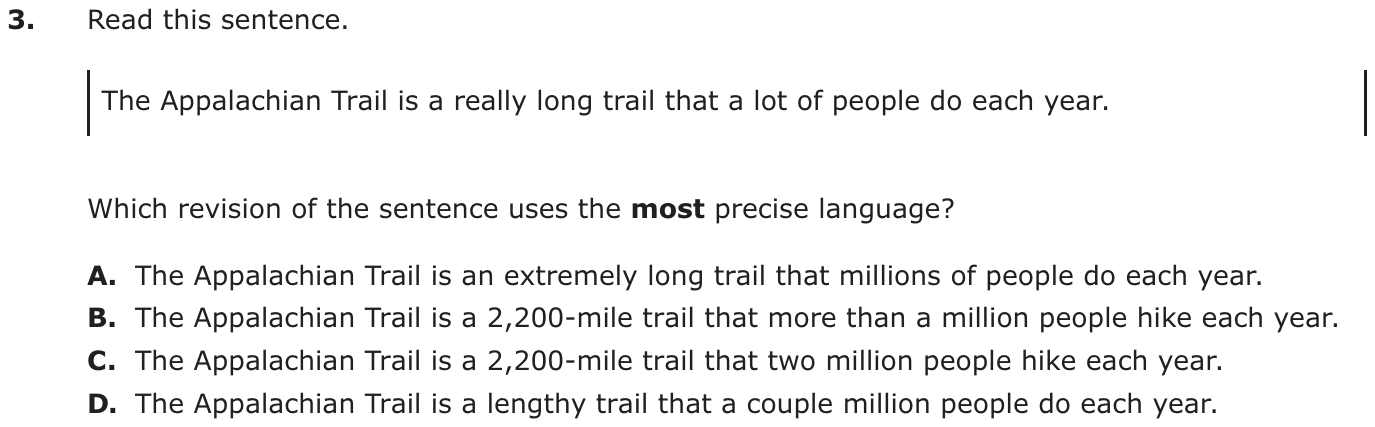
Question 116 of 120
2024 Test B English, question 5Passage Find Time to Volunteer
Find Time to Volunteer
(1) Many people believe that they gain a greater sense of purpose by giving their time to serve others. (2) These are the people who spend their free time volunteering at various places within the community. (3) Those who are served benefit from the work of these volunteers. (4) However, research shows that those who volunteer also receive benefits.
(5) For many students, this proposition may sound impossible. (6) Schoolwork can require hours of study each week. (7) Volunteering at a retirement center or homeless shelter requires both time and energy. (8) Extracurricular activities fill up after-school time. (9) Family obligations and part-time jobs often have to be worked into the schedule, too. (10) However, if students can find time to volunteer, even for a few hours a month, they may find that the benefits outweigh the scheduling difficulties.
(11) To begin with, students who engage in volunteer activities acquire valuable skills and experience, which can help them focus on potential fields of study and career options. (12) Furthermore, when students list volunteer work on college applications, admissions counselors see applicants who care about making their community and college campus a better place.
(13) Volunteerism benefits more than students applying to college. (14) This type of experience is equally important for students moving directly into the workforce after high school. (15) Volunteering demonstrates initiative, dedication, and a strong work ethic, qualities that companies value in a potential employee. (16) In a CareerBuilder study, 60 percent of managers regarded volunteerism as a significant asset when considering applicants.
(17) Students who volunteer undoubtedly make a positive investment in their future, but they also affect their present quality of life. (18) Studies have shown that volunteering is good for both the mind and the body. (19) Volunteering can boost mood levels and reduce anxiety. (20) According to the Mayo Clinic,1 the feeling of doing something meaningful and the appreciation received from that action can reduce stress.
(21) Even the busiest of students can find a way to donate some time to a worthy cause. (22) Though managing different commitments may seem overwhelming at times, students are sure to feel a sense of fulfillment in volunteerism.
1Mayo Clinic: a nonprofit medical organization dedicated to treatment and research
Question
Which revision of sentence 2 uses the most precise language?
- AThese are the people who spend their free time volunteering at animal shelters, helping with activities in community centers, or cleaning up parks.
- BThese are the people who spend their free time helping others in numerous ways at a variety of places, events, or organizations that need support.
- CThese are the people who spend their free time working at local establishments that help people, animals, or other groups in need of assistance.
- DThese are the people who spend a lot of time volunteering at places where they can help people in many ways.
Show the answer
Correct answer: A
The question asks which revision of sentence 2 uses the most precise language.
A. CORRECT. In sentence 2, the author states that people who volunteer in their free time do so “at various places.” The revision to sentence 2 provides the most precise language because it references three specific places (animal shelters, community centers, and parks) where people often volunteer.
B. Incorrect. Although this sentence mentions “a variety of places, events, or organizations” at which people volunteer, the revision does not use the most precise language, because it does not list specific places, events, or organizations.
C. Incorrect. Although this sentence mentions “local establishments that help people, animals, or other groups,” the revision does not use the most precise language, because it does not name the specific types of establishments at which people can volunteer.
D. Incorrect. Although this sentence mentions “places where [volunteers] can help people in many ways,” the revision does not use the most precise language, because it does not provide specific examples of where people can volunteer.
Question analysis
This revising question uses a persuasive essay urging high school students to find time to volunteer. It asks which rewrite of the second sentence, about the people who spend free time volunteering at various places, uses the most precise language. The trap is that longer, list-like wording can look more specific than it really is.
- Grade level
- Grade 6 reading and task
- Compared with grade 7
- Below grade 7 Grade 7 writers learn to replace vague wording with precise language. Here that skill is applied to one sentence of a plain persuasive essay, with no grammar to fix, which makes it lighter than typical grade 7 revision work.
- Estimated difficulty
- Routine: one familiar step, little to misread.
- Thinking it demands
- Depth of knowledge 1, recall and reproduction · mainly evaluate
- What makes it hard
- Evidence
- Answered from one sentence or line
- Reading level
- Passage: about grade 11, 354 words; question and choices: about grade 10, 102 words.
- Students, last 30 days
- Not enough answers yet to show (it takes 10).
Why it is hard, traps and wrong answers (shows the answer)
Why it is hard
Sentence 2’s vague phrase is “various places,” and only one revision replaces it with places a reader can picture: animal shelters, community centers and parks. The wrong revisions grow longer or list the kinds of people helped, which can pass for precision on a quick read. Asking whether a revision names a real place settles it.
Every choice must be checked minor Choosing the answer
Every revision is longer than sentence 2 and sounds more detailed, so each has to be checked for whether it names actual places or only adds general words such as “organizations” and “establishments.” (Embretson & Wetzel, 1987)
Strategy: Find the vague phrase in sentence 2, then ask of each revision whether it tells the reader something more definite or simply uses more words to say the same thing.
Traps
- Wordy, vague or informal: A revision is grammatical but wordy, imprecise or too casual for the passage.
The wrong answers, classified
B Wordy, vague or informal (Connors & Lunsford, 1988)
Mistakes a longer string of general categories, “places, events, or organizations,” for precision, though none is named and the sentence only grows wordier.
C Wordy, vague or informal (Connors & Lunsford, 1988)
Is drawn by the three-part list of people, animals and other groups, but “local establishments” still leaves the actual places unnamed.
D Wordy, vague or informal (Connors & Lunsford, 1988)
Accepts “a lot of time” and “many ways,” which keep the original’s vagueness and even drop the point that volunteers give their free time.
Working it out, step by step
Figure out what the question asks
You need to rewrite sentence 2 with more precise language. Precise means exact. Precise words help the reader picture something real. Sentence 2 says: “These are the people who spend their free time volunteering at various places within the community.” Look for the part that is vague.
Find the vague phrase
The vague phrase is “at various places.” Various means different kinds. But the sentence never says which places. You can’t picture them. A better sentence would name real places. Example: I help out at different spots is vague. I help out at the library and the food bank is precise.
Check each choice
- A names three real places: “animal shelters,” “community centers,” and “parks.” You can picture each one.
- B says “a variety of places, events, or organizations.” That is a longer list of general words. It still names nothing real.
- C says “local establishments.” An establishment is a business or group. It still doesn’t say which ones.
- D says “a lot of time” and “many ways.” Those words are vague too. D even drops the idea of free time.
Pick the answer
Watch out: C has a list, “people, animals, or other groups,” so it looks detailed. But that list tells who gets help, not where volunteers go. Only one choice names the places. So the answer is A.
Why this answer and not the closest wrong one
C is the closest wrong answer. Its list of people, animals and other groups sounds specific. But “local establishments” could be any place at all. A replaces “various places” with three places a reader can picture: animal shelters, community centers and parks. That makes A the most precise.
More questions like this
The original DOE question
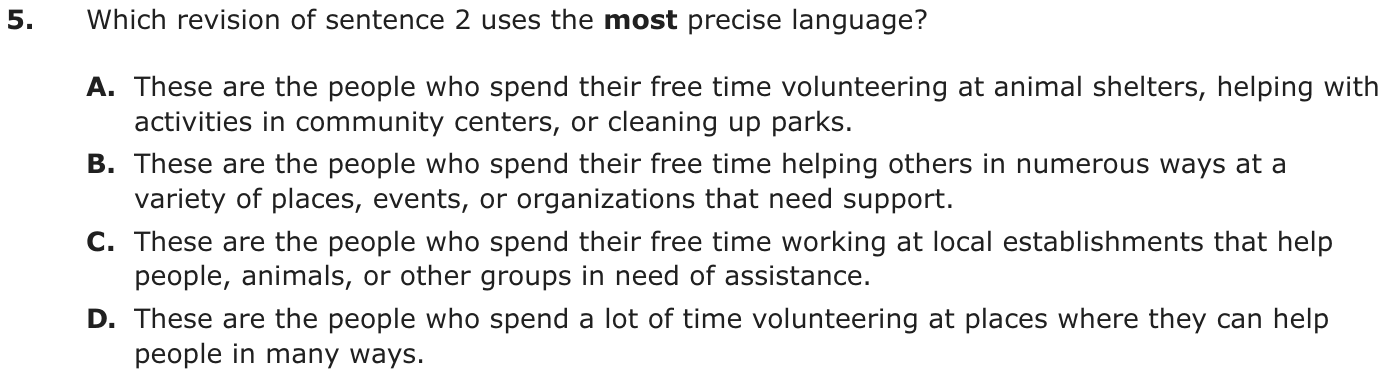
The passage “Find Time to Volunteer” as printed (page 163)
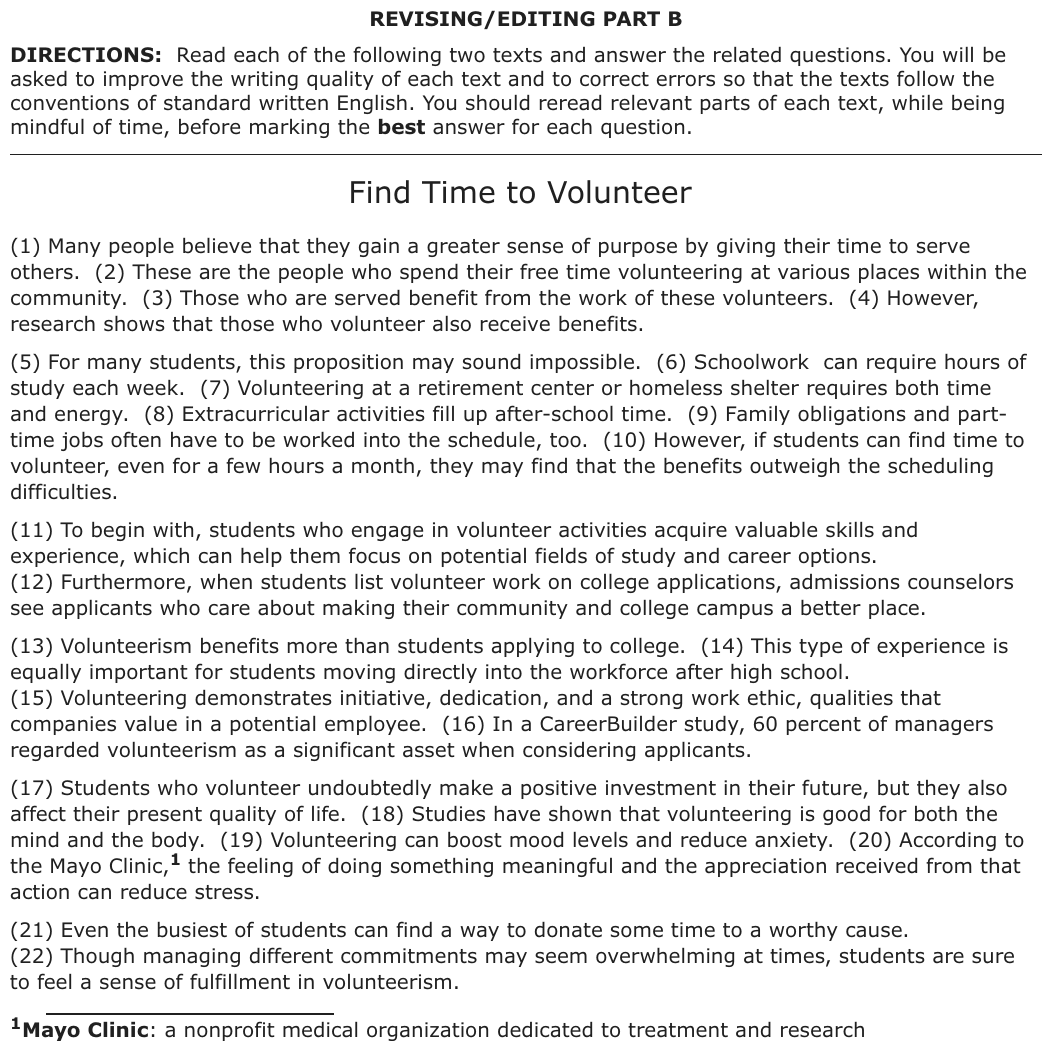
Question 117 of 120
2024 Test B English, question 6Uses the passage above: “Find Time to Volunteer”.
Question
Which sentence should follow sentence 4 to introduce the main claim of the passage?
- AWith that in mind, high school students should consider engaging in some form of regular volunteerism.
- BFortunately for students, these benefits are guaranteed to produce both immediate and long-term results.
- CIn fact, studies have confirmed that volunteerism can be beneficial for students, the family, and the community.
- DFor this reason, high school students should learn about how helping others can strengthen their communities.
Show the answer
Correct answer: A
The question asks which sentence should follow sentence 4 to introduce the main claim of the passage.
A. CORRECT. Sentence 4 states that “research shows that those who volunteer also receive benefits.” The sentence in the option logically follows the ideas in sentence 4 and provides the best thesis statement for the passage because it introduces the main claim that high school students should consider the benefits of volunteerism.
B. Incorrect. While the sentence refers to the “benefits” mentioned in sentence 4, it erroneously asserts that “immediate and long-term results” are “guaranteed.” In addition, the sentence does not introduce the main claim of the passage that volunteering is beneficial for high school students.
C. Incorrect. Although the sentence states that “volunteerism can be beneficial for students,” it introduces the idea that “the family, and the community” benefit as well, which is not part of the main argument. Therefore, this sentence should not follow sentence 4 to introduce the main claim of the passage.
D. Incorrect. Although the sentence introduces the claim that “high school students should learn about” volunteering, it focuses on the idea that volunteering strengthens the community, which is not the main claim. This sentence does not accurately introduce the claim that volunteering is beneficial for high school students and thus should not follow sentence 4.
Question analysis
This introduction question asks which sentence should come right after sentence 4 of the volunteering essay to state its main claim. Students must work out what the whole essay argues and match it to an opening line, while the choices mention benefits, studies and communities in ways that sound like a thesis.
- NYS standards
- 7W1a introducing claims and counterclaims
- Grade level
- Grade 7 reading and task
- Compared with grade 7
- At grade 7 Stating a precise claim is a core grade 7 argument skill. Students must sense the essay’s claim from all six paragraphs and test four openers that each sound like a thesis, typical of careful grade 7 revision.
- Estimated difficulty
- Moderate: several steps, or a close reading with one strong distractor.
- Thinking it demands
- Depth of knowledge 2, skills and concepts · mainly evaluate
- What makes it hard
- Evidence in several places moderate
- A very close wrong answer moderate
- How sentences fit together minor
- Evidence
- Answered from the whole text
- Reading level
- Passage: about grade 11, 354 words; question and choices: about grade 10, 76 words.
- Students, last 30 days
- Not enough answers yet to show (it takes 10).
Why it is hard, traps and wrong answers (shows the answer)
Why it is hard
Three of the four sentences sound like a thesis, and two contain “high school students should,” so tone decides nothing. Students go wrong when they choose a sentence that only repeats the research point of sentence 4, or one that urges a different action. The question rewards stating the essay’s claim first, that students should volunteer because it pays off for them, and then finding the sentence that says exactly that.
Evidence in several places moderate Working it out
The essay never states its claim in one sentence; it has to be pieced together from the benefits for college, work and health in paragraphs 3 to 5 and sentence 21’s “Even the busiest of students can find a way.” (Kirsch & Mosenthal, 1990; Gorin & Embretson, 2006)
A very close wrong answer moderate Choosing the answer
The right sentence and the one about strengthening communities both open with a linking phrase and “high school students should”; they part only on what students should do, volunteer or learn about communities. (Embretson & Wetzel, 1987; Gorin & Embretson, 2006; Ascalon et al., 2007)
How sentences fit together minor Working it out
The new sentence follows sentence 4’s “those who volunteer also receive benefits,” so it must turn that research point into what students should do about it. (Halliday & Hasan, 1976)
Strategy: Skim the body paragraphs and state in a few words what the essay wants its readers to believe. Then choose the sentence that says exactly that and follows naturally from sentence 4.
Traps
- Off the point: Adds or keeps something that does not support the paragraph's or the passage's focus, or an introduction or conclusion that misses the main point.
- Too broad or too strong: A choice overstates, generalizes, or uses absolute words the text does not support.
The wrong answers, classified
B Too broad or too strong (King et al., 2004)
Follows the word “benefits” from sentence 4 but overstates them as “guaranteed” and never says what students should do, so no claim is introduced.
C Off the point (Halliday & Hasan, 1976)
Likes the research-sounding “studies have confirmed,” but it restates sentence 4 as a fact rather than a claim and widens the benefits to families and the community.
D Off the point (Halliday & Hasan, 1976)
Sees the thesis-like “high school students should,” but it asks students to learn about strengthening communities, a point the essay never develops, instead of urging them to volunteer.
Working it out, step by step
Figure out what the question asks
You need a sentence to go right after sentence 4. It must introduce the main claim. A claim is the main point a writer wants you to believe or act on. In an essay like this, it is often a should statement. Example: Students should get more sleep. So first figure out what the whole essay argues.
Find the essay’s main claim
The essay keeps urging students to make time to help. Sentence 10 says “if students can find time to volunteer, even for a few hours a month, they may find that the benefits outweigh the scheduling difficulties.” Paragraphs 3 to 5 give benefits for college, jobs and health. Sentence 21 says “Even the busiest of students can find a way to donate some time to a worthy cause.” So the claim is: high school students should volunteer, because it helps them.
Use the clue in sentence 5
The new sentence will sit just before sentence 5. Sentence 5 says “For many students, this proposition may sound impossible.” A proposition is a suggestion. So the sentence before it must suggest something students could do. That points to a sentence telling students to volunteer.
Check each choice
- A says students “should consider engaging in some form of regular volunteerism.” That is the essay’s claim. “With that in mind” links it to the benefits in sentence 4.
- B says the benefits are “guaranteed.” That overstates them, and it never tells students to do anything.
- C just repeats that studies found benefits. It also adds families, which the essay never discusses.
- D tells students to “learn about” helping communities. The essay never argues for that.
Pick the answer
Watch out: D also says “high school students should,” so it sounds like a claim. But it asks them to learn, not to volunteer. Only one choice states what the essay argues. So the answer is A.
Why this answer and not the closest wrong one
D is the closest wrong answer, because it also tells high school students what they should do. But the essay never asks students to study how helping makes communities stronger. It argues that volunteering pays off for the students themselves. A says exactly that, and it sets up “this proposition” in sentence 5.
More questions like this
The original DOE question
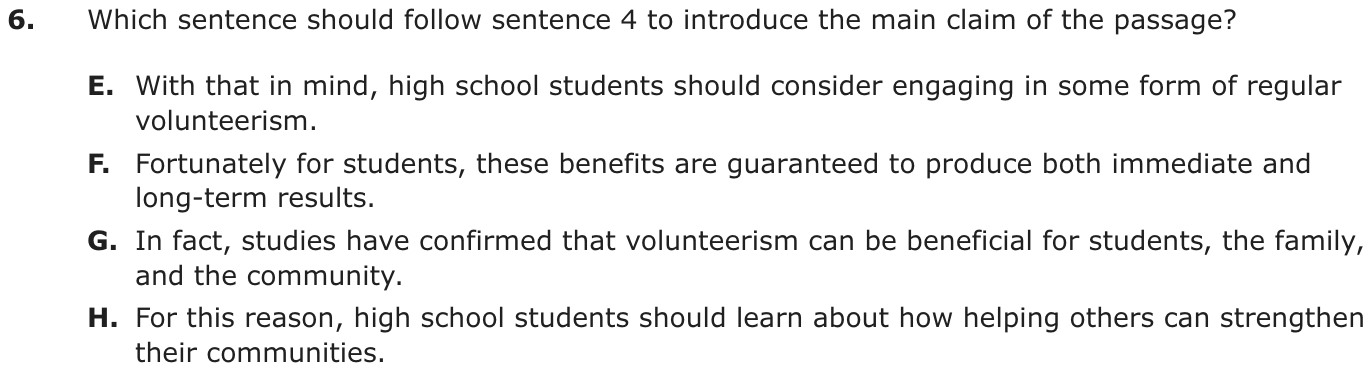
Question 118 of 120
2024 Test B English, question 7Uses the passage above: “Find Time to Volunteer”.
Question
Which sentence is least relevant to the ideas presented in the second paragraph (sentences 5–10) and should be deleted?
- Asentence 6
- Bsentence 7
- Csentence 8
- Dsentence 9
Show the answer
Correct answer: B
The question asks which sentence is least relevant to the ideas presented in the second paragraph (sentences 5–10) and should be deleted.
A. Incorrect. Sentence 5 introduces the topic of the second paragraph, which is that finding time to volunteer “may sound impossible” for many students. Sentence 6 logically follows this idea because it provides one reason why students might hesitate or be unable to volunteer. Therefore, sentence 6 is relevant to the ideas presented in the second paragraph and should not be deleted.
B. CORRECT. Sentence 7 states that “time and energy” are required for volunteering, which partially addresses the topic of the second paragraph about the various commitments that fill high school students’ schedules. However, sentence 7 interrupts the flow of the paragraph by interjecting specific examples (“volunteering at a retirement center or homeless shelter”) into a general list of activities and commitments. Thus, the sentence is the least relevant to the paragraph and should be deleted.
C. Incorrect. In the second paragraph, the author discusses why some high school students may hesitate to volunteer. In sentences 6 and 9, the author points out that “schoolwork” and “family obligations and part-time jobs” are activities that require students’ time and may cause them to hesitate taking on any additional activities. Sentence 8 contributes to this idea by stating that “extracurricular activities” also require a time commitment from students. As a result, sentence 8 contributes to the ideas in the second paragraph and should not be deleted.
D. Incorrect. In the second paragraph, the author acknowledges that some high school students may hesitate to volunteer because of “schoolwork” and “extracurricular activities.” Sentence 9 contributes to this idea by stating that “family obligations and part-time jobs” also require a time commitment and may cause students to hesitate to volunteer. Therefore, sentence 9 contributes to the ideas in the second paragraph and should not be deleted.
Question analysis
This revising question focuses on the second paragraph of the volunteering essay, which explains why students may think they have no time to help others. Students pick the one sentence that is least relevant and should be deleted. Since every sentence touches on how students spend their time, the challenge is seeing which one breaks the paragraph’s line of thought.
- NYS standards
- 7W1b supporting claims with evidence
- Grade level
- Grade 7 reading and task
- Compared with grade 7
- At grade 7 Spotting a sentence that does not belong is regular grade 7 revision work. The paragraph is short and plain, but every candidate is loosely tied to students’ busy lives, so students must pin down the paragraph’s exact point first.
- Estimated difficulty
- Moderate: several steps, or a close reading with one strong distractor.
- Thinking it demands
- Depth of knowledge 2, skills and concepts · mainly analyze
- What makes it hard
- How sentences fit together moderate
- Every choice must be checked minor
- Evidence
- Answered from one paragraph or stanza
- Reading level
- Passage: about grade 11, 354 words; question and choices: about grade 5, 22 words.
- Students, last 30 days
- Not enough answers yet to show (it takes 10).
Why it is hard, traps and wrong answers (shows the answer)
Why it is hard
The sentence to delete is the only one in the paragraph that mentions volunteering, so students who test each sentence against the essay’s topic keep it and cut one of the others. The paragraph’s point is narrower: sentence 5 says volunteering “may sound impossible” for many students, and sentences 6, 8 and 9 list what already fills their schedules. Sentence 7 is loosely related, which is why the stem asks for the least relevant sentence rather than an irrelevant one.
How sentences fit together moderate Working it out
Sentences 6, 8 and 9 list the commitments that already fill students’ time, schoolwork, activities, family and jobs, while sentence 7 turns to what volunteering itself demands and breaks that list. (Halliday & Hasan, 1976)
Every choice must be checked minor Choosing the answer
Every candidate touches on students’ busy lives, and sentence 7 is the only one that mentions volunteering, so each must be tested against the paragraph’s exact point rather than the essay’s topic. (Embretson & Wetzel, 1987)
Strategy: Say in a few words what sentences 5 and 10 tell you the paragraph is about. Then test each listed sentence: does it add to that point, or does it shift to a different one?
Traps
- Fixes what isn't broken: Changes a part of the sentence that was already correct, while the real error stays; or, where the question asks which sentence has an error or should go, picks one that is correct and belongs.
The wrong answers, classified
A Fixes what isn't broken (Connors & Lunsford, 1988)
Cuts sentence 6 because schoolwork says nothing about volunteering, judging by the essay’s topic word, though schoolwork is the first commitment on the paragraph’s list.
C Fixes what isn't broken (Connors & Lunsford, 1988)
Treats extracurricular activities as a separate subject, though sentence 8 adds another after-school demand to the list explaining why volunteering seems impossible.
D Fixes what isn't broken (Connors & Lunsford, 1988)
Senses that the paragraph lists school pressures and cuts family obligations and part-time jobs as outside school, missing that “too” adds them to the same list of demands.
Working it out, step by step
Figure out what the question asks
You need the sentence in paragraph 2 that fits least and should be cut. Every sentence in a paragraph should support its main point. Example: My dog loves the park. He chases balls. Cats sleep a lot. He rolls in the grass. The cat sentence doesn’t fit. So first find the paragraph’s point. Then test each listed sentence against it.
Find the paragraph’s main point
Sentence 5 says “For many students, this proposition may sound impossible.” The proposition is the idea of volunteering. Sentence 10 says the benefits may “outweigh the scheduling difficulties.” So the paragraph is about why students feel too busy. The sentences in between should list what already fills their time.
Test each listed sentence
- Sentence 6: “Schoolwork can require hours of study each week.” That is one thing that fills their time.
- Sentence 7: “Volunteering at a retirement center or homeless shelter requires both time and energy.” This is about volunteering itself. It names two places, and it breaks the list.
- Sentence 8: “Extracurricular activities fill up after-school time.” These are things like sports and clubs. That is another item on the list.
- Sentence 9: “Family obligations and part-time jobs” fill time “too.” The word too adds them to the same list.
Read the paragraph without it
Try reading sentences 6, 8 and 9 in a row. Schoolwork, activities, family and jobs make one smooth list of things that fill a student’s week. Then sentence 10 answers that worry. Nothing is missing when sentence 7 is gone. That shows it is the least relevant.
Pick the answer
Watch out: Sentence 9 can seem off topic, because family and jobs are outside school. That makes D tempting. But the paragraph is about everything that fills a student’s time. So the answer is B, sentence 7.
Why this answer and not the closest wrong one
Sentence 9 is the closest wrong answer, because family and jobs are not schoolwork. But its last word, “too,” adds them to the same list as schoolwork and activities. Sentence 7 is the only one about what volunteering takes, not what already fills the week. So B is the one to cut.
More questions like this
The original DOE question
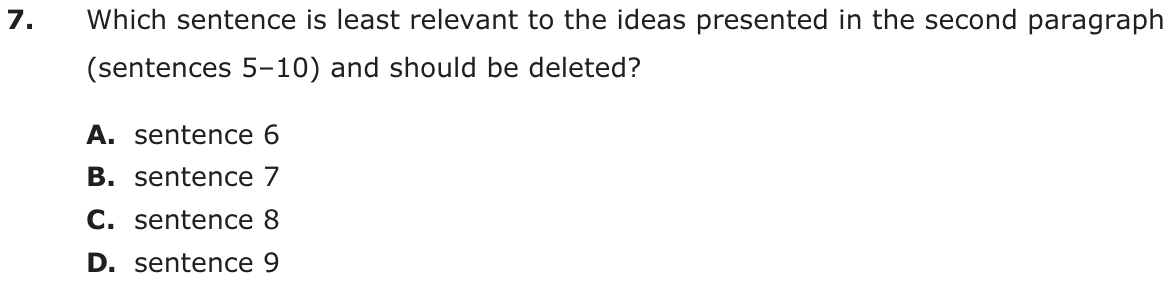
Question 119 of 120
2024 Test B English, question 8Uses the passage above: “Find Time to Volunteer”.
Question
Which of these would best follow sentence 12 and support the ideas presented in the third paragraph (sentences 11–12)?
- AThese students show that they are likely to be responsible, reliable, and helpful young adults. Admissions counselors know that character traits like these will benefit the applicants as well as whomever they interact with.
- BVolunteering can help students meet new people who can provide references and advice to the students when they are applying to colleges. It can also be an invaluable opportunity for students to meet possible future employers.
- CThe counselors hope that young adults who demonstrate this behavior will go on to volunteer during their college years, working on campus in student government and leadership programs or serving in the community at hospitals, schools, and homeless shelters.
- DMany colleges are looking for students who are not just academically successful but who also work well with others and care about improving and serving surrounding communities.
Show the answer
Correct answer: D
The question asks which option would best follow sentence 12 to support the ideas presented in the third paragraph (sentences 11–12).
A. Incorrect. The subject of the main clause in sentence 12 is “admissions counselors.” Although the second sentence in the option mentions “admissions counselors,” it does not support the ideas in the paragraph, because the statement that “admissions counselors know that character traits like these will benefit the applicants” focuses on how students benefit, while sentence 12 focuses on how these traits benefit the community.
B. Incorrect. While sentence 11 discusses the potential academic and professional connections that can be made through volunteering, sentence 12 moves on to the topic of college admissions. Since the sentences in the option revert back to the topic of connections, they do not support and logically follow a sentence about how college admissions counselors view students with volunteering experience.
C. Incorrect. Although the sentence in the option continues on the subject of admissions counselors and follows the idea in sentence 12 that these counselors tend to favor students who “care about making their community and college campus a better place,” the sentence focuses on what students will do while in college rather than on how volunteering helps them get into college. Therefore, the sentence does not best follow sentence 12 and support the ideas presented in the third paragraph.
D. CORRECT. In sentence 12, the author states that college admissions counselors view students who list volunteer work on admissions applications as “applicants who care about making their community and college campus a better place.” The sentence in the option best follows sentence 12 and supports the ideas in the third paragraph because it provides additional details about why admissions counselors look beyond academics when considering students for admissions and the positive qualities assigned to those who have volunteering experience.
Question analysis
This supporting-details question asks which addition would best follow the volunteering essay’s sentence about how college admissions counselors view applicants who list volunteer work. Every option mentions college and sounds reasonable on its own, so students must decide which one develops the paragraph’s point rather than drifting to a related idea.
- NYS standards
- 7W1b supporting claims with evidence
- Grade level
- Grade 8 reading and task
- Compared with grade 7
- Above grade 7 Grade 7 students choose evidence that supports a claim. Here the options are one or two full sentences, all of them about college, and the right fit depends on the precise idea in sentence 12, a finer judgment than usual.
- Estimated difficulty
- Hard: combines ideas, needs a plan, and has more than one tempting wrong answer.
- Thinking it demands
- Depth of knowledge 2, skills and concepts · mainly evaluate
- What makes it hard
- A very close wrong answer major
- How sentences fit together moderate
- A lot to read minor
- Evidence
- Answered from one paragraph or stanza
- Reading level
- Passage: about grade 11, 354 words; question and choices: about grade 13, 153 words.
- Students, last 30 days
- Not enough answers yet to show (it takes 10).
Why it is hard, traps and wrong answers (shows the answer)
Why it is hard
Every option stays on the subject of college, so the work is matching sentence 12’s exact idea: counselors see applicants who care about making their community a better place. The near miss also explains what counselors value, but it swaps caring for the community for a new set of traits and ends on what those traits do for the applicants. Students who restate sentence 12 before reading the options can hear that the right one simply widens it, from community service to what colleges want beyond grades.
A very close wrong answer major Choosing the answer
The right sentence and the two-sentence option about responsible, reliable, helpful students both explain why volunteers impress admissions; only the right one keeps sentence 12’s point, caring about improving communities. (Embretson & Wetzel, 1987; Gorin & Embretson, 2006; Ascalon et al., 2007)
How sentences fit together moderate Working it out
The new sentence must extend sentence 12’s specific idea, what admissions counselors see in volunteers, rather than return to sentence 11’s skills and careers or move on to college life. (Halliday & Hasan, 1976)
A lot to read minor Understanding the question
The options run 27 to 39 words, two of them two sentences long, and all four are about college, so topic alone rules none of them out. (Kintsch, 1998; Gorin & Embretson, 2006; Freedle & Kostin, 1993)
Strategy: Restate sentence 12 in your own words, then ask of each option whether it explains or extends that exact point about what admissions counselors value.
Traps
- Off the point: Adds or keeps something that does not support the paragraph's or the passage's focus, or an introduction or conclusion that misses the main point.
The wrong answers, classified
A Off the point (Halliday & Hasan, 1976)
Follows the admissions counselors from sentence 12 but replaces caring for the community with new traits, responsibility and reliability, and turns to how those traits help the applicants.
B Off the point (Halliday & Hasan, 1976)
Is drawn by “applying to colleges,” but networking for references and future employers is a new benefit that neither sentence 11 nor sentence 12 develops.
C Off the point (Halliday & Hasan, 1976)
Stays with the counselors and picks up “college campus” from sentence 12, but jumps ahead to what students might do in college instead of explaining admission decisions.
Working it out, step by step
Figure out what the question asks
You need the sentence that best follows sentence 12. A good next sentence adds to the same idea. It does not jump to a new point. Example: after Dogs make loyal pets, the sentence They stay by their owners’ side fits. Dogs come in many colors drifts away. So first put sentence 12 in your own words.
Restate sentence 12
Sentence 12 says that “when students list volunteer work on college applications, admissions counselors see applicants who care about making their community and college campus a better place.” Admissions counselors are the people who choose which students get into a college. So the idea is this: colleges like volunteers because volunteers care about their communities.
Check each choice
- D says colleges want students who are “not just academically successful.” That means more than good grades. They also want students who “care about improving and serving surrounding communities.” That explains sentence 12 and builds on it.
- A swaps in new traits: “responsible, reliable, and helpful.” Then it says those traits help the applicants and the people around them. It drops caring for the community.
- B brings in a new benefit: meeting people who can give advice or jobs. Neither sentence 11 nor sentence 12 talks about that.
- C jumps ahead to what students might do in college. It doesn’t explain how volunteering helps them get in.
Pick the answer
Watch out: A is the most tempting. It is about what counselors value, just like the right answer. But it changes the reason they value it. Only D keeps sentence 12’s idea of caring for the community. So the answer is D.
Why this answer and not the closest wrong one
A is the closest wrong answer. Like D, it explains why admissions counselors like volunteers. But A’s reasons are new ones, such as being responsible and reliable. D keeps sentence 12’s exact idea, caring about the community, and adds that colleges want more than good grades. So D supports the paragraph best.
More questions like this
The original DOE question
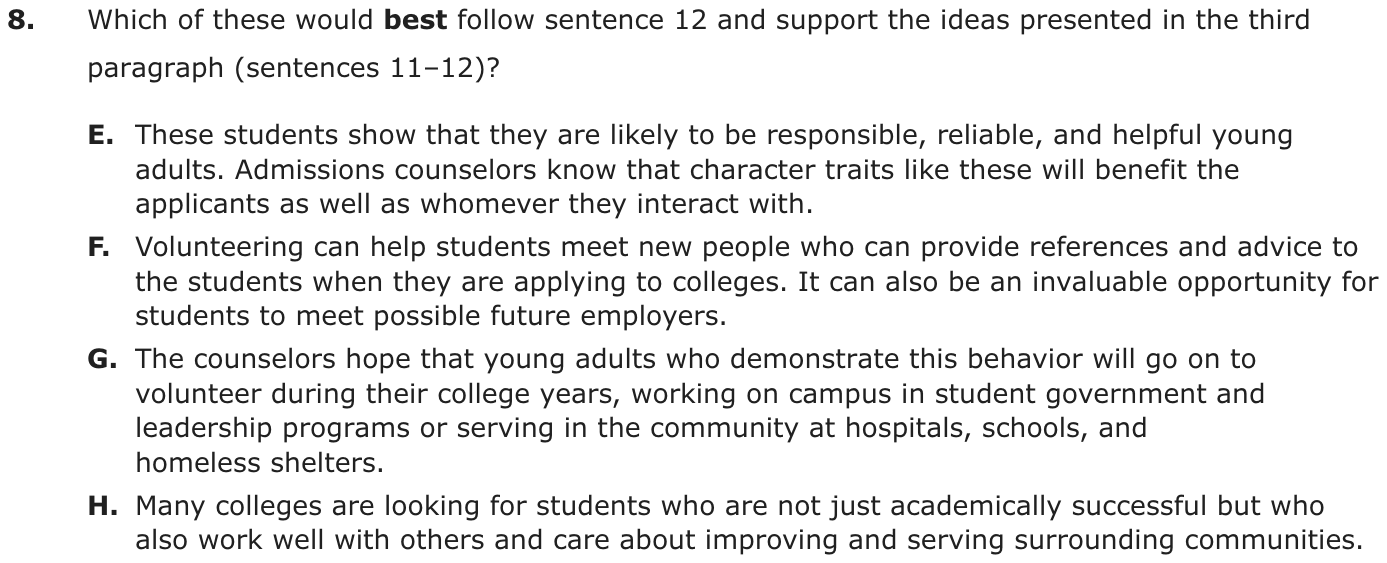
Question 120 of 120
2024 Test B English, question 9Uses the passage above: “Find Time to Volunteer”.
Question
Which concluding sentence should replace sentence 22 to provide the best support for the argument presented in the passage?
- AIn every city, there are homeless shelters, food pantries, youth centers, and political campaigns that depend on the support and commitment of hardworking young people.
- BClearly, students who volunteer will experience a host of benefits, such as learning new skills, meeting interesting people, opening up opportunities for the future, and gaining a sense of satisfaction.
- CWhen students carefully evaluate their activities and prioritize volunteerism, they find a way to work it into their schedule and are soon encouraging their peers to do the same.
- DWhether they are seeking admission to college, preparing to enter the workforce, or simply looking to reduce stress, high school students who volunteer can help themselves as much as they help others.
Show the answer
Correct answer: D
The question asks which concluding sentence should replace sentence 22 to provide the best support for the argument presented in the passage.
A. Incorrect. Although the sentence lists examples of organizations that depend on “hardworking young people” as volunteers, it should not replace sentence 22, because its use of specific examples does not provide a strong conclusion to the main idea in the passage, and it does not best support the main argument that students benefit themselves and their community when volunteering.
B. Incorrect. While the sentence supports the argument that students “will experience a host of benefits” through volunteerism, it should not replace sentence 22 as a concluding sentence, because it does not best support the main argument that volunteerism benefits both the students and their community.
C. Incorrect. Although the sentence emphasizes the importance of prioritizing volunteerism, it should not replace sentence 22, because it focuses on the main idea in the second paragraph (“For many students, this proposition may sound impossible.”), rather than the main argument that volunteerism benefits both students and their community. This sentence introduces the idea that student volunteers “are soon encouraging their peers” to volunteer, which does not best support the argument presented in the passage.
D. CORRECT. This sentence should replace sentence 22 to conclude the passage because it lists specific reasons for volunteering (“Whether they are seeking admission to college, preparing to enter the workforce, or simply looking to reduce stress”) and best supports the main argument that volunteering not only helps students but can also help their community (“high school students who volunteer can help themselves as much as they help others”).
Question analysis
This conclusion question asks which sentence should replace the last line of the essay urging high school students to volunteer. Students need a closing statement that best supports the argument as a whole. Several options list benefits or name real places to volunteer, so the challenge is telling an ending that fits the whole essay from one that drifts.
- NYS standards
- 7W1e concluding an argument
- Grade level
- Grade 7 reading and task
- Compared with grade 7
- At grade 7 Writing a conclusion that sums up an argument is a grade 7 standard. Students recognize one rather than write it, but they must keep the essay’s several reasons in mind while judging four endings that all sound final.
- Estimated difficulty
- Moderate: several steps, or a close reading with one strong distractor.
- Thinking it demands
- Depth of knowledge 2, skills and concepts · mainly evaluate
- What makes it hard
- Evidence in several places moderate
- A very close wrong answer moderate
- Evidence
- Answered from the whole text
- Reading level
- Passage: about grade 11, 354 words; question and choices: about grade 15, 134 words.
- Students, last 30 days
- Not enough answers yet to show (it takes 10).
Why it is hard, traps and wrong answers (shows the answer)
Why it is hard
All four endings sound final, and the strongest wrong one is a fair-sounding list of benefits that opens with “Clearly.” The right ending wins on fit: its three reasons are the essay’s own, college, work and stress, and it keeps the opening idea that volunteers help others as well as themselves. Students who sketch the essay’s reasons paragraph by paragraph before reading the endings can see which one gathers them and which adds a point of its own.
Evidence in several places moderate Working it out
The reasons a conclusion must gather sit in three body paragraphs, college admission in paragraph 3, the workforce in paragraph 4 and stress in paragraph 5, well before sentence 22. (Kirsch & Mosenthal, 1990; Gorin & Embretson, 2006)
A very close wrong answer moderate Choosing the answer
The right ending and the “host of benefits” ending both list what volunteers gain; they part on whether the list matches the essay’s own reasons and keeps the help volunteers give others. (Embretson & Wetzel, 1987; Gorin & Embretson, 2006; Ascalon et al., 2007)
Strategy: List the essay’s reasons for volunteering, one phrase per paragraph, then pick the ending that pulls them together without bringing in a new point.
Traps
- Too narrow: A single detail offered as the central idea or a summary, or a summary that keeps minor details and leaves out an essential part.
- Off the point: Adds or keeps something that does not support the paragraph's or the passage's focus, or an introduction or conclusion that misses the main point.
The wrong answers, classified
A Off the point (Halliday & Hasan, 1976)
Likes the concrete list of shelters, pantries and campaigns, but naming groups that need young volunteers sums up none of the essay’s reasons for volunteering.
B Too narrow (King et al., 2004)
Sums up only what students gain, adding “meeting interesting people,” which the essay never mentions, and drops the point that volunteers help others too.
C Off the point (Halliday & Hasan, 1976)
Carries on sentence 21’s point that busy students can find time, then adds students recruiting their peers, so it ends on scheduling instead of the reasons to volunteer.
Working it out, step by step
Figure out what the question asks
You need a new last sentence for the essay. A good conclusion sums up the argument. It pulls the main reasons together without adding a new idea. Example: an essay on biking to school might end, Biking keeps you fit, saves money and helps clean the air. So first list this essay’s reasons.
List the essay’s reasons
- Paragraph 1: volunteers help others, and “those who volunteer also receive benefits” (sentence 4).
- Paragraph 3: volunteering helps with college applications.
- Paragraph 4: it helps students “moving directly into the workforce,” which means starting a job.
- Paragraph 5: it helps the mind and body, and it “can reduce stress.”
So a good ending names college, work and stress. It also keeps the idea that volunteers help both others and themselves.
Check each choice
- D names all three: “seeking admission to college, preparing to enter the workforce, or simply looking to reduce stress.” It ends with students who “help themselves as much as they help others.” That matches the essay.
- B lists benefits, but it adds “meeting interesting people.” The essay never says that. It also leaves out helping others.
- A lists places that need volunteers. It sums up none of the essay’s reasons.
- C is about fitting volunteering into a schedule and getting friends to join. Getting friends to join is a new idea.
Pick the answer
Watch out: B starts with “Clearly” and lists good things, so it sounds like an ending. But its list is not the essay’s list. So the answer is D.
Why this answer and not the closest wrong one
B is the closest wrong answer, because it also sums up what volunteers gain. But it adds a benefit the essay never discusses, and it drops the help volunteers give others. D gathers the essay’s own reasons, college, work and stress, and keeps both sides of the essay’s idea.
More questions like this
The original DOE question