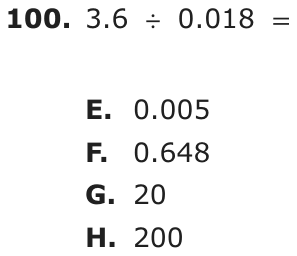
Question
- A0.005
- B0.648
- C20
- D200
Show the answer
Correct answer: D
Question analysis
This decimal division question asks for 3.6 divided by 0.018, with no context. Students rewrite the division so the divisor is a whole number and then divide. Because the divisor has three decimal places, moving the decimal point the right number of places in both numbers is where students go wrong.
- NYS standards
- 6.NS.3 multi-digit decimal operations
- Grade level
- Grade 6 content, by NYS standard
- Compared with grade 7
- Below grade 7 Dividing multi-digit decimals is a grade 6 fluency standard, and this is a single division with no context. It is easier than typical grade 7 work, though shifting three decimal places invites a place-value slip.
- Estimated difficulty
- Straightforward: two steps or one careful reading.
- Thinking it demands
- Depth of knowledge 1, recall and reproduction · mainly apply
- What makes it hard
- Error-prone arithmetic moderate
- Solution
- 2 steps
- Reading level
- Question and choices: about grade 16+, 1 words.
- Students, last 30 days
- Not enough answers yet to show (it takes 10).
Why it is hard, traps and wrong answers (shows the answer)
Why it is hard
This is a single division, and the only real hazard is the decimal point. Shifting it three places in the divisor but only two in the dividend gives a listed answer ten times too small. An estimate settles it: 0.018 is about 0.02, and 3.6 ÷ 0.02 = 180, so the answer must be in the hundreds.
Error-prone arithmetic moderate Working it out
The divisor 0.018 has three decimal places, so both numbers must be multiplied by 1,000, turning 3.6 into 3,600, not 360, before dividing by 18. (Brown & Burton, 1978; Junker & Sijtsma, 2001)
Strategy: Multiply both numbers by 1,000 so the divisor becomes a whole number, then divide; estimate first by asking roughly how many 0.02s fit into 3.6.
Traps
- An arithmetic slip: The right method with a plausible arithmetic error: a digit, a place value or a times-table fact.
- Wrong operation: Adds instead of multiplying, divides the wrong way round, turns a ratio or rate upside down, or undoes a step in the wrong direction (subtracts what should be added back).
The wrong answers, classified
A Wrong operation (Hegarty, Mayer & Monk, 1995; King et al., 2004)
Divides the wrong way round, 0.018 ÷ 3.6 = 0.005, putting the smaller number on top as if division always shrinks.
B Wrong operation (Hegarty, Mayer & Monk, 1995; King et al., 2004)
Multiplies instead of dividing, 36 × 18 = 648, and misplaces the decimal point too, since 3.6 × 0.018 is really 0.0648.
C An arithmetic slip (Junker & Sijtsma, 2001)
Moves the decimal point two places instead of three, dividing 360 by 18 to get 20, a result ten times too small.
Worked solution, step by step
Formulas used
- Scaling a division
- a is the number being divided, and b is the number you divide by. n is any number except 0. Multiplying both numbers by the same n keeps the answer the same, just like an equal fraction. Use it to turn a decimal you divide by into a whole number.
Sort out the problem
You need . The number you divide by, 0.018, has three decimal places. That means three digits after the decimal point. Dividing by a decimal is hard, so first turn 0.018 into a whole number.
Multiply both numbers by 1,000
Multiplying by 1,000 moves the decimal point 3 places to the right. Do it to both numbers, so the answer does not change.
Watch out: 3.6 has only one decimal place, so fill in zeros: 3.6 becomes 3,600. Moving its point only two places gives , choice C.Divide the whole numbers
This works because , so . Watch out: divide 3.6 by 0.018, not the other way around. Dividing 0.018 by 3.6 gives 0.005, choice A.
So the answer is D, 200.
Check your answer
Multiply back: . Also estimate. 0.018 is close to 0.02, and . The answer should be near that, and 200 is. Dividing by a number less than 1 gives a bigger answer, so 200 makes sense.
More questions like this
The original DOE question