Question
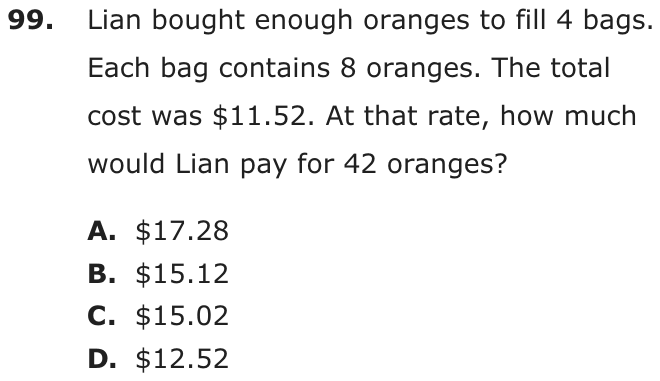
Lian bought enough oranges to fill 4 bags. Each bag contains 8 oranges. The total cost was $11.52. At that rate, how much would Lian pay for 42 oranges?
- A$17.28
- B$15.12
- C$15.02
- D$12.52
Show the answer
Correct answer: B
First, find the amount, in dollars, that Lian paid for each orange. There are 4 bags with 8 oranges each.
Divide the total cost by the total number of oranges to get the cost per orange:
Multiply to find the cost of 42 oranges:
Question analysis
This rate word problem says Lian paid $11.52 for 4 bags of 8 oranges each and asks how much 42 oranges would cost at the same rate. Students find the price of one orange and multiply. Since 42 oranges is not a whole number of bags, working by the bag instead of by the orange invites mistakes.
- Grade level
- Grade 6 content, by NYS standard
- Compared with grade 7
- Below grade 7 Finding a unit price and scaling it up is grade 6 rate work. The decimals are multi-digit, but the plan is routine, with less to manage than grade 7 problems built on percents or negative numbers.
- Estimated difficulty
- Straightforward: two steps or one careful reading.
- Thinking it demands
- Depth of knowledge 2, skills and concepts · mainly apply
- What makes it hard
- Error-prone arithmetic moderate
- A very close wrong answer minor
- Solution
- 3 steps
- Reading level
- Question and choices: about grade 2, 25 words.
- Students, last 30 days
- Not enough answers yet to show (it takes 10).
Why it is hard, traps and wrong answers (shows the answer)
Why it is hard
The plan is familiar, total oranges, price per orange, then the new cost, so the work lies in the decimals. Because 42 oranges is five bags and two oranges, students who price by the bag either round up to six bags or must handle the leftover. Estimating, since 42 is about a third more than 32, gives roughly $15 and rules out the far choices but not the near one.
Error-prone arithmetic moderate Working it out
Two decimal operations are done by hand: 11.52 ÷ 32 = 0.36 for one orange, then 0.36 × 42 = 15.12, where a dropped carry is easy. (Brown & Burton, 1978; Junker & Sijtsma, 2001)
A very close wrong answer minor Choosing the answer
The choices $15.12 and $15.02 differ by 10 cents, so a rough estimate of about $15 cannot choose between them; only the exact product can. (Embretson & Wetzel, 1987; Gorin & Embretson, 2006; Ascalon et al., 2007)
Strategy: Multiply to find how many oranges were bought, divide the total cost by that number to get the price of one orange, then multiply by 42.
Traps
- Misreads the question: Misses or misreads a condition or a word in the question: "at least", "each", "remaining", "not".
- An arithmetic slip: The right method with a plausible arithmetic error: a digit, a place value or a times-table fact.
The wrong answers, classified
A Misreads the question (Hegarty, Mayer & Monk, 1995)
Prices whole bags, rounding 42 oranges up to 6 bags of 8, and pays 6 × $2.88 = $17.28, missing that "at that rate" means per orange.
C An arithmetic slip (Junker & Sijtsma, 2001)
Uses the right method but slips one digit in multiplying 0.36 by 42, a tens-place error that lands 10 cents short of the total.
D Little reason to choose it (Haladyna & Downing, 1993; Rodriguez, 2005)
No common working gives $12.52, exactly one dollar more than $11.52; no price per orange or per bag leads there, so it mostly draws guesses.
Worked solution, step by step
Formulas used
- Unit price
- The unit price is what one item costs. Divide the total cost by how many items you got. It works because the total is shared equally among the items.
- Cost
- The unit price is the cost of one item, here one orange. Multiply it by how many items you buy to get the total cost. This works when every item costs the same.
Sort out the question
Lian bought 4 bags with 8 oranges in each bag. She paid $11.52 in all. You need the cost of 42 oranges. “At that rate” means each orange costs the same as before. So find the price of one orange first.
Count the oranges
Each of the 4 bags holds 8 oranges, so multiply to find how many she bought.
Lian bought 32 oranges for $11.52.
Find the price of one orange
This is easier in cents: . So one orange costs $0.36, or 36 cents.
Find the cost of 42 oranges
Break 42 into 40 and 2 to make it easier.
The 42 oranges cost $15.12.
Avoid the traps and answer
Watch out: $15.02, choice C, is only 10 cents away. Multiply and add with care. Watch out: Lian pays for each orange, not for full bags. Buying 6 whole bags would cost $17.28, choice A.So the answer is B, $15.12.
Check your answer
42 oranges is 10 more than 32. Those 10 oranges cost $3.60, since . Then . Same answer, so $15.12 is right.
More questions like this
The original DOE question