Question
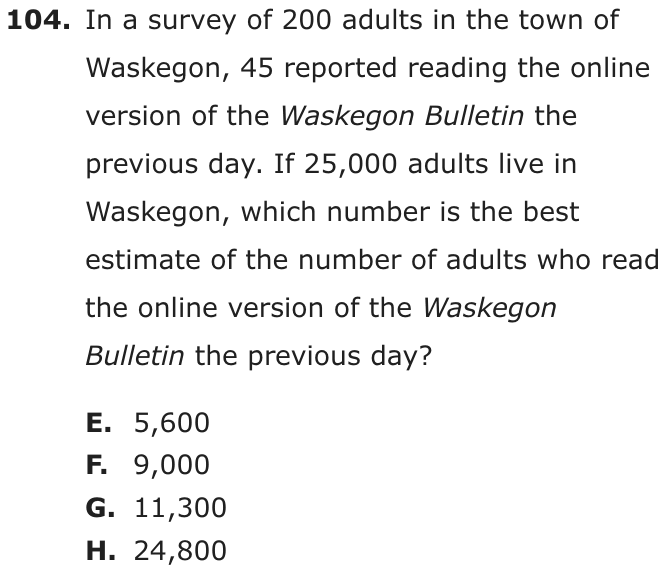
In a survey of 200 adults in the town of Waskegon, 45 reported reading the online version of the Waskegon Bulletin the previous day. If 25,000 adults live in Waskegon, which number is the best estimate of the number of adults who read the online version of the Waskegon Bulletin the previous day?
- A5,600
- B9,000
- C11,300
- D24,800
Show the answer
Correct answer: A
In the survey, 45 out of 200 adults reported reading the online version of the Waskegon Bulletin, and there are 25,000 adults living in Waskegon. Set up a proportion to find the number of adults who read the online version.
Rounded to the nearest 100, this number is 5,600.
Question analysis
In a survey of 200 adults in Waskegon, 45 said they read the online Waskegon Bulletin the day before, and the town has 25,000 adults. This sampling question asks for the best estimate of how many adults in town read it. Students scale the sample's rate up to the population with a proportion and round.
- Grade level
- Grade 6 content, by NYS standard
- Compared with grade 7
- At grade 7 Using a sample to estimate a count for a whole population is typical grade 7 statistics and ratio work. This version takes one proportion with large numbers and a rounding step, about the usual grade 7 demand.
- Estimated difficulty
- Straightforward: two steps or one careful reading.
- Thinking it demands
- Depth of knowledge 2, skills and concepts · mainly apply
- What makes it hard
- Turning words into math minor
- Error-prone arithmetic minor
- Solution
- 3 steps
- Reading level
- Question and choices: about grade 13, 50 words.
- Students, last 30 days
- Not enough answers yet to show (it takes 10).
Why it is hard, traps and wrong answers (shows the answer)
Why it is hard
The idea is a single proportion, and the choices are far apart, so a reasonable estimate is enough. The main trap is treating 45 out of 200 as 45 percent, which doubles the estimate; the other wrong choices combine the survey numbers without a proportion. Noting that 45 is a bit under a quarter of 200, so the town figure must be a bit under a quarter of 25,000, confirms the choice.
Turning words into math minor Understanding the question
The survey's 45 out of 200 is a rate to scale up to the town's 25,000 adults, a fraction of the sample rather than a percent. (Hegarty, Mayer & Monk, 1995; Koedinger & Nathan, 2004)
Error-prone arithmetic minor Working it out
The scale factor 25,000 ÷ 200 = 125 and the product 45 × 125 = 5,625 involve large numbers, and the result must then be rounded to the nearest hundred. (Brown & Burton, 1978; Junker & Sijtsma, 2001)
Strategy: Set the survey's fraction, 45 out of 200, equal to the unknown number out of 25,000, then scale up: 25,000 is 125 times 200.
Traps
- Numbers taken from the question: Combines the numbers in the question without a model of the situation, or is simply a number that appears in the question.
- Misunderstands the concept: A wrong belief about a concept: that percents can be added, that area grows like length, that averages can be averaged, that a bigger denominator means a bigger fraction.
The wrong answers, classified
B Numbers taken from the question (Hegarty, Mayer & Monk, 1995)
Multiplies the two survey numbers, 45 × 200 = 9,000, combining numbers from the question without setting up a proportion.
C Misunderstands the concept (Smith, diSessa & Roschelle, 1993; De Bock et al., 1998; Ni & Zhou, 2005)
Treats 45 out of 200 as 45 percent, as if 100 adults were surveyed: 0.45 × 25,000 = 11,250, about 11,300.
D Numbers taken from the question (Hegarty, Mayer & Monk, 1995)
Subtracts the 200 surveyed adults from the 25,000 in town, giving the number of adults who were not surveyed.
Worked solution, step by step
Formulas used
- Proportion
- A proportion says two ratios are equal. A ratio compares two numbers by dividing. Here a out of b in the survey matches c out of d in the whole town. Use it when a small group stands for a bigger group.
Sort out the question
A survey asked 200 adults, and 45 of them read the online paper. The town has 25,000 adults. You need a good estimate of how many adults in the whole town read it. Assume the town is like the survey. Then the same fraction of adults read it.
Set up a proportion
A proportion says two fractions are equal. Let x be the number of readers in the town. The fraction of readers is the same in both groups.
Watch out: multiplying 45 by 200 gives 9,000, choice B. That mixes the numbers without a plan.Find the scale factor
The scale factor is how many times bigger the town is than the survey group.
The town is 125 times as big. So multiply the top, 45, by 125 too.
Scale up the readers
Break 125 into 100 and 25.
About 5,625 adults read it. Watch out: 45 out of 200 is not 45%. A percent is out of 100. Using 45% gives about 11,300, choice C.
Round to the nearest hundred
The choices are rounded, since this is an estimate. 5,625 is between 5,600 and 5,700. Its last two digits, 25, are less than 50, so round down to 5,600.
So the answer is A, 5,600.
Check your answer
45 out of 200 is a bit less than 50 out of 200, which is one fourth. One fourth of 25,000 is 6,250. So the answer should be a bit less than 6,250. 5,600 fits, and the other choices are all much bigger.
More questions like this
The original DOE question