Question
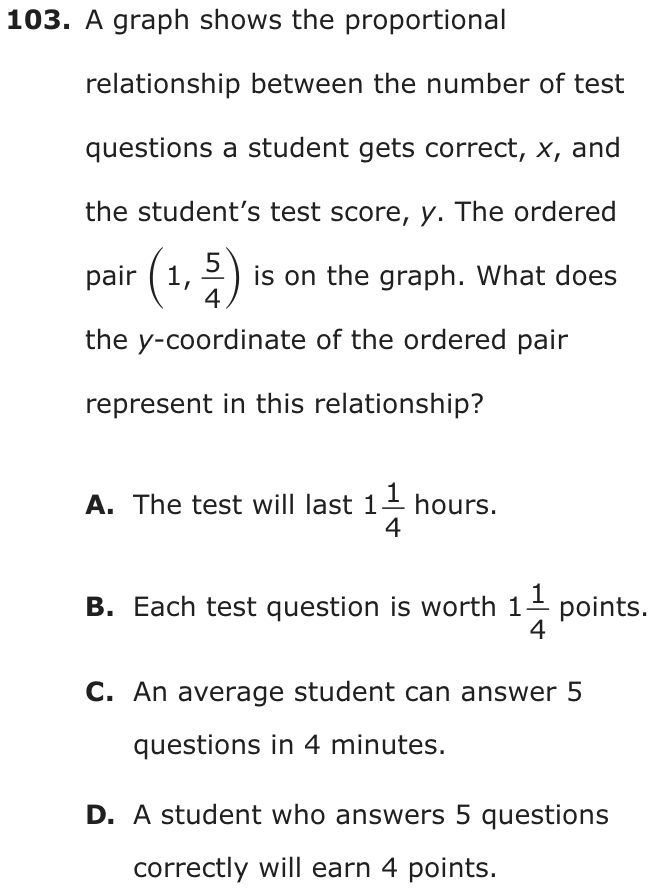
A graph shows the proportional relationship between the number of test questions a student gets correct, x, and the student’s test score, y. The ordered pair is on the graph. What does the y-coordinate of the ordered pair represent in this relationship?
- AThe test will last hours.
- BEach test question is worth points.
- CAn average student can answer 5 questions in 4 minutes.
- DA student who answers 5 questions correctly will earn 4 points.
Show the answer
Correct answer: B
The graph represents a proportional relationship, which means the y-intercept of the graph is (0, 0).
This means that the point represents the unit rate for this situation.
In this situation, x represents the number of questions answered correctly, and y represents the number of points received.
Therefore, for each question answered correctly, the student receives , or , points.
Question analysis
A proportional relationship links the number of test questions a student gets right, x, to the test score, y, and the point (1, 5/4) lies on its graph. Students decide what the y-coordinate of that point means in the situation. The choices reuse the numbers 5, 4 and 1 1/4 in different ways, so the meaning of each coordinate must be kept straight.
- Grade level
- Grade 7 content, by NYS standard
- Compared with grade 7
- At grade 7 Explaining what a point on the graph of a proportional relationship means is named in the grade 7 standards. This item is a direct case, with the graph described in words rather than drawn and only one point to interpret.
- Estimated difficulty
- Straightforward: two steps or one careful reading.
- Thinking it demands
- Depth of knowledge 2, skills and concepts · mainly understand
- What makes it hard
- Solution
- 2 steps
- Reading level
- Question and choices: about grade 7, 73 words.
- Students, last 30 days
- Not enough answers yet to show (it takes 10).
Why it is hard, traps and wrong answers (shows the answer)
Why it is hard
The question checks one idea: when x is 1, the y-coordinate is the score for one correct answer, the unit rate. The pitfall is reading 5/4 as two separate numbers, 5 and 4, and attaching them to questions and points the wrong way round. Ruling out the choices about hours and minutes is quick, since the relationship never mentions time.
Variables instead of numbers minor Understanding the question
No graph is drawn: the relationship and the point (1, 5/4) exist only in words, so students must say for themselves that x counts correct answers and y counts points. (Koedinger & Nathan, 2004; Enright, Morley & Sheehan, 2002)
An answer in an unexpected form minor Choosing the answer
The point gives 5/4, but two choices write it as 1 1/4 and two split it into 5 and 4, so the right reading must be recognized in another form. (Enright, Morley & Sheehan, 2002)
Strategy: Say in words what x and y stand for, then read the ordered pair as a sentence: when x has the first value, y has the second.
Traps
- Wrong operation: Adds instead of multiplying, divides the wrong way round, turns a ratio or rate upside down, or undoes a step in the wrong direction (subtracts what should be added back).
- Numbers taken from the question: Combines the numbers in the question without a model of the situation, or is simply a number that appears in the question.
The wrong answers, classified
A Numbers taken from the question (Hegarty, Mayer & Monk, 1995)
Attaches 1 1/4 to hours of testing, matching the number while ignoring that y measures the test score, not time.
C Numbers taken from the question (Hegarty, Mayer & Monk, 1995)
Reads 5/4 as 5 questions in 4 minutes, using the numbers 5 and 4 with units that the relationship never measures.
D Wrong operation (Hegarty, Mayer & Monk, 1995; King et al., 2004)
Reads 5/4 as 5 correct answers for 4 points, turning the rate upside down; the point means 1 correct answer earns 5/4 points.
Worked solution, step by step
Formulas used
- Proportional relationship
- x and y are two amounts that change together, here right answers and the test score. k is the constant of proportionality: how much y goes with 1 of x. In a proportional relationship, y is always the same number times x. So when x is 1, y equals k.
Sort out the question
x is the number of questions a student gets right. y is the student’s test score, in points. An ordered pair such as lists x first and y second. The y-coordinate is the second number, . You need what that number means.
Read the point as a sentence
In the point, x is 1 and y is . Put those into words: a student who gets 1 question right scores points.
Use the proportional rule
The relationship is proportional. So the score is always the same number times the questions right.
So k is . Every right answer adds the same points. That makes the points for each question.
Write it as a mixed number
A mixed number is a whole number plus a fraction. Four quarters make 1 whole, so five quarters are 1 whole and 1 quarter.
Each question right is worth points.
Match the choices
Choice B says each question is worth points. That matches. Watch out: choice D splits into 5 and 4. But 5 right answers earn points, not 4. Choices A and C talk about time, which this relationship does not measure.
So the answer is B, each test question is worth points.
Check your answer
Try another point. A student with 4 right answers scores points. That fits B, since four questions at points each make 5 points. It does not fit D, which says 5 questions earn 4 points.
More questions like this
The original DOE question