Also in 2025 Practice Test B English, question 29.
Passage At Dusk
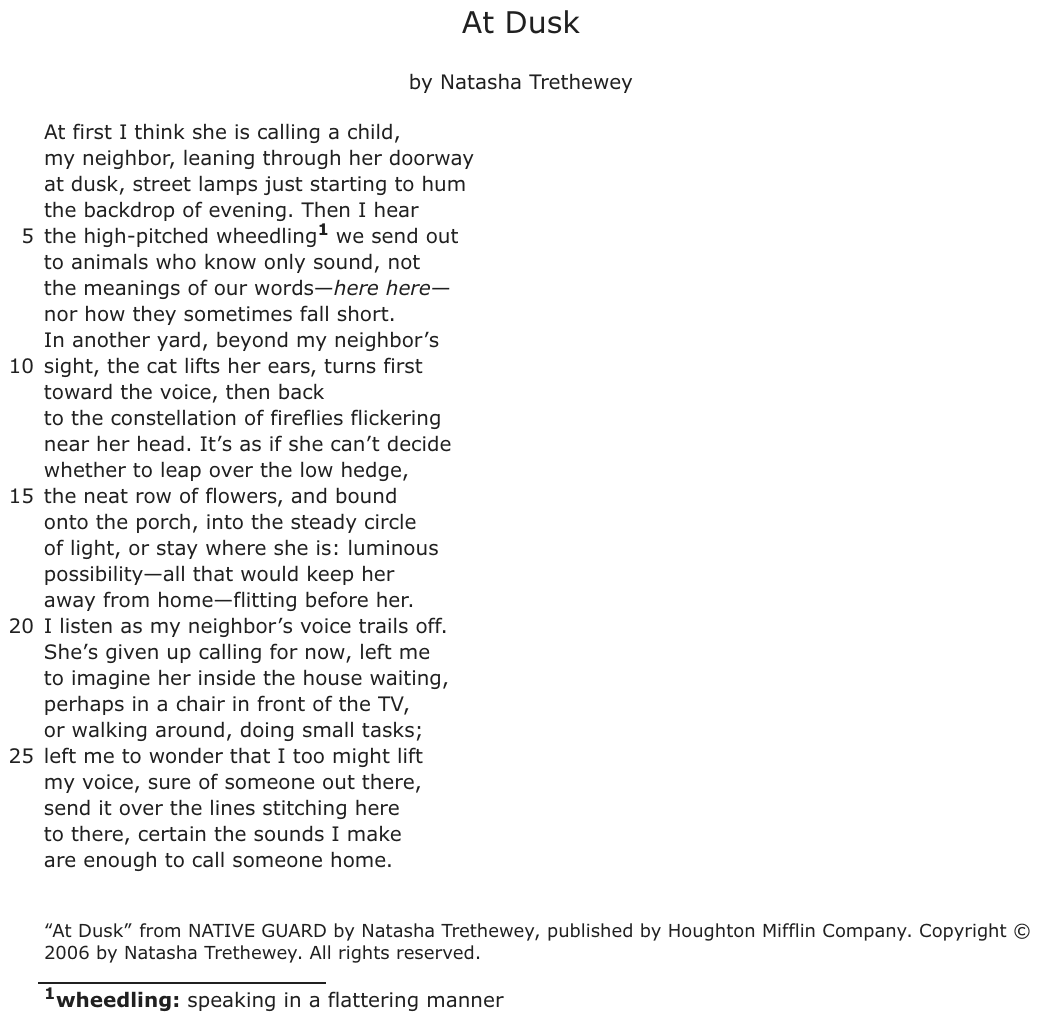
At Dusk
by Natasha Trethewey
At first I think she is calling a child,
my neighbor, leaning through her doorway
at dusk, street lamps just starting to hum
the backdrop of evening. Then I hear
the high-pitched wheedling1 we send out
to animals who know only sound, not
the meanings of our words—here here—
nor how they sometimes fall short.
In another yard, beyond my neighbor’s
sight, the cat lifts her ears, turns first
toward the voice, then back
to the constellation of fireflies flickering
near her head. It’s as if she can’t decide
whether to leap over the low hedge,
the neat row of flowers, and bound
onto the porch, into the steady circle
of light, or stay where she is: luminous
possibility—all that would keep her
away from home—flitting before her.
I listen as my neighbor’s voice trails off.
She’s given up calling for now, left me
to imagine her inside the house waiting,
perhaps in a chair in front of the TV,
or walking around, doing small tasks;
left me to wonder that I too might lift
my voice, sure of someone out there,
send it over the lines stitching here
to there, certain the sounds I make
are enough to call someone home.
“At Dusk” from NATIVE GUARD by Natasha Trethewey, published by Houghton Mifflin Company. Copyright © 2006 by Natasha Trethewey. All rights reserved.
1wheedling: speaking in a flattering manner
Question
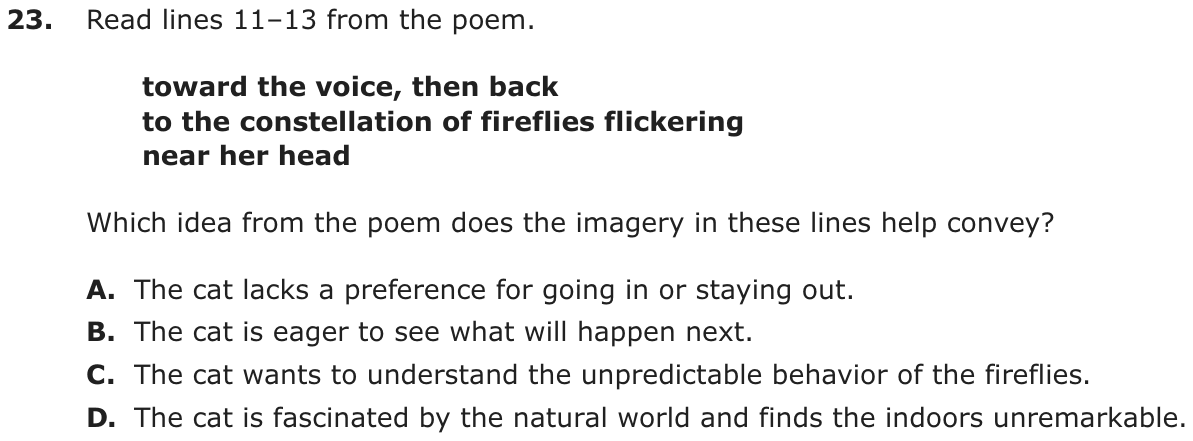
Read lines 11–13 from the poem.
toward the voice, then back
to the constellation of fireflies flickering
near her head
Which idea from the poem does the imagery in these lines help convey?
- AThe cat lacks a preference for going in or staying out.
- BThe cat is eager to see what will happen next.
- CThe cat wants to understand the unpredictable behavior of the fireflies.
- DThe cat is fascinated by the natural world and finds the indoors unremarkable.
Show the answer
Correct answer: D
The question asks which idea the imagery in lines 11–13 helps convey.
A. Incorrect. Line 13 includes the speaker’s observation that the cat seems “as if she can’t decide” whether to stay outside or go to the neighbor. However, the imagery of the “constellation of fireflies flickering” in line 12 suggests that the cat does have a preference for exploring the more exciting “luminous / possibility” (lines 17–18) of the outdoors.
B. Incorrect. The imagery in lines 10–11 of the cat turning “first / toward the voice, then back” might seem to suggest that the cat is eagerly watching both the neighbor and the fireflies to see what will happen next. However, line 13, in which the cat seems “as if she can’t decide,” indicates that what will happen next is actually under the cat’s control.
C. Incorrect. The imagery in lines 12–13 of the “fireflies flickering / near her head” does indicate the fireflies’ unpredictable behavior. However, the imagery in lines 10–11 of the cat turning “first / toward the voice, then back” establishes that the cat’s attention is split between the fireflies and the “high-pitched wheedling” (line 5) of the neighbor’s voice, rather than being fully captured by wanting to understand the fireflies.
D. CORRECT. The imagery in line 12 of “the constellation of fireflies flickering” suggests that the outdoors holds fascinating attractions, an idea supported by the description in lines 17–18 of the cat’s current location outdoors as one filled with “luminous / possibility.” The imagery in lines 10–11 of the cat turning “first / toward the voice, then back” indicates that the cat has considered but rejected the option of returning indoors, and the description in lines 16–17 of the indoors as offering only a “steady circle / of light” suggests that the indoors seems unremarkable to the cat in comparison to the outdoors.
Question analysis
This reading question quotes three lines from At Dusk in which a cat turns from a calling voice back to fireflies flickering near her head, and asks which idea the imagery helps convey. Students must interpret a visual image in light of the lines around it and judge how far the poem supports each reading of the cat's attention.
- Grade level
- Grade 8 reading and task
- Compared with grade 7
- Above grade 7 Grade 7 students explain what imagery conveys, but this image is brief and the four ideas offered for it differ in subtle ways, so ruling them out takes closer reading than typical grade 7 work.
- Estimated difficulty
- Hard: combines ideas, needs a plan, and has more than one tempting wrong answer.
- Thinking it demands
- Depth of knowledge 3, strategic thinking · mainly analyze
- What makes it hard
- Reading between the lines major
- Figurative or literary language moderate
- Evidence in several places minor
- Evidence
- Answered from one paragraph or stanza
- Reading level
- Passage: 236 words (a poem; reading level not measured); question and choices: about grade 6, 77 words.
- Students, last 30 days
- Not enough answers yet to show (it takes 10).
Why it is hard, traps and wrong answers (shows the answer)
Why it is hard
The answer is the best available rather than a perfect one: its first half is plain in the image of the cat turning back to the fireflies, while its second half rests on the comparison with a steady porch light. Meanwhile the very next words say she “can't decide,” which makes indifference look like the safe reading. The question rewards seeing that being torn is not the same as having no preference, since the image shows which way she turns.
Reading between the lines major Working it out
The quoted lines never mention the indoors, so the claim that the cat finds it unremarkable has to be drawn from the contrast with “the steady circle / of light” in lines 16–17. (Graesser, Singer & Trabasso, 1994; Kintsch, 1998)
Figurative or literary language moderate Understanding the question
“The constellation of fireflies flickering” turns insects into a field of stars beside the cat's head, and that image of wonder is what students are asked to interpret. (Graesser, Singer & Trabasso, 1994; Kintsch, 1998)
Evidence in several places minor Working it out
The words right after the quotation say “It's as if she can't decide,” and the evidence that tips the balance sits in lines 16–19, outside the three lines quoted. (Kirsch & Mosenthal, 1990; Gorin & Embretson, 2006)
Strategy: Picture the cat's movements in these three lines, then test each choice against the words of lines 10–19 and drop any idea the image does not actually show.
Traps
- Twists what the text says: Uses the text's topic and ideas but changes what it says: who did it, how much, when, or why.
- Reads too much in: A reasonable-sounding conclusion that goes further than the text allows.
- Word match: Repeats striking words or phrases from the text, so it looks supported, but its meaning does not fit the question.
The wrong answers, classified
A Twists what the text says (King et al., 2004)
Takes “as if she can't decide” in line 13 to mean the cat has no preference, but being torn means feeling two pulls, and these lines show her turning back to the fireflies.
B Reads too much in (Graesser, Singer & Trabasso, 1994)
Reads the cat's turning back and forth as eager waiting for what will happen, though the lines show attention divided between two pulls, not suspense.
C Word match (Freedle & Kostin, 1993)
Repeats the fireflies' flickering from the image and invents a wish to understand their behavior, when the lines show fascination with the lights, not curiosity about insects.
Working it out, step by step
Figure out what the question asks
Imagery is language that helps you see, hear or feel a scene. You need the idea that the images in lines 11–13 help show.
Picture lines 10–13
The cat “turns first / toward the voice, then back / to the constellation of fireflies flickering / near her head.” A constellation is a group of stars that forms a picture. So the fireflies are like little stars blinking around her. She hears the call, but she turns back to them.
Compare outdoors and indoors
Outside, the night sparkles like stars. Lines 17–18 call it “luminous / possibility,” full of glowing chances. Home is “the steady circle / of light” on the porch (lines 16–17). Steady means it does not change. Next to the flickering stars, that light is plain. Unremarkable means not special.
Check each choice
- A is wrong. The cat “can’t decide,” but that means she feels two pulls. The image shows her turning back to the fireflies.
- B is wrong. She is not waiting for something to happen. Her attention is split between two pulls.
- C is wrong. She is drawn to the fireflies’ glow, not trying to figure out how they act.
- D is right. She is fascinated by the night, and the porch light is plain next to it.
Watch out: A is tempting because of line 13. But being torn is not the same as having no preference.
Choose the answer
The poem never says the cat has made up her mind. But the images make the night magical and home ordinary. That fits D best. So the answer is D.
Why this answer and not the closest wrong one
A is the closest wrong answer, since the next words say “It’s as if she can’t decide.” But a cat with no preference would not care either way. This cat turns back to the fireflies, which shows a strong pull. D fits that pull, and the plain “steady circle / of light” shows why home seems less special.
More questions like this
The original DOE question
The passage “At Dusk” as printed (page 48)